Category: Cyber Resilience and Internet Safety

curricular area and keeping learners safer online

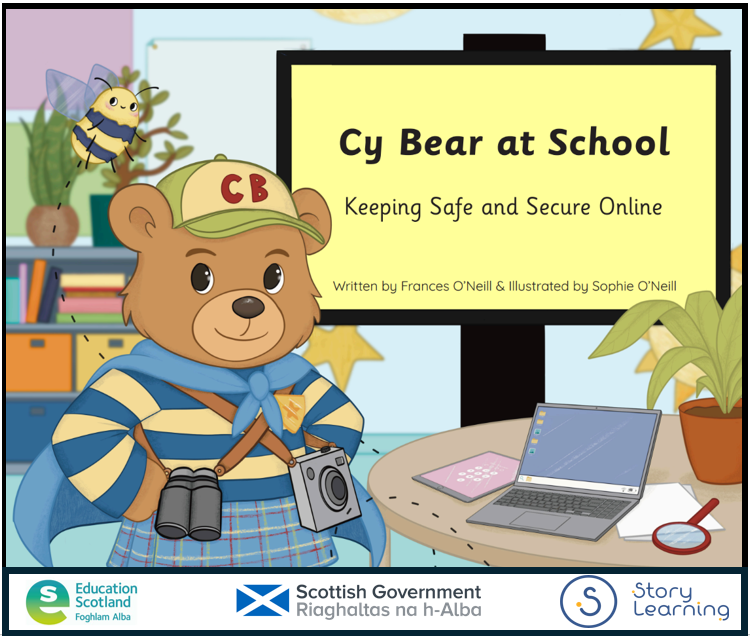
decorative header image of front cover of story book featuring a cartoon bear standing in a primary school classroom

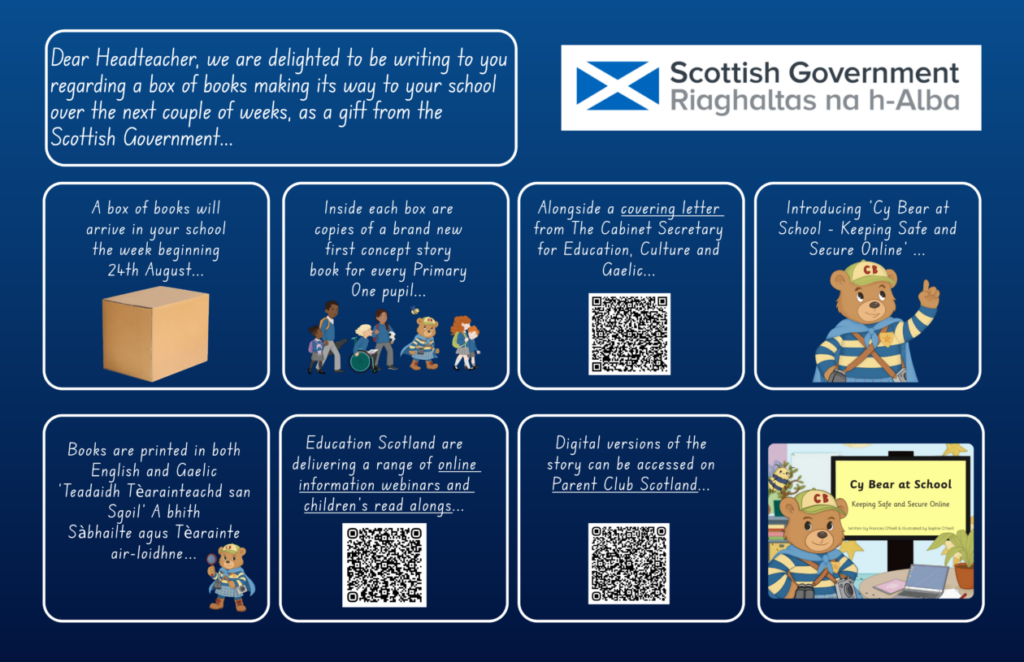
Cy Bear at School – Keeping Safe and Secure Online

Introducing a brand new first concept storybook raising cyber security awareness for younger children aged 4-7 years. 

In today’s digital world, learning how to stay secure online is just as important as staying safe in the real world. 

Just as children learn to lock their doors at home, they can also learn how to “lock” their digital spaces. “Cy Bear at School – Keeping Safe and Secure Online” is packed with clear explanations, colourful storytelling and engaging hands-on invitations to explore play and learn together. 

“Passwords have been the cornerstone of online security for decades, helping to protect our digital identities and sensitive information from unauthorised access.” – National Cyber Security Centre.

This bright, friendly storybook introduces children to the importance of securing devices by highlighting where teachers use passcodes and passwords in a primary school setting.  

Through simple language and fun illustrations, Cy Bear helps children understand the importance of strong passwords and good digital habits – turning every child into a Cyber Security Hero!   

Join Cy Bear and his best friend, Cy Bee, on a buzzing adventure through school as they teach the basics of cyber security.   A fun, friendly story that turns every child (and bee!) into a real Cyber Security Hero! 

As a gift from the Scottish Government, each Primary One child in Scotland will receive their very own copy of “Cy Bear at School – Keeping Safe and Secure Online” in August 2026 and will have the opportunity to join in live read alongs, (delivered by Education Scotland) with their class throughout 2026/27. 

Browse the webinar calendar to find a suitable read along date/time and join with your class. There are AM and PM options, ASN and GME too Upcoming Webinars – DigiLearn. 

Everyone can access an online copy “Cy Bear at School – Keeping Safe and Secure Online” on Parent Club Scotland: Tips for creating strong passwords to stay secure online | Parent Club.


CSW2025: ACE Cyber Security Competition (S3-S6)

See below for a team competition that learners can participate in.


ACE Cyber Security Competition (S3-S6)

Competition Sign up window is now open!

Register Here

Teams can include up to four students, with mixed ages and genders permitted. All team members must be aged 14–18 (S3-S6) and in full-time education.

Each team must have a designated guardian aged 18 or over, appointed by the school/college. This person can oversee multiple teams and does not need to be a teacher or teach a digital subject. The guardian will be the main contact and responsible for managing communications, especially if the team reaches the finals.

Round 1 is Online between 24th of November to 12th of December 2025. Teams will be sent the questions and links for the submission of team answers to their team guardian before the 14th of November. This round features a series of problem-solving questions and brain teasers. These can be printed and completed at any time and in any order during the two-week competition window. However, all answers must be submitted in a single session via Microsoft Forms. The necessary materials will be sent directly to team guardian

Final Round is where successful teams will be invited to attend a live final event at their regional ACE (Academic Centre of Excellence in Cyber Security) University. In Scotland this is either Abertay University or Edinburgh Napier University (ongoing discussions regarding possibility of Hybrid or Satellite delivery). Team guardians can select their preferred ACE University when signing up. The live finals will be in late February or March 2026. More details will the confirmed and communicated with team guardians.

Sign up before the 7th of November!

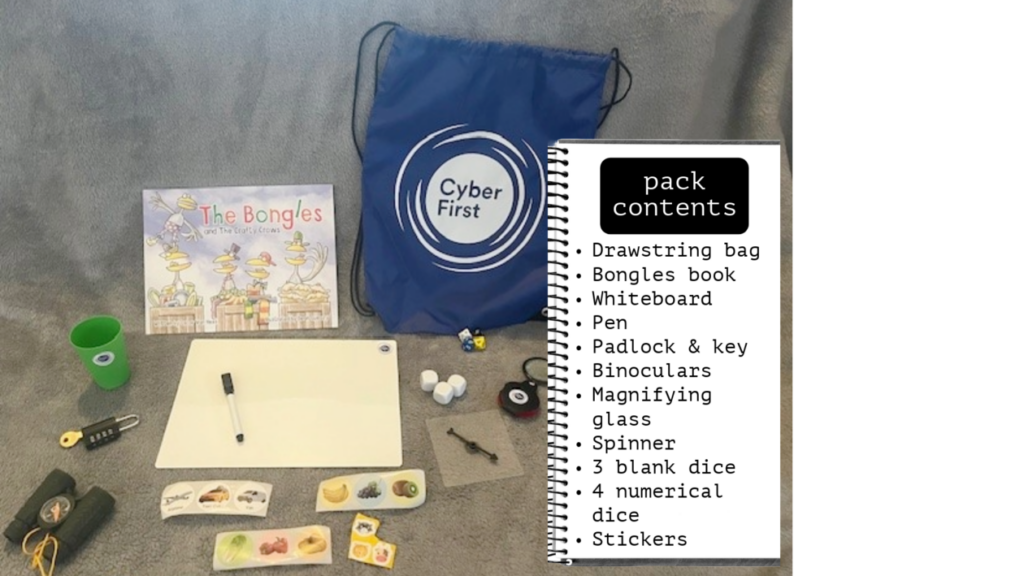
Exploring cyber security play pack, for early level learners.

By attending The Bongles and The Crafty Crows educator webinar (60 minutes, multiple dates) or by participating in the 2-part Cyber Resilience Internet Safety early level support webinars (120 minutes)  you will be eligible* to request a ‘exploring cyber security play pack’, for the early level learners in your care.

You will be invited to share feedback on how children choose to explore the pack and evaluate the effectiveness of the contents.

Please click here to view the pack contents and some suggestions of experiences it can provide.

Alternatively you may choose to create a similar play pack of your own, that compliments the story and provides children with the experience of handling and investigating concrete objects, that relate to the story and concept of cyber security.

*First come first served basis. 60 packs available.
AI generated image of toddlers surrounded by screens

Younger Children’s Screen Time.

Sharing our reading with you…

We recently shared a variety of recommend reading links around screen time.

In this post we share some more, but this time, the research and articles focus on younger children’s screen time, some including babies.

Special thanks to our National Early Language and Communication Team colleagues for sharing many of the articles and research links with us.

Before you browse through the links below, please consider these questions first.

Q –  What does screen time mean to you?

Q – Do you unpick children’s screen time in order to understand how/why the screen is being used?

Q – Do you view screen time as only watching content, or playing games, or do you view any/all kind of screen use as screen time?

Q- Do you know what the different ways we can use screens are? E.g.,  to consume, create or communicate content?

Q – Do you consider using screens in a practical way to solve real life problems? E.g., using apps such as the camera, calculator, weather forecast, maps, measure and audio recording?

Q- Do you view young children’s (early level and younger) screen time as an opportunity for independent learning or as a means for the adult and child to connect and play and learn together?

Q- What do you think the adult’s role should be when children are using screens?

You might find it helpful to revisit section 4.4 of Realising the Ambition: Being Me (page 49) and also 6.4 (page 70).


Our ability to use language unlocks all areas of learning. Children’s language development thrives through exposure to environments of rich and diverse spoken language experiences. We grow a sense of purpose for the child by our own use of language and engaging them with a wide variety of stories, rhymes, songs, symbols and texts in different media all around them. Building this purpose helps to nurture engagement and encourages children to see themselves as readers and writers. This doesn’t just happen by chance.

Realising the Ambition: Being Me page 70

Q – Do we use language to unlock learning when children are using screens?


Links to research and articles.

Preschoolers’ screen time and reduced opportunities for quality interaction: Associations with language development and parent-child closeness – ScienceDirect Gath, M, McNeill, B, and Gillon, G (2023)

Is the screen time duration affecting children’s language development? – A scoping review – ScienceDirect Bhutani, P et al (2024)

Screen Time and Parent-Child Talk When Children Are Aged 12 to 36 Months | Media and Youth |  Brushe.M, Haag.D, Melhuish. E, et all (2024)

Froebel-Trust-Research-Highlight_Tech.pdf Flewitt and Gemayel (2023)

Digital Play (ed.ac.uk)  Plowman (2020)

Screen time for babies and toddlers: the evidence | Baby & toddler articles & support | NCT NCT (2019)

Why not all screen time is the same for children – BBC Future Hoggenboom,M (2022)

Babies need humans, not screens | UNICEF Parenting  Nelson, C (2023)

Header image generated by Microsoft CoPilot. 

Please feel free to share your thoughts via this Microsoft Form

cyber resilience lessons

Cyber Resilience and Internet Safety Lessons

These resources have been created in collaboration with teachers from Barrhead High School and Bearsden Academy. They are designed to be easy to use, with clear definitions and concise language.

The lessons are designed to introduce and reinforce that learners need to:

  • understand risks and potential harms
  • develop skills and strategies to reduce risk
  • have strategies in place to manage or report potential harms

This approach is based on the work of this literature review by the University of Glasgow (2024) – access the literature review with this link

Use this link to access the OneDrive folder:

Education Scotland digilearn cyber resilience BGE lessons

You must be logged in to Glow to access the resources. 

PowerPoint files cannot be edited but you should be able to make a copy in your own OneDrive and edit that.

Systematic literature review of digital risk

A systematic review of digital risk and mitigations in children aged 8 to 12 – Challenges and Opportunities by Hana Butorova, Yvonne Skipper, and Christopher Hand, School of Education, University of Glasgow

The University of Glasgow have undertaken this systematic review of literature on the subject of cyber resilience on behalf of Education Scotland.

A systematic review of digital risk and mitigations in children aged 8 to 12


DSAS ELC logo

Introduction to The Digital Learning Through Play Award in ELC.

Introduction to The Digital Learning Through Play Award in ELC.

The Digital Learning Through Play Award in ELC in Scotland is a national award scheme to promote, recognise and encourage a whole setting approach to the use of digital technology in ELC settings.  

The award framework echoes national practice guidance for the early years in Scotland, Realising the Ambition: Being me (2020), which guides and supports the ELC sector to provide high quality early learning and childcare, meeting the developmental needs of our youngest learners, enabling children to flourish as successful learners, confident individuals, responsible citizens, and effective contributors.   

 Purpose of the award. 

This award has been designed to support ELC settings to integrate digital technologies into children’s play and learning experiences, both outside and indoors.  Opportunities to learn with and through technology in practical and creative situations, provide children with flexibility and choice while exploring technology as a way to solve problems.  

Investigating virtual environments through digital technology can inspire curiosity and creativity, encouraging children to develop imagination, beyond what is possible without the stimulus afforded by technology.  Through immersive, stimulating learning environments and meaningful adult-child interactions, children are inspired and motivated to learn. 


Create an account on the DSAS website to get started!

Access a preview of the framework here (downloadable Word doc)

Join our ELC channel on the DSAS Team in Glow

You can also catch up on previous recordings from introduction sessions for more of a flavour of what the award encompasses:

The first video is an introduction to the award, with DSAS validator Malcom Wilson.

The second recording is a practitioner’s account of gathering and submitting evidence and the validation call, by guest presenter Linda McGavin at Invegowrie ELC.

YouTube player

YouTube player

Summer term early level webinar dates for you diary.

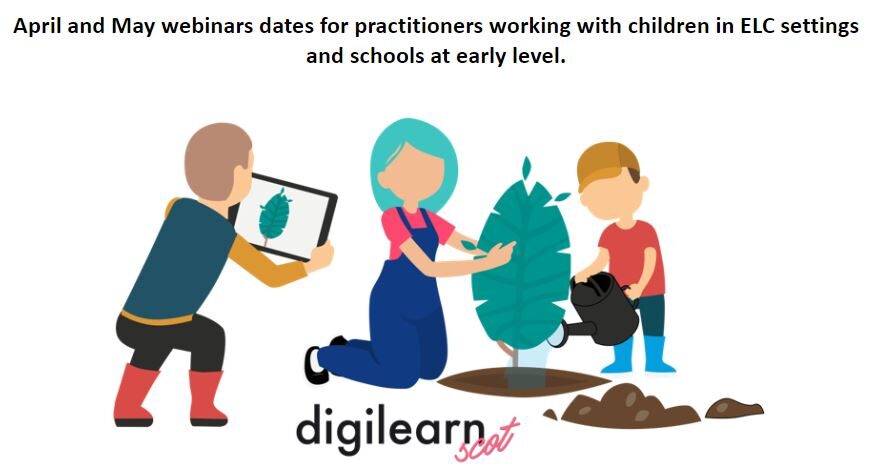
The series of This is early level Digital and Spotlight CLPL sessions will be delivered for the final time in April and May. If you missed out on the previous webinars, there is still time to sign up.

The webinars are suitable for practitioners working with children at early level across a range of ELC settings and schools.  A Glow log in is NOT required to sign up or join the online sessions.

Please click on the hyperlinks below for session information and sign up details.

APRIL 2024

Tuesday 16th April 4pm This is early level Digital: CRIS 3 part course. SESSION 1

Thursday 18th April 4pm  This is early level Digital: Spotlight on Practitioner Collaboration.

Tuesday 23rd April 4pm This is early level Digital: Spotlight on Transition

Tuesday 30th April 4pm This is early level Digital: CRIS 3 part course. SESSION 2


MAY 2024

Tuesday 14th May 4pm This is early level Digital: CRIS 3 part course. SESSION 3

Tuesday 21st May 4pm This is early level Digital: Spotlight on Outdoor Play

Tuesday 28th May 10am This is early level Digital: Spotlight on Making Data Visible


Sign up coming soon:

Monday 13th May 4pm – The New Digital ELC Setting Award

Thursday 16th May 10am – The New Digital ELC Setting Award

Friday 17th May 12.30pm – The New Digital ELC Setting Award

Safer Internet Day 2024

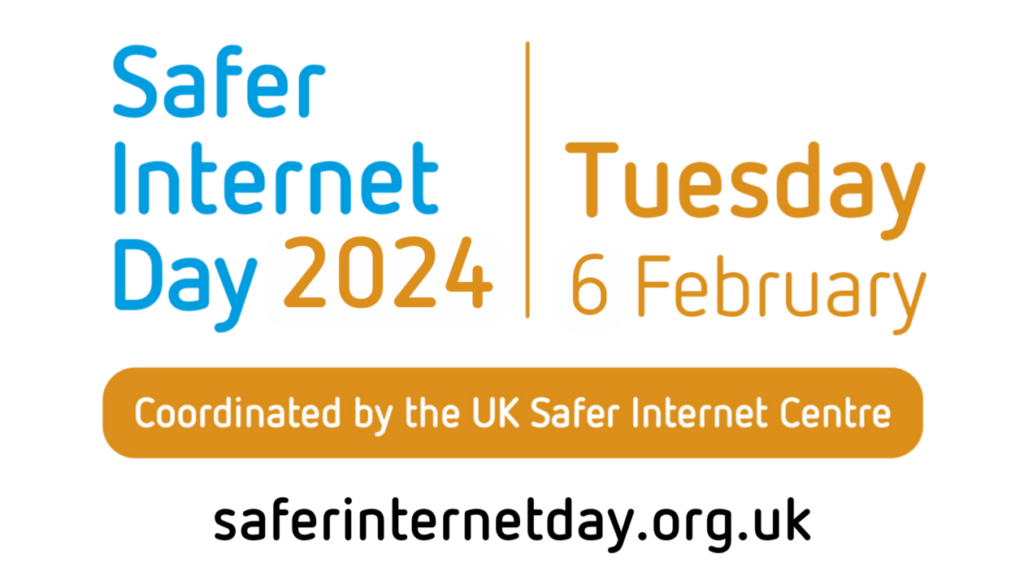
Safer Internet Day 2024 took place on the 6th of February 2024, with celebrations and learning based around the theme ‘Inspiring change? Making a difference, managing influence and navigating change online’.

Safer Internet Day is held every February all around the world. Last year, over 170 different countries celebrated the day! Safer Internet Day is a chance to think about any worries we might have about using technology and the internet, but it’s also about celebrating all the fantastic things technology can help us with.

Safer Internet Day is the UK’s biggest celebration of online safety.

Created in consultation with young people across the UK, this year Safer Internet Day will be focusing on change online, this includes covering:

  • Young people’s perspective on new and emerging technology
  • Using the internet to make change for the better
  • The changes young people want to see online
  • The things that can influence and change the way young people think, feel and act online and offline

Coordinated in the UK by the UK Safer Internet Centre, the celebration sees thousands of organisations get involved to promote the safe, responsible and positive use of digital technology for children and young people.

Visit UK Safer Internet Centre or browse the links below to become involved!

Education Resources   (suitable for early level to senior phase)

Supporters Registration

Films

Get involved on social media

Parents and carers

Supporters Map


You may also find education resources from Common Sense Education helpful to begin conversations and explore digital citizenship.  Check out our webinar calendar for upcoming live lessons with Jenna Khanna from Common Sense Education.

Common Sense Education – Daily Activities for Primary


common sense education logo