
Pupils as Digital Leaders at Carron Primary School

Malcolm Wilson, ICT Curriculum Development Officer within the Curriculum Support team of Service and School Improvement, Falkirk Council Education Services, supported the first session with the new Digital Leaders group of pupils in Carron Primary School.

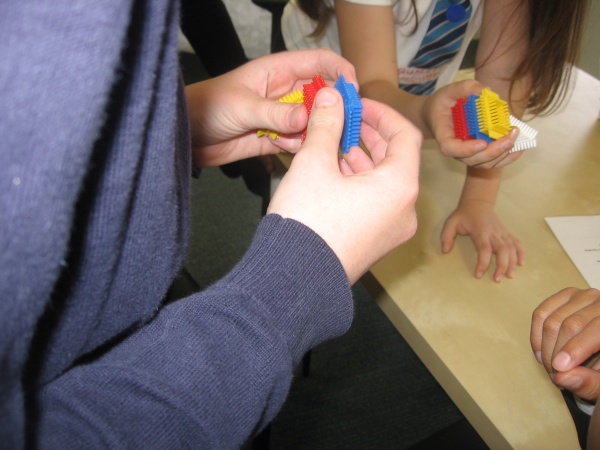
The pupils had selected to be a part of this group and will be led by teacher John Bell. This first session let the pupils say what they felt their contribution could be in taking the group forward in supporting the use of technologies in Carron Primary School. Pupils gave a variety of ideas which encompassed being the ones in the school who: know how to navigate the school computers, are willing to try to find a solution to an issue, are not being afraid to try things out and are eager to learn more (both together and on their own). Different pupils said what they saw as their areas of knowledge, interest and expertise ranging from programming in Scratch to creating things for a website.

Pupils used their wireless laptops to then work together on creating games using the software 2DIY from 2Simple which is installed on all Falkirk Council primary school networked computers.

More information about Digital Leaders can be found here: https://blogs.glowscotland.org.uk/fa/ICTFalkirkPrimaries/2014/04/23/pupils-as-digital-leaders/
Subject Development Group Evaluation 2013/14

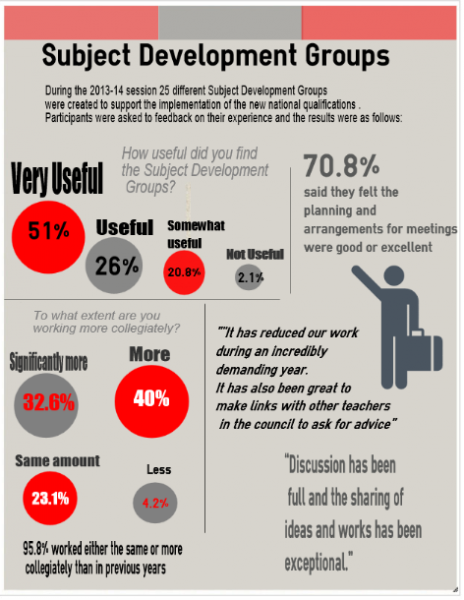
Gillian Campbell (Curriculum Support Officer- Secondary) coordinated the creation and development of ‘Subject Development Groups’ from September 2013. 25 subject specific groups were created and allowed opportunities for staff to look at the development of the new National Qualifications and share the burden of workload across schools.

Over the course of the year the groups met to plan development, implementation and evaluation of the NQs with each of our secondary schools able to send at least one teacher to each group.

Government funding was used, in part, to support the work detailed by each group to complete development work outlined in their individual action plans. This resource allowed SDGs to create and provide professional learning opportunities for subject teachers. In addition to this Falkirk have used the expertise of our SQA Nominees, markers and verifiers to assist with the professional development of their subject colleagues.

A survey was sent out to all staff involved to gauge their opinions on the value and format of SDG meetings. The results showed overwhelming positivity for the groups and the resources and networking opportunities they have provided.Some of the detail from this survey is provided in the infographic attached to this post.

SDGs have continued into the 2014/15 session to support the ongoing development of the nationals and higher as well as looking ahead where applicable to the new Advanced Highers to begin in session 2015/16.

Teachers continue to share work, ideas, thoughts and opinions through shared network and online folders, Glow and email.

For more information on Subject Development Groups or for access to the detailed evaluation of the project, please email: gillian.campbell@falkirk.gov.uk

Fife Enterprise and Manufacturing Challenge

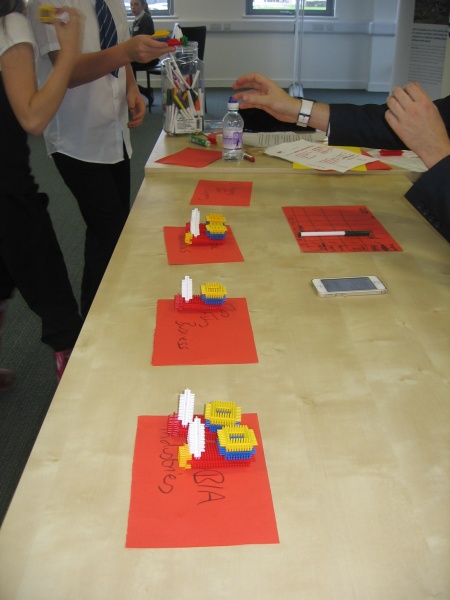
Yvonne McBlain, curriculum support officer with Falkirk Council, enjoyed visiting the Fife Enterprise and Manufacturing Challenge organised by Tree of Knowledge in partnership with Fife Council (Culture of Enterprise team) and SMAS (Scottish Manufacturing Advisory Service).  This event gave Primary 7 pupils a better insight into the world of enterprise, employability and manufacturing. SMAS previously delivered a version of this challenge  with manufacturing businesses throughout Scotland, and have kindly allowed Tree of Knowledge to develop it for use with pupils.

From Monday 14th September 2014, all 141 of Fife’s primary schools were represented by a team of primary 7 pupils who spent a day on the challenge and had a chance to become Fife’s Enterprise, Employability and Manufacturing school champions! The winning school will be featured in a quarterly publication that goes out to all businesses in Fife.

On each day, teams of 7 pupils from 6 primary schools competed against each other through a range of enterprising activities; from developing a brand, creating a product, delivering sales pitches to local businesses and ultimately selling their product in a competitive market to our highly demanding customers! The rules were simple; the school team with the most profit at the end of the day won! The EE+M Challenge is a sustainable programme that will ensure every primary 7 pupil in Fife has an experience of this event in some way, shape or form.

Yvonne spoke to members of staff attending with their pupils on 9th October and enjoyed being part of the “Dragon’s Den” panel for the young people. The pupils were highly engaged throughout the day and made visible progress in a whole range of skills for life and work such as: sharing and presenting ideas, negotiating, working with and persuading others,  and problem-solving.  Teachers and support for learning assistants attending from the schools were able to observe how their young people tackled all tasks and noted how valuable the whole experience was for all concerned. The pupils involved will take their experience back to their schools and replicate the process for their fellow pupils using a different “product”. In this way, learning  is consolidated and sustained. The standard of organisation, presentation and content was extremely high throughout the day and it was great to see such a productive partnership in action. It was clear that the manufacturing challenge in the afternoon really impacted on pupils and gave them a much deeper understanding of all stages in a complex business organisation. It was an excellent example of interdisciplinary learning delivered within a very relevant and real context.

Questioning at St Margaret’s Primary School and Nursery Class

Gillian Campbell, Curriculum Support Officer, oversaw moderation funding projects during the 2013-14 session including one led by Stacey Collier-West, DHT at St Margaret’s Primary School and Nursery Class.
After consultation with the Curriculum Support Team it was decided that, at St Margaret’s Primary School and Nursery Class, Bloom’s Higher Order Questioning should be introduced across the school.
Three teachers were selected to observe good practice in another school and to then come back to St Margaret’s and demonstrate the Bloom’s pedagogy to three of their teaching colleagues.
Before travelling to the local school for observations the teachers involved completed a ‘Record of Collegiate Visit’. On this they detailed ‘Pre-visit’ notes where they outlined what the hoped to get out of the visit. They then used this same form to note points of interest, observations and notes made during the session and action points they feel will be addressed as a result of what they have seen.
After the process each member of teaching staff involved completed a self-evaluation sheet (based on Guskey’s framework) which delved into their personal reactions, personal learning, thoughts on organisation, support and change as well as their feelings about their new knowledge and skills and most importantly the impact on pupil learning.
Feedback from the three teachers involved in the initial stages of the project were positive in their evaluation of the work. One commented:
“I felt very supported by all members of staff and although I was a little apprehensive initially about the unknown, staff reassured me and the experience was highly enjoyable… Management was very supportive and asked at different points how it was going and if it was useful”
Constructive feedback did show that the turnaround between observing another school in the morning and then teaching in their own school in the afternoon was very tight and added pressure for the teachers involved.
The school have taken steps to monitor impact on pupil learning since running this project and will carefully study CEM data and other information including quality assurance information (observations, pupil voice groups and jotter monitoring).
Sarah Myles, classroom practitioner described her thoughts on the project:
“It was very important for me to see the questioning taking place as it made it very clear and manageable whereas before, on paper, I was not sure how to deliver this to younger pupils. The teacher took time to explain where the school had gone on its journey- starting with the fans then adapting them for younger pupils.”

Developing pupil understanding of the curriculum

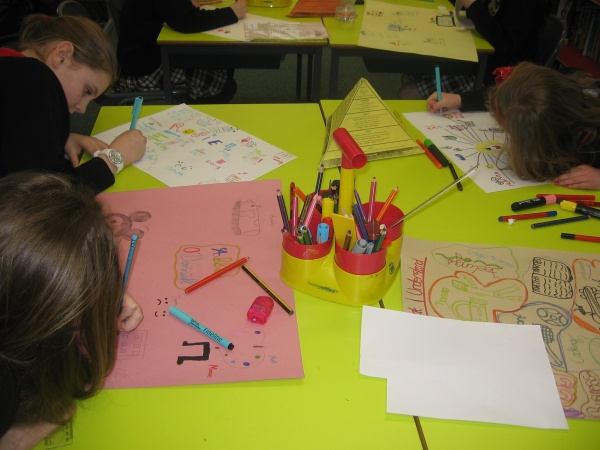
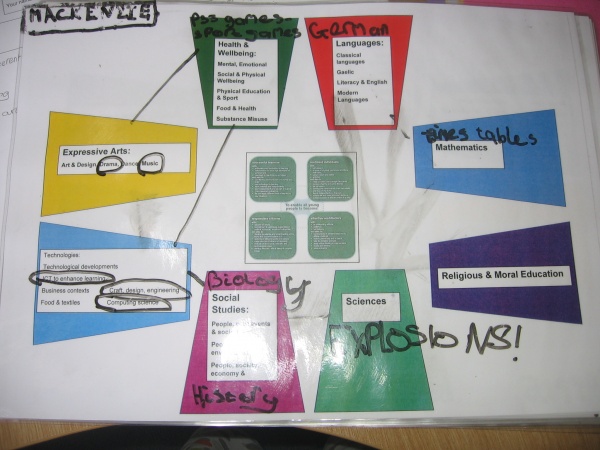
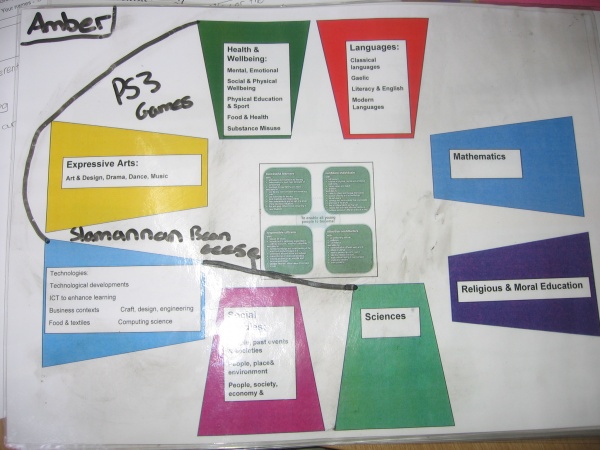
Yvonne McBlain, from Falkirk Education Service Support and Improvement team has been exploring pupil understanding of the curriculum with colleagues in St Bernadette’s RC PS and Bankier PS. Click here to see the Bankier version of the learning experience shared with pupils on 13th June 2014, and here to see Yvonne’s analysis of the impact gained.

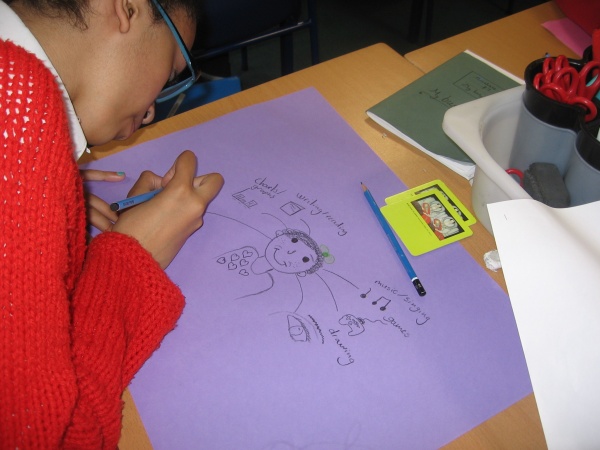
Maria McNally and her primary 6/7 pupils were the first to trial this experience earlier this session – click here to read Yvonne’s evaluation of these. Pupils were able to explain things they understood, and how they had come to understand these things. They were offered an opportunity to explore how they reached this understanding so that they could apply successful approaches for new learning too.

 The whole set of experiences is designed to:

  1. Help pupils learn the difference between knowing about something, and really understanding it.
  2. Let pupils discover how they reach deep understanding – what works for them (based on David Perkins & Harvard/Tapestry Teaching for Understanding programme)
  3. Help pupils review their own understanding so far and how it helps them build a good life
  4. Ensure that pupils know what the curriculum is and how curriculum for excellence and the four capacities relate to their lives present and future (helps with pupil profiling too)
  5. Help pupils see how they apply their understanding in different contexts
  6. Enable pupils to see the natural connections and overlaps between curriculum subject areas
  7. Let pupils see how their school learning articulates with wider achievement
  8. Develop pupils as independent learners

Yvonne will continue to trial and develop this set of learning experiences to complement the methods other Falkirk schools are using to enable their pupils to build independent learning capabilities. Click here to see some pupil understanding charts made during the lessons, and see how pupils connected their understanding across curriculum subjects below. Yvonne would be happy to hear from any teachers wanting to be involved in exploring this further. yvonne.mcblain@falkirk.gov.uk

Changes to the GTCS Standards

Hazel Cunningham, Probationer Supporter at Falkirk Council Curriculum Support  Team, has completed a project as part of her To Lead or Not To Lead programme on the changes to the GTCS Standards for Full Registration. After thorough professional dialogue with a wide variety of Falkirk Council teaching staff and an in-depth Needs Analysis, she has produced a powerpoint and guidelines which have been distributed to all Headteachers in the authority. The resource can be used to train staff on the main changes in the new GTCS Standards for full Registration which are a mandatory requirement or it can be used to support self-evaluation as part of Professional Update. For further information please contact Hazel at hazel.cunningham@falkirk.gov.uk

The resource can be accessed here.

Guidelines can be accessed here.

Dance – Progression

Morag Young and Morag Simpson, Physical Education Lead Officers from Falkirk Council Curriculum Support Team organised a series of two Dance twilight sessions for primary class teachers and specialists. These courses were led by Anne Murphy,  from Education Scotland. Anne demonstrated how to provide a progressive Dance programme focussing on the Significant Aspects of Learning in PE from Early Level through to Second Level.  Content examples were given to and developed by the group showing how to link learning in a dance context with all other curricular areas.

Examples of the very positive feedback are shown below.

“This has impacted on the way I would teach a dance block with the children now as it is not about following a routine.”

” Children will get more ownership of their learning through dance by using these approaches”

” Will now use the ideas given to promote higher order thinking skills while teaching dance.”


Gymnastics – Using Apparatus

Morag Young and Morag Simpson, Physical Education Lead Officers from Falkirk Council Curriculum Support Team organised a Gymnastics twilight for primary class teachers and specialists. This course was led by Anne Murphy,  from Education Scotland and specifically focussed on using apparatus. Anne demonstrated how to provide a progressive Gymnastics programme focussing on the Significant Aspects of Learning in PE from Early Level through to Second Level.  This was a follow on course from the first session with Anne in February, focussing on  developing practical content with literacy and numeracy links.

Examples of the very positive feedback are shown below.

“This was a wonderful course to support teachers, such as myself, when working to build confidence in our own practice.”

“The opportunity to learn more about the various techniques and how to carry them out properly was excellent and very enjoyable.”

“Demonstrations of the equipment has allowed me to be more confident using the equipment in my teaching.”


11th Enterprise in Education & Enterprise Champions Awards

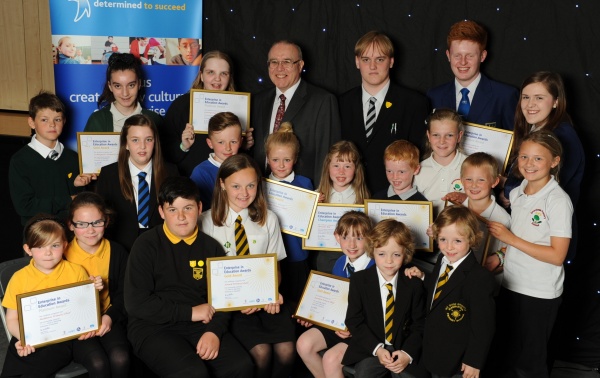
Lynne Lauder, Enterprise Co-ordinator, oversaw the 11th Enterprise in Education Awards at Grangemouth High School on Thursday 12th June.
10 Schools attended the event to receive their certificates presented by Nigel Fletcher, Acting Director of Education.
The Awards, which started in 2006, recognise excellence in the delivery of  Enterprise in Education in schools. Awards are presented at Bronze, Silver and Gold level.  Schools who have managed to sustain Gold level for three years have the opportunity to go for Platinum.  

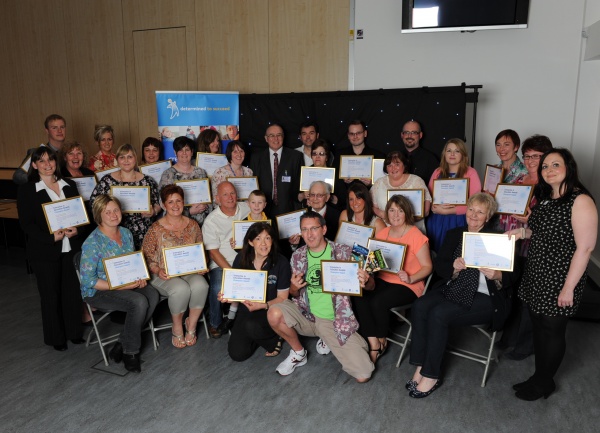
The schools recognised at Gold Year 2 or Year 3 at the event were, Antonine PS, Bantaskin PS, Grange PS, Kinneil PS, Deanburn PS, Larbert Village PS & St Margaret’s PS.   Four schools achieved Platinum status, Drumbowie PS, Maddiston PS, Carrongrange School, Larbert HS.  We now have 21 Platinum Enterprise schools in Falkirk.Schools also have the opportunity to nominate partners as Enterprise Champions and to date we have 461 individuals who have received recognition for their work in inspiring and motivating young people to be more enterprising.
The event was a great success as is demonstrated by these smiling faces .