Probationers Experience Active Literacy

 Sharon Wallace, Curriculum Support Team has delivered Active Literacy training this week to all primary probationer teachers in Falkirk.

The two sessions covered the range of strategies and methodologies used across all stages to develop skills in all areas of literacy.

The probationers enthusiastically participated in activities including a spelling test to highlight how we draw on our own phonological awareness, knowledge of spelling rules and phonemes to spell words. They also put a series of words into Elkonin boxes examining the 40 phonemes in the Active Literacy programme.

Sharon provided the primary probationers with a full overview of the programme from early to second level. They developed their knowledge of phonemic awareness, spelling strategies including: mnemonics, words within words and syllabification. Colleagues are aware of how the five finger strategy, effective use of resources such as Smart notebook tools, magnetic boards and letters and reciprocal teaching can enable pupils to become better spellers. Evidence is showing that pupils are transferring their knowledge of phonemes to other types of writing in different situations.

Sharon also explained how the six key comprehension reading strategies are used across a range of ‘texts’. Probationer teachers discussed the reading skills they are currently developing with their classes and how the six key comprehension strategies supports this development.

In terms of writing, Sharon provided colleagues with an overview of the seven different genres and how these should be addressed across the course of the year.

Sharon also shared the new Active Literacy for parents animation.

[kml_flashembed movie="http://www.youtube.com/v/TnXMSAcKcCo" width="425" height="344" allowfullscreen="true" fvars="fs=1" /]Feedback so far has been very positive and has included:

“Thanks very much for the course. I feel really enthusiastic and excited to try out the Active Literacy strategies in class.”


Active Literacy – P6/7 Training

Sharon Wallace, Curriculum Support Officer of the Curriculum Support Team has carried out Active Literacy training over the past two weeks with 54 teachers. The two three hour sessions examined the writing programme incorporating spelling and the reading programme.

Session one looked at how teachers can support pupils in becoming independent spellers. Pupils are taught strategies to use their previously learned knowledge of phonemes and spelling rules to more complex, polysyllabic words.

 The course examined the programme for spelling strategy work, alongside the new addition of ‘vocabulary building’, homophones and common confusions. Trials of the programme so far indicate that pupils are really enjoying the investigation element of prefixes and suffixes and how these affect the meaning of words.

The session also examined the writing genres covered at second level looking at incorporating writing trios, chunking, use of genre success criteria and next steps.

Session two focused on the development of the six key comprehension strategies across a range of texts. These strategies are:
1. Prior knowledge and prediction
2. Metalinguistics
3. Visualisation
4. Inference
5. Main ideas
6. Summarising and paraphrasing.

Sharon demonstrated how to develop these skills using a traditional ‘novel’ text, moving image (film trailer) and a poem. The course also looked at using online tools such as Powtoon, go animate and twixster to develop reading skills.

Colleagues were given a ‘Stories Allways’ resource containing a range of Scottish myths and legends as well as two CDs. This is a great resource as it provides pupils with a range of challenging questions, tasks and a synopsis of each tale.

Colleagues enthusiastically participated in a range of Active Literacy activities across the course of the two sessions and feedback so far has been really positive.

“The course was delivered extremely well by Sharon Wallace and the resources provided were very useful.”

“The course was presented over 2 days in which it provided an overview of the key methodologies and strategies as outlined in North Lanarkshire’s Active Literacy 6/7 programme. I thought all aspects of the course were useful and it enhanced my knowledge and understanding of the 6/7 programme which I will now be able to confidently implement in the classroom.”

“I am new to teaching as well as the Active Literacy programme. I had very little knowledge and understanding prior to the course however I now feel I can confidently implement active literacy in the classroom.”

“Sharon is a very enthusiastic presenter and it is clear that she wholly believes in the Active Literacy Programme. Her passionate delivery and ideas instil in you, the confidence to have a go in your own classroom.”

Primary ICT Co-ordinator Support Session – mobile device focus

Malcolm Wilson, ICT Curriculum Development Officer in the Curriculum Support team of Falkirk Council Education Services, provided support sessions for Primary ICT Co-ordinators, with a focus on mobile devices for schools at the beginning stages of looking at how to use them in learning and teaching. How mobile devices can be used to make a difference to learning and teaching, the practical implications of this in a school, and how to overcome barriers to successful integration, are issues around which schools embarking on the journey exploring using mobile devices consider.

This post describes just a few resources which may be useful to help schools at the beginning of the journey towards considering using mobile devices to support learning and teaching.

AUP

When schools have wireless,  which can be accessed by pupils on their own device, and pupils are signed up to an Acceptable Use Policy which sets out responsibilities, they can then consider how best to to incorporate personally-owned mobile devices in learning and teaching.

Falkirk Council Education Services provides educational establishments with an Acceptable Use Policy which takes account of mobile devices and social media. This is available here: https://blogs.glowscotland.org.uk/fa/mobiledevices/documents/

Device Neutral Assignments

Device Neutral Assigments are tasks which let pupils choose tool according to device available. With multiple types of devices in a classroom (where pupils bring their own device), rather than the tool as the focus for learning, instead the tool should be chosen to suit the intended learning – and may be chosen by teacher or pupil to best suit task to support learning or demonstrate understanding of the learning – the learning activity does not presume a specific tool will be used. The link below provides further description of device-neutral assignments and provides links to tools for any learning activity (such as creating a video, note-taking, creating a video, creating audio, creating an assessment, etc) with suggested example apps/software/online tool specific to each device  https://blogs.glowscotland.org.uk/fa/mobiledevices/device-neutral-assignment/ 

QR Codes

Quick Response codes are square barcodes which, with a mobile device app, turn the mobile device camera into a barcode reader, to then provide a very quick way to access weblinks, video, images or text. http://goo.gl/1nnb2

Socrative

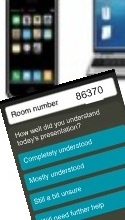
Socrative is a free classroom response system works on any Internet-connected device. This lets teachers set up questions for responses by pupils on any device. Pupils go to http://m.socrative.com & enter the teacher’s classroom number. http://goo.gl/w7t16. Socrative has a host of resources freely shared by other teachers worldwide.

Padlet

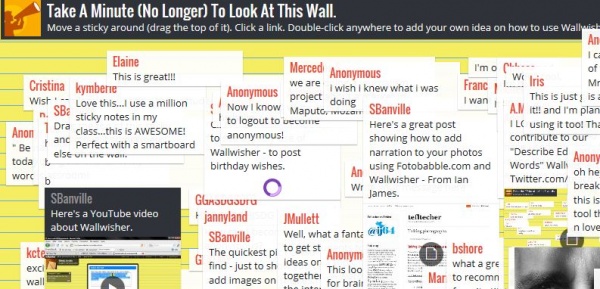
Padlet provides a classroom-friendly feedback discussion area online , private to the classroom, which can provide a useful tool in formative assessment in providing an online feedback tool which works on any Internet-connected device. 

http://goo.gl/dSC1eQ

Managing Devices in the Classroom

The Traffic Light Approach is one way teachers have found useful to support classroom management of mobile devices. Using this approach the teacher determines the level of use, or not, of mobile devices, at any given time in classroom

http://goo.gl/E7ms6d

Resources to support moving from One to Many to 1:1

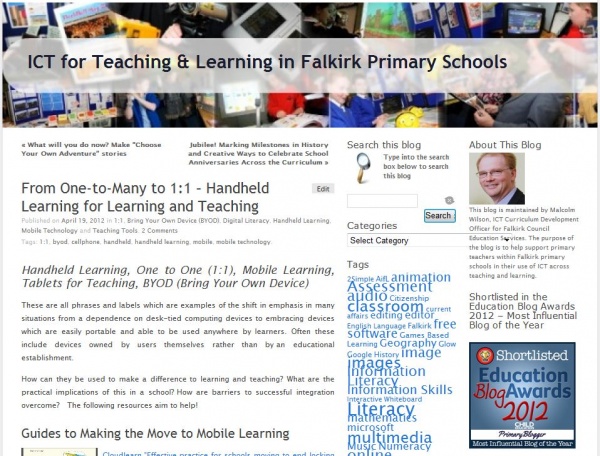
From One to Many to 1:1 provides extensive links to resources which support the shift in emphasis in many situations from a dependence on desk-tied computing devices to embracing devices which are easily portable and able to be used anywhere by learners. Often these include devices owned by users themselves rather than by an educational establishment. The phrases often used to describe this form of application include: Handheld Learning, One to One (1:1), Mobile Learning, Tablets for Teaching, and BYOD (Bring Your Own Device).

Update on our Teaching for Deep Learning Programme

Yvonne McBlain from Falkirk’s Curriculum Support team has now created a page for each of our Teaching for Deep Learning sessions here in Glow. Five of our secondary schools have used, or are beginning to use these sessions as content for their Teacher Learning Communities and working groups. Nineteen of our primary schools have already accessed at least one of the sessions – sometimes as a whole staff, and other times within smaller collegiate groups. We have 18 TfDL (Teaching for Deep Learning) facilitators who are being trained to deliver the sessions – some want to do this in their own schools only, whereas others are happy to make themselves available across the authority where needed. Four of our secondary schools are modelling a whole range of Donaldson Review recommendations regarding professional learning in their use of the programme. Most have recruited teachers interested in becoming facilitators within their schools, who then attend an information session (Click to view) on the programme from Yvonne. Each school is then deciding how they can enable staff to identify which sessions should be priorities for their professional learning this session. Once these decisions are made, teacher learning communities interested in the same sessions can be formed. The same model of distributed leadership (facilitators) and professional autonomy through self-evaluation is being taken forward by some of our primary schools “in house” too. Feedback from participants of  sessions so far confirms the value of the programme as one of the ways in which we can move Falkirk schools from Good to Great.

Introduction to the Storyline Approach

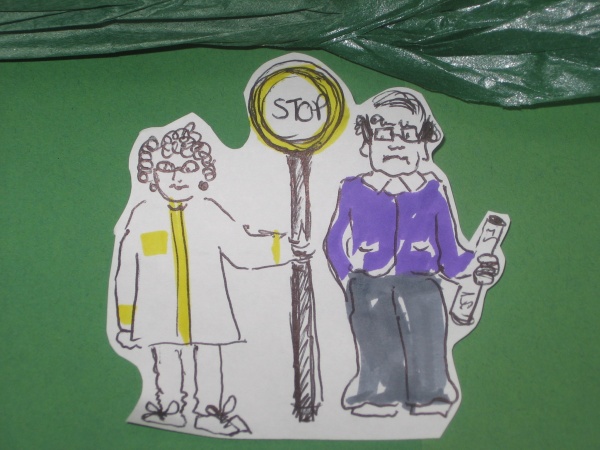
On 12th September 2013, Yvonne McBlain of Falkirk’s Curriculum Support Team delivered introductory training on the use of the Storyline Approach. The practitioners attending the training listened to a short presentation setting out the philosophy and structure of storyline methodology, but the bulk of the twilight session was about actually “doing” storyline. This involved them creating a setting for their storyline – in this case a new community (see below) called Camelon Court .  They then worked collaboratively to create 3 families for this new community. As usual in storyline, the creation of these characters was enjoyable, engaging, and the resulting verbal introductions to the families was entertaining too. Click here to see the biography format used by the groups to create these families. Already we can see potential relationships and narratives emerging! Look out for part two next week!

 You may want to explore more Falkirk storyline work in our Storyline Glow group, or see what is happening nationally and internationally with the Storyline approach at http://www.storyline-scotland.com/

Active Literacy Workshop for Parents and Carers

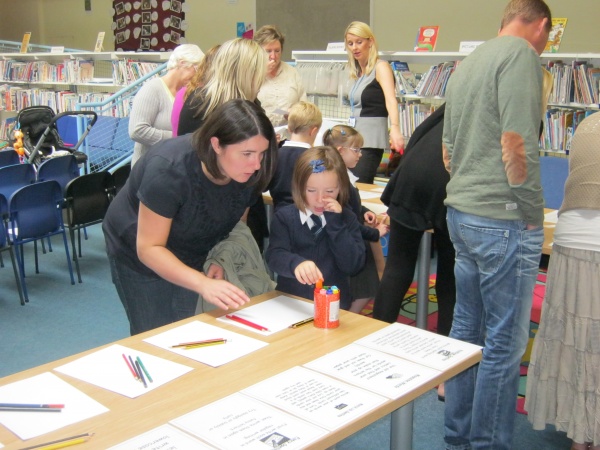
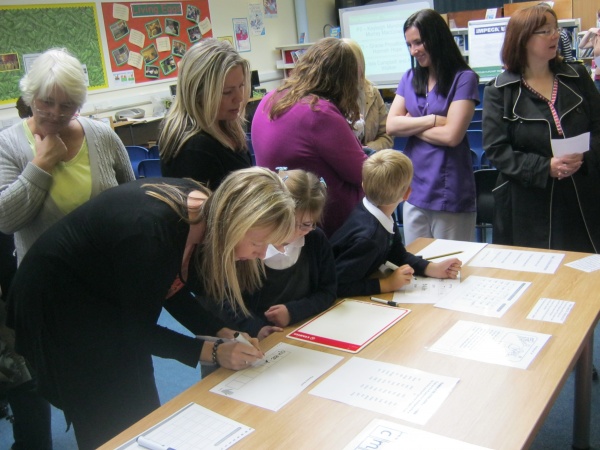
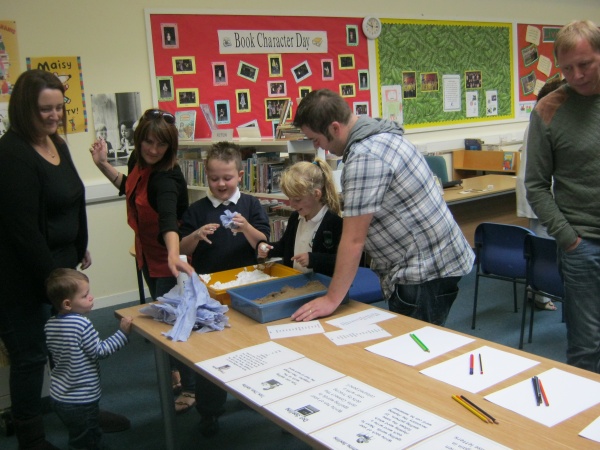
Sharon Wallace, Curriculum Support Officer of the Curriculum Support Team has developed some helpful materials to support Falkirk establishments in sharing the learning at home. This active literacy workshop provides parents, carers and extended families with an overview of the active literacy strategies and methodologies from P1 to P7. It looks at the areas of spelling and phonics, reading and writing and how children can be supported with these at home.

Parents and carers are also invited to be ‘reciprocally taught’ by their children in a series of different workshop activities which include:

  • phoneme stories
  • Elkonin boxes
  • rainbow writing
  • spell-er-cise
  • diacritical marking
  • fun spelling tasks

So far this session, the following schools have already hosted workshops:

  • Maddiston Primary
  • Shieldhill Primary
  • Kinneil Primary


These workshops are accompanied by parental leaflets aimed at P1-3, P4-5 and P6-7 parents.

For more information, please contact Sharon Wallace.

Active Numeracy Workshop Materials for Parents and Carers

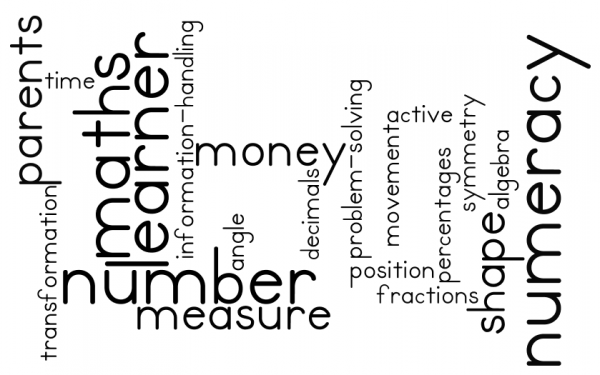
Sharon Wallace, Curriculum Support Officer, Curriculum Support Team, has been working on materials aimed at sharing active learning methodologies with parents and carers. The workshop aims to share some of the strategies relating to mathematics, in particular mental strategies with people at home.

It also includes suggested websites which are helpful in developing mental mathematical skills e.g. www.sumdog.com and www.mangahigh.com

 Workshop activities include:

  • recalling facts
  • applying facts
  • the use of open questions
  • addition, subtraction, multiplication and division
  • numbers in society

Active numeracy parent presentation 2013 can be accessed from this link.

Thoughts turn to next year’s Enterprise Awards

Planning begins for the next round of Enterprise in Education Awards.

Lynne Lauder, Enterprise Co-ordinator, Curriculum Support Team will once again co-ordinate the Enterprise in Education Awards event which will be held on 12th June 2014.

To support schools in planning their submissions, an informal information event will be held at Camelon Education Centre at 3:30pm on 1st October 2013.  The session will highlight the essential elements of a successful submission and provide some hints and tips on how to ease the submission process.   To book a place at the session contact Lynne by email on lynne.lauder@falkirk.gov.uk or telephone on 01324 501975.

Sharing Active Literacy with Parents/ Carers


Sharon Wallace and Stuart Lennie, Curriculum Support Officers from the Curriculum Support Team, have been working together on a short active literacy animation. The aim of this short film is to share the terminology relating to active literacy to a wider audience, including parents and carers. This animation can be accessed through Falkirk Council’s You Tube channel and schools are also using it as part of Active Literacy workshops.

The voiceover is that of Maddiston P6 pupil Elliot who did a super job explaining the active literacy terminology.

Active Literacy Animation for Parents and Carers

[kml_flashembed movie="http://www.youtube.com/v/TnXMSAcKcCo" width="425" height="344" allowfullscreen="true" fvars="fs=1" /]