
 Yvonne McBlain and Malcolm Wilson of Falkirk Council Service and School Improvement Team have created a new interdisciplinary learning blog. Yvonne will develop and maintain this blog as a major element of support for IDL across Falkirk Council education establishments. She is working hard to fill the blog with useful material and valuable IDL practice. Click here to visit, and contact yvonne.mcblain@falkirk.gov.uk if you have suggestions, ideas or interdisciplinary learning practice to share.
Interactive tools for teaching primary numeracy and maths at second level
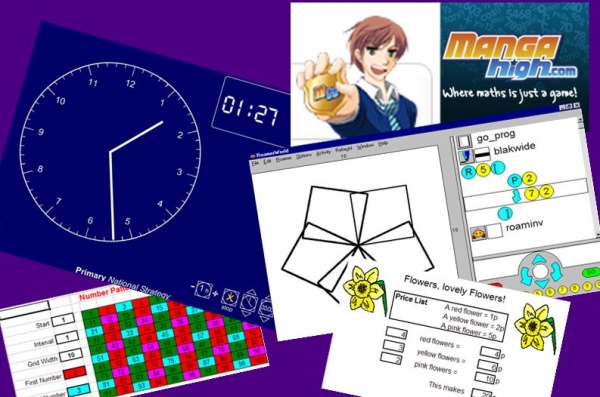 Malcolm Wilson, ICT Curriculum Development Officer in the Curriculum Support team of Falkirk Council Education Services, presented a session to teaching staff giving a hands-on opportunity to explore a range of interactive software and online tools to support teaching numeracy and maths at second level.
Resources explored in this session included:
RoamerWorld – a simulated programmable on-screen robot. It is a graphical version of Logo. It provides concrete implementation of shape, position and movement abstract concepts. It has 16 in-built curricular-related activities.
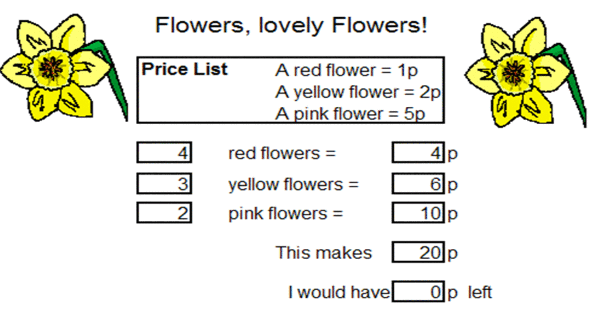 Number Magic – spreadsheets to help with a series of calculations that need to be repeated often. Once they are set up they can be used to explore the effect of changing one number on the others. The data can also be displayed very easily as a graph or chart. Number Magic has a number of in-built curricular examples – in Blue level exercises folder.
National Numeracy Strategy Resources – Interactive flash resources to support mathematics available on every Falkirk primary school network PC in shared documents. Each has an associated set of instructions. These Flash files can be dragged into an open SMART Notebook page (or just used in an Internet browser). These included tell-the-time, thermometer, shape-sorting, symmetry, fractions and angle resources.
SMART Notebook resources – there are many tools and mathematics-specific resources in the SMART Notebook Gallery Essentials for Educators, and there is a huge number of pre-created SMART Notebook resources in the shared documents folders of every Falkirk primary networked PC.
 Manga High – free online games-based maths teaching resource aimed at 7-16 year-olds. This combines development of maths skills with video game format games. The teacher selects specific maths/numeracy areas and level within the Curriculum for Excellence which assigns pupils teaching activities and game. The teacher can get reports on progress of individual pupils.
Other online resources included:
Primary Games Arena – a wide range of free online games matched to developing different numeracy and mathematics skills.
Math is Fun – inlcudes games and a dictionary of mathematcis concepts for pupils.
Maths in the City – providing ideas for taking learning in mathematics and numeracy outside
Sumdog – numeracy actvities where pupils can compete with others in a safe environment
Wolfram Alpha – described as a computational search engine!
The new Standards for Full Registration
Hazel Cunningham, Primary Probationer Supporter, Service and School Improvement Team is currently undertaking a To Lead or Not to Lead project on effective transition between the old and new Standards for Full Registration.
The aims of the project are:
* to raise awareness across Falkirk teaching staff of the main changes in the new Standards for Full Registration
* to support colleagues in analysing the differences between the old and new Standards for Full Registration in order for them to adapt their practice
* to provide an overview for managers of the main changes to enable more effective Quality Assurance and focused CPD
The focus so far has been gathering evidence of what people already know about the changes in the new Standards and looking at the best way to provide information to a wide audience of people. Twilight sessions have been run on ‘Working with the Revised Standards’ (August 2013) and input given at the PT Network meeting (Sept 2013), Curriculum Support Team meeting (Nov 2013), Early Careers Network (Jan 2014) and DHT Network (Jan 2014). Feedback from courses provided so far has been positive – “a very worthwhile course in developing my knowledge and understanding of the GTCS Standards. I feel I have gained knowledge which I can pass onto my colleagues through ERD and CAT sessions” (PT Network Meeting).
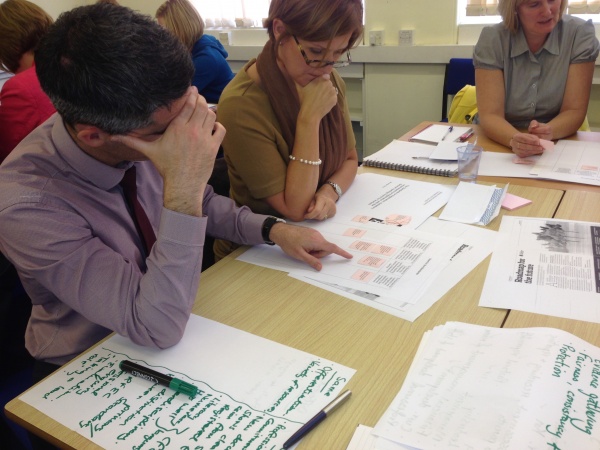
By the end of the project Hazel aims to have a package which can be used by schools to support delivery of CAT sessions on the New Standards eg. presentation or poster.
To influence the outcome of this project, post your responses to the following questions:
* How much do you already know about the New Standards ?
* What other support or information would benefit you in your present role ?
* How might this information best be conveyed to Falkirk’s teachers ?
For any further information on the project please contact Hazel Cunningham at hazel.cunningham@falkirk.gov.uk
Larbert High School 16 Days of Action
 Larbert High School pupils enjoyed the challenge of selling baking and merchandise to raise awareness and support for the White Ribbon 16 days of Action Campaign.
The 16 days of action campaign which raises awareness of domestic violence has been driven forward by a dedicated group of pupils from Larbert High School along with the support of their teacher, Stacey McMichan and school based Police Officer, Alan Imrie. In keeping with the campaign, pupils at Larbert High School have had the opportunity to sign a pledge to never commit, condone or remain silent about domestic violence. School teacher Stacey McMichan said “Domestic violence is a huge problem in society. We hope that by raising awareness of this in a school environment we can highlight to young people the importance of acceptable behaviour in a relationship. By exploring this topic, the pupils will be better equipped as adults to recognise relationships which are not healthy and to speak out against abuse. I am aware that this topic may be sensitive for some pupils, and throughout the campaign we have encouraged pupils to speak to guidance staff or PC Imrie if they need any advice or support with any issues raised”In the New Year the school has plans to further develop the understanding of domestic violence, with trained staff delivering classroom inputs.
Further information can be found on this subject at www.whiteribbonscotland.org.uk.
Curriculum Support Team wishes everyone a Merry Christmas and Happy New Year
Primary Probationer Teachers Get to Know the Teaching for Deep Learning Programme
 Yvonne McBlain and Sharon Wallace of Falkirk Curriculum Support Team recently introduced the primary probationer teachers to the Falkirk Teaching for Deep Learning Programme. During this introduction, participants experienced programme session 1 “What is Understanding”. This session explores the concept of understanding and has been used by a number of teacher learning communities in Falkirk schools. Here are some of the definitions of understanding created by the probationer teachers:
Understanding is applying and transfering knowledge flexibly as well as being able to teach others.
Understanding is achieved through repetition (perhaps in different contexts).
Understanding is transferring the skill and knowledge to another context. Embedding the skill through revisiting.
– apply and transfer knowledge to other areas of the curriculum
– be able to explain to others
Click here to access Session 1 through Glow, and here to see the power point presentation from Sharon and Yvonne’s session with probationer teachers.
Coffee, croissant, controversy Planning Meetings
 Yvonne McBlain and Karen Thomson of Falkirk curriculum support team facilitated two lively sessions recently with principal teachers, depute and head teachers. The initial session explored how our establishments were including each element of the NAR planning flow chart in their planning processes. Discussion focused on the numbers of layers of planning being used, and how this was contributing to the improvement of teaching and learning. Participants requested a second session to enable them to bring along and share their planning layers and documentation.
So, on 10th December Julie McKenna shared how Airth Primary are using a digital tool to manage their planning. Staff use this system to create discrete and interdisciplinary units of work in the form of planning wheels with skills and other information noted. They are able to track both the depth and coverage of experiences and outcomes and the progression of skills. At Airth PS, all staff collaborate to create the annual long term plan, and their planning wheels form the rest of their planning structure, with any other detail being recorded in the weekly plans. Julie and her staff now intend to develop how they integrate their assessment and recording into their planning.
Jill Stocks and Andrew Watson from Bonnybridge Primary shared how they use the Learning Unlimited tool “Realistic Record Keeping and Powerful Planning”. Bonnybridge PS staff work from the experiences and outcomes to create annual master plans for literacy, numeracy, and non core learning. Further detailed planning takes place in weekly plans, meaning that the school has two layers of planning. You can click here to see a collection of the master plans for second level. Staff are also using maths pathways to support their planning of progression in specific numeracy skills – click here to view. Jill and Andrew now intend to develop their tracking of coverage and depth of learning within the E & Os. They value the way this planning tool has enabled a significant shift away from a resource-led approach to planning, increased focus on the principles of curriculum design, and a reduction of paperwork for planning. Early years senior managers also shared their development of floor books as their main planning layer in nursery settings. They value the way floor book planning makes visible the relevance, personalisation and choice and progression of learning for pre and ante-pre school children. It was noted that not all practitioners are comfortable yet with not having additional layers of planning and documentation.
The rest of the meeting consisted of really valuable discussion of how to effectively integrate assessment, manage tracking and monitoring, and how to enhance awareness of when each of the four contexts for learning is being addressed. Click here to see the power point presentation for this second meeting.
Using Media to Support Literacy Skills
 Sharon Wallace, Curriculum Support Officer of the Curriculum Support Team and John Doherty, Principal Teacher of English and Literacy at Larbert High School this week delivered a CPD opportunity to staff from the Braes Cluster.
The aims for this session were:
•To provide an overview of ways to use ‘cultural tools’ to support pupils to learn and express their ideas
•To explore ways pupils can read with understanding, communicate effectively face to face, in writing and through an increased range of media
Sharon began with an overview of the six reading comprehension skills and outlining the range of media resources available to support the development of these skills.
John began by outlining the key differences between a ‘book’ as text and ‘film’ as text:
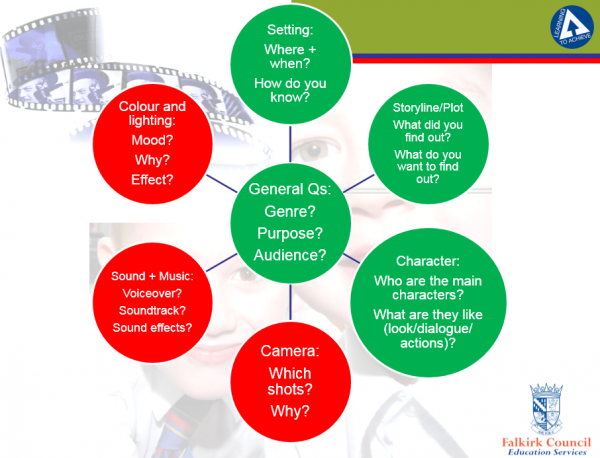
John then identified the different types of camera angles: close-up, extreme close-up, high/ how angle shot, long shot, point of view shot, zoom and tracking. John showed different stills from a range of films and the teachers identified each shot. The teachers were then asked to use their mobile devices to produce a camera shot from this list.
John then went onto analysing the use of music in film and we learned that music in film is known as the soundtrack. It can be divided into two categories –
a. Diegetic music (in the film – characters can hear)
b. Non-diegetic music (music that characters cannot hear – not part of the film’s ‘reality’)
We then analysed a scene from Jurassic Park identifying examples of diagetic and non-diagetic music.
The final part of the course looked at the effect of lighting in film. We analysed a range of stills taken from recent films and examined the effect the lighting had on the meaning of the text.
At the end of the session, colleagues put all of their newly learned knowledge and skills to the test by analysing the film trailer for War Horse.
Feedback from this session was very positive and the course will be running again at Camelon Education Centre on March 5th from 4 til 5.30pm. (Course Code SW008). We are also hoping the Film Club will be attending this session too to share how Falkirk establishments can sign up to the fabulous range of resources on offer to support the development of literacy skills using film as text.
For more information about this and other literacy courses, please contact Sharon Wallace.
Active Literacy – Networking
 Sharon Wallace, Curriculum Support Officer of the Curriculum Support Team has hosted three Active Literacy Networking sessions this week at Camelon Education Centre. Colleagues participated in Early, First and Second level network meetings with a focus on sharing good practice and professional discussion around literacy.
Colleagues from a number of Falkirk Council establishments participated in a range of activities including: updates, Using Smart Notebook Toolkit 2.0 and sharing good practice. Sharon was delighted to hear all the good practice and good news stories happening. It is really encouraging to hear how confident pupils are using the six key comprehension strategies in reading and how much pupils are enjoying learning new strategies to help with their common/ tricky words.
Teachers were provided with an update of all things new in the world of literacy including:
- The Literacy Strategy
- Every Day’s a Learning Day
- The Daily What (Bothkennar’s article)
- Courses delivered this term including Using Twixter and Fakebook
- The Thinking Reader approach
- Using Blooms fans and comprehension skills triangles
Sharon demonstrated how Smart Notebook Toolkit 2.0 can be used to create effective learning experiences for spellings and phonics. Colleagues then produced their own Active Literacy games using anagram, keyword, multiple choice, sentence arrange, vortex sort, word biz and word guess.
Sharon then invited colleagues to share examples of good practice and these included:
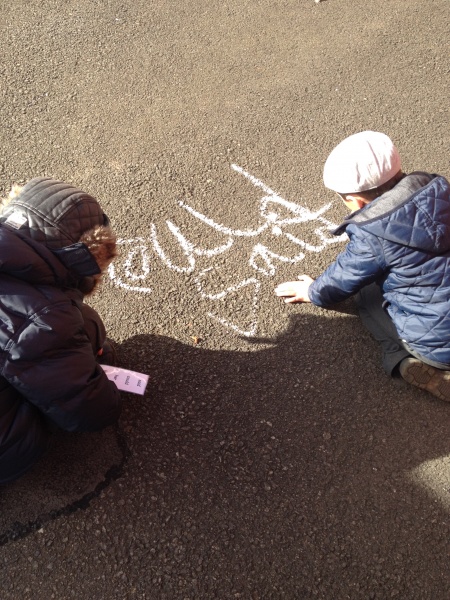
- Bainsford Primary teachers Emma Cuthbert and Claire Morrison shared some fabulous evidence of literacy using the outdoor environment and also how they have been engaging with parents and consolidating phoneme work. They also recommended the use of online support materials such as Geraldine the Giraffe!
- Helen McNeill from Whitecross Primary shared some fabulous task cards she has produced to enable her learners to be independent in their Active Literacy activities.
- Laura Cotton, a probationer from Bo’ness Public has produced her own materials using Toolkit 2.0 and she shared her lesson on the phoneme ‘ee’
Some colleagues were unable to attend, but still shared their good practice and these included:
- Andrew Watson, DHT from Bonnybridge Primary kindly shared his reading planner for ‘The Wreck of the Zanzibar’
- Carol from Laurieston shared her Reading toolkit for second level
- Alison Marshall from Drumbowie shared her reading planner for Carrie’s War
Suggestions for the theme for the next round of network meetings included – more ideas using Toolkit 2.0 and reading. The Daily What and Film Club have offered to attend our network meetings to share what they can do to support schools too.