Here is Orla’s Sway…
ADA LOVELACE, ANIMATION AND MATHS
Here is Orla’s Sway…
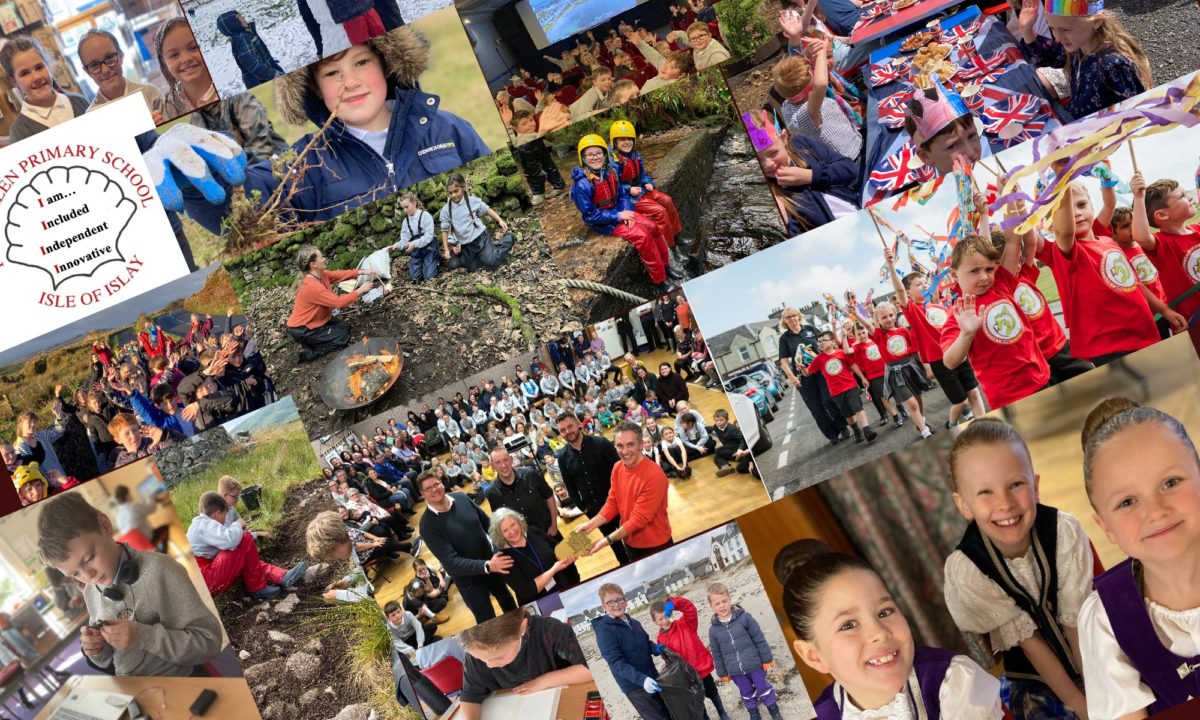
Primary School of the Year 2022
Here is Orla’s Sway…
Here is Rhys’ Sway on maths around me.
Here is a sway by Aaron on Maths facts he has found out.
 This year the Gaelic Choir at Port Ellen were going to Dunoon for the National Mod. The first day of the mod we were in the bus then we went to Inveraray. When we got to hunters quay we got to our lodge.We all went for a practice. Then we got our red and purple tee shirts. After that we went swimming and there were two pools opposite each other. One had a bridge and one was deep. We went for dinner I had chicken and it was fantastic.
The Second day of the mod we woke up at 7.30am. I had a shower then got my stuff. My nana and papa was there to pick me up in the car to the grammar school. Then we went to practice my poem then I went In. Thought I was 1st on but I was 2nd on and I was so nervous but then I did it. I waited for the competition to end I didn’t get a medal but I took part though.
We had lunch. Then we went to the High Kirk and we all sang two songs, our own choice and a prescribed song in the unison. We had to go to the Queens Hall to sing one more song, the Puirt-à-beul. We won all of the songs! So we had to get recorded for the tv. We went back to Islay, happy that we had achieved so much.
By Phoenix
 On Wednesday 3rd October Port Ellen primary invited the older generation in the village into school to enjoy a lovely afternoon tea. There were scones and pancakes prepared by P1-3, sandwiches made by P4-6 and cupcakes made by P67 as well as shortbread made by Anne Holyoake. Children helped serve the tea and sat and chatted with the visitors, and they entertained them with dancing, singing, poetry, music and talks about their learning. More than 50 people came along, and there were 4 people over 90 present that afternoon, and the children really enjoyed spending time chatting and performing. Everyone joined in with a singalong of Birlinn Ghoraidh Chróbhain and a medley from WW1, while the gaelic choir practiced their songs before the Mod. The children even got to enjoy some cakes at the end too!
We have all been learning about life in castles at Port Ellen this term following our exciting trips to Dunyvaig Castle to take part in the archaeological dig. Primary 123 have made their own castles with working drawbridges from paper, and they have been researching what people who lived in the castles did. Here is a clip explaining their work.
https://vimeo.com/273074678
On Friday 4th May the school attended the Islay WW100 service in memory of all those lost in the sinking of the Tuscania and Otranto in WW1. Here is a video created by Islay Info of the day.

This year the council is trialling an exciting new way of giving out funds to community groups, where people living in Argyll and Bute make the decision.
We want everyone to know about this and have the chance to vote.
To find out more and to vote for the projects you would like to be funded please go to the website: www.abpb.argyll-bute.gov.uk
If you have any questions, or need support to vote, please contact communitydevelopment@argyll-bute.gov.uk. 01369 708669
One day after rugby club we where pulled in and I was chosen to be the mascot for the Scotland Rugby Team through the Islay Minis Rugby club, which is a club for people who want to play rugby till there in s2 and then they have to go to the one in high school. On February 24th me, my dad and my grandad headed to Murrayfield to see the Scotland vs England rugby match as I was the mascot. When we got the stadium we had to meet up with the rest of the mascots to go and sit in a room and wait for some other people as they were late. When every one was in the room our parents went to there seats and we were taken into the tunnel where we waited for the game to start. When the game was just about to start the players came out and lined up. I was partnered with Stuart Hogg who was my favourite player. When we ran out we had walk forward and kneel as Princess Anne walked behind us and shook the players hand. After that we went off and went to our seat and watched the game. Where we were sitting we had the subs right behind us. After half time we back to our seats and the game started up and it started up. When England were progressing through our defence, Jamie Bhatti, another one of my favourite players, he was injured and carried off and when he came up the steps to his seat he almost fell as he had torn something in his leg. After the game we went down and had to wait till the players got ready and got changed then they came out to sign our t-shirts and other stuff. I was really thrilled that Scotland won!
By Taylor
Today is the hundred year anniversary of a tragic event that happened on Islay right at the end of the First World War. The SS Tuscania, carrying 2000 American troops, was torpedoed by a U-boat 7 miles off the coast of Islay. Many of the survivors, but even more of the bodies ended up on our shores. The survivors were rescued and looked after by the locals who took them into their homes, and the dead were buried in graves around Islay. Today a service is being held at the American monument on the Oa and at the war graves in Kilnaughton cemetary to remember the tragic events of 100 years ago. The school Gaelic choir will be singing An Eala Bhàn, The White Swan, a song written by a soldier from Uist who fought at the Somme.

Below is a news article, written by the children, that tells the story of the Tuscania as though they were on Islay a hundred years ago:
 ILEACH’S SAVE LIVES OF TORPEDOED AMERICAN SOLDIERS
On the 5th February a tragedy happened, the SS Tuscania, a US troopship that was carrying more than 2,000 American soldiers, was torpedoed 7 miles off the South East coast of the Isle of Islay. The SS Tuscania was going to Liverpool from New York City and was part of a convoy of 14 vessels. It was a tragic night with conditions like no other, the rough seas and darkness in the sky made it impossible to see. Sadly the SS Tuscania was torpedoed twice by a U- boat at 6:40pm; the first torpedo missed the SS Tuscania but sadly the second one hit it. It left a huge v shaped hole in the troop ship and destroyed many of the lifeboats. The torpedo hit the middle of the boat on the starboard side. The SS Tuscania sank at around 10pm. After having fired the torpedoes the submarine immediately dived to escape as escort vessels came to attack. Some of the men managed to get onto the lifeboats, left and got to safety, but others fell overboard due to rapid waves and rough seas. Luckily Three British destroyers; Grasshopper, Mosquito, and Pigeon came to help others, putting their own lives at risk to come alongside the Tuscania and as safely as they could transfer the men for one ship to another by rope whilst still being fired upon by the U-boat. The destroyers saved 1,500 men
As the lifeboats were approaching the coast of Islay in the dark, the men aboard the lifeboats would have heard the sounds of the crashing waves. An Islay man, Duncan MacDonald, is reported to have been on one of the lifeboats and he persuaded the other men on the lifeboats to wait until morning before they carried on. When it was light they then made their way safely into Port Ellen. Another 50 men sadly died when they were attempting to make their way in the dark and their lifeboats crashed on the rocks. One boat landed near Upper Killeyan and the survivors started to make their way to the Morrison’s family home. Robert set off to see what he could do to help, while his sisters Betsy and Annie had begun baking scones for them. One of the survivors was Arthur Siplon, who said ‘Men were in good spirits despite tragedy occurring all around them.’
Other people helped save them on the island, but many just collected the bodies of the dead. Luckily 132 men made it safely to Islay but sadly a lot of them were badly injured.
One of the survivors Everett Harpham wrote a letter to a friend in America saying that they nearly drowned and when it was light enough to see there was some bodies lying near them dead and they had to listen to the groans of the dying comrades until a Highlander rescued them. Arthur Siplon had been knocked off a lifeboat by a wave and managed to get back on and he was trying to help his friend Wilbur Clark up, when a big wave hit the boat again and they were both thrown against a rock and Wilbur Clark hit his head and sadly died.
Loads of people were found dead around the island in places like Lochindaal, Kilnaughton and Bowmore. There were 53 bodies buried in Port Charlotte, 83 were buried in Port Ellen and 46 bodies at Port- nan- Gallan. It is estimated that 182 lives were lost. There was a funeral at Port-nan-Gallan where 28 bodies were buried by Captain Ramsey and then on the 11th 18 more bodies were buried. Port Charlotte also had a funeral and over 400 people attended even in the rain.
We are all sorry for everyone’s loss and if anyone finds a body please contact the police.
By Sarah, Rebecca and Lauren P7
This term P67 have been learning about renewables and how energy is produced from different sources. They went on a trip around the renewables projects on Islay and this inspired a group to enter the BP STEM Challenge by making and testing their own Hydro Energy device. Watch the video they made for their entry below.
Nuclear is a non renewable energy source.
Nuclear doesn’t release any gasses or fuels but if a tsunami happens or a terrorist attacks it, it will release a lot of bad chemical that can cause global warming it can also kill people and it wont go away for thousands years.
The chemical reaction will cause radiation the parts of it will have to be hidden in a special rock because its the only rock that can hold it with out letting it go this rock has no cracks so it can hold it. This rock is on Islay!
Nuclear is from Radioactive minerals which are uranium they are found by mining. When the minerals are spilt they split in Nuclear reactors.
Nuclear only needs a tiny bit to create a lot of energy, It doesn’t release gasses or fuels.
They are expensive to run, if they leak they can have a massive effect on people.


On Saturday 18th November I went to London as a finalist for the Tomorrows Engineer competition. In the competition there were 10 finalists from all around the UK. All the finalists had to meet up in the Science Museum to present their invention in front of 4 judges and the audience. We had professional posters made to show our inventions. My invention was the Scaredy Sheep, a device that would bark like a dog and is attached to the sheeps ear so when sheep get stuck on their backs they are scared into jumping up again.
When the finalists first arrived we went down into a room where the judges were and we got to talk to them and the host so we weren’t as scared to talk about our inventions in front of them. We also had to get head sets on so we could do a sound check. After the break we all went down and sat down. The first thing that happened was a balloon experiment and a bubble experiment. In the bubble experiment a lady got bubble mixture and big bubble stick. Another lady came out and got another bubble stick and each side of the room did a bubble competition. The balloon experiment was really cool because a lady put a balloon on fire and it made a REALLY loud bang.
Then the first finalists went up to present their ideas. Then we got a quick break to explore the museum. After about 15 minutes we had to go back and on my way in their was a robot called Oscar who walked into me. Oscar was a really cool robot because he speaks to you and hands out chocolates and lollipops. Finally we got into the room and sat down and then there was another quiz. Then it was lunch and after we got to have a quick demonstration on how the body digests food. It wasn’t a good sight at all!
After the disgusting demonstration I had to go up and present my idea. I was nervous but excited and was proud of explaining my invention. Then the judges came out and the host announced the winner, and the winning design was an excellent hover wheelchair. We all congratulated the winner and then we got to explore more of the museum. After a long day I went back to my hotel. I really enjoyed the competition and I would like to be an engineer when I grow up. While I was there I learnt that to complete something you have to stick with it and keep trying.
 This week, 6-10th November is Tomorrow’s Engineers week. At Port Ellen we will be doing lots of engineering challenges and finding out more about what an engineer is and how they solve problems. We will be engineers on a mission, solving problems and sorting the planet. See the PPT below to find out more about engineering careers.
 Primary 6&7 have been busy inventing. They have been creating design boards for the Young Imagineers competition run by Statoil. They had to come up with a great engineering idea that could solve a problem for the future, and lots of great ideas were generated; extra robotic arms and hands so you can get more done, high viz vests for cows, smart material kneepads that bounce you back when you fall in the playground, the Scooper for stopping ice cream dripping on your hands and lots more. 3 were chosen by the class to enter for the competition; Sarah’s Scaredy Sheep device stops sheep getting stuck on their backs by barking like a dog, Rebecca has designed a device that uses static electricity from clothes to repell rain from your glasses and Lauren has invented a device that knows when the inside of your car gets too hot and sends an alarm to your key. Good luck in the competition and great engineering!
This short film, narrated by scientist and TV presenter Heather Reid at Whitelees Windfarm, explores the opportunities for using the power of the wind, waves and tides in Scotland to produce energy. LOGON TO GLOW TO VIEW
What different skills do engineers need to do their jobs?
LOGON TO GLOW TO VIEW
Watch this STEM video to find out about the different types of engineering that are happening around the world.
LOGON TO GLOW TO VIEW
Scotland has a great history of excelling in the field of engineering. We have been looking at different types of engineering in school and we want to focus especially on renewable engineering, which will help solve the problem of global warming. LOGON TO GLOW TO VIEW
On Tuesday the 19th of September P6/7s from Islay and Jura went to Oban for the fabulous Stramash trip. At first I didn’t feel too sure about going but as it got closer I felt more and more exited. We were on the ferry first and then the bus for 1 hour in order to get to the hostel. By the time we were in Oban we had already got told who was in our groups and who was in our rooms. After the chat we went into our groups and discussed what we were unsure about and what we were exited for. That night we had already been in our rooms so we went and played games at the lovely Ganovan beach and grass. We played fun games in our groups but by then I just wanted to go to bed.

The next morning I woke up to a shock when I found out we were doing canoeing in about an hour, I wasn’t really sure about canoeing so it just made it even worse when I found out I had to wear a wetsuit! At the end of canoeing I found it WAS really fun so it made me more confident about the rest of the week. That afternoon we were doing coasteering, another one I wasn’t to sure about! I thought it was just jumping off a rock into the sea but that was a small part of it. You had to climb rocks with barnacles on them then at the end you got to jump of the rock which was fun. That night we got to go swimming, the pool had a big slide in it so I went down it. My friend Taylor also belly flopped into the pool! 
On Thursday morning my group was going gorge walking so I had to put on another wetsuit sadly. We got into the bus and drove to the gorge. Once I saw the currents I knew it would be fun so I had a go at going down on my back. I knew whatever I did I would be happy with but this one was even more fun than I thought, it was so deep at the waterfall I couldn’t touch the bottom. We carried on up the woods until it came to a dead end then we went to the hostel to have lunch. There was lots of different instructors for each activity. After lunch my group did an adventure walk to the woods then a castle. Some of my friends that went before me said it was rubbish but when we got to light a fire it got interesting because it took my friend Craig 32 tries with the Swedish fire stick to light a fire. We then drew a picture of what we could hear and see. We then set off to the castle. Once we got to the bottom of the hill at the castle the instructor said a story about a whale a guy and a girl attached to the whales heart. After that we got to the castle and saw an eagle. That excellent day we had a bonfire that night so we got to toast marshmallows on it. 
The last day we only had one activity left that was rock climbing. Once we got to the amazing Ganovan beach and grass we walked to the rocks. I never knew how much equipment you needed to wear until he explained that it was so safe. The first rock we climbed was easy. I did it with Robbie from Keils then we moved on to the next rock! It was scary at first because it was big but when I started I was up there in seconds. We had the choice to abseil down but I didn’t but some people did. 
Overall I achieved making friends, rock climbing, abseiling, gorge walking and coasteering. The one that I found most challenging was coasteering because of the wave splashing up on to you. I found gorge walking the funnest because you got to float down the gorge. I also found rock climbing boring because you had to wait but when it was your turn it was so fun. I was scared of jumping of rocks and swimming in the sea but when I finished coasteering I overcame my fear. Overall Stramash was brilliant and I did stuff I would of never thought I would of and I would certainly go back to Oban for Stramash. 
By Jack
 Islay is a beautiful island off the west coast of Scotland, and one of the reasons it is so lovely is because farmers work hard to keep the land the way it has looked for generations, conserving the environment. But the land has also influenced how and what types of farming happen on Islay. As an Island the costs of transport are also an important consideration, as is the weather. All these factors contribute to the difficulties and successes of farming beef, sheep and barley on Islay.
Farming on Islay is very important to Islay’s landscape and the farmers that work hard to get paid and have more than just one job but two! The farmers on Islay have kept the landscape as it was years ago. The farming on Islay gives jobs to many people so that they can make money and live their lives as the years pass by.
The main land types found on Islay are rough grazing, grassland, peat bog and moorland. Grassland is low lying and is used by farmers to grow grass for silage, grass to feed animals and can also be used to grow barley; this is the most useful land for farmers, but in the winter it gets very wet and muddy and can’t be used to keep animals on. Rough grazing land can’t be used to grow grass or crops, it tends to be hilly with plants like heather, rushes and patches of rough grass. Animals can graze it, although it is mostly used by sheep. Rough grazing is useful in the winter because it stays dry, drains well and you can overwinter animals on it. It can’t be used to grow vegetables or crops because it is stoney and the soil is poor. Peatbogs are of no use to farmers as animals can get stuck in the bogs and the grazing is too poor. Farmers on Islay often drain the land to keep it dry enough to grow grass. Because of the limits imposed by the type of land on Islay, the main farming is Beef and Sheep, with a little barley production.
Islay has a wonderful type of weather for grass which has mainly rain and wind with a tint of sunshine as there is hardly any snow or frost on the island. The normal temperatures varies as seasons pass as in the summer there is more sun and it is not as rainy as autumn or winter as in winter it is mainly rainy and windy but it is still sometimes sunny. The lowest average temperature on islay is 3’c. In autumn the weather is changing to winter and during that there is sometimes gale force winds and there is about 130mm of rain through the season. In summer the weather becomes less rainy and becomes more sunny.
Islay is an island than can only be reached from the mainland by ferry or plane. This means farmers have to pay to get their produce off the island and also pay extra to get the equipment and resources they need to farm on the island. As a result of this farmers on Islay struggle to compete financially with those on the mainland. For example, fertilizer and concentrates need to be brought over on container ships and unloaded onto lorries. This means fertilizer and concentrates cost more for Islay farmers. The type of farming that can happen here is also affected by transport; milk, soft fruits and other products will go off when transported for long periods of time so are not farmed on Islay. However, sheep and cattle are easy to transport over time, and the barley that is grown is sold locally. So farmers on the mainland have an advantage over famers on Islay.
We are pleased and proud to announce Port Ellen is one of 6 finalists in the Rolls-Royce Science Prize 2017-18! We are going to be carrying out a year long project on engineering and renewables. Read more about the prize taken from the Rolls-Royce Website below:
The Rolls-Royce Science Prize is an annual awards programme that helps teachers implement science teaching ideas in their schools and colleges. The Prize recognises and rewards excellence in Science teaching across the full spectrum of teaching, from special education needs to high ability pupils. It also promotes innovative and sustainable strategies for teaching science which addresses a specific need in the schools or colleges and at the same time contributes to teachers’ continuing professional development.
 On Wednesday 8th June, two members of staff and three pupils from Port Ellen Primary flew to Glasgow to attend the Scottish Education Awards. The school had got through to the finals of the Science, Technologies, Engineering and Mathematics (STEM) Award along with another primary school and a high school. Assessors visited the school back in March to see STEM activities in class, speak to children about their experience of STEM learning and talk to staff about the development of STEM in Port Ellen.
Charlet Rose Munro, Rowan Morris and Natalie Logan were very excited to attend such a large event………and we were all even more surprised to be announced winners! The award was sponsored by BAE systems and the presenter told the girls that he was very happy to see girls being so keen on science and engineering and that he hoped he might see some of them working for the company in the future. It is predicted that the UK will have a huge shortage of scientists and engineers in the near future.
This award reflects a high level of commitment to STEM learning throughout the school, from Pre-5 to P7. We all feel that encouraging children to be curious about the world around them leads to high levels of engagement in learning and that STEM subjects promote creativity, problem solving, co-operation, resilience and reflection. The school was recognized as having ‘an adaptable and resourceful teaching team who makes best use of the local environment and technology……..and that by engaging in partnerships, the school supports and extends the development of skills for life, learning and work.’ We are all very chuffed to have achieved this recognition.
 Over the past year all the primary schools on Islay and Jura have been involved in an Island wide history project in conjunction with Islay Heritage and archaeologists from the University of Reading.
  The children have been learning about their history and heritage, as well as the many STEM skills required to be an archaeologist. The results of their learning are now on display in the Gaelic College, Ionad Chaluim Chille Ile, in the Islay and Jura School’s Heritage Exhibition.
 The project started with a party from every primary school on Islay visiting the Giant’s Grave site, 90 children in all. This involved a lengthy walk from Nerabus up through the forestry to the site, where the archaeologists were excavating and surveying. The children were then able to experience the different fieldwork techniques, from geophysics to troweling to photography. They learned about life in the early Neolithic period, and discussed with the experts what the grave was for, how it might have looked and how the people at the time lived. They then returned to the classroom to continue the learning, carrying out many different tasks; timelines, brochures, reports, sways, story telling videos, den building, pot making, art and imaginative writing. Some of these can be seen on the Islay Heritage site, as well as at the exhibition.
 Then in late March the archaeology team returned for phase 2 of the project, in which schools adopted their own local monument and carried out surveys. Children applied some of their previous learning on Geo-physics and photography, whilst also learning how to make scale drawings and documentaries. They then got to see the results of the survey transferred into 3D representations of the site. Bowmore surveyed Cill a’ Bhulig, the remains of an old chapel, Port Charlotte surveyed Carnduncan, a Bronze Age burial cairn, Port Ellen surveyed Kilbride Chapel and Small Isles and Keills surveyed a crannog at Loch nan Deala.
 It has been a great learning experience for all involved and made us grasp just how much fascinating history we pass on Islay everyday without even realizing it. The process of revealing Islay’s past through the use of modern archaeological techniques has been a truly great experience, and the children have a far better understanding of their Island as a result. We would like to thank all those involved for providing us with the experience, including the Mactaggart fund for enabling the project to take place. We hope people will visit the exhibition over the next two weeks for a unique insight into Islay’s past.