The Education Secretary has announced up to £1.3m for Computing Science education in Scottish schools. Schools will be able to use this money, which will go directly to them, to buy physical computing resources to support engagement with Computing Science in the BGE stages. They are able to access £2000, with additional £500 available for resources that will be incorporated into transition events with associated primary schools or pupils with additional support needs.
She also announced two appointments to the new teacher-led the University of Glasgow ‘STACS’ initiative, which aims to help prepare pupils for careers in tech.
This paper provides an overview of Computing Science delivery in Local Authority secondary schools.
Education Scotland carried out a survey of 356 schools between July 2021 and October 2021. The survey was promoted via local authority technologies leads, Computing Science teacher groups and Education Scotland officer contacts with local authorities and RICs. At the point of writing, the survey had 309/356 unique local authority school responses. This represents 86.8% of local authority secondary schools. While this is the majority of schools, it is acknowledged that the survey data is not complete and that this paper should be treated as provisional in this respect.
The survey collected data relating to Computing teacher numbers, delivery of Computing Science in S1/2 and opportunities for learners to study Computing Science or related courses in the senior phase.
The paper also provides an overview of Senior Phase Computing Science uptake and attainment, including summary data relating to attainment and deprivation.
This page is for secondary teachers interested in entering teams into a FREE cyber security Capture the Flag event on TryHackMe.
The challenges will be suitable for complete beginners as well as experienced tech-savvy students. Try Hack Me will support teachers with three recorded lessons. This information might be useful to know before starting with the recorded lessons and the Capture the Flag event: TryHackMe | Network Fundamentals
This video from TryHackMe gives an overview of the platform to get you started
The Digital Wellbeing Award for Cyber Resilience and Internet Safety is designed to provide education professionals with the resources and support required to help pupils safely navigate the digital world.
Schools that successfully complete the programme receive a nationally recognised award by Education Scotland. Register your school
We’re delighted, and immensely proud to be able to announce that we have been shortlisted for two awards at the upcoming Scottish Cyber Awards 2021.
Even to be shortlisted is a great achievement for us and we’d like to thank all of the educators who have engaged with us, and also our Education Scotland colleagues that support us.
The awards we’re shortlisted for are:
Best Cyber Education Programme category for the
Best New Cyber Talent
We can’t wait to see you all at the Cyber Awards and hear about the impact that everyone’s work us having across the country.
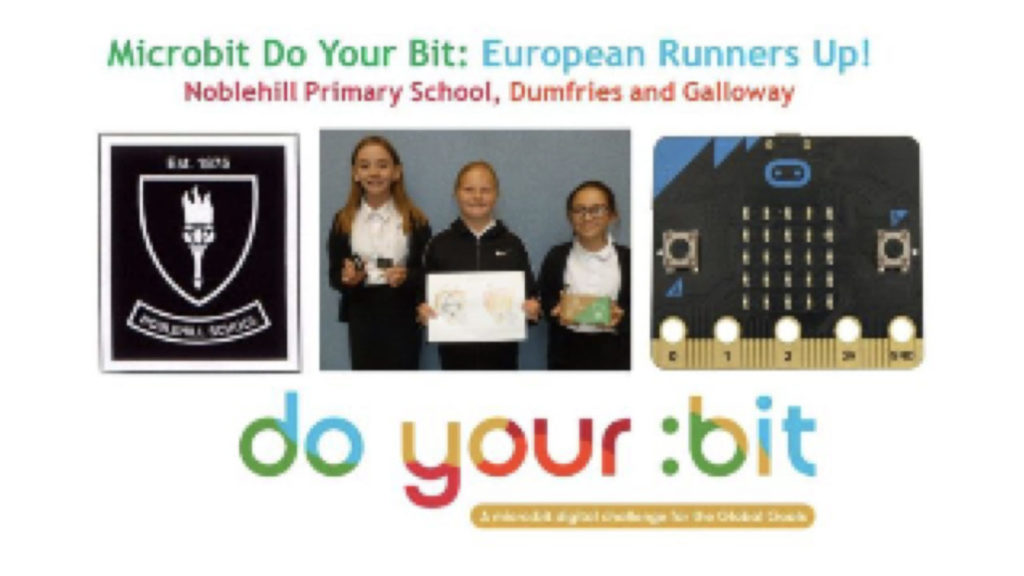
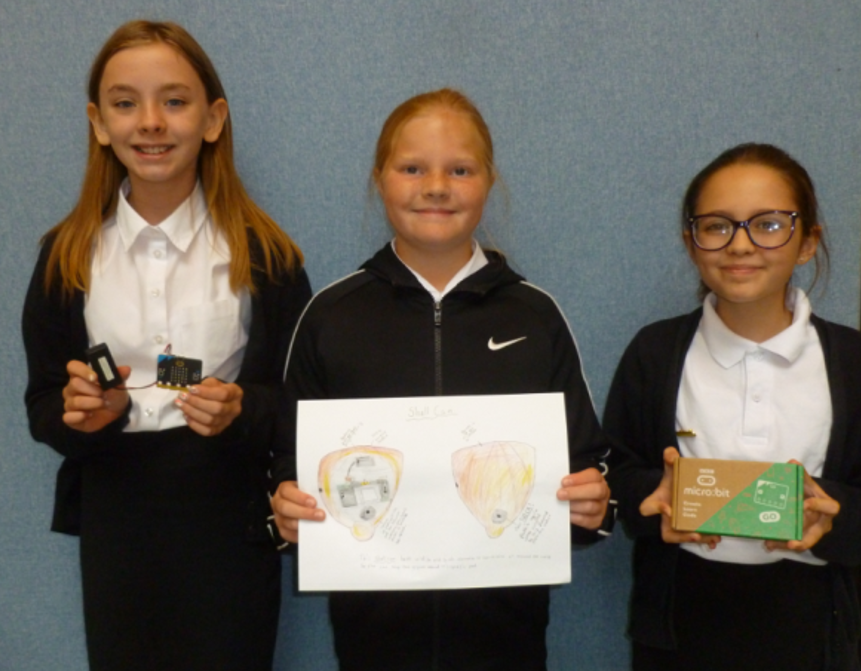
During Term 4 of last session, P6 pupils at Noblehill Primary School in Dumfries and Galloway took part in a Micro:Bit Global Challenge. Their challenge was to design a ‘gadget’ which would support the work currently being undertaken around the world to support climate change. The pupils chose Verity, Lilly and Sophie’s design ‘Shell Cam’ as the winners and this was entered into a global competition. Shell Cam was designed to be hidden somewhere on the beach and video all the different species that spent time there. This information would then be sent back to scientists so they could track the movement and number of species.
We have recently heard the amazing news that the design was chosen as runner up in Europe!!!
The success has been posted on the Micro:Bit webpage along with the answers to a few questions that our amazing team had to give:
How do you feel being runners-up in Europe? – ‘Amazed, surprised, actually can’t believe it, it’s just WOW!’
Why did you choose to tackle the problem of animals becoming extinct? – ‘A lot of animals are becoming extinct and food chains are being damaged so we wanted to think of a way to help.’
How long have you been using the micro:bit? – ‘We have only used them 3 or 4 times but we loved them.’
How has taking part in do your:bit inspired you? – ‘We want to know more about what the Micro:Bits can do as well as help theenvironment.’
What will you create next? – ‘Maybe a similar kind of thing but more for plants/ flowers, different types of nature.’
Well done team, Noblehill are very proud of you!
Lindsey Kirkwood, Principal Teacher, Noblehill Primary School
The programme is structured to support digital leaders at all levels to reflect on current and emerging practice and consider the nature and purpose of digital learning and teaching. Participants will be encouraged to examine and discuss the themes of
developing self regulated digital learners
opportunities for curriculum change and flexibility
enhancing a digitally enabled learning environment
The programme is primarily facilitated online. There will be series of online presentations, discussions and readings, along with problem finding activities around each theme. Groups of participants will collectively use their knowledge to identify potential solutions and ideas to address these issues.
The collective outputs from the sessions will be shared nationally.
This programme may be of particular interest to groups of participants from the same setting, for example school working groups. Individual participants are welcome to invite colleagues to particular sessions that may be of interest.
This is not a programme based on digital skills development, but the application and use of digital skills to enhance learning and teaching. As such, this programme is best suited to practitioners and leaders who are confident users of learning technologies or have an understanding of how technology can support/enhance learning and learning environments.
There will be a short information session about the programme on 26th August at 4pm.
This guide has been created to provide information to help parents understand more about the esports industry.
The contents of the guide include:
Information about the British Esports Student Champs
Benefits of esports
Esports in education
Academic pathways
Inclusivity and diversity in esports
How you can get involved with your child
Parents testimonials
Online safety
Tom Dore, Head of Education at British Esports Association, said:
“At British Esports we’re helping to establish industry standards for safeguarding and keeping young people safe online. Developing the Parent & Carers guide in collaboration with NSPCC has allowed us to celebrate many of the positives around esports, and also highlight important issues around safeguarding and online safety.
It is crucial as an industry that we’re doing everything we can to keep young people safe while participating in esports. We should look to traditional sport, and other established industries, to learn from their ongoing work. British Esports strongly encourages all stakeholders in the esports industry to scrutinise their own practise around their work with young people and prioritise safeguarding and online safety throughout their organisations.’
Esports (or electronic sports) is a term used to describe competitive video gaming. With 81% of children playing video games online nowadays, games are arguably a larger part of their lives than ever before.
The British Esports Association (BEA) is a not-for-profit national body established in 2016 to promote esports in the UK, increase its level of awareness, improve standards and inspire future talent. As a national body, their aims are to support esports and provide expertise and advice.
They help to educate parents, teachers, media, policy makers and government around what esports is and what its benefits are. BEA aim to:
Promote esports in the UK and increase its level of awareness
Improve the standard of UK esports
Inspire future talent
There has been lots of work with colleges in Scotland so far but the BEA are keen to support more schools setup, deliver and develop esports clubs for children and young people. Running an esports club is about more than playing games, there is the setup of equipment, recruitment of friends and peers, and all the digital literacy required to produce videos of their games. In fact, capturing gameplay can become a whole production with sounds, graphics and video editing going on to showcase their gaming skills.
The Noteable service providing access to cloud based computational notebooks is now available via the App Library in Glow.
Noteable provides a cloud based environment for coding activities using Python and R/R Studio. This can be used to support the delivery of Computing Science and Data Science based courses as well as Higher Applications of Mathematics.
A DPIA will be required before schools in local authorities can access the service. This document should provide most of the information required for Local Authorities.
To access the Noteable app in Unify, the Glow Key Contact has to make contact with RM who will issue an application request form. Once completed and returned, the app will be made available to admins for the authority who can accept the terms and conditions and install across their establishments
DPIA Support
EDINA, at the University of Edinburgh have provided documentation to help with DPIAs. This documentation is available below.
It states that the legal basis is Contract. What is the basis of the contract? Who is the contract with given the Local Authorities haven’t signed anything directly with Edinburgh University
EDINA, at the University of Edinburgh holds an agreement with Education Scotland to integrate and supply the Noteable service through the GLOW system to Scottish schools. Contractual agreements to access GLOW apps fall between Education Scotland and the Local Authority. Service level contracts and agreements between EDINA, the University of Edinburgh and service users are relevant and applicable where there is a legal basis to supply the service as a paid subscription.
LA QUESTION: Does the Local Authority have to request removal of material from the cloud once the qualification is done or doe this happen automatically?
Once a user has been tagged with a ‘Suspended’ or equivalent affiliation by the Identity Management System that feeds into the Noteable system through GLOW, using the SAML2 authentication standard, the user’s account will be made unavailable for access and user accounts are deleted one year after the user’s affiliation is set to ‘Deleted’.User account deletion does not include deleting assignment work submitted to Instructors – this data is considered owned by the relevant Instructor and will remain within their Noteable service user space until the instructor account has been Suspended and Deleted according to the schedules described above.
LA QUESTION: Please describe the technical measures that will be put in place to support the protection the data in the cloud
The Noteable service adopts Jupyter technology into its infrastructure stack and does not link to Jupyter project servers that may be based outside of the United Kingdom. The Noteable hardware and software infrastructure stack are run by and within University of Edinburgh’s IT infrastructure. The Information Security Strategy of the University of Edinburgh includes information on Cyber security incident prevention and management requirements and advice for staff members of the University. (https://www.ed.ac.uk/infosec/information-protection-policies/information-security-required-reading/information-security-strategy).
To protect data within the Noteable service, The infrastructure that Noteable is built upon takes nightly backups of the virtual machines running the Noteable service. The service itself runs within Docker containers in those virtual machines. The backups are retained for 4 weeks (this information is available within the Data Retention Policy as well).
LA QUESTION:
University of Edinburgh’s website states: ‘Noteable is integrated with Learn to allow for a central launch point into a pre-set environment without the need for a separate login.’ Are you able to explain what Learn’ is?
LEARN refers to the University of Edinburgh’s specific online learning environment, and in the case of schools the word ‘Learn’ would be replaced with ‘GLOW’ as the equivalent. As these are the University of Edinburgh’s specific websites, information about Noteable will be specific to their use case. Further information on Noteable for schools can be found on our YouTube playlist and website.
LA QUESTION: Noteable – Cookie Policy (edina.ac.uk) – are you able to clarify the third parties you rely on to sub-contract the processing if this includes personal data
Noteable uses New Relic and Google Tag manager for gathering performance and traffic metrics. All data is obfuscated for New Relic and used only for performance metric purposes. Google Tag manager is used on the service launch page and there is no personal data that is fed or added to Google Tag manager.
LA QUESTION: Will personal data be included on any assignments? E.g. teacher name, signature and pupils name, class, schools?
Data securely authenticated by Noteable using the SAML2 authentication protocol used with the GLOW system will possibly include student names to track assignments and school name identification on the launch page and for assignment management.
LA QUESTION: What departmental controls or controls by University of Edinburgh etc. will be put in place to protect personal data? E.g. ‘Student Guide to using Noteable for Assignments’
Backups of data on the Noteable service are outlined in the policy which includes further information on the virtual machines which run the infrastructure of the service.
Personal data is obfuscated in all possible instances and solely used for authentication purposes to access the service and a user’s saved environment and files.
LA QUESTION: What do teachers have access to?
Teachers have access to a user-specific instance of Noteable, including computational notebook files and environments they have created and saved previously, including options to choose computational notebook types with Python and R-based notebooks. Teachers have assignment features enabled when they authenticate into Noteable through GLOW, and can create assignments for their class using the Formgrader tab on the Noteable service dashboard. Teachers have access to the Formgrader feature for releasing assignments to their classes from Noteable as well, which will release an assignment file from the source in the teacher’s user space for students in their class to fetch in the Assignments tab of Noteable.
LA QUESTION: Do you rely on any sub-processors? The storing of data outside the UK would have to be a yes as University of Edinburgh is a Data Processor. We need to understand if anyone else is ?
No personal data that Noteable may use is stored outside of Scotland and the United Kingdom. All data is stored on University of Edinburgh hardware.





You must be logged in to post a comment.