Year: 2013

Larbert High School 16 Days of Action

Larbert High School pupils enjoyed the challenge of selling baking and merchandise to raise awareness and support for the White Ribbon 16 days of Action Campaign.

The 16 days of action campaign which raises awareness of domestic violence has been driven forward by a dedicated group of pupils from Larbert High School along with the support of their teacher, Stacey McMichan and school based Police Officer, Alan Imrie. In keeping with the campaign, pupils at Larbert High School have had the opportunity to sign a pledge to never commit, condone or remain silent about domestic violence. School teacher Stacey McMichan said “Domestic violence is a huge problem in society. We hope that by raising awareness of this in a school environment we can highlight to young people the importance of acceptable behaviour in a relationship. By exploring this topic, the pupils will be better equipped as adults to recognise relationships which are not healthy and to speak out against abuse. I am aware that this topic may be sensitive for some pupils, and throughout the campaign we have encouraged pupils to speak to guidance staff or PC Imrie if they need any advice or support with any issues raised”In the New Year the school has plans to further develop the understanding of domestic violence, with trained staff delivering classroom inputs.

Further information can be found on this subject at www.whiteribbonscotland.org.uk.

Primary Probationer Teachers Get to Know the Teaching for Deep Learning Programme

Yvonne McBlain and Sharon Wallace of Falkirk Curriculum Support Team recently introduced the primary probationer teachers to the Falkirk Teaching for Deep Learning Programme. During this introduction, participants experienced programme session 1 “What is Understanding”. This session explores the concept of understanding and has been used by a number of teacher learning communities in Falkirk schools. Here are some of the definitions of understanding created by the probationer teachers:

Understanding is applying and transfering knowledge flexibly as well as being able to teach others.

Understanding is achieved through repetition (perhaps in different contexts).

Understanding is transferring  the skill and  knowledge to another context. Embedding the skill through revisiting.

– apply and transfer knowledge to other areas of the curriculum

– be able to explain to others

Click here to access Session 1 through Glow, and here to see the power point presentation from Sharon and Yvonne’s session with probationer teachers.

Coffee, croissant, controversy Planning Meetings

Yvonne McBlain and Karen Thomson of Falkirk curriculum support team facilitated two lively sessions recently with principal teachers, depute and head teachers. The initial session explored how our establishments were including each element of the NAR planning flow chart in their planning processes. Discussion focused on the numbers of layers of planning being used, and how this was contributing to the improvement of teaching and learning. Participants requested a second session to enable them to bring along and share their planning layers and documentation.

So, on 10th December Julie McKenna shared how Airth Primary are using a digital tool to manage their planning. Staff use this system to create discrete and interdisciplinary units of work in the form of planning wheels with skills and other information noted. They are able to track both the depth and coverage of experiences and outcomes and the progression of skills. At Airth PS, all staff collaborate to create the annual long term plan, and their planning wheels form the rest of their planning structure, with any other detail being recorded in the weekly plans. Julie and her staff now intend to develop how they integrate their  assessment and recording into their planning. 

 Jill Stocks and Andrew Watson from Bonnybridge Primary shared how they use the Learning Unlimited tool “Realistic Record Keeping and Powerful Planning”. Bonnybridge PS staff work from the experiences and outcomes to create annual master plans for literacy, numeracy, and non core learning. Further detailed planning takes place in weekly plans, meaning that the school has two layers of planning. You can click here to see a collection of the master plans for second level. Staff are also using maths pathways to support their planning of progression in specific numeracy skills – click here to view. Jill and Andrew now intend to develop their tracking of coverage and depth of learning within the E & Os. They value the way this planning tool has enabled a significant shift away from a resource-led approach to planning, increased focus on the principles of curriculum design, and a reduction of paperwork for planning. Early years senior managers also shared their development of floor books as their main planning layer  in nursery settings. They value the way floor book planning makes visible the relevance, personalisation and choice and progression of learning for pre and ante-pre school children. It was noted that not all practitioners are comfortable yet with not having additional layers of planning and documentation.

The rest of the meeting consisted of really valuable discussion of how to effectively integrate assessment, manage tracking and monitoring, and how to enhance awareness of when each of the four contexts for learning is being addressed. Click here to see the power point presentation for this second meeting.

Using Media to Support Literacy Skills

Sharon Wallace, Curriculum Support Officer of the Curriculum Support Team and John Doherty, Principal Teacher of English and Literacy at Larbert High School this week delivered a CPD opportunity to staff from the Braes Cluster.

The aims for this session were:

•To provide an overview of ways to use ‘cultural tools’ to support pupils to learn and express their ideas

•To explore ways pupils can read with understanding, communicate effectively face to face, in writing and through an increased range of media

Sharon began with an overview of the six reading comprehension skills and outlining the range of media resources available to support the development of these skills.

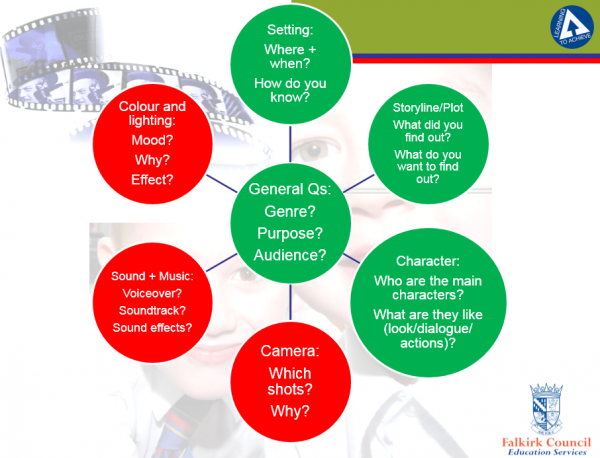
John began by outlining the key differences between a ‘book’ as text and ‘film’ as text:

John then identified the different types of camera angles: close-up, extreme close-up, high/ how angle shot, long shot, point of view shot, zoom and tracking. John showed different stills from a range of films and the teachers identified each shot.  The teachers were then asked to use their mobile devices to produce a camera shot from this list.

John then went onto analysing the use of music in film and we learned that music in film is known as the soundtrack. It  can be divided into two categories –

   a. Diegetic music (in the film – characters can hear)

  b. Non-diegetic music (music that characters cannot hear – not part of the film’s ‘reality’)

We then analysed a scene from Jurassic Park identifying examples of diagetic and non-diagetic music.

The final part of the course looked at the effect of lighting in film. We analysed a range of stills taken from recent films and examined the effect the lighting had on the meaning of the text.

At the end of the session, colleagues put all of their newly learned knowledge and skills to the test by analysing the film trailer for War Horse.

Feedback from this session was very positive and the course will be running again at Camelon Education Centre on March 5th from 4 til 5.30pm. (Course Code SW008). We are also hoping the Film Club will be attending this session too to share how Falkirk establishments can sign up to the fabulous range of resources on offer to support the development of literacy skills using film as text.

For more information about this and other literacy courses, please contact Sharon Wallace.

Active Literacy – Networking

Sharon Wallace, Curriculum Support Officer of the Curriculum Support Team has hosted three Active Literacy Networking sessions this week at Camelon Education Centre.  Colleagues participated in Early, First and Second level network meetings with a focus on sharing good practice and professional discussion around literacy.

Colleagues from a number of Falkirk Council establishments participated in a range of activities including: updates, Using Smart Notebook Toolkit 2.0 and sharing good practice. Sharon was delighted to hear all the good practice and good news stories happening. It is really encouraging to hear how confident pupils are using the six key comprehension strategies in reading and how much pupils are enjoying learning new strategies to help with their common/ tricky words.

Teachers were provided with an update of all things new in the world of literacy including:

  1. The Literacy Strategy
  2. Every Day’s  a Learning Day
  3. The Daily What (Bothkennar’s article)
  4. Courses delivered this term including Using Twixter and Fakebook
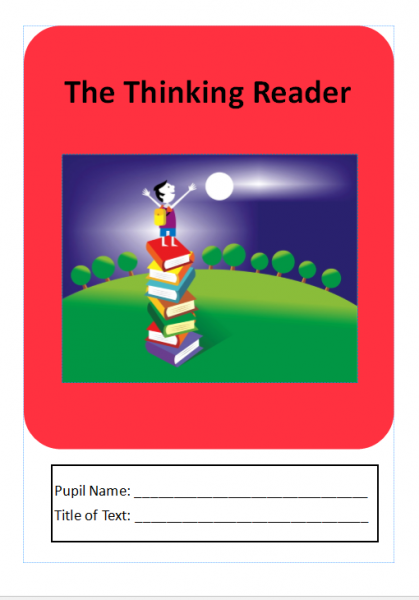
  5. The Thinking Reader approach
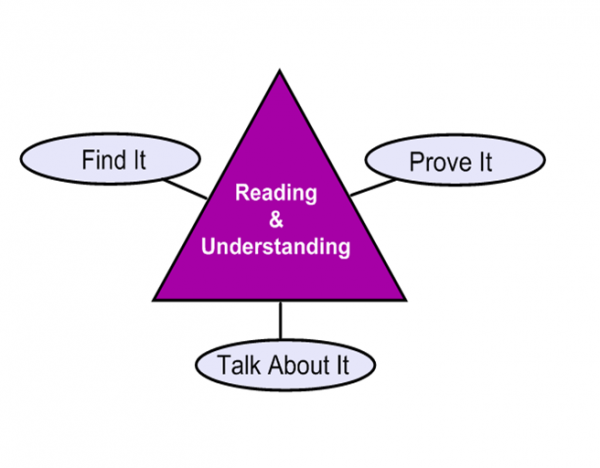
  6. Using Blooms fans and comprehension skills triangles

Sharon demonstrated how Smart Notebook Toolkit 2.0 can be used to create effective learning experiences for spellings and phonics. Colleagues then produced their own Active Literacy games using anagram, keyword, multiple choice, sentence arrange, vortex sort, word biz and word guess.

Sharon then invited colleagues to share examples of good practice and these included:

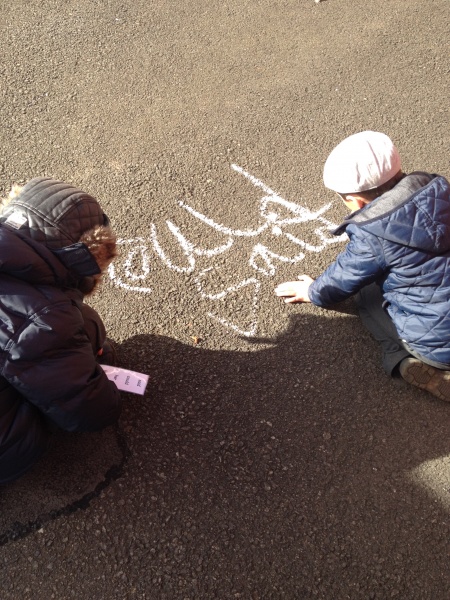
  • Bainsford Primary teachers Emma Cuthbert and Claire Morrison shared some fabulous evidence of literacy using the outdoor environment and also how they have been engaging with parents and consolidating phoneme work. They also recommended the use of online support materials such as Geraldine the Giraffe!
  • Helen McNeill from Whitecross Primary shared some fabulous task cards she has produced to enable her learners to be independent in their Active Literacy activities.
  • Laura Cotton, a probationer from Bo’ness Public has produced her own materials using Toolkit 2.0 and she shared her lesson on the phoneme ‘ee’

Some colleagues were unable to attend, but still shared their good practice and these included:

  • Andrew Watson, DHT from Bonnybridge Primary kindly shared his reading planner for ‘The Wreck of the Zanzibar’
  • Carol from Laurieston shared her Reading toolkit for second level
  • Alison Marshall from Drumbowie shared her reading planner for Carrie’s War

Suggestions for the theme for the next round of network meetings included – more ideas using Toolkit 2.0 and reading. The Daily What and Film Club have offered to attend our network meetings to share what they can do to support schools too.

Get involved in Falkirk’s Town Heritage!

 Yvonne McBlain, Curriculum Support Teacher with Falkirk Council Education Services recently met with Julia Branch, THI Heritage Engagement Officer from Falkirk Community Trust. During this meeting, Julia and Yvonne explored a range of ways in which the Falkirk Townscape Heritage Initiative (THI ) http://glo.li/194nhCZ could contribute to the range of teaching and learning experienced by our pupils. The THI Team has been given permission to start, and are keen to work with interested establishments, practitioners and young people. The THI is grant giving initiative funded by the Heritage Lottery Fund, Historic Scotland & other local partners. The project’s overall aim is to breathe new life into Falkirk’s historic Town Centre by improving the physical appearance of the area and enhancing the things that make Falkirk special and unique. This will include repairing and conserving important historic buildings, restoring traditional shop frontages, and improving the public realm.  Alongside the physical regeneration work, Julia will be implementing a ‘Community Engagement’ programme, which will bring local history to life, offer the community and schools opportunities to learn about and promote Falkirk’s rich heritage. If you are interested in taking part in this part of the project or want more information please contact Julia via email julia.branch@falkirkcommunitytrust.org or phone 07739328530. Julia has created a really useful Pathfinder pack of classroom resources within Scran which you can access here http://glo.li/194nDtb , and more resources will follow.

The Thinking Reader – Active Literacy

Sharon Wallace, Curriculum Support Officer, Curriculum Support Team has delivered a CPD session to 22 teachers entitled ‘Active Literacy Reading – The Thinking Reader Approach’.

The aims of the session were:

To provide an overview of the thinking reader approach

To provide an overview of the six comprehension strategies in reading

To examine ways forward for the teaching of reading using active approaches.

After examining the benefits of reading, Sharon explained that the thinking reader approach is used to teach children reading strategies to improve their ability to understand what they read. It is an approach which can be applied to a range of ‘texts’.

Sharon demonstrated the thinking reader approach using the text ‘Chinese Cinderella’. Colleagues gained a deeper understanding of this text through the following activities:

  1. Using prior knowledge – what do you already know about Cinderella?
  2. Metalinguistics – colleagues were asked to include the word ‘unwanted’ in a sentence and highlight words/ phrases they like/ don’t understand in an identified paragraph
  3. Visualisers – colleagues were asked to produce a visualiser of the character Naing using the information in the extract
  4. Inference – two questions were posed about the text relating to inference e.g. What is the relationship between Naing and Jun-Ling
  5. Main Ideas – What are the main themes from the text you can gather using the information you have already been given
  6. Summarising – summarise the character of Naing in a tweet

Sharon then explored how the thinking reader approach relates to the key reading skills which are assessed in the context of the Scottish Survey for Literacy and Numeracy.

Sharon then shared how she had previously used the thinking reader approach with the following texts:

P2 – The Daily What article/ Beware of the Bears

P3 – The Wish Cat

P4 – Michael Rosen’s poetry

P5 – Moving Image Education film

P6 – Poetry from the Active Literacy Pack

P7 – Poetry from the Active Literacy Pack

S1 – Chinese Cinderella

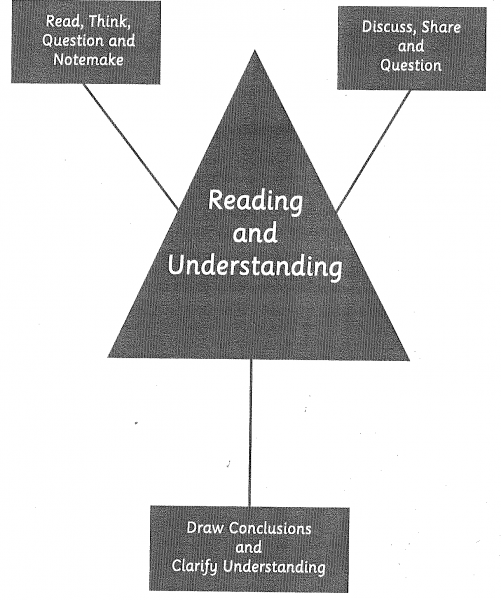
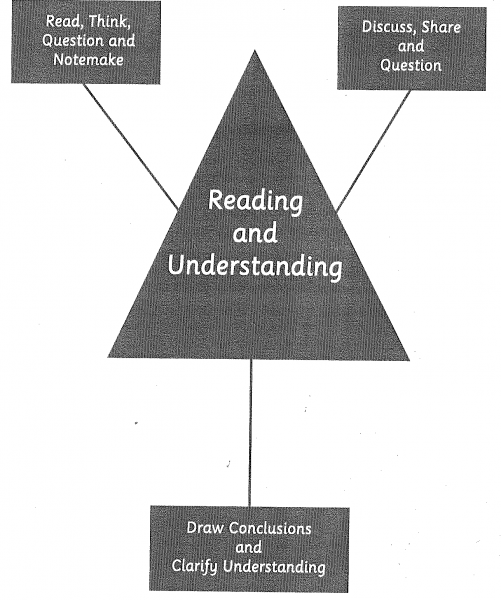
The course also looked at the comprehension triangles from the Active Literacy programme:

Sharon then examined ways to use effective questioning in reading lessons, examining the role of Blooms fans and how these can be used at different ages and stages.

The course was well received and feedback included:

“I wanted to thank you for the CPD last night. It’s really helped me work out a plan of action for all of my reading groups and not just the group that weren’t ‘getting’ the Bloom’s Fans work. It was good to have input on the key comprehension strategies and I’m going to start as of Monday”.

“I really enjoyed the course last night and I think (or hope!) that I am starting to understand the type  of questions and activities that the pupils should be completing”.

This course will be re-run on Tuesday 11th March from 4 til 5.30pm for any colleagues who didn’t get an opportunity to attend this one.


Active Numeracy

Sharon Wallace, Curriculum Support Officer, Curriculum Support Team for Falkirk Council has delivered a lecture to 91 second and third year ITE students at Stirling University entitled ‘Active Approaches to Numeracy’.

The aim of the session was to provide an overview of how Falkirk establishments are using active methodologies to increase attainment in mental mathematics.

Sharon explained that numeracy is a skill for life, learning and work. It is not just a subset of mathematics, it is also a life skill which permeates and supports all areas of learning. (Maths and Numeracy Principles and Practices paper).

Sharon asked the students to make a list of all the numbers they had encountered on their way to Stirling Uni that morning and the students surprised themselves at how many numbers there are in society. Answers included: car number plates, alarm clocks, measures on their breakfast cereal/ milk, house numbers, cash line etc.

After giving the ITE students a short mental maths ‘quiz’, Sharon encouraged the students to share the strategies they used to calculate the answers. One question was ‘If a loaf of bread is £1.19, how much would four loaves cost?’ There were a range of strategies used and discussed.

Sharon then shared the ‘Every day’s a learning day’ numeracy video which is available on Falkirk Council’s you tube channel.

The session went on to look at ways in which pupils can benefit from more active approaches to numeracy with examples.

Sharon also provided the students with examples of how asking effective questions can gain a deeper understanding of mathematical concepts.

The students had to devise their own numeracy problems for a class they are currently supporting using just the answer as a starting point. There were a wide variety of questions devised which stimulated lots of thought and discussions.

Sharon then went onto ask the students to consider how they can create effective maths environments looking at inside and outside spaces.

The final part of the course looked at a variety of different numeracy websites available to enhance and increase knowledge and understanding of mental maths.