Author: Professional Learning

Seasons for Growth

Venue – Business Suite, Council Headquarters

What does it do?

Seasons for Growth aims to strengthen the social and emotional wellbeing of children and young people (aged 6-18) who are dealing with significant life changes by:

  • Exploring the impact of the change and loss on everyday life
  • Learning new ways to respond to these changes


Who is it for?
Anyone who is living with the effects of change and loss. Many factors can cause change such as:

  • Friends can come and go
  • Loss of someone or something you love
  • Parents and families separate
  • Moving to a new place
  • Impact of illness
  • Family work-life changes

Change affects everyone differently, as does grief. It’s the impact of the change, not the event itself that Seasons for Growth focuses on.

Please book via Business World

Teacher Time

The Pre-School Home Visiting Teacher (PSHVT) Service would like to offer mainstream Primary 1 teachers a series of 3 online workshops on TEAMS. These are aimed at supporting children who are currently on our PSHVT caseloads who will be transitioning to Primary 1 after the summer. These workshops will introduce a strategy called ‘Teacher Time’.


This course aims to support teachers with:

Building relationships with pupil(s)

Building confidence

Planning of learning activities

Tracking/monitoring of pupil progress

Enhancing relationships/communication with pupil’s parents/carers

Promote relationships with support staff

Networking with other Primary 1 teachers to share ideas

Providing opportunities to ask questions and engage in professional dialogue


Target Audience – Primary 1 Teachers with pupil(s) on PSHVT caseloads


Dates:

2 June 2026, 3:30 – 5pm

16 June 2026, 3:30-5pm

22 September 2026, 3:30 – 5pm


Places can be booked through Business World.

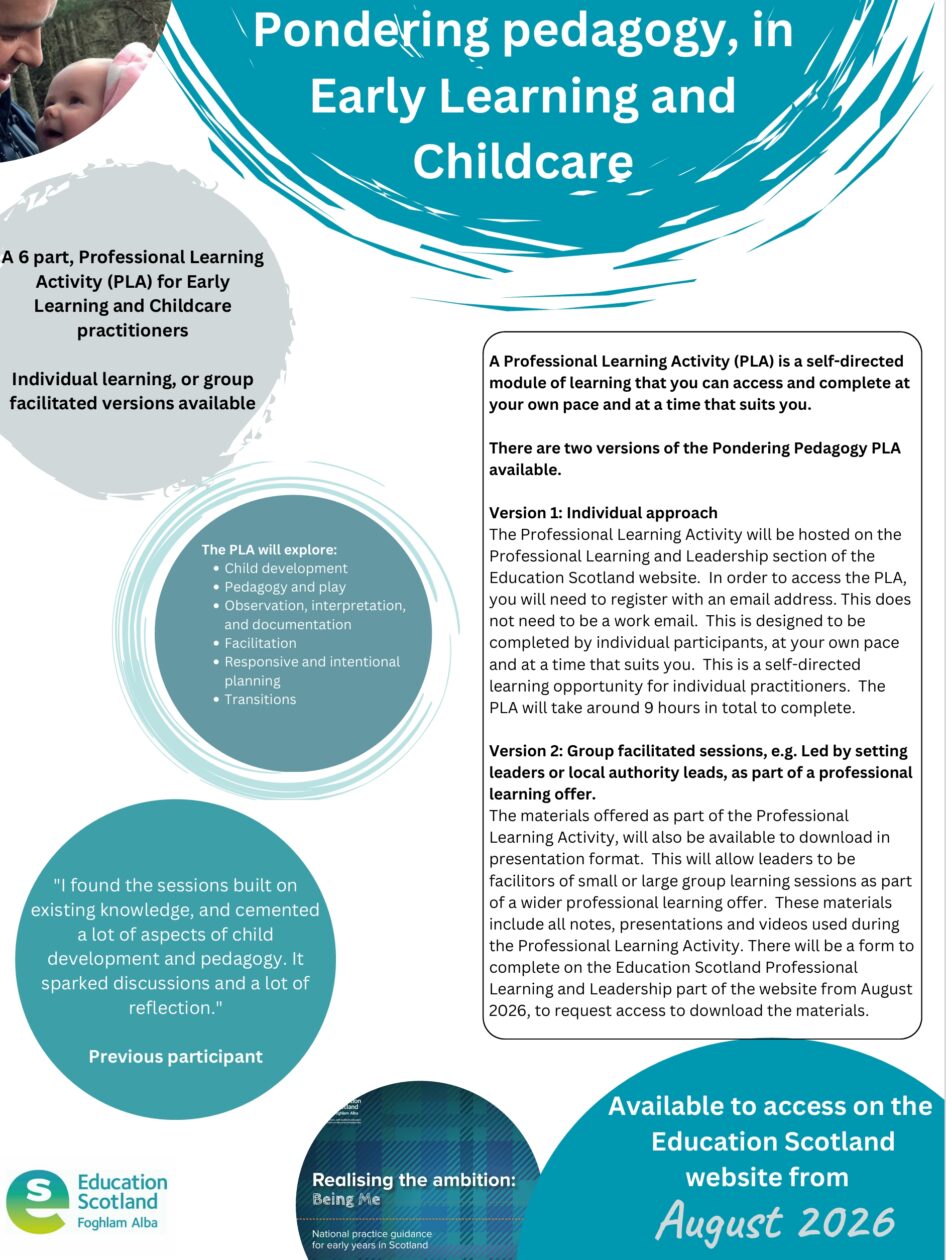
Pondering Pedagogy, in Early Learning and Childcare

A 6 part, Professional Learning Activity (PLA) for Early Learning and Childcare practitioners

Individual learning, or group facilitated versions available

Let’s explore

The PLA will explore:

  • Child development
  • Pedagogy and play
  • Observation, interpretation, and documentation
  • Facilitation
  • Responsive and intentional planning
  • Transitions

Quote from previous participant. “I found the sessions built on existing knowledge, and cemented a lot of aspects of child development and pedagogy. It sparked discussions and a lot of reflection.”

A Professional Learning Activity (PLA) is a self-directed module of learning that you can access and complete at your own pace and at a time that suits you.

There are two versions of the Pondering Pedagogy PLA available.

Version 1: Individual approach

The Professional Learning Activity will be hosted on the Professional Learning and Leadership section of the Education Scotland website. In order to access the PLA, you will need to register with an email address. This does not need to be a work email. This is designed to be completed by individual participants, at your own pace and at a time that suits you. This is a self-directed learning opportunity for individual practitioners. The PLA will take around 9 hours to complete in total.

Version 2: Group facilitated sessions, e.g. Led by setting leaders or local authority leads, as part of a professional learning offer.

The materials offered as part of the Professional Learning Activity, will also be available to download in presentation format. This will allow leaders to be facilitators of small or large group learning sessions as part of a wider professional learning offer. These materials include all notes, presentations and videos used during the Professional Learning Activity. There will be a form to complete on the Education Scotland Professional Learning and Leadership part of the website from August 2026, to request access to download the materials.

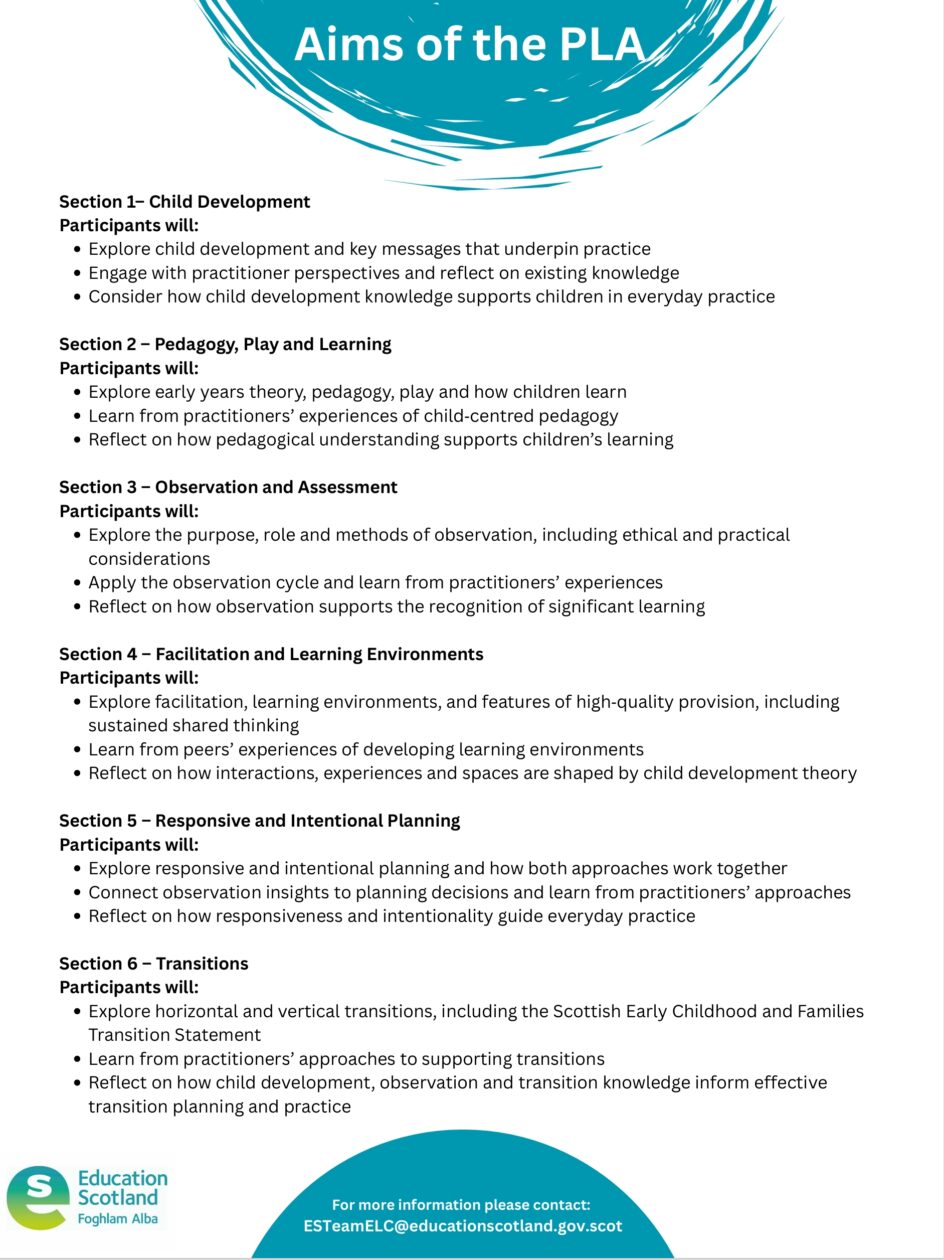
Aims of the PLA

Section 1– Child Development
Participants will:

  • Explore child development and key messages that underpin practice
  • Engage with practitioner perspectives and reflect on existing knowledge
  • Consider how child development knowledge supports children in everyday practice

Section 2 – Pedagogy, Play and Learning
Participants will:

  • Explore early years theory, pedagogy, play and how children learn
  • Learn from practitioners’ experiences of child‑centred pedagogy
  • Reflect on how pedagogical understanding supports children’s learning

Section 3 – Observation and Assessment
Participants will:

  • Explore the purpose, role and methods of observation, including ethical and practical considerations
  • Apply the observation cycle and learn from practitioners’ experiences
  • Reflect on how observation supports the recognition of significant learning

Section 4 – Facilitation and Learning Environments
Participants will:

  • Explore facilitation, learning environments, and features of high‑quality provision, including sustained shared thinking
  • Learn from peers’ experiences of developing learning environments
  • Reflect on how interactions, experiences and spaces are shaped by child development theory

Section 5 – Responsive and Intentional Planning
Participants will:

  • Explore responsive and intentional planning and how both approaches work together
  • Connect observation insights to planning decisions and learn from practitioners’ approaches
  • Reflect on how responsiveness and intentionality guide everyday practice

Section 6 – Transitions
Participants will:

  • Explore horizontal and vertical transitions, including the Scottish Early Childhood and Families Transition Statement
  • Learn from other practitioners’ approaches to supporting transitions
  • Reflect on how child development, observation and transition knowledge inform effective transition planning and practice

For more information please contact:

ESTeamELC@educationscotland.gov.scot

SSC Webinar with Learning through Landscapes: Making Outdoor Learning and Play Inclusive: Wednesday, 17th June 2026: 4-5pm

Making Outdoor Learning and Play Inclusive

Date: Wednesday, 17th June 2026

Time: 4pm – 5pm

Platform: Teams

Cost: Free (Registration required)


Learning through Landscapes (LtL) is the UK’s leading outdoor learning and play charity. Join Jane Mackenzie (Early Years Lead, Scotland) and Niki Cooke (Training and Development Officer) as they explain how to make outdoor inclusive play work!


They will outline the benefits of being outdoors in nature for learning and some of the climate and sustainability work the charity undertakes in partnership with schools. Of particular interest to the SSC audience will be Nicola’s role in the development of outdoor sensory circuits.


Jane is the Early Years Lead in Scotland for LtL, and delivers training, advice and guidance to support colleagues working at the Early Level to build confidence in their approaches to outdoor learning and play and to best support their children’s connection to nature. She coordinates the Forest Kindergarten and Nurturing Nature projects and has a keen understanding of both the benefits and challenges of getting outdoors with children and young people.


Niki is a Training and Development Officer for LtL. She is a qualified teacher who has worked in education for many years, championing time spent outdoors as an essential part of a child’s education experience. She brings a wealth of knowledge of working with children with additional support needs and a deep understanding of how to connect children to the natural world in meaningful and achievable ways.


This webinar will be suitable for Early Years teachers, Primary teachers, Secondary teachers, Teachers of Outdoor Learning, Complex Needs teachers, Specialist teachers and support staff.


More information and register for this session


Sheila Mackenzie, Scottish Sensory Centre

Emotional Literacy Support Assistant (ELSA) Training

Strengthening the Universal Plus Level supports for pupil resilience and wellbeing in mainstream schools is a key priority within education in the Scottish Borders, in response to nationally increasing need. As part of this, the Educational Psychology Service is pleased to be able to offer training and coaching in the Emotional Literacy Support Assistant training programme for 2 Pupil Support Assistants/Additional Needs Assistants in each SBC High School, and 3 in our largest High Schools, from August 2026.

What is the ELSA programme?

ELSA is an evidence-based initiative developed and supported by Educational Psychologists, who apply their professional knowledge of children’s social and emotional development to areas of need experienced by students. Educational Psychologists deliver training to ELSAs in evidence-based interventions and provide on-going professional supervision to help maintain high quality in the work undertaken by ELSAs, thereby helping to ensure safe practice for ELSAs and pupils.

Candidates put forward for this training must be agreed and supported by the school.

What is an ELSA?

An ELSA is a trained PSA who plans, monitors and delivers short-term, evidence-based interventions that are bespoke and focused on individual pupil needs relating to social, emotional and mental health.  It is an early-intervention approach where ELSAs can help with areas such as self-esteem, emotional literacy, managing strong feelings, social skills, relationships, and loss.  A full time ELSA PSA typically spends about 5 hours a week doing ELSA work.

What training and support will they get?

ELSAs should already have appropriate ‘soft skills’ in relation to being approachable, able to build relationships with children and young people, and being creative in planning sessions to meet individual needs.

The training will consist of 6 in person full days across the academic year. ELSAs will need to attend every session from 9:30am – 3:30pm.  LOCATION TBC: (central e.g. HQ)

  • Day 1 – Tuesday 18th August 2026 (In-service)
  • Day 2 – Monday 19th October 2026 (In-service)
  • Day 3 – Tuesday 24th November 2026
  • Day 4 – Monday 15th February 2027 (In-service)
  • Day 5 – Tuesday 4th May 2027 (In-service)
  • Day 6 – Monday 7th June 2027


Following the 6 days of training, ELSAs will receive 6 x 2 hr supervision sessions each year. This will be one session per half term. ELSAs will also need to participate in an SBC evaluation of the programme.

Training content is likely to include the following areas:

  • Facilitation skills for active listening and reflective conversations
  • Emotional Awareness and Emotional Regulation
  • Self-Esteem
  • Social and Friendship Skills
  • Planning and Delivering Intervention Sessions
  • Setting SMART Targets and Evaluating Sessions

A line manager (e.g., senior manager) should be designated to support ELSAs in the setting, ensuring a manageable workload and helping other staff to understand the parameters of the role, including realistic expectations regarding outcomes for children and young people.  They will also support the referral process to the ELSAs and practicalities of arranging appointments.  We would expect ELSAs to be given ring fenced time to start practising learnt skills with a young person from training Day 4 onwards.


School Name: PSA Name: Email: Confirmation can attend all days*
PSA Line Manager
PSA 1
PSA 2
PSA 3 (Peebles High School and Galashiels Academy only)

*PSA Line Manager only required to attend the afternoon of Day 3


Please return by 1st June 2026 to Michelle Bradley (Michelle.Bradley@scotborders.gov.uk)


Upcoming Ed Scot Offers

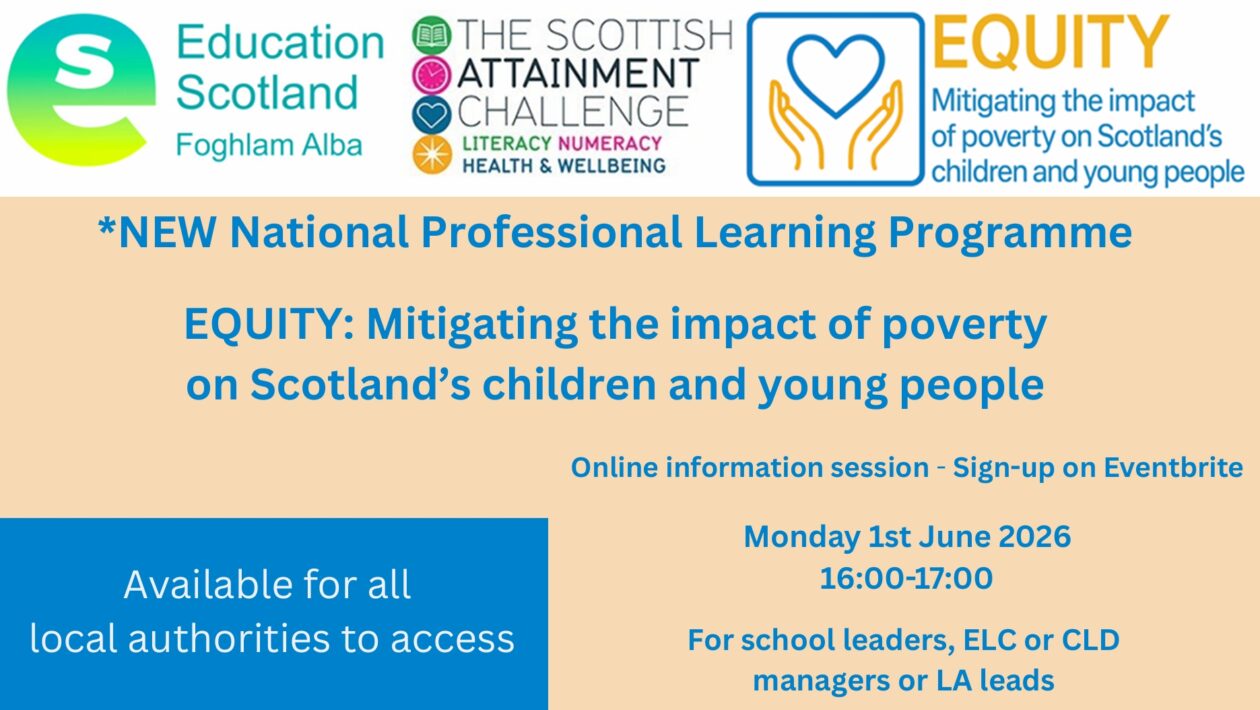
Equity

The second online information session regarding the national Equity: Mitigating the impact of poverty on Scotland’s children and young people professional learning programme, will be taking place on Monday 1st June. This session is for school leaders, ELC or CLD managers or LA leads.


Further information/sign-up link included in the flyer attached.  National Comms will follow after the pre-election period.


Attendance – 19th May – A new report ‘Improving Attendance in Scotland: 2024-2026: Evidence, Impact and Actions for Consideration’ will publish on 18th March 2026. This session will share the key messages, what attendance data over the last two year tells us and practice which is having a positive impact to improve attendance.


https://www.eventbrite.co.uk/e/improving-attendance-in-scotland-tickets-1988484537781?aff=oddtdtcreator


10th June

This session builds on the previous webinar on 19th May which provided an overview of the key messages from the Education Scotland report ‘Improving Attendance in Scotland: 2024-2026 – Evidence, Impact and Actions for Consideration’. This session will further explore the key findings from the report through sharing effective practice from schools. Examples will be shared from a primary and a secondary school.


https://www.eventbrite.co.uk/e/improving-attendance-in-scotland-2024-2026-effective-practice-in-schools-tickets-1988486756417?aff=oddtdtcreator


P1 Play Pedagogy

The events team has brought to our attention that some local authorities have not been receiving the registration information for the leading play pedagogy in primary one resource. We have had lots of emails from people who did not receive the first or second email attempt to pass it on.

We have now put everything in to a padlet and this has been sent out and we think that most LAs are receiving this now.


I thought I would send on to you all so you have it as a simple padlet link. We have also extended the sign up to the 13th May as a result of the email problems.


There are currently over 100 schools signed up so far which is fantastic but I think there will be others who just may not have the information they need to do so due to their LA email blocks.


Play Pedagogy in P1 – Information Session Padlet


PIRLS 2026

Dear Colleagues,


I am writing to let you know of a new Education Scotland web page developed to support those primary schools participating in the Progress in International Reading Literacy Study (PIRLS) 2026.


The web page brings together key information and guidance to help the sample of schools involved prepare for the study, which is due to take place between 6 May and 19 June.


The resource includes:

  • A class lesson aimed at introducing the purpose of PIRLS to P5 learners.
  • Practical guidance and information for schools, learners and their parents/carers.
  • Exemplar video demonstrations of reading passages and assessment questions from the IEA.
  • Information on the four questionnaires designed to gather insights into reading in Scotland.
  • Support and information from Pearson UK, the National Research Centre charged by the Scottish Government to deliver the assessment.
  • Short information films for learners, parents/carers and schools.


The web page can be accessed here: https://education.gov.scot/resources/progress-in-international-reading-literacy-study-pirls-2026/

Equity: Mitigating the impact of poverty on Scotland’s children and young people

This information session, to be held online on Monday 1st June 2026 at 4.00 to 5.00pm, will provide information to potential facilitators about the new national professional learning programme: ‘Equity: Mitigating the impact of poverty on Scotland’s children and young people’.

The programme has been developed by Education Scotland and The City of Edinburgh Council, along with a range of other key partners, including four pilot local authorities.

Potential facilitators are school leaders, ELC or CLD managers or Local Authority leads. All the resources required to lead the programme will be provided by Education Scotland, including online resources for participants and facilitator slides and notes. The programme uses a flexible, hybrid model, with both individual and group learning elements, where the group learning can be online or in person. It can be delivered at establishment, team, cluster, or local authority level.

Register for this information session if you would like to find out more about delivering the programme with your team, cluster or local authority (or wish to share or delegate this task). The programme is suitable for delivery with ELC and CLD participants, as well as those working in schools. Please note this session repeats the one held on 18/3/26.

The learning outcomes of the programme are:

  • To know and understand the theory, data and evidence base around poverty both locally and across Scotland
  • To know and understand the impact of poverty on learning, achievement and attainment both locally and nationally
  • To reflect on and critically examine personal leadership attitudes, values and beliefs within a social justice and equity context
  • To know and understand the practice and approaches that can improve outcomes for children and young people impacted by poverty
  • To develop and apply knowledge and skills to effectively plan for equity and ensure measurable impact.

Coaching in Education – self-directed learning

Coaching in Education is an open access resource designed to support all educators to learn about the far-reaching benefits of coaching which can have a significant impact on how we learn and develop within Scottish education.

This resource is designed to support those working in education to:

  • build an understanding of coaching in education and how it can benefit our workforce
  • build skills in using a coaching approach across different contexts
  • develop an understanding of how a coaching approach can be applied in education.

These self-directed professional learning activities (PLAs) are designed to support you to use a coaching approach and to learn and develop your coaching practice.

1. Introduction to Coaching in Education

This resource will introduce you to the practice of coaching in education and will support you to reflect on how coaching has the potential to impact you in your role.

2. Coaching Skills: Building the Coaching Relationship

Explore how to build effective and supportive coaching relationships through developing key coaching skills such as contracting, listening, and questioning.

3. Coaching Models and Tools

Explore tools and techniques to support you to use a coaching approach in your education setting.

A key feature of these professional learning activities is reflective learning and applying learning to practice. We have developed a reflective journal to accompany these self-directed professional learning activities that you may find helpful.

There are also versions of these modules which have facilitator notes for leading sessions with colleagues: Facilitating professional learning on coaching | Coaching in Education | Self-directed professional learning | Professional Learning | Education Scotland

Coaching in Education – Reflective Journal

Before accessing the PLAs, you may wish to check out our guide to creating an account on our website.

We have designed this Reflective Journal (Word) to be used with the Coaching in Education self-directed learning activities.  It is intended as an optional support and is not for submission.

Please note there are corresponding workshops on these topics that can be used to facilitate professional learning in your setting.

Leadership Academy Offers 26-27

Leadership Academy 2026-27

Are you interested in leadership professional learning for next session? 

 Please use this form to apply – Leadership Academy Application Form  – Fill in form. Please note that HT/Line Manager endorsement is required.

Have a look at the opportunities which will be available through the SBC Leadership Academy:

Aspiring to Middle Leadership (Education Scotland Programme facilitated by SBC

The AML programme is accessed online with additional facilitated sessions with SBC  

Leading their own learning, participants will: 

  • increase their knowledge of recent and emerging research around the roles of middle leadership 
  • enquire into their own strengths and areas for development as an aspiring or new middle leader 
  • increase their knowledge and understanding of the roles of middle leadership and the skills and abilities required to carry out key aspects of these roles 
  • increase their knowledge and understanding of an aspect of wellbeing, inclusion, equity or equalities, with a view to leading a change in this area. 

The programme starts with four short introductory activities including a self-evaluation activity (‘self-evaluation wheel’) which you can complete through your Reflective Journal. This will act as both a planning tool and a record, with spaces for reflections on your learning. Your Reflective Journal is just for you. If you wish to receive a certificate when you complete the programme, you will need to submit a Learning Summary. 

Programme Induction – Friday 25th September – Inspire Learning, Tweedbank 

Touchpoint Session – Friday 6th November – Inclusion, Wellbeing & Equalities – Doug Crabbe, Targeted Pupil Support Team 

Touchpoint Session – Friday 26th February – Middle Leadership in SBC – How to put your learning into practice  

Applying Your Learning – individual practice in school/setting  

Sharing Event – May 2027 

The introductory session will take you through the programme content, share the research that underpins the programme, and support you to start the process of planning your learning pathway, using the self-evaluation wheel to enquire into and identify your areas of strength and interest and areas for development. We will also explore how we will work as an SBC cohort and access SBC specific leadership support. 

You will then undertake individual, self-directed learning, using online self-directed Professional Learning Activities (PLAs), based on your completed self-evaluation wheel. 

A set of eight PLAs, each exploring one of the Roles of Middle Leadership identified in the research, is available. You should select two as a minimum. You can expect to spend 2-3 hours on each PLA. 

You should then select at least two PLAs from a list based on the Inclusion, Wellbeing and Equalities themes. You should base your selections on areas of interest, identified learning needs, school or setting improvement plans or an area you are leading on or are likely to lead on in the future. You might also consider any recent professional dialogue with your school leadership or manager, e.g., as part of your Professional Review and Development (PRD), and /or your professional standards, competences or code, e.g., the General Teaching Council (Scotland) (GTCS) Standard for Middle Leadership or the CLD Competent Practitioner Framework. 

Remember the importance of applying and integrating what you have learned online into your practice, or the practice of your wider setting. This is why we suggest 8-12 months for programme completion. This timeframe takes in completion of a minimum of four PLAs, time to apply your learning, and to identify any actual or potential impact on you, your learners or your colleagues. 

Middle Leaders Leading Change (Education Scotland – facilitated by Scottish Borders Council) 

This programme is suitable for current Middle Leaders. 

This programme is structured around four pillars: 

  • Self-awareness: develop awareness of individual areas of strength / development needs and how this awareness can inform improvements to leadership 
  • Anti-racism:  develop an understanding of identity, privilege and power and how to actively encourage and celebrate diversity 
  • Leadership of change: develop knowledge, understanding and confidence in the use of different models to lead and scaffold change 
  • Coaching as a model of practice: enhance awareness and knowledge of coaching approaches for leadership and increase confidence in practising these. 

These themes are explored using self-directed professional learning activities (PLAs). There are six discrete PLAs that can be completed in any order to best suit participant needs. This allows participants to dip in and out of different areas of learning during the programme. 

MLLC offers opportunities for exploring research and reflecting on each of the four pillars. The learning has been carefully chosen to allow you to draw conclusions that will better equip you in your role of leading change. Although there is no set timeline, as a rough guide each of the PLAs can take between two and four hours with options for further reading. Past participants have tried to set aside time each month during term time to complete one of these PLAs. 

Once you have completed the PLAs, you are then encouraged to apply your learning as part of the programme.   

This is a flexible online programme consisting of five core self-directed professional learning activities (PLAs) and one optional. To complete the programme, you will undertake all 6 PLAs and submit a template related to your learning from the programme. 

  • Self-awareness for middle leaders 
  • Understanding middle leadership 
  • Change Models 
  • Using data to lead change 
  • Engaging others in change  

Choice of: 

  • Curriculum/CIC 
  • Anti-Racism 
  • Coaching  

Key Dates

Programme Induction – Friday 1st October – Inspire Learning, Tweedbank please note change of date

Touchpoint Session – Friday 30th October 2026

Touchpoint Session – Friday 29th January 2027

Applying Your Learning – individual practice in school/setting  

Sharing Event – May 2027


Senior Leadership Pathway (Scottish Borders Council) 

This programme is aimed at those in any post/level who aspire to Headship 

The programme takes a full academic year to complete 

Phase 1 – Values Based Leadership (Columba 1400) – January – April  

Phase 2 – Leading an Inclusive School – May – July  

Phase 3 – Evidence Based Strategic Leadership – August – October  

Phase 4 – Project Based Learning – October – Dec