A 6 part, Professional Learning Activity (PLA) for Early Learning and Childcare practitioners
Individual learning, or group facilitated versions available
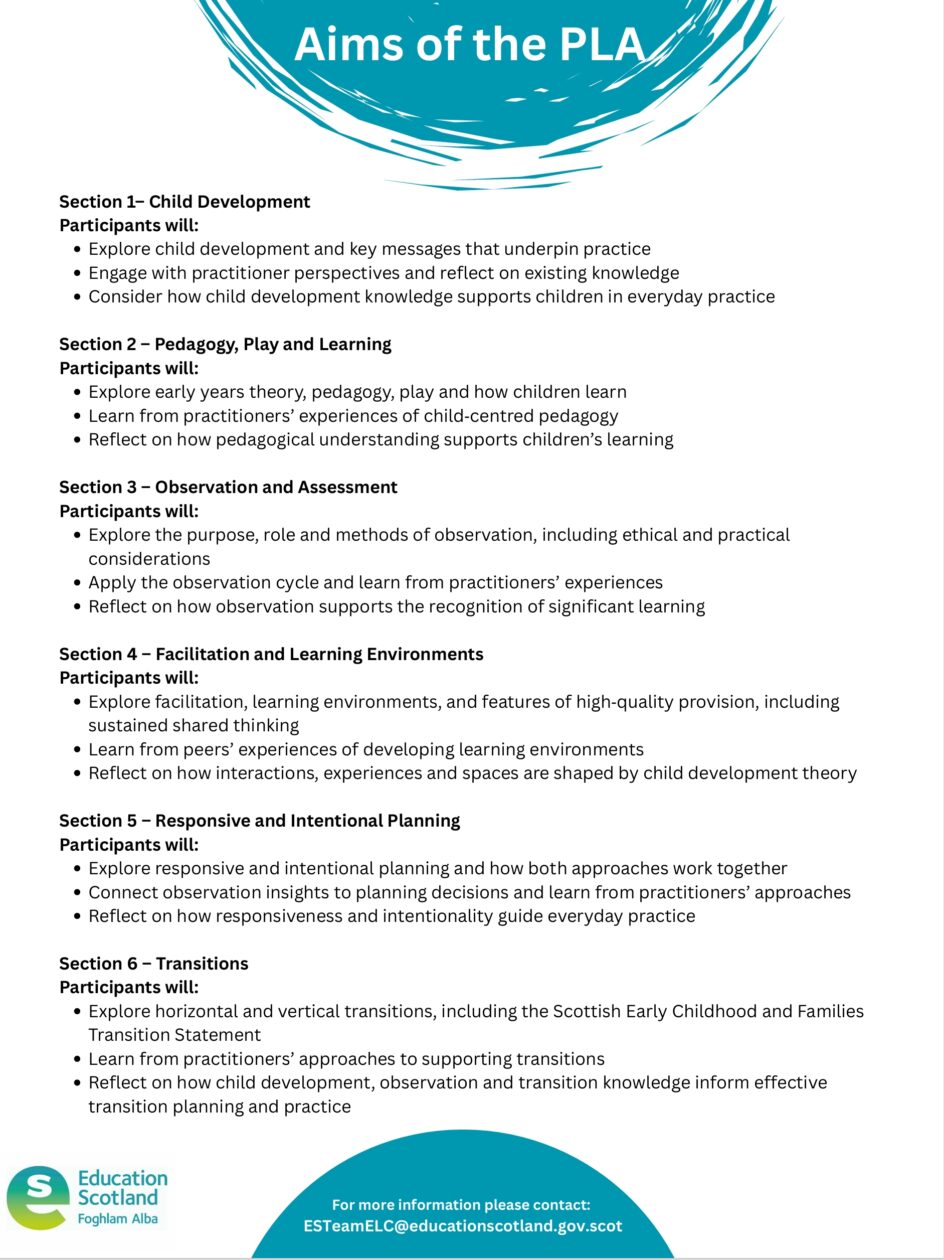
Let’s explore
The PLA will explore:
- Child development
- Pedagogy and play
- Observation, interpretation, and documentation
- Facilitation
- Responsive and intentional planning
- Transitions
Quote from previous participant. “I found the sessions built on existing knowledge, and cemented a lot of aspects of child development and pedagogy. It sparked discussions and a lot of reflection.”
A Professional Learning Activity (PLA) is a self-directed module of learning that you can access and complete at your own pace and at a time that suits you.
There are two versions of the Pondering Pedagogy PLA available.
Version 1: Individual approach
The Professional Learning Activity will be hosted on the Professional Learning and Leadership section of the Education Scotland website. In order to access the PLA, you will need to register with an email address. This does not need to be a work email. This is designed to be completed by individual participants, at your own pace and at a time that suits you. This is a self-directed learning opportunity for individual practitioners. The PLA will take around 9 hours to complete in total.
Version 2: Group facilitated sessions, e.g. Led by setting leaders or local authority leads, as part of a professional learning offer.
The materials offered as part of the Professional Learning Activity, will also be available to download in presentation format. This will allow leaders to be facilitators of small or large group learning sessions as part of a wider professional learning offer. These materials include all notes, presentations and videos used during the Professional Learning Activity. There will be a form to complete on the Education Scotland Professional Learning and Leadership part of the website from August 2026, to request access to download the materials.
Aims of the PLA
Section 1– Child Development
Participants will:
- Explore child development and key messages that underpin practice
- Engage with practitioner perspectives and reflect on existing knowledge
- Consider how child development knowledge supports children in everyday practice
Section 2 – Pedagogy, Play and Learning
Participants will:
- Explore early years theory, pedagogy, play and how children learn
- Learn from practitioners’ experiences of child‑centred pedagogy
- Reflect on how pedagogical understanding supports children’s learning
Section 3 – Observation and Assessment
Participants will:
- Explore the purpose, role and methods of observation, including ethical and practical considerations
- Apply the observation cycle and learn from practitioners’ experiences
- Reflect on how observation supports the recognition of significant learning
Section 4 – Facilitation and Learning Environments
Participants will:
- Explore facilitation, learning environments, and features of high‑quality provision, including sustained shared thinking
- Learn from peers’ experiences of developing learning environments
- Reflect on how interactions, experiences and spaces are shaped by child development theory
Section 5 – Responsive and Intentional Planning
Participants will:
- Explore responsive and intentional planning and how both approaches work together
- Connect observation insights to planning decisions and learn from practitioners’ approaches
- Reflect on how responsiveness and intentionality guide everyday practice
Section 6 – Transitions
Participants will:
- Explore horizontal and vertical transitions, including the Scottish Early Childhood and Families Transition Statement
- Learn from other practitioners’ approaches to supporting transitions
- Reflect on how child development, observation and transition knowledge inform effective transition planning and practice
For more information please contact:
ESTeamELC@educationscotland.gov.scot