Year: 2014

The Global Storylines are happening now!

Fourteen Falkirk teachers are currently putting their Global Storyline training into practice by delivering their Giant of Thistle Mountain storyline. This training was delivered by colleagues from WOSDEC (get more info at www.globalstoryline.org.uk ), and will run this session and next. Diana Ellis, Marie-Jeanne McNaughton and Lynn Baxendale from WOSDEC, and Yvonne McBlain, curriculum support teacher with Falkirk Education Services, caught up with our teachers on Wednesday 12th February, to find out how the storylines were developing. The teachers shared where they had reached in the storyline plan, and described the impact it was having on their pupils. Gemma Douglas at Kinnaird is delivering her storyline with her own class, and supporting primary 1 & 2 colleagues so that they can take part in the storyline too – it’s going really well and having very specific impact on the skills of certain pupils. Jenny Deacon at Carron PS is finding that her pupils have “totally embraced” the storyline and are demonstrating very sophisticated levels of thinking (click here to see some of Jenny’s documentation). Angelique Watt, and Emma-Jame Williamson are adapting the storyline for their enhanced provision pupils at Larbert Village PS, who are engaging really well with the characters and progressing their social skills too. Holly Keenan at Bonnybridge PS has used the storyline to develop her primary 2 pupils’ understanding that it is people who make a community. Jennifer Main at Wallacestone PS can already see how her pupils are applying and developing their awareness of rights and responsibilities through the storyline, and Liz Stephen and Laura Beattie are finding that their pupils are better at co-operating while in role during the storyline at Deanburn PS. Click here to see a photo of the “floor book” record which Laura is using to document the project, and note Liz’s class frieze of Thistle Mountain below. Gillian Cain at Comely Park PS found that her pupils are also developing their understanding of communities through the context, and are so enthusiastic about it that they choose to draw Thistle Mountain during golden time.
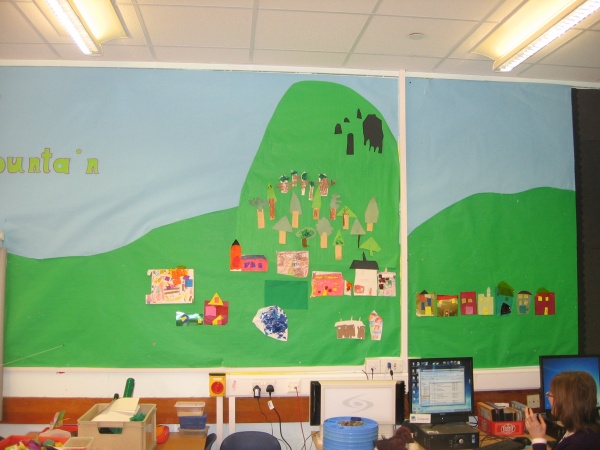
WOSDEC have adapted the Giant of Thistle Mountain for second level pupils, and the teachers involved with this plan were really pleased with the degree of impact already on their pupils. Click here to see some of the extended and creative writing done by primary 5/6/7 composite pupils at Limerigg PS with their teacher Ashley Thomson. Pupils at Limerigg are very engaged in the storyline and are sad that other pupils in the authority are not able to take part – they thought everyone should be doing this topic! Katrina Lucas at Comely Park PS, and Heather Nicol at Carron PS both have pupils who are responding really well to the storyline (see Heather’s class Thistle Mountain frieze at the start of this post), and developing their creative and critical thinking during the drama and other activities. Brenda Bennie at Kinnaird PS and Nicola Kemp at Bantaskin PS have been “blown away” by the improvement in their pupils’ understanding of stereotypes and citizenship in general. Their pupils have really got the message that you “shouldn’t judge things you don’t know about”.

It was evident from these updates from the teachers, that the global storyline is already having a huge impact on Falkirk pupils. Marie-Jeanne, Diana and Lynn were also hugely impressed by the degree of reflection, professional enquiry skills and creativity of the teachers involved. Yvonne has suggested that some teachers may want to share their work at the Global Citizenship Showcase event which will take place at Larbert Village PS on 15th May 2014.
Bantaskin Primary 1 Toys Storyline

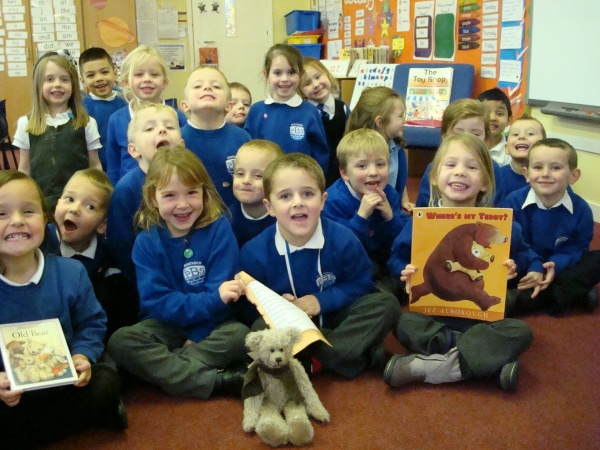
Susan Waddell and Joanne Brown of Bantaskin Primary School used the storyline approach to deliver their recent Toys interdisciplinary learning project. Earlier in the session, Susan had taken part in storyline training delivered by Yvonne McBlain, curriculum support teacher with Falkirk Council Education Services and got in touch to let Yvonne know how her first storyline had gone. Click here to view the storyline plan for this project, which links learning in science, technology and social subjects.

The project ran between October and December 2013 and used letters from a character called the Toymaker to direct the children’s learning towards specific experiences and outcomes. These E & Os are naturally connected to show pupils the overlap between science and technology and let them discover some of the properties of materials through a focus on toys past and present. Click here to see pupils investigating replica toys of the past through the handling boxes provided by Library Support for Schools, and Museum Services at Callendar House.

Click here to see how the pupils identified and sorted toys for different age groups, and here to see an example of one of the letters used by Susan and Joanne from the toymaker. The toymaker also gave the children a homework task – click here to see an example of a home-made puppet, and  here to see a picture of the storyline celebration which the children used as a showcase event to share their learning with their parents and bring their storyline to a close.

Susan and Joanne felt that the storyline approach really engaged and focused their pupils on the learning. Pupils enjoyed their learning and when asked what they had learned, or what they were better at said:

Tylor “I learned about that toys are for big people and people who are five as well…I’m better at learning about toys”

Paul “So we would know what stuff was made of.”

Logan “Test it in the bubble bath for the toymaker…what is soggy and plastic is not soggy….” “He (the toymaker) said to fix the toy cos it was broken and it had batteries.”

Jodi “Toys that have got batteries to make them work… (I got better at) drawing, when we were a baby we scribbled, now we’re better at drawing.”

The storyline helped Susan and Joanne deliver science content about simple forces, the qualities of materials used in making toys through the ages, and supported skill development in working together and fine motor skills. Susan is now considering how to make the storyline more responsive to pupil ideas and input – in other words – how to let pupils control the story while maintaining the line of curriculum content and skill development required.

Kinneil Nursery Class Try Storyline

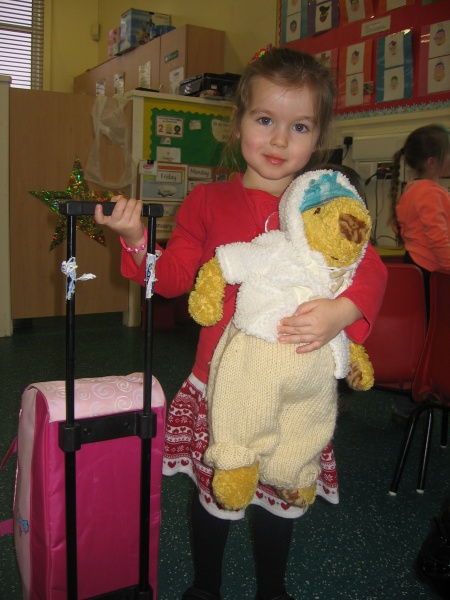
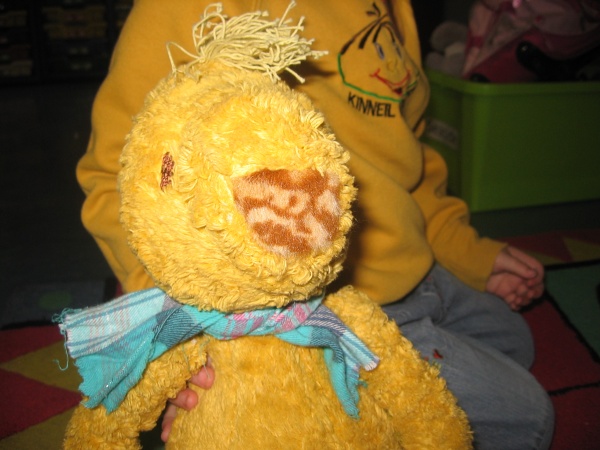
Clare Doherty and the nursery team at Kinneil Primary used the storyline approach during January 2014 to explore aspects of Health and Well-Being, Literacy and Technology. This project began in response to some reading about dinosaurs and their eggs. The children were obviously interested in creatures which came from eggs and the team explored how their storyline might work. Yvonne McBlain provided some advice and a storyline plan based around a dragon’s egg, which Clare and the team adapted for their purposes. The children “discovered” a large egg in the nursery one day – click here to see some of the “egg” research they then did. They couldn’t decide whether their egg needed to be kept warm or cold, so built one nest indoors, and another outdoors just in case. The staff used a series of letters from the “mother” of the egg, to direct the children towards their research and HWB skill and knowledge development. Activities around the nursery were linked to the context throughout and enabled the children to develop small motor skills using a range of materials. When the egg finally hatched, and the children were able to see the creature, they decided he looked like the character from the book they were reading during their Scottish studies. He therefore became Hamish McHaggis and staff were then able to link him effectively to Burns teaching and learning. Clare felt that one of the benefits of the storyline was to make these Hamish books more accessible to the children.

In order to bring the storyline to a satisfactory conclusion for the children, staff delivered a letter from Hamish’s mum explaining that just after Chinese New Year, Hamish had to join her in Hong Kong. Click here to take a look at the children’s mind map of what he would need to pack for the journey. On 31st January, the storyline finished with a celebration where the children waved goodbye to Hamish.  

This storyline engaged most pupils by choice and linked very well into literacy week. Click here and here to see writing by some of the afternoon children who were keen to complete their booklets so Hamish could take them with him on his journey. The storyline provided an interdisciplinary learning context which proved to be very responsive to the children’s interests and to the seasonal learning often delivered at this time of year. It also motivated and engaged the children’s interest really well. Click here to see the storyline plan used by the team.

Bonnybridge Primary 6/7 Debate the Commonwealth

Michelle Cairns and her primary 6/7 pupils at Bonnybridge Primary School have been able to apply their debating, listening and talking skills by taking part in the BBC Commonwealth project. This project also offered some breadth and challenge for pupils because of the issues they had to consider while preparing for their debate. They considered homelessness as an issue in this country and other Commonwealth countries. They had to analyse their thinking  and communicate their ideas using a range of technology including  “Skyping” pupils in other countries. Visit http://glo.li/1fZfGyo  for more detail and to link to the television and radio broadcasts which the children took part in.

British Council offers Chinese New Year Education Pack

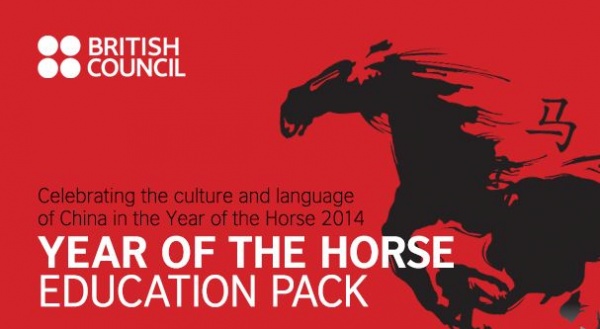
The British Council have produced an education pack for primary schools which supports study of Chinese New Year and the start of the Chinese spring festival on 31st January. 2014 will be the Year of the Horse, and the pack has many useful ideas, lesson plans, links and support materials for discrete and interdisciplinary learning linked to this theme. It includes learning experiences across the curriculum and addresses elements of international education and global citizenship. Click here to download the pack.

What is “Interdisciplinarity”?

Anne Pearson, Acting Head of Service for Falkirk Council Education Services found this interesting video clip (click below to view). Myra Strober of Stanford University shares her interpretation of interdisciplinarity, its current influence and application within education, and how it is best fostered.

[kml_flashembed movie="http://www.youtube.com/v/Yd0QlFBuZxk" width="425" height="344" allowfullscreen="true" fvars="fs=1" /]

What is good interdisciplinary teaching and learning?

The latest national guidance we have on the features of good interdisciplinary learning offers the following list:

  1. Starts with the experiences and outcomes, carefully selected within a few curriculum areas.
  2. Clear success criteria focus the intended learning, within & across the experiences & outcomes.
  3. Connections between disciplines within the IDL are clear & meaningful.
  4. Learning does not become “lost” within the context.
  5. Purpose, benefits & types of IDL are carefully considered & understood by all.
  6. Planning clearly shows where children are applying existing knowledge & understanding.
  7. Children can discuss connections, compare & contrast contributions of different curriculum areas, use & develop higher-order thinking skills
  8. Progression is clear across the different curriculum areas.
  9. A whole-school framework/overview of IDL is developed to ensure progression & coherence.
  10. Assessment is planned as an integral part of learning & teaching, based around the success criteria.
  11. Principles of curriculum design are used to inform teacher’s decisions about organising learning & their evaluations.

These were defined in a presentation by Graeme Logan and Joanne MacLauchlan in December 2012.

St Bernadette’s RC PS Track Coverage of the Experiences and Outcomes

Marianne Savage, principal teacher at St Bernadette’s RC PS has created Microsoft Publisher poster versions of the experiences and outcomes at first and second levels of Curriculum for Excellence. She developed these from the South Ayrshire Early Years Annual overview document below. Marianne has very kindly agreed to share these (now converted into PDF format to ease access – you will need to assemble the pages and enlarge the documents if printing):

Early Level South Ayrshire Annual Overview       First Level 

 Second Level sheet 1                                             Second Level sheet 2

Marianne’s head teacher, Cathy Quinn,  had these printed A2 size by Printworks so that staff throughout the school could highlight the E & Os being addressed by learning and teaching. Staff use colour coding to monitor coverage via this simple tracking system and record the levels of breadth and depth achieved. Click here to visit St Bernadette’s school blog, and contact Marianne or Cathy on 01324 503400 for more information.

Key Features of IDL Good Practice

[kml_flashembed movie="http://www.youtube.com/v/CcdLzAvF5UQ" width="425" height="344" allowfullscreen="true" fvars="fs=1" /] Graeme Logan and Joanne McLauchlan of Education Scotland broadcast a Glow TV session in December 2012 which offers useful guidance on interdisciplinary learning. Although aimed at primary schools, much of the advice is valuable in helping us shape effective planning, teaching and assessment of IDL within our schools. Click on the image at the start of this post to watch a You Tube video presentation summary of this session produced by Yvonne McBlain. Alternatively, click here to link to the National Primary IDL Glow group where you can watch the full recording of this session.  Click this document to see some reflective questions which may help you self-evaluate your practice while you watch these presentations.