Higher – Random Number Array Function

The class was asked to create a function that generated 100 number dice throws and stored them in an array.

This function is used to create an array of random integers. The size of the array and the magnatude of the values is set when the function is called.


def randomNumbers(size,min,max):
    # creates an array of (size) random numbers between min and max
    import random
    numbers=[]
    for loop in range(size):
        numbers.append(random.randint(min,max))
    return numbers

rndNumbers=randomNumbers(100,1,6)

Higher – Substring Operations

pre-defined functions (with parameters):

  • to create substrings

In Python we can treat strings as arrays of characters. We do this by using

string[start:stop:step]

where

  • start is the postion of the first character to be displayed.
  • stop is the postion to stop displaying characters (not displayed).
  • step is the step value, just like a for loop.

Read more

N5 – Input Process Output

Leading on from the work we did last term and this week. We created a program to solve the calorie counter problem.


Analysis

Inputs

  • calories in porridge
  • calories in toast
  • calories in marmalde
  • calories in coffee

Process

  • add all calories and store in total

Output

  • The total number of calories in breakfast

Design

  1. Get the number of calories in porridge
  2. Get the number of calories in of toast
  3. Get the number of calories in of marmalade
  4. Get the number of calories in of coffee
  5. Total = Porridge + toast + marmalade + coffee
  6. Display the total number of calories


Higher – Input Validation (Revision)

We use the standard algorithm input validation to check that the user is entering a value that is expected by the program. In the example below our function is used to check that the entered integer is between a max and min value.


def getValidInt(fMin,fMax):
    print("Please enter a number between",str(fMin), "and",str(fMax))
    number=int(input())
    while number<fMin or number>fMax:
        print("Sorry try again")
        print("Please enter a number between",str(fMin), "and",str(fMax))
        number=int(input())

    return number

def main():
    min=-100
    max=100
    
    number1=getValidInt(min,max)
    number2=getValidInt(1,20)
    print(number1,number2)

main()

The function follows the AREA standard algorithm, that is Ask Repeat Error Ask. so

  1. Ask for valid number
  2. Repeat While number not valid
  3.     Display Error
  4.     Ask for valid number

Too remember this mnemonic easier think Jonathan Ross for step 2, as in Python we would use a While.

The code above makes use of local variables as well as formal and actual parameters. Can you spot them?

Higher – Procedures – Horse Hands

A computer program stores the names, ages and height (the height of horses is measured in ‘hands’ – for example, 16) of fifteen horses in a riding school. The user of the program will be asked to select a horse by entering a maximum age and height of the horse they wish to ride. The data for the fifteen horses will be used to provide the user with a list of suitable. A horse is suitable if its age and height are both less than or equal to the values entered by the user.

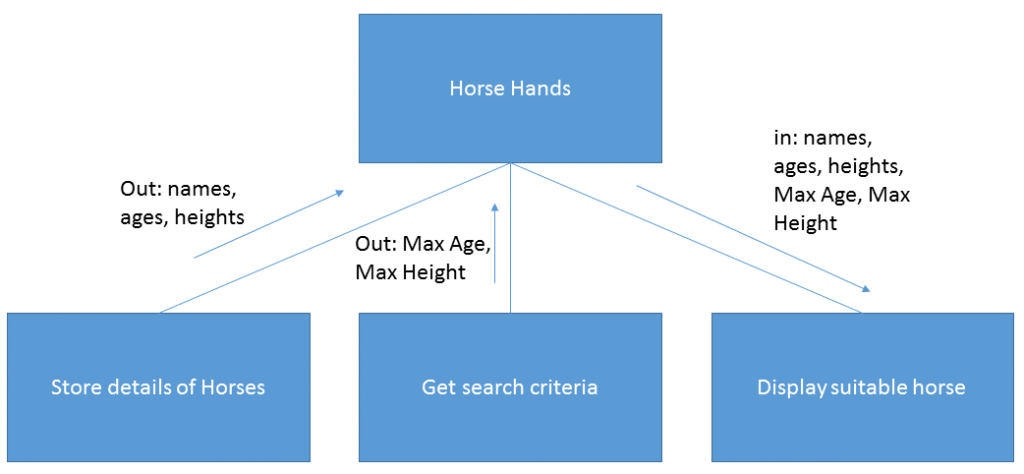
To solve the program above we first of all have to break the program into smaller steps.

  1. A computer program stores the names, ages and height (the height of horses is measured in ‘hands’ – for example, 16) of fifteen horses in a riding school.
  2. The user of the program will be asked to select a horse by entering a maximum age and height of the horse they wish to ride.
  3. The data for the fifteen horses will be used to provide the user with a list of suitable. A horse is suitable if its age and height are both less than or equal to the values entered by the user.

We then have to look at how data is passed inside the program

This allows us to create a program that uses procedures to solve the problem.

def storeHorses():
    names=["Bob","Frank","Sue"]
    ages=[4,5,6]
    heights=[12,13,14]
    return names,ages,heights

def getSearch():
    maxAge=int(input("What is the max age you want to ride > "))
    maxHeight=int(input("What is the max height you want to ride > "))
    return maxAge,maxHeight

def displayHorses(names,ages,heights,maxAge,maxHeight):
    for horse in range(3):
        if ages[horse]<=maxAge and heights[horse]<=maxHeight:
            print(names[horse],ages[horse],heights[horse])

def main():
    #set up up variables
    names=[]
    ages=[]
    heights=[]
    maxAge=0
    maxHeight=0
    
    names,ages,heights=storeHorses()
    maxAge,maxHeight=getSearch()
    displayHorses(names,ages,heights,maxAge,maxHeight)

main()

Higher – Rock Paper Scissors – Solution

So when we implemented the code we got something like this

#Mr Stratton

import random

#set up variables
random.seed
object=["Rock","Paper","Scissors"]
playerChoice=""
computerChoice=""
winner=""

#Get players choice
playerChoice=object[int(input("Rock - 1\nPaper - 2\nScissors - 3\n"))-1]

#Get computer choice
computerChoice=object[random.randint(0,2)]

#get winner
if playerChoice=="Rock":
    if computerChoice=="Paper":
        winner="Computer"
    if computerChoice=="Scissors":
        winner="Player"
    if computerChoice==playerChoice:
        winner="Draw"
        
if playerChoice=="Paper":
    if computerChoice=="Scissors":
        winner="Computer"
    if computerChoice=="Rock":
        winner="Player"
    if computerChoice==playerChoice:
        winner="Draw"
        
if playerChoice=="Scissors":
    if computerChoice=="Rock":
        winner="Computer"
    if computerChoice=="Paper":
        winner="Player"
    if computerChoice==playerChoice:
        winner="Draw"


#display winner
print("\n"*10)
print("Player threw",playerChoice)
print("Computer threw",computerChoice)

if winner=="Player":
    print("Player is the winner")
    
if winner=="Computer":
    print("Computer is the winner")
    
if winner=="Draw":
    print("Its a draw")


However, although it does follow the design from yesterday it isn’t very effcient.
Can you see a way to make it more effient?

#Mr Stratton

import random

#set up variables
object=["Rock","Paper","Scissors"]
playerChoice=""
computerChoice=""
winner="Draw"

#Get players choice
playerChoice=object[int(input("Rock - 1\nPaper - 2\nScissors - 3\n"))-1]

#Get computer choice
computerChoice=object[random.randint(0,2)]

#get winner
if playerChoice=="Rock":
    if computerChoice=="Paper":
        winner="Computer"
    elif computerChoice=="Scissors":
        winner="Player"

        
elif playerChoice=="Paper":
    if computerChoice=="Scissors":
        winner="Computer"
    elif computerChoice=="Rock":
        winner="Player"

        
elif playerChoice=="Scissors":
    if computerChoice=="Rock":
        winner="Computer"
    elif computerChoice=="Paper":
        winner="Player"

        
else:
    print("Error in player choice")
    
#display winner
print("\n"*10)
print("Player threw",playerChoice)
print("Computer threw",computerChoice)
if winner=="Player":
    print("Player is the winner")
elif winner=="Computer":
    print("Computer is the winner")
else:
    print("Its a draw")

Read more