This guide is designed to help you in using digital tools to support pupils with English as an Additional Language.

A free Pages workbook download from Connected Falkirk and DigiLearnFalk, designed to help pupils explore their iPad and some of the core apps including Pages, Notes, Maps and GarageBand.
Go directly to the Box download. Once you have it downloaded to your iPad open it with Pages (you may have to tap Edit in the top right hand corner). You can then share it with students via Airdrop or uploading the file to your Virtual Learning Environment.
Canva for Education is the all-in-one design platform for professional teaching resources and school communications.
Canva for Education is a premium version of Canva that is free for educators. It provides access to millions of stock images, fonts, and professional templates. While it can be used for simple posters, it is also a powerful tool for building interactive presentations, classroom newsletters, and even school websites.
Instant Professionalism: You don’t need design skills to create high-quality work. Thousands of “Education” templates are ready-made for lesson plans, certificates, and worksheets.
Brand Consistency: You can set up a “Brand Kit” for your school, saving your school’s specific colors and logos so every letter or poster you make is perfectly on-brand.
Multimedia Hub: You can embed videos from YouTube, live links to forms, or even record your own screen directly into a Canva presentation.
Collaboration with Colleagues: You can share folders with other staff members. This allows you to co-design a transition project or share a pack of classroom labels across a whole department.
1. Launch: Access via the Canva app on your iPad or through the web browser.
2. Verified Status: For teachers to access the “Education” version for free you need to get verified or added to an existing Canva Education ‘Team’ by an already verified member of your school staff team.
3. Choose a Template: Use the search bar for terms like “P7 Transition,” “Reading Newsletter,” or “Classroom Labels.”

4. Drag and Drop: Use your finger or mouse to move elements around. Add your own photos or choose from Canva’s library of millions of free graphics.
5. Share & Export: Tap the Share button (top right). You can “Download” as a PDF for printing, use ‘public view’ or ’embed’ to create a live viewable version of your design. You can also share custom templates with other uses and download your creations as videos.
Professional Newsletters: Move away from plain Word documents. Use the Newsletter templates to create visual updates for parents. You can even embed “Live Links” that parents can click to open permission forms or school webpages.
Display Packs: Search for “Classroom Decor.” You can instantly create cohesive sets of labels, birthday charts, and learning walls that all share the same color scheme and font.
Instructional Videos: Use the “Present and Record” feature. You can talk through your slides, and Canva will record a small “bubble” of you speaking in the corner. This is perfect for creating “flipped learning” videos or instruction guides for parents.
Canva Sheets: A visual way to track and display data. Use it to create colourful class seating plans or to track (publicly available) data in a way that is far more visual and readable than a standard spreadsheet.
Freeform is an infinite digital canvas for visual brainstorming and project planning.
Freeform is an “infinite whiteboard” app that comes built into the iPad on models running iPad OS 16.2 and above. Unlike a document or a slide deck, there are no page breaks or borders. You can add text, photos, videos, PDFs, web links, and hand-drawn sketches anywhere on the canvas. As you add more content, the board simply expands in every direction.
Total Creative Freedom: Because the canvas is infinite, pupils don’t have to worry about running out of space or fitting their ideas into a specific layout.
Multimedia Hub: You can “drop” almost any file onto a board. This makes it perfect for gathering research, as pupils can keep their notes, photos, and YouTube videos all in one viewable space.
Real-Time Collaboration: Up to 100 people can work on the same board at once. You can see everyone’s cursors moving and see ideas grow in real-time – ideal for whole-class “thought-dumps.”
Built-in Tools: It uses the same familiar Apple markup tools as “Notes,” making it easy for pupils to sketch, annotate images, or highlight text.
Launch: Find the Freeform app icon on your iPad home screen (White icon with a blue/orange squiggle).
Start a Board: Tap the ‘New Board’ icon (square with a pencil) to begin.
Add Content: Use the icons at the top to add Sticky Notes, Shapes, Text Boxes, or Photos/Files.
Zoom and Pan: Use two fingers to pinch and zoom out to see the whole board, or drag to move to a different area of the canvas.
Collaborate: Tap the Share button (box with an arrow) to invite others to edit the board with you via a link. There are two options for sharing, ‘Collaborate’ and ‘Send Copy’. ‘Send Copy’ will send a carbon copy to others which they can then use for themselves (you will not see changes). ‘Collaborate’ allows you to choose between users being able to make changes or view only. When you send using ‘Collaborate’ always use ‘Anyone with the Link’. We recommend that you use the Notes option to share Freeform boards, simply select your collaboration options then hit the Notes icon, this will automatically create a note with the link which you can Airdrop to learners – this method is generally found to be more reliable than directly airdropping from the share panel.
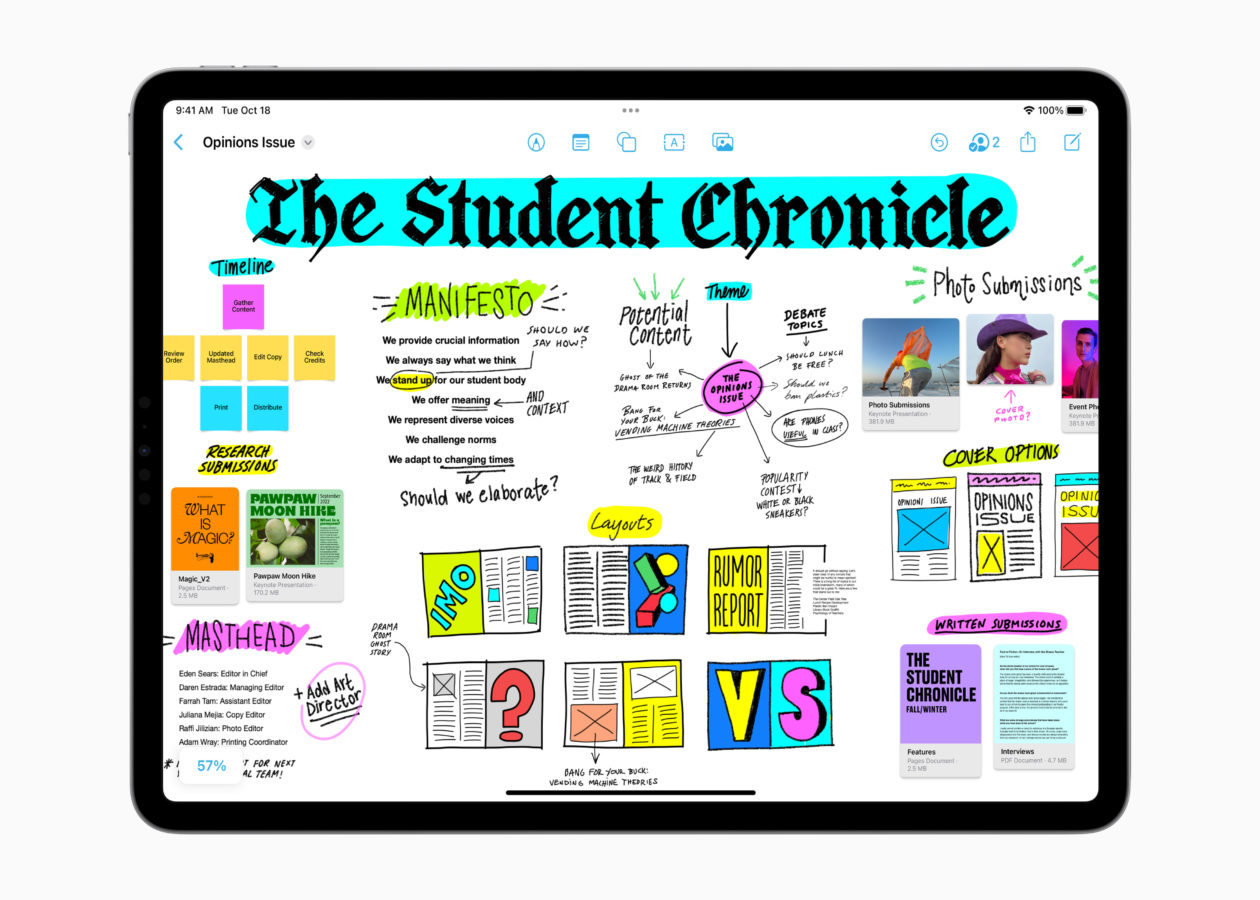
Storyboarding: Use the “Shapes” tool to create comic-strip boxes. Pupils can draw their scenes, add text for dialogue, and even drop in sound recordings of their characters speaking.
Project Planning: Use the infinite space to map out a complex experiment. Pupils can take photos of each stage of their build and “connect” them with arrows to show the process.
Multimedia Revision: Create a revision board on a topic like “The Wars of Independence.” Embed links to BBC Bitesize, drop in PDFs of primary sources, and add sticky notes with key dates.
Mood Boards: Pupils can gather inspiration from the web, crop images directly on the board, and use the markup tools to sketch colour palettes or textures alongside their found images.
Visual Scaffolding: Teachers can create a “Pre-filled Board” with prompts, sentence starters, and images, then share it as a template for pupils to build upon.
Get Started with Freeform on iPad
How to Use Freeform – Apple Support
Jacob’s Quick Tips – A Complete Guide to Freeform

Looking for more tailored support? Take a look at our digital learning support request system.
Here you’ll find everything you need to revisit information from our information session on the Digital Schools Awards Digital Wellbeing Award. If you missed it don’t worry, there is a recording of the session available below or on YouTube.