Quite a few students have been asking for a better explanation of how the Internet works. This sequence of videos takes you through all areas and aspects of the Internet. If you have a Khanacademy account (you do S4) then you can even earn a badge for watching the videos.
It is well worth a watch for National 4,5 & higher and it will now be making up part of our future courses.
So I was reading a programming blog from a few years ago that was asking, why can’t programmers.. program?. The article set a challenge to
Write a program that prints the numbers from 1 to 100. But for multiples of three print “Fizz” instead of the number and for the multiples of five print “Buzz”. For numbers which are multiples of both three and five print “FizzBuzz”.
Now technically the answer to the puzzle uses nothing more than Nat 5 constructs, so can you code a Python solution? Share it here if you get a nice one
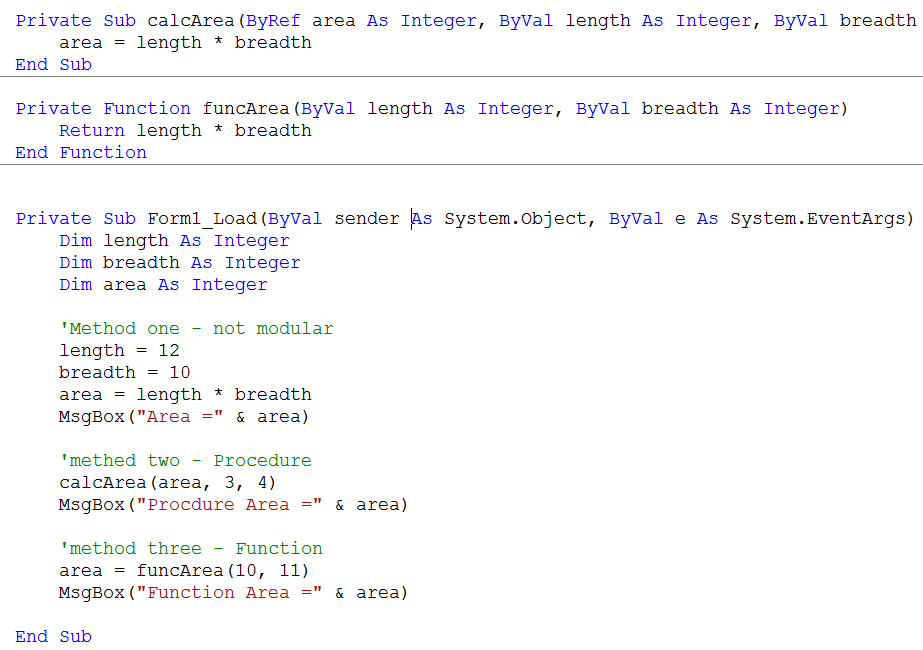
Still a lot of confusion over the definition of a function and procedure in Higher Computing Science and how they differ.
A procedure is a sub program that contains a block of code. It uses parameters to pass data to and from the main program.
A function is a sub program that contains a block of code. It uses parameters to get data from the main program and passes back a single piece of data using RETURN.
In the program below you can see a procedure called calcArea and a function called funcArea. Both of these sub programs do the same thing but they way the work is different. The last two lines of code could be merged into
MsgBox(“Function Area =” & funcArea(10,11)).
The procedure is always called on it’s own. Can you name another function shown in the program below?
Theme: Computer architecture
Subjects: Higher Computing Science
Audience: Student
When: Wednesday, 16 March 2016 7:30 PM
Presented by: Ian King, SCHOLAR Online Tutor for Computing and Information Systems
Session link: http://heriot-watt.adobeconnect.com/scholarhomework (Enter as a Guest)
Not everyone uses a desktop computer to view web pages. A significant proportion of the population now uses mobile devices to view websites. This means that designers have to use a website design that can respond to these devices by changing page size, position of elements, etc. Normally this would be done with CSS scripting however the process is slightly different in WebPlus.