|

June – Article 6 – I have the right to live and grow as a person.
Article 6 of the UNCRC (Life, Survival and Development) guarantees that every child has the inherent right to life, requiring schools to ensure children develop to their full potential physically, mentally, and socially. It is one of the four core principles of Rights Respecting Schools, focusing on nurturing well-being and safety.
Key Aspects of Article 6 in Schools:
Holistic Development: Schools must support children to grow healthily, not just survive.
Safe Environments: Promoting emotional, physical, and mental wellbeing to prevent harm.
Fundamental Principle: As one of the four main pillars of the UNCRC, it underpins how all other rights are implemented.
Practical Application: In Rights Respecting Schools, this includes promoting nutritious food, exercise, and strong mental health support.
Schools, guided by UNICEF UK’s Rights Respecting Schools Award, focus on creating an environment where children can thrive
May – Article 12 – I have the right to be listened to and taken seriously.
Article 12 of the UN Convention on the Rights of the Child (UNCRC) is a core principle in UNICEF’s Rights Respecting Schools Award (RRSA), ensuring that every child has the right to express their views, feelings, and wishes in all matters affecting them. These views must be taken seriously by adults and given due weight based on the child’s age and maturity.
Key Aspects of Article 12 in Schools:
Meaningful Participation: It moves beyond tokenistic “pupil voice” to ensuring children’s opinions genuinely influence decisions.
Active Engagement: Children are recognized as active participants in their own lives, not just passive recipients of care or education.
The Lundy Model: Many UK schools use the Lundy model to implement this, focusing on four areas: Space (safe opportunities), Voice (enabling expression), Audience (listening), and Influence (acting on views).
Application: It applies to all aspects of school life, including classroom rules, learning, and school policies.
Implementation Examples:
Class Charters: Students collaborate to create rules, respecting the rights of others.
School Councils & Pupil Roles: Opportunities for leadership and input.
Active Listening: Staff are trained to listen to and respect pupils’ perspectives.
To learn more, please visit https://www.unicef.org.uk/rights-respecting-schools/
April – Article 5 – My family should help me know and use my rights.
Article 5 of the UN Convention on the Rights of the Child (UNCRC) focuses on parental guidance and a child’s evolving capacities. It requires schools and governments to respect the rights of parents/carers to provide guidance to their children, ensuring this direction keeps pace with the child’s increasing maturity and ability to make their own decisions.
Key aspects of Article 5 within Rights Respecting Schools include:
Balancing Guidance and Autonomy: Schools acknowledge that as children grow, their capacity to make informed choices increases, shifting from needing direction to exercising their own rights.
Partnership with Parents: The role of parents and guardians in guiding children to exercise their rights properly is respected.
Evolving Capacities: Adults, including teachers, support children to develop their ability to act independently and responsibly, ensuring guidance is tailored to their maturity level.
Holistic Development: This aligns with the broader RRSA, which aims to nurture children to reach their full potential, emphasizing dignity and respect.
Incorporating Article 5 helps ensure that schools, through their Rights Respecting Schools Award (RRSA) framework, support both the protection of children and their growing independence.
To learn more, please visit https://www.unicef.org.uk/rights-respecting-schools/
Article 30 of the UNCRC protects a child’s right to learn and use the language, customs, and religion of their family, even if these are not shared by the majority in their country. In Rights Respecting Schools, this ensures minority cultures are respected, valued, and celebrated, fostering inclusivity and belonging.
Key Aspects of Article 30 in Schools
Language & Culture: Children have the right to practice their own culture, language, and religion.
Minority Rights: It specifically protects children from minority groups or indigenous backgrounds.
Inclusion: Schools often use this article to promote diversity, for instance, during events like Black History Month.
Identity: It supports a child’s right to maintain their identity and heritage.
Implementation in a Rights Respecting School
Celebrating Diversity: Recognizing different religious holidays, cultural traditions, and languages spoken by pupils.
Inclusive Curriculum: Ensuring teaching materials and books reflect different cultures and viewpoints.
Policy Support: Reviewing anti-bullying and behaviour policies to ensure they respect cultural and religious differences.
Empowerment: Encouraging children to share their heritage and feel proud of their background, fostering a sense of belonging.
Unicef UK
Unicef UK
+3
Article 30 is crucial for developing a child’s personality and talents, as outlined in Article 29, by encouraging respect for their own culture and others
We are proud to be a GOLD Rights Respecting school. A Gold: Rights Respecting school is the highest level of the UNICEF UK Rights Respecting Schools Award, awarded to schools that have fully embedded the UN Convention on the Rights of the Child (CRC) into their core policies, culture, and daily practice. It signifies that children’s rights are championed, understood, and respected across the entire school community.
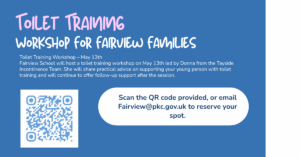
Toilet Training Workshop – Parent Information
We are pleased to let you know that Fairview School will be hosting a toilet training workshop on May13th, 10-12pm. The session will be led by Donna from the Tayside Incontinence Team, who will share practical guidance and advice on the most effective ways to support a young person through their toilet training journey.
During the workshop, Donna will talk through helpful strategies, answer any questions you may have, and offer reassurance around common challenges. Following the session, she will also stay in touch with you to provide ongoing support as your young person progresses.