
King’s Oak Guide to Talk for Writing
What is Talk for Writing?
Talk for Writing (TfW) is a teaching framework developed by Pie Corbett. It helps children become better writers by talking through ideas before writing. The idea is: if you can say it, you can write it.
3 Main Stages of Talk for Writing
- Immitation – Learn from the model (Week 1 and 2)
- A model text and toolkit (e.g. suspense, characterisation) is selected (see King’s Oak TfW yearly overview)
- A cold piece is completed by the children. A blue sticker is used to identify this in the jotter. The teacher should provide a stimulus for this but children should complete the task independently. Cold pieces should then be used to select features from the relevant tool kits that the class needs to work on.
- Teacher provides a ‘hook’ to engage the class.
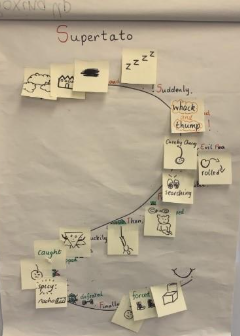
Children learn the text off by heart using a story map and actions (a section a day).
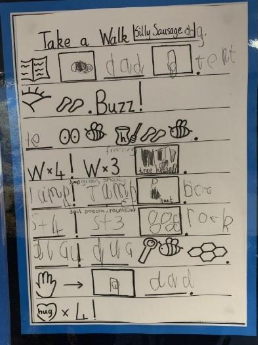
- Children draw their own story map in jotter or the class story map can be stuck into jotter.
- Children should ‘read as a reader’ and complete Short Burst Writing Activities (SBW) that deepen their understanding of the text. Activities at this stage might include, role play, expressive arts activities, building vocabulary, oral comprehension, cloze procedure, sequencing, annotating, improving sentences, spine poems, 5 sentence stories, grammar activities, etc. (The JumpStart Literacy books have lots of great activities).
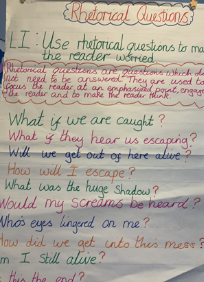
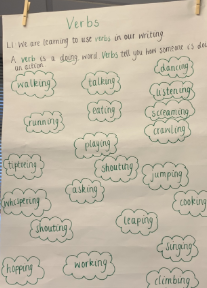

- Children should then move on to ‘reading as a writer’ where they will analyse the structure of the text and identify and understand the key features that make the text effective. During this process they will ‘box up the text’, identifying how the text is organised (see below)
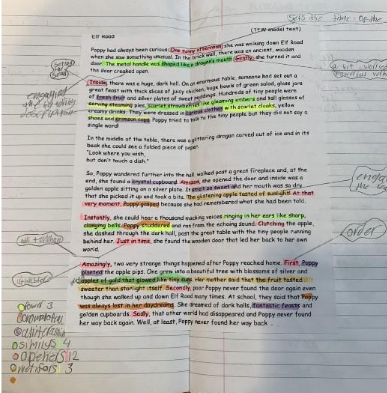
- After completing the boxing up stage the class should co construct the toolkit. During this phase it may be useful to underline and highlight important features of the text. Examples of important features should be displayed on class washing lines so that children can ‘magpie’ these when creating their own texts. The new toolkit should be displayed and referenced daily.
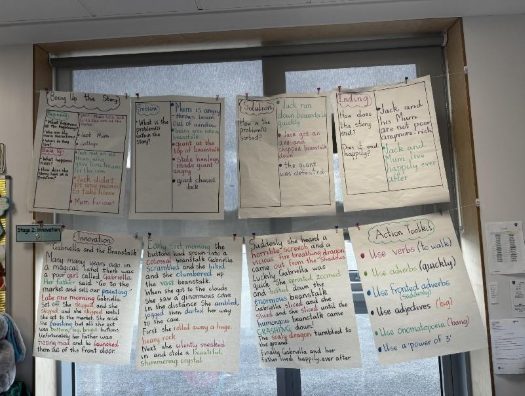
- Innovation – Change parts of the model (Week 3)
- The children adapt the model text to create a new version (a section a day). This is done on the class story maps and on individual story maps then written as a new text.
- Story maps can be changed using sticky notes or pre made grids
- They keep the structure but change characters, settings or events e.g. ‘The Three Little Pigs’ could be changed to ‘The Three Little Robots’.
- Shared writing should be completed at this stage and displayed on washing lines.
- Some children may choose to ‘hug’ the class story map closely but others may be more confident to change theirs to something completely different.
- This stage builds confidence and creativity.
- Self and Peer assessment should be used at this stage.
- Teacher assessments at this stage should inform planning for the next stage to see what groups of pupils still need to work on.
- Invention (or Independent Application) – Write your own (Week 4)
- A new hook or stimulus should be provided by the teacher.
- Children plan and write their own version from scratch, using what they have learned ( a paragraph a day)
- Shared writing should still be completed but should focus on the aspects of the process that still need reinforcing or any areas that need revisiting or strengthening.
- Children should be encouraged to refer to structure, toolkit and class washing lines.
- The goal is independent, high quality writing.
- This piece of writing is known as the ‘hot piece’ and a red sticker should be used in the jotter.
- The teacher should assess the hot piece, reflecting back on the cold piece to see progress made and use these assessments to inform planning for next unit.
Key Features of Talk for Writing in King’s Oak
- Storytelling and oral rehearsal – Speaking before writing.
- Magpie-ing – collecting good words and phrases to use.
- Toolkits – checklists of features for different genres (e.g. suspense, information)
- Shared Writing – teacher models writing in front of class.
- Cold and Hot Tasks – write before and after the unit to show progress.
- Developing a love of reading – class libraries should promote reading and every class should participate in daily reading.
- Reading Spine – every class has a lits of books that should be read throughout the year.
- Jotter Presentation – see presentation policy.
- Marking – tickled pink and green for growth.
- All time Toolkit – each class should have an ‘All Time Toolkit’, including important basics such as, punctuation, spacing, connectives etc. This should be referenced in all writing activities.