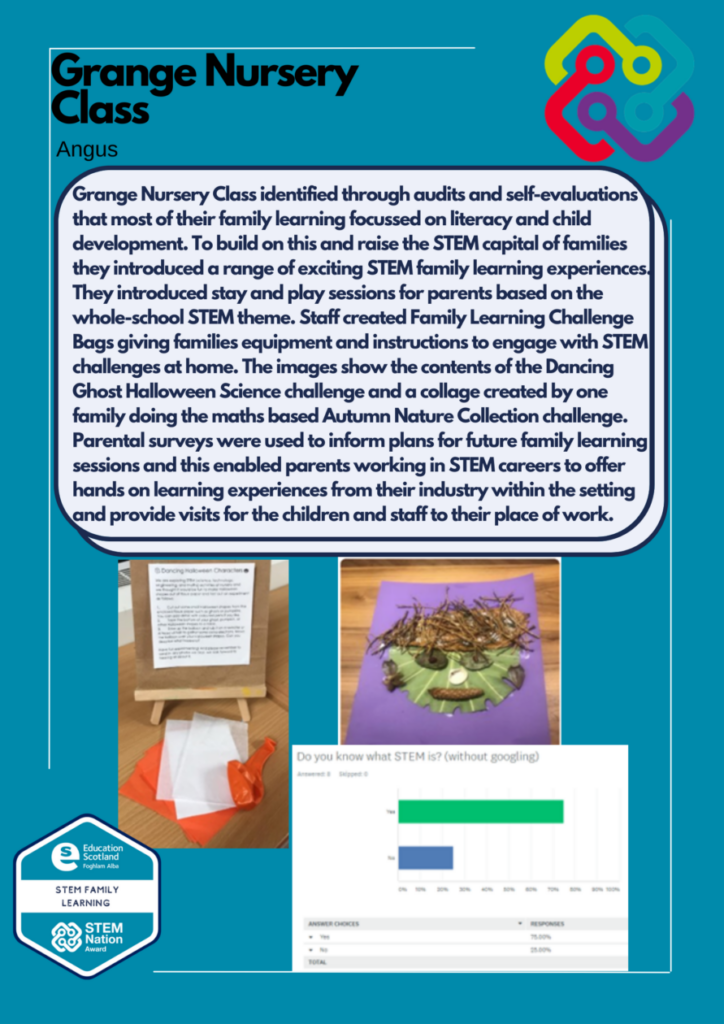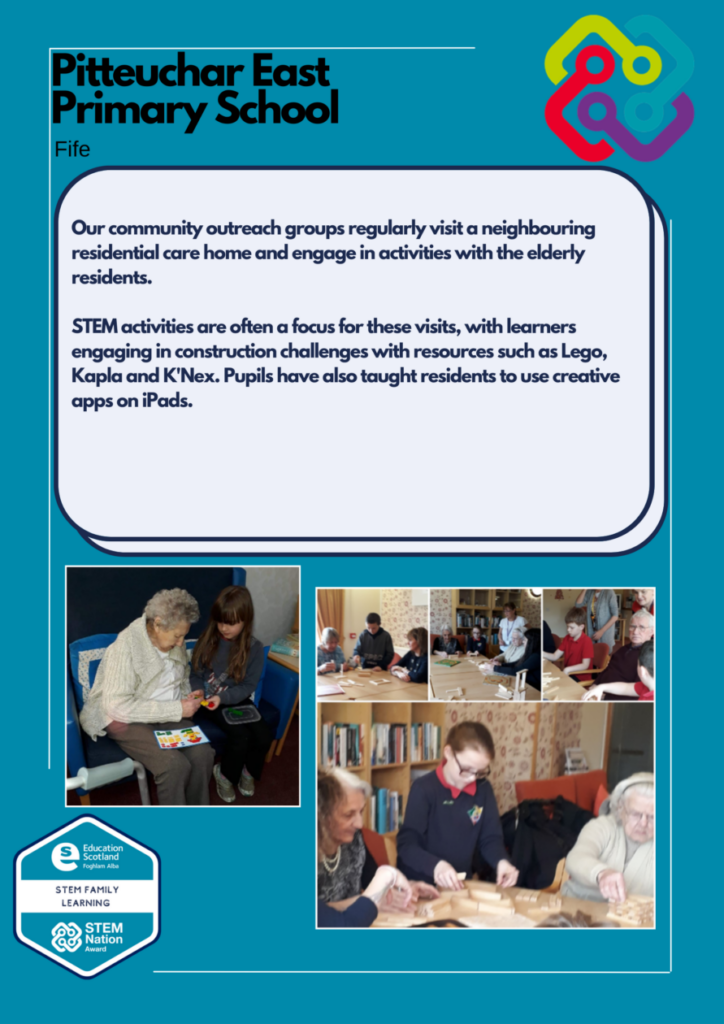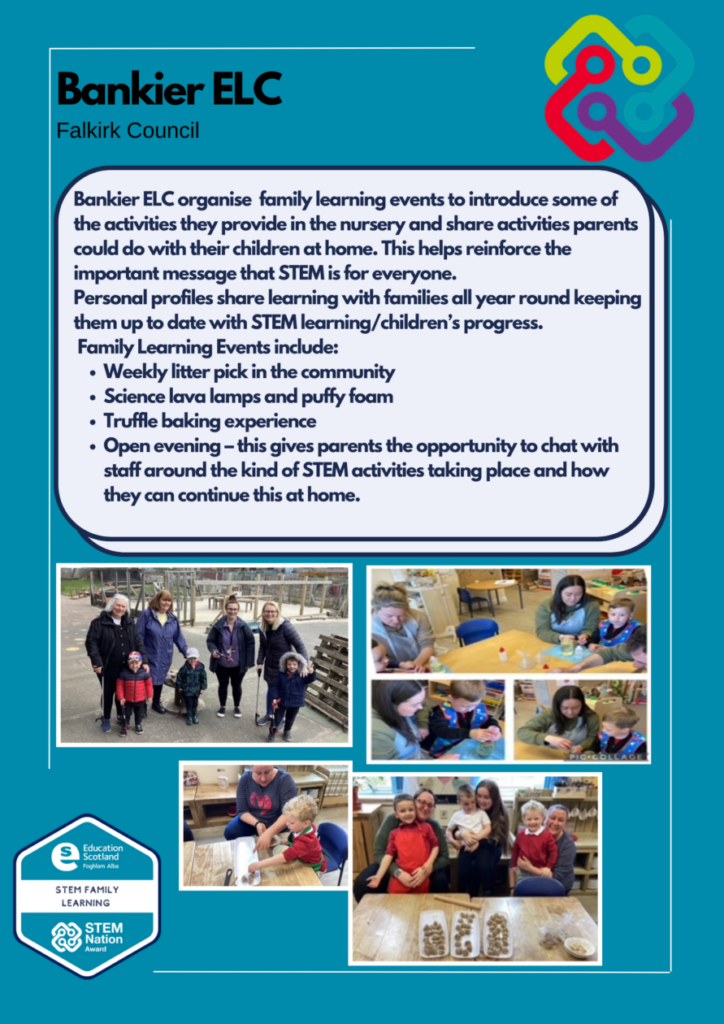
The STEM family learning element recognises practice and commitment to family learning within early learning and childcare settings and schools. Settings applying for this element will be using STEM to make connections with the local community. This work will be helping to deliver equity in STEM by building STEM capital to support all learners and their families.
What does this look like in ELC settings and schools?
- We are taking action to make a difference to where we live through community-based STEM and Learning for Sustainability projects. We work in partnership with relevant agencies, including community learning and development, third sector and further education partners, to develop and deliver relevant, fun and engaging STEM family learning opportunities.
- Parents and families are actively and meaningfully involved in STEM family learning programmes and activities.
- Practitioners work with parents and families to identify and reduce barriers to participation. Parents’ own learning journeys are negotiated, valued and supported.
- STEM education is a regular feature in our school or setting events and communications with parents and families.
- Our parents and families are gaining an understanding of the importance of STEM skills, careers and pathways.
What does this look like in a CLD setting – adult learning?
- Our STEM adult learning programmes are being developed in partnership with learners to build STEM capital. An increasing number of adult learners are becoming involved in the development and delivery of STEM learning programmes for other members of the community.
- Our adult learners are actively and meaningfully involved in STEM community activities such as citizen science projects and science festival activities.
- Our practitioners are aware of potential barriers to participation and work with adult learners to reduce these. Our learners are offered opportunities to gain accreditation for aspects of their STEM learning.
- We use social media and other methods of communication to promote and share details of our STEM-based community learning programmes in order to engage adult learners and the wider community.
- Adult learners working with our provider are gaining an understanding of the importance of STEM skills, employability and progression routes.
- An increasing number of adult learners are developing skills in leadership, problem solving and critical thinking that will enable them to make informed decisions in their everyday lives
What does this look like in a CLD setting – family learning?
- Our STEM family learning programmes are being developed in partnership with learners and their families to build STEM capital. Families are taking action to make a difference to where they live through community-based STEM and Learning for Sustainability projects.
- Our practitioners are aware of potential barriers to participation and work with families to reduce these. Parents and families are offered opportunities to gain accreditation for aspects of their STEM learning.
- STEM features regularly in our provider’s communications with parents, families, schools and the wider community through social media and the use of other digital technologies.
- Parents and families are gaining an understanding of the importance of STEM skills, employability skills and progression routes.
- We seek opportunities to integrate intergenerational learning into our STEM programmes wherever possible. This is allowing us to engage wider audiences in STEM learning and is helping us to address unconscious bias relating to equity and equality in STEM.
What does this look like in a CLD setting – youth work?
- Our STEM youth work activities are being developed in partnership with learners to build STEM capital.
- We work with our learners, parents and our local school(s) to highlight the links between informal STEM learning and formal in-school education. Our learners are also encouraged to participate in wider STEM community events such as citizen science projects and science festival activities.
- Our practitioners are aware of potential barriers to participation and work with young people to reduce these. We work independently and or in collaboration with our local school(s) to provide our learners with opportunities to gain accreditation for their STEM learning.
- STEM features regularly in our provider’s communications with youth group members, families and our partners through social media and the use of other digital technologies.
- Young people and their families are gaining an understanding of the importance of STEM skills for employability and lifelong learning.
- Our young people are actively and meaningfully involved in STEM-based elements of youth work programmes. As a result, learners are developing STEM and creativity skills that can be applied in a variety of contexts
Hints and tips
Interesting practice examples