Category: CLD

CLD and professional learning – an analysis

Education Scotland’s role is changing. Going forward the organisation will have a focus on curriculum and professional learning. In late 2024, a paper was presented to Education Scotland’s (ES) leadership team giving an overview of the context for our Education Scotland’s CLD officers’ support to the sector. A recommendation from that paper was to initiate an exploratory phase of work to develop ES’s potential role within the recommendations from the independent review of CLD, and within the refocussed work of ES.

To support this proposal, we undertook an appraisal of the current evidence on professional learning in Scotland, to assimilate the available data and draw out common themes. As part of that we want to reflect on the current Education Scotland CLD professional learning offer, drawing on evaluation data we hold, and engagement work we have carried out.

You can read the full paper here: CLD – A PL analysis

For further discussion or questions please contact Susan.Epsworth@educationscotland.gov.scot

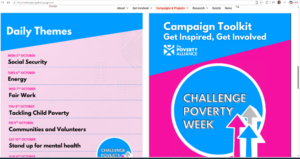
Challenge Poverty Week – Scotland 2026

The Poverty Alliance organise Challenge Poverty Week every year in Scotland. They want to highlight the injustice of poverty in Scotland, and to show that collective action based on justice and compassion can create solutions.

The week is an opportunity to raise your voice against poverty and unite with others in calling for a just and equal Scotland.


The Education Scotland CLD Team would like to highlight a variety of professional learning resources that are available with links to poverty across a wide range of examples and areas. They include community-based adult learning, youth work and community development. Please take a look to enhance and improve your understanding and practise and support others by sharing the resources.


Challenging Poverty | Resources | Education Scotland – a series of CLD case studies

CLD, Poverty & Social Justice Education Scotland wakelet

Scotland’s Equity Toolkit | Resources | Education Scotland – with sections on families and communities amongst others

Equity: Mitigating the impact of poverty – An Education Scotland professional learning programme.

Informed level | Inclusion, wellbeing and equalities framework | Leading professional learning | Professional Learning | Education Scotland – with sections on impacts of inequalities, bias, prejudice-based behaviours and trauma informed practice.

Cost of the School Day PLA – self-directed learning activity


Education Scotland CLD team would also like to highlight a couple of other organisations as part of promoting Challenge Poverty Week 2026.

The Joseph Rowntree Foundation launched their latest Poverty in Scotland 2026 report to launch the start of Challenge Poverty Week. These are some of the key messages:

“This year, as well as assessing the national picture, we have focused on the vital role of local government in reducing poverty, backed by new public attitudes data and engagement with people with lived experience. In findings that must shape live discussions about the future of local governance and public service reform in Scotland, we have heard that:

  • people think councils are too underfunded to provide the services needed in their area
  • there is significant public disaffection with councils, regardless of people’s backgrounds and across Scotland’s different communities
  • councils are not doing enough to tackle poverty, with people on low incomes and living in more deprived areas reporting worse experiences of services and higher levels of disaffection.”

See here for an article from COSLA as part of their promotion of Challenge Poverty Week.


Child Poverty Action Group has focused work in Scotland – including cost of the school day. CPAG’s work in Scotland:

We work for the one in five children in Scotland growing up in poverty.

We collect evidence from families living in poverty and campaign for solutions to bring about a society where children have a fair chance in life free from hardship. We provide training, advice and information on social security to frontline workers to make sure families get the financial support they need.”


Events are happening across the week by various organisations so please see here for further information: Challenge Poverty Week – The Poverty Alliance

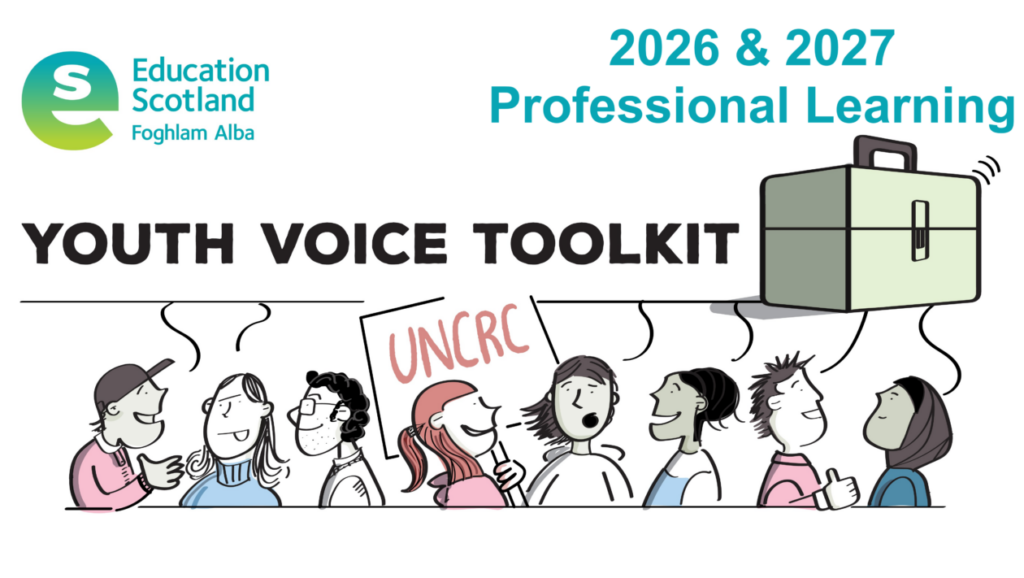
Youth Voice Toolkit – Professional Learning (Oct to March)

Due to popular demand, Education Scotland are providing a range of future dates for professional learning on the Youth Voice Toolkit. The toolkit allows practitioners to support non-tokenistic and representative consultations of children and young people in schools, communities, organisations and local authorities, around any theme or topic. A complete list of these dates can be found below alongside a synopsis of the toolkit and why it’s important for all pracitioners and settings:

Dates

Youth Voice Toolkit: Professional Learning Tickets, Thursday, October 8  •  4 PM – 5 PM

Youth Voice Toolkit: Professional Learning Tickets, Wednesday, November 4  •  4 PM – 5 PM

Youth Voice Toolkit: Professional Learning Tickets, Wednesday, December 9  •  4 PM – 5 PM

Youth Voice Toolkit: Professional Learning Tickets, Thursday, January 14, 2027  •  4 PM – 5 PM

Youth Voice Toolkit: Professional Learning Tickets, Wednesday, February 17, 2027  •  3 PM – 4 PM

Youth Voice Toolkit: Professional Learning Tickets, Thursday, March 25, 2027  •  4 PM – 5 PM


What is the Youth Voice Toolkit?

The toolkit is a national package of guidance and resources designed to help educational, community, and place-based settings effectively consult with children and young people. It provides a clear, step-by-step approach, alongside practical tools and resources, to support meaningful and inclusive participation.


Why is this important?

Youth voice, whenever children and young people are asked for their views on a theme, issue, or decision, can often be rushed, unrepresentative, tokenistic or poorly planned. This can leave young people feeling frustrated, disengaged and as though their opinions do not matter. The toolkit addresses these challenges by guiding practitioners through a proven approach that gives clear and concise instructions with easy to use resources.


What difference can it make?

The toolkit equips settings with the tools and confidence to work with children and young people to agree how they want to be consulted on issues that matter to them. It also empowers young people to gather and represent the views of their peers. As a result, feedback is more accurate, inclusive of seldom-heard voices and more likely to lead to meaningful action and positive change.


What does the toolkit involve?

It requires a practitioner to lead on its adoption, following these key steps:

  • Creating a youth voice charter which details how children/young people wish adults to work with them when it comes to consultation
  • Deliver part 1 of the Empowering Youth Voices resource pack to a youth voice structure (e.g. pupil council, youth forum, class etc) to upskill them on how to work as a team to represent their peers
  • Deliver part 2 of the resource pack to the same youth voice structure to guide them through the process of planning and carrying out peer research on a chosen theme or issue within their setting.
  • Support the youth voice structure to analyse findings, share results and create an action plan based on what their peers have said.
  • Repeat part 2 of the resource pack when examining a new theme or topic


If you have any questions or thoughts please contact youthvoice@educationscotland.gov.scot
International Adult Literacy Day 2026

International Adult Literacy Day 2026 

UNESCO states that “Literacy is a fundamental human right for all. It opens the door to the enjoyment of other human rights, greater freedoms, and global citizenship. Literacy is a foundation for people to acquire broader knowledge, skills, values, attitudes, and behaviours to foster a culture of lasting peace based on respect for equality and non-discrimination, the rule of law, solidarity, justice, diversity, and tolerance and to build harmonious relations with oneself, other people and the planet. Despite progress, at least 739 million youth and adults worldwide still lack basic literacy skills in 2024. At the same time, 4 in 10 children are not reaching minimum proficiency in reading, and 272 million children and adolescents were out of school in 2023. 

This year, International Literacy Day (ILD) marks its 60th anniversary. It was proclaimed by UNESCO in 1966 during the 14th session of the General Conference. Celebrated under the theme “Literacy for people, the planet and prosperity,” ILD 2026 provides an opportunity to take stock of progress, deepen understanding of persistent and emerging challenges, and shape future literacy agendas in a rapidly changing world. 

The global celebration will be convened by UNESCO on 8-9 September 2026 in Mexico, in collaboration with the Government of Mexico. 

“As we celebrate the 60th anniversary of International Literacy Day, we reaffirm literacy as a fundamental human  right  and  a  powerful  force  for  transforming  lives,  economies and societies.” 

Khaled El-EnanyDirector-General of UNESCO 


Scotland in focus 

Education Scotland CLD team would like to support the International celebrations by sharing resources and information linked to Adult Literacy: 

Community Based Adult Learning Celebration – Highland

Over this year Highland Council have been celebrating community based adult learning, which includes adult literacy. They have been showcasing community based adult learning across the Highlands, the history all the way to the present day – an incredible history to learn from and a celebration of the fantastic work taking place across the area. They have produced an online version which you can read here by clicking on this link. 


Approximately one in four adults in Scotland experience challenges with literacy. 

According to the Literacy Trust, in Scotland, around 26.7% of adults face challenges due to limited literacy skills, which can affect their confidence, employability, and ability to navigate daily life – literacytrust.org.uk. The Scottish Survey of Adult Literacy and Numeracy (SSAL) 2009, the largest survey of its kind in Scotland, found that 3.6% of adults face serious challenges in literacy practices, with poverty being a significant factor influencing lower literacy capabilities. The OECD Survey of Adult Skills (PIACC) 2024 – found that across participating member countries adults living in the most deprived areas are more likely to have lower literacy skills, highlighting the link between social inequality and literacy outcomes. However there is no up to date data on statistics in Scotland. 

Dyslexia Awareness Week – 28th September until 4th October

This Dyslexia Awareness Week Scotland (28 September to 4 October), Dyslexia Scotland is championing support, reasonable adjustments and things that help people with dyslexia to work and learn at their best.

Some printables and ready-made social media posts are already available for you to use and Dyslexia Scotland will be adding exciting free events and thoughtful lesson plans.

Main landing page: https://dyslexiascotland.org.uk/dyslexia-awareness-week

Stakeholder assets: https://dyslexiascotland.org.uk/campaign

Thank you for supporting the Dyslexia Scotland campaign and helping make Scotland dyslexia friendly. Please share this information with your learners, practitioners, volunteers and organisations!

Erasmus updates ! Get prepared – British Council

Erasmus+ Programme

Find out how you can access life-changing opportunities for you, your learners and your colleagues.

The Erasmus+ programme provides grants for international placements and partnership projects. Applications open in November 2026 so it’s the ideal time to start your planning now. This opportunity is open to any organisations across the Community Learning & Development sector with various workstreams to consider applying under.

The British Council recently did an input at the Education Scotland ESOL network and Adult Literacy network. We recorded the presentation to share with a wider audience so please find the link here. 

The British Council have various recordings you can watch to learn more on their website:  https://www.britishcouncil.org/erasmusplus

There are sections for the adult learning sector and youth sector.

For the youth sector there are a series of webinars coming up – See here

You can also sign up to the British Council newsletter and receive regular updates. https://www.britishcouncil.org/erasmusplus/newsletter


If you need inspiration about the opportunities and benefits of international learning exchanges then have a look at our recordings which showcase four different local authorities from projects that took place this year through the Scottish Education Exchange Programme. All the projects really showcase the impact of being involved in opportunities such as this, along with the focused areas for improvement that the projects have inspired them to be taking forward.

Aberdeenshire & North Lanarkshire – delivery and practitioner focused

Glasgow Clyde College with Glasgow Life & Highland – partnership & learner voice


Adult Literacy – International Projects for Improvement!

Education Scotland recently hosted a webinar highlighting two projects funded through the Scottish Education Exchange Programme (SEEP). Both projects were delivered by CLD adult literacy teams and the session was recorded on Youtube. Link is here.

These projects exemplify the opportunity of applying for funding to link up with partners internationally to share learning and highlight the longer term outcomes that can be achieved through inspiring and learning from practice outwith Scotland, to improve learning for communities in Scotland.

Details of the two projects are here:

Glasgow Clyde College & Glasgow Life – Literacy for Life: Unlocking Potential

The project is seeking to achieve an increase in the levels of literacy in Scotland by building on examples of good practice in other countries with high levels of literacy, and to develop an easy, cost-effective diagnostic and e-learning tool which can be used across Scotland’s colleges, local authorities and adult learning settings.


Highland – Learner voice

A research and development project exploring international good practice in community-based adult learning (CBAL) learner voice initiatives. A cohort of 12 adult learning practitioners and Learning Leaders from Highland travelled to the Aontas Summit in Dublin to learn about learner voice structures in Ireland. Thereafter, learning from the experience will be applied to the redevelopment of learner voice work in Highland communities.


SEEP Project – Learner Voice & Literacies Practise Internationally – Erasmus inspiration!

The SG Test and Learn project is a small-scale project that was developed and delivered in collaboration with Scotland’s colleges, universities and Community Learning & Development (CLD) organisations The aim of the project is to support the collaborative actions set out in Scotland’s International Education Strategy.This webinar is aimed at the Community Learning and Development sector – local authority, third sector or College, but any educator may be interested to learn more as resources are shared in relation to literacy, international practise, international models, community work and successful delivery of international projects involving multiple partners which include learners themselves. Webinar is 2nd September at 12pm  – Registration form is here.

Remember that Erasmus is due to open for applications in November so you may find ideas from these examples, make connections or learn how to deliver a project which involves international travel.

Learner Voice In Highland

A research and development project exploring international good practice in community-based adult learning (CBAL) learner voice initiatives. A cohort of 12 adult learning practitioners and Learning Leaders from Highland travelled to the Aontas Summit in Dublin to learn about learner voice structures in Ireland. Thereafter, learning from the experience will be applied to the redevelopment of learner voice work in Highland communities.

Glasgow Clyde College, Glasgow Life & partners

Literacy for Life: Unlocking Potential

The project is seeking to achieve an increase in the levels of literacy in Scotland by building on examples of good practice in other countries with high levels of literacy, and to develop an easy, cost-effective diagnostic and e-learning tool which can be used across Scotland’s colleges, local authorities and adult learning settings.


Education Scotland aims to have an inclusive environment for all participants, by identifying and removing barriers in our practices.

Target Audience – Please be aware that the target audience for this event is for professionals within the Education Sector in Scotland.


NEW!! Professional Learning Activities (PLAs) for CLD


The CLD team at Education Scotland has recently developed and published nine new professional learning activities (PLAs) that are particularly relevant for CLD practitioners and leaders. PLAs are short self-directed interactive learning materials that allow you to save your responses and reflections to keep a record of your learning. The new PLAs cover:

  • Mis & dis-information
  • STEM in CLD
  • Youth Awards in schools and community settings (part 1 and 2)
  • Learning for Sustainability for CLD
  • Inclusive practice & dyslexia in CLD
  • New Scots Integration Strategy
  • Attendance: Power of partnerships
  • Improving racial literacy in CLD

Accessing these new self-directed learning opportunities is quick and easy. A wide range of PLAs including these new ones can be found here: Self-directed professional learning | Professional Learning | Education Scotland. If you don’t already have an account it is quick and easy to register for one.

We are always looking for feedback on our professional learning offer. If you would like to share your experience or suggest themes for new PLAs please contact Susan.Epsworth@educationscotland.gov.scot


CLD Adult Literacy – International Projects! Inspiration for Erasmus……

Education Scotland recently hosted a webinar highlighting two projects funded through the Scottish Education Exchange Programme. Both projects were delivered by CLD adult literacy teams and the session was recorded on Youtube. Link is here.

These projects exemplify the opportunity of applying for funding to link up with partners internationally to share learning and highlight the longer term outcomes that can be achieved through inspiring and learning from practice outwith Scotland, to improve learning for communities in Scotland.

Details of the two projects are here:

The Aberdeenshire CLD Kenya Literacies Learning Exchange builds on an international partnership between Aberdeenshire Council’s Community Learning and Development Service and Inspire Nyeri, a community based literacies organisation in Kenya. Through virtual collaboration and an exchange visit, the project enabled staff to learn from innovative, community led literacy approaches used in Nyeri. Insights inform the co-development of inclusive, sustainable and outcome focused literacies models for use in Aberdeenshire. The project has strengthened professional learning, enhanced local literacies provision, reduce stigma around literacies learning, and create a framework for future international exchange, benefitting learners, families, and communities in both regions.

Aberdeenshire Kenya Literacies Exchange Programme | Engage Aberdeenshire

Strengthening CLD Adult Literacy and Numeracy in North Lanarkshire: Learning from Ireland’s Best Practice

This project is a professional knowledge exchange visit to Ireland involving eight North Lanarkshire participants—staff, volunteers and learners. The visit learned from Ireland’s successful adult literacy approaches, particularly their innovative awareness raising campaigns, helping to address declining participation in Scotland. Insights gained will support the recommendations of the Independent Review of CLD, strengthening system-wide learning and partnership working. Resources shared so far are here:

Adult Literacy For Life – Ireland 10 year strategy

National Adult Literacy Agency – Ireland

Ireland – Community Education Framework

An article about the North Lanarkshire CLD team and learners was earlier published here: ‘I was 49 before I could write my own address’ – BBC News