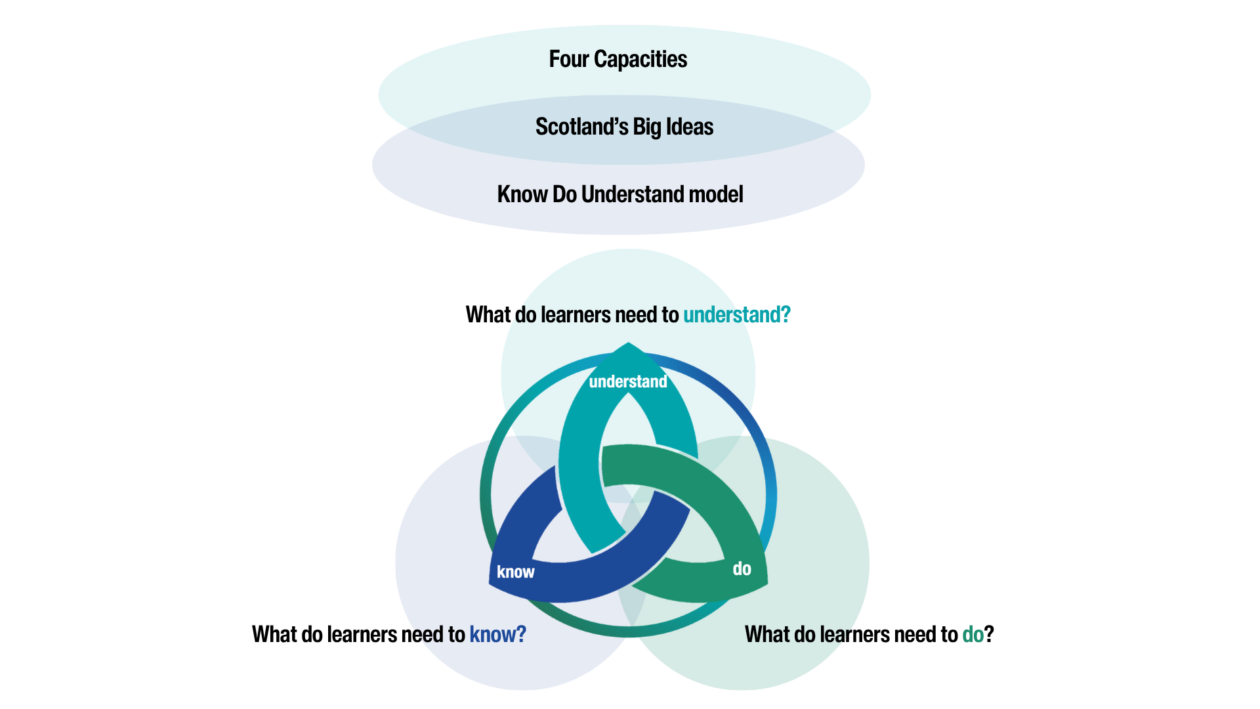
Scotland’s Curriculum is deliberately moving away from Experiences, Outcomes and Benchmarks to a concept-based curriculum. This will be a Know-Do-Understand (KDU) model informed by overarching big ideas in each of the curriculum areas. Co-design groups of teachers, practitioners and partners have begun work on the refreshed curriculum. In November 2026, the first draft of KDU frameworks for the curriculum areas was released. The framework is explained below, and should be read alongside Explainer 3.
The Big Ideas
These provide a rationale for the ‘why’ and ‘what’ children and young people learn within a curriculum area. They capture the most important overarching understandings and insights that articulate the way that a curriculum area makes sense of the world, the significance of this learning and how it contributes to development of the four capacities.
An overview of all the Big Ideas and Purpose Statements
Understand
Understand statements describe the relationship between concepts. The concepts that form the understand statements are drawn from the Big Ideas. Understand statements capture the learning across a curriculum level and are transferable across different case studies, contexts, cultures and times. This transferability is what gives them power, enabling learners to use their knowledge beyond the classroom.
Know
This part of the knot outlines the facts, definitions, examples or case studies that children and young people to know need in order to build and illustrate their understanding.
Know statements should make sense with: (“I know”) written in front of them.
Do
This part of the knot outlines the things that children and young people learn to do within a discipline. These practical actions and experiences sit alongside knowledge and contribute to the development of understanding. This includes curriculum area and subject specific skills, processes and strategies.
Do statements should make sense with: (“I can” ) written in front of them.
Notes
Notes clarify the intended meaning of Know, Do, Understand statements.
They might use
- includes, but not limited to
- includes […] and excludes […] to provide specific guidance on what is stage-appropriate.
- clarify technical terminology for teachers and practitioners.
- provide nudges towards cross-curricular learning and making connections
Strands
Strands are used to organise the knowledge, skill and understanding and help teachers and practitioners navigate the curriculum. Strands make progression visible in each curriculum area.
Curriculum Areas
| Curriculum Area | Supplementary Information |
|---|---|
| Expressive Arts | |
| Health and Wellbeing | |
| Languages | Progression Guidance French Progression Guidance German Progression Guidance Spanish |
| Languages Gaelic (Learners) | Progression guidance Gaelic (Learners) |
| Languages Latin | Progression guidance Latin |
| Languages Scots (Learners) | Progression guidance Scots (Learners) |
| Literacy and English | |
| Literacy and Gàidhlig | |
| Numeracy and Mathematics (arranged by level) Numeracy and Mathematics (arranged by sub strand) | Note: These two documents have the same content however they are organised differently to best suit the needs of practitioners |
| RMPS | |
| Sciences | |
| Social Studies | |
| Technologies | |
| Roman Catholic Education | |
| Religious Education Roman Catholic | Scripture Texts |