Hi everyone,
Our Winter News letter seems a distant memory now but we would like to start as always by welcoming any new families who have joined our centre during this time.
Well what a busy term this has been with so much to share so lets have a recap of some of our best bits!
SPACE
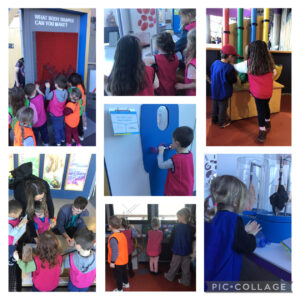
Children explored all things space over a short term cycle finishing off there topic with a trip to the science centre!
Fairy Tales
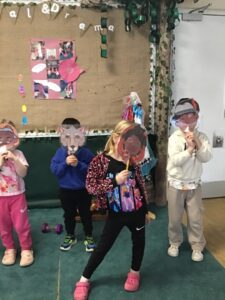
We are currently exploring fairy tales, children have not been shy in
demonstrating not only their wonderful acting skills but also their ability too retell stories… we look forward to seeing where this themed focus will take us!
Working together for change – PROGRESS UPDATE
Up, Up & Away
UP, UP and AWAY ! 
Staff have been familiarising themselves with the up up and away document, the literacy caterpillar has now been introduced into centre and staff are working towards creating greater links and opportunity for family links between centre and home to create a literacy rich environment for all! Keep your eyes peeled for our CP Library – COMING SOON.
Up, Up and Away – Literacy Caterpillar Why is literacy important? What is Literacy?
Children’s Rights
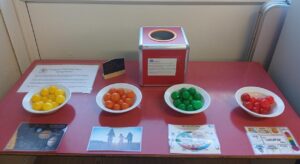
Staff have been working alongside children to increase their knowledge on their rights and the responsibilities that come with them.
 Article 24 – The Right to Be Healthy
Article 12 – The Right To Be Heard
Article 28 – The Right to Education
Article 31 – The Right to Play
Children’s Rights – Working together for change What are Children’s Rights?
Centre Improvement Plan 2025/26
Transitions
We pride ourselves on delivering a strong transition programme for our children who are moving on, as we believe it is pivotal in making their move from EYC to school, seamless, enjoyable and most importantly, less daunting.
This year will be no exception, our children will have an array of experiences to help promote their understanding of expectations, learn new skills, meet teachers, explore grounds, make new friends, and even take part in their very first after dinner disco!!
Here is a sneaky peak at some of the things the children got up to last year, and what you may expect for your own.
 Growing up project
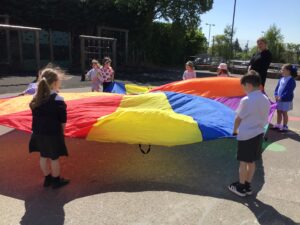
Children are paired with last years primary 1’s and have the opportunity to take part in a variety of activities over a 4 week period. These activities will take place across primary 1 classrooms, the primary 1 playground and the trim trail. Children will meet with their new teachers, as well as Mrs. Loney, Mrs. Readie & Mrs. Pash
Date: Wednesday 29th April, 6th, 13th & 20th June 2026 Time: 9:15am to 10:15am
 Lunch in the Canteen
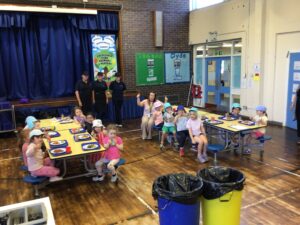
We have visit the school canteen twice a week from May. Here, children learn skills such as collecting, carrying and clearing trays, where to order lunches, sitting safely and being responsible. We also meet our new dinner ladies, and find out how to get to both our new playground and the toilets from the lunch hall.
NB: various days and opportunities for children to participate in this will be made available throughout the term.
Date: Week beginning 4th May Time: 11:45am
 Neon Disco
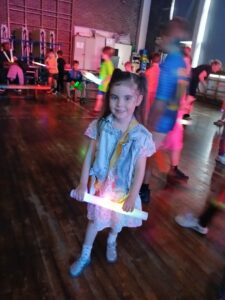
All pre-schoolers are invited along to join P1 to P3 at their NEON DISCO. Last year this was attended by almost all of our pre-schoolers, who had a great time dancing, waving their glow sticks and being out after dinner!!
Date: TBC Time: TBC
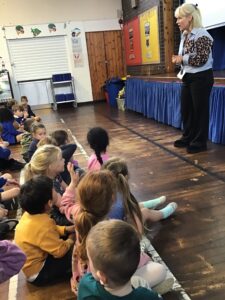
School Assembly
Children are taken along to a whole school assembly to experience what this will be like when they go to school.
Date: Where possible, every Friday from May onwards Time: 9:30am
Sun Safety
In order to ensure we keep your children safe in the sun we use the MET OFFICE UV index as a guide to inform us when your child may need sun cream on whilst playing outdoors.
Whilst we do have sun cream in centre, we ask if your child has sensitive or you would prefer not to use the one on site, that you pack a cream in the EYC bag. We would like to remind parents that first application of sun cream should be added at home on days in which sun cream is advised. UV 3 and above.
This is an index, developed by the World Health Organisation, called the ‘Solar UV Index’. It shows the strength of the sun’s ultraviolet (UV) radiation. The index is split into categories (Low, Moderate, High, Very High and Extreme). We have included advice about what you need to do to stay safe in the sun for each category.
| UV index |
UV summary |
Exposure category |
Advice |
 |
|
No significant UV |
It’s safe to stay outside. |
  |
 |
Low |
You can safely stay outside. Consider sunscreen in direct sunlight. |
   |
 |
Moderate |
Take care during midday hours and do not spend too much time in the sun unprotected. Sunscreen advised. |
  |
 |
High |
Seek shade during midday hours, cover up and wear sunscreen. |
   |
 |
Very high |
Avoid being outside or seek shade from 11am to 3pm. Shirt, sunscreen and hat are essential. |
 |
 |
Extreme |
Avoid being outside during midday hours. Shirt, sunscreen and hat essential. |
 |
|
No data |
|
Family Events Calendar
Printable version
March 2026
Thursday 5th March
World Book Day
This year children are asked to wear their FAVOURITE colour, we can wait to welcome in our rainbow of small folk! 🌈
Friday 6th March
Science centre outing
We are so excited to consolidate our learning about Space with a whole centre outing to the Glasgow Science Centre
Thursday 12th and Friday 13th March
‘Mothers and others stay and play sessions’
A celebration of all the caregivers in our lives- Join our staff and children for an interactive session to recognise those who we love.
April 2026
Friday 3rd April and Monday 6th April
Easter weekend
Centre closed for Easter weekend.
Thursday 16th April
Spring Scavenger Hunt
Join us for a Spring Scavenger hunt around or EYC and school grounds. See how many Spring photos you can spot!
Saturday 25th April
Gardening Day
We invite our families in to help us get our gardens ready to grow!
Open gate from 11am – 2pm, drinks and snacks available for all our helpers.
Wednesday 29th April
‘Growing up Project’
A transition programme for Pre-school children. These sessions will run for 4 weeks every Wednesday morning from 9:15am to 10:30am. If your child does not attend a Wednesday morning, they are also welcome to join.
Other dates:
Wednesday 6th May
Wednesday 13th May
Wednesday 20th May
May 2026
Monday 4th May
May bank holiday
Centre closed- re-opens on Tuesday 5th May
Thursday 7th May
In service day
Centre closed- re-opens on Friday 8th May
Friday 22nd May and Monday 25th May
Holiday weekend
Centre closed for May bank holiday- re-opens Tuesday 26th May
Wednesday 27th May
Primary 1 Transition Programme
Our EYC children who are due to attend primary 1 will begin their school visits.
June 2026
Wednesday 3rd June- Primary 1 transition programme
Our EYC children who are due to attend primary 1 will attend their second school visit.
Tuesday 9th June
Bookbug
Bookbug – 5pm-5.30pm. Please sign up using our family engagement QR code. This is always available in our EYC hallway and posted closer to the time of event.
Wednesday 10th June
Primary 1 transition programme
Our EYC children who are due to attend primary 1 will attend their final school visit.
Tuesday 16th June and Thursday 18th June
Stay and Play sessions
Tuesday 16th June 10-11am
Thursday 18th June 2-3pm
Please use our family engagement QR code to register your interest.
Thursday 25th June
School finishes for summer holidays. EYC remains open
July 2026
Saturday 25th July
Pre-school Graduation
Pre–school children graduation ceremony. Join us to celebrate our little learners and their achievements on Saturday 25th July 11am-1pm. Invitations will be sent to families of graduating children.
Friday 31st July
We last day of 2025/26 term – We say goodbye & good luck to our pre-schooler.
FOLLOW US on Facebook or X
to keep up to date with all the daily going’s on in centre.
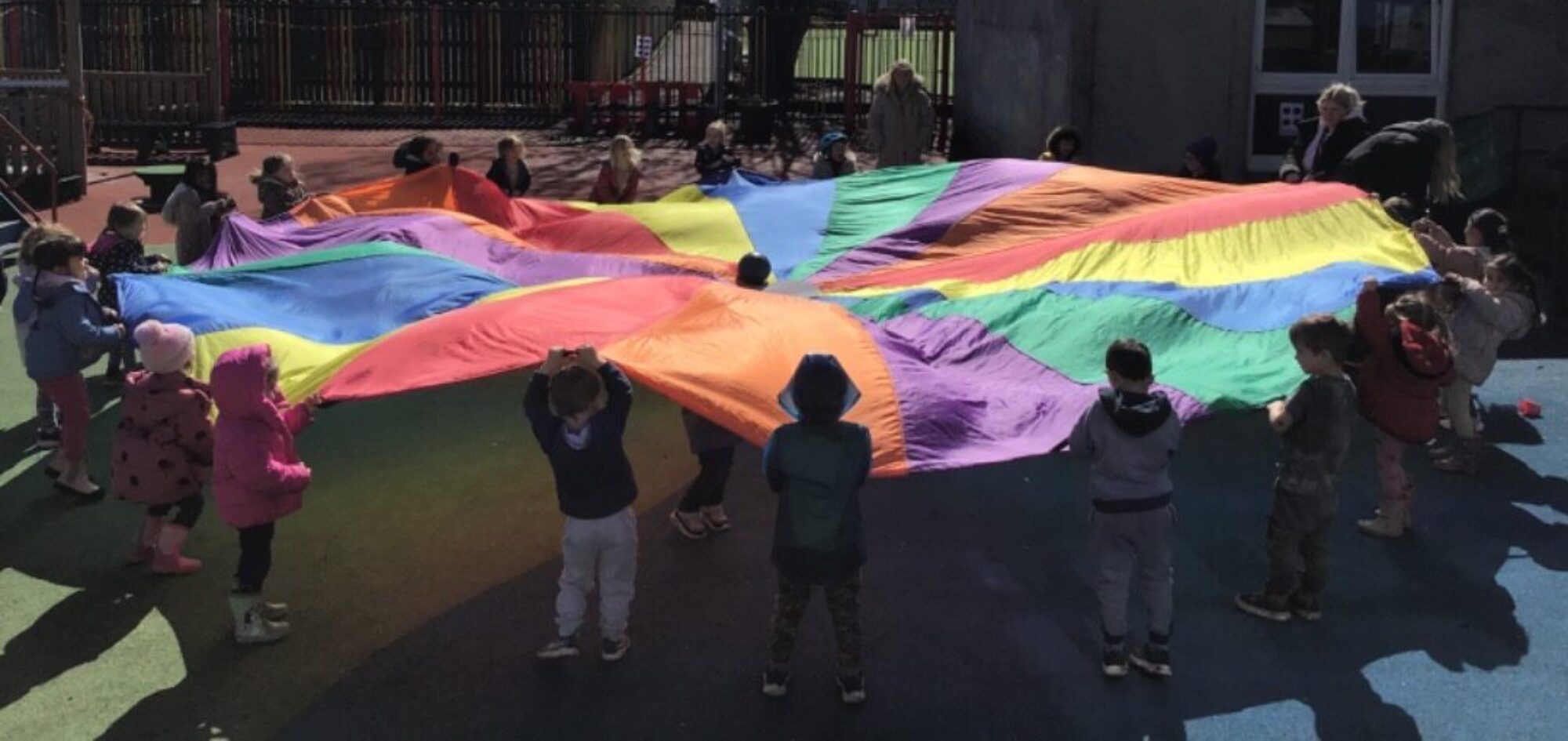
 As part of our ongoing Children’s Rights commitment, we are continuing our journey to embed children’s rights at the heart of everything we do.