Author: Miss Abercrombie

Festive Digital Activities for Learners

The festive season is here, bringing with it a wonderful opportunity to blend seasonal cheer with engaging digital learning opportunities. Whether you’re looking for activities which build digital creativity, seasonal STEM challenges, or fun ways to practice digital skills, this guide gathers a sleigh-full of festive activities from DigiLearnFalk, Connected Falkirk and our friends designed to spark joy and curiosity in learners of all ages. Get ready to wrap up the year with some digital learning fun!

Local Resources

Our home grown Falkirk festive resources designed to be used with 1:1 and Shared iPads.

Creative Activities for Learners Festive Edition II

The latest edition of our Creative Activities for Leaners which focuses on festive fun. (Pssst…Edition I is still available here, as is the YouTube playlist for Edition 1 which can be found here).

Festive Activities for Early and First Level

This free downloadable Keynote contains seven festive activities for early and first level learners. Explore creativity, coding and games which all help to build familiarity with iPad as well as build digital skills and confidence. 

You can preview a PDF version of the Keynote below, for best results and access to all activities (including voice instructions to support pre-readers) within the one document please download the Keynote file from our Box folder here. Find out more details about our festive activities for early and first level learners here.

Codemas

Three coding themed challenges to celebrate the festive season and boost STEM learning.

Other Resources

Festive resources for 2026 from our friends and partners. Please note, some of these activities use text-to-image AI, all Falkirk Council Education employees using or thinking of using AI in the classroom must familiarise themselves with the AI in Education: Guiding Principles and Support page.

Adobe Express 12 Days of Creativity

Twelve joyful, low-prep Adobe Express activities to celebrate learning and wrap up the year with creativity and cheer. Whether you unwrap one activity each day or all 12 at once, getting started is easy: Pick an activity.

All learners and teachers in Falkirk have access to Adobe Express via Glow. For more information on this and how to log in visit this page.

To access the 12 Days of Creativity challenges:

  • iPad users log into Adobe Express app as usual and the activities will appear on the main home page
  • Desktop users can click this link: adobe.ly/12DOC25

Find out more directly from Adobe Express here or browse the activities below.

Day 1: Design an ugly sweater

Skills: Gen AI Styles + Background Swapping

Day 2: Design Your Very Own Stuffie

Skills: Generate Image, Background Swapping, Image Effects

Day 3: Design a One-Word Wallpaper

Skills: Text Effects, Background Swapping

Day 4: Transform Yourself Into a Dancing Elf

Skills: Photo Upload, Crop, Wobble-loop Animation

Day 5: Animate a Funky Snack

Skills: Animation, Layered Elements, GIF Export

Day 6: Send a Vintage Postcard

Skills: Text Effects, Layering

Day 7: Record a News Story From Future You

Skills: Gen AI Styles + Background Swapping

Day 8: Assemble a Talking Snowman

Skills: Generate Image, Background Swapping, Image Effects

Day 9: Sugarcoat Your Favourite Animal

Skills: Text Effects, Background Swapping

Day 10: Construct a Personalized Snow Globe

Skills: Multi-Layer Video Editing, Animation

Day 11: Personalize a Time Capsule

Skills: Video and Music Editing

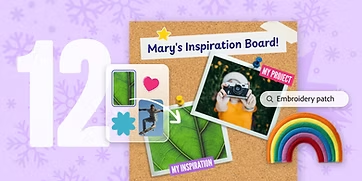
Day 12: Curate an Inspiration Board

Skills: Layering, Image Effects, Text Effects

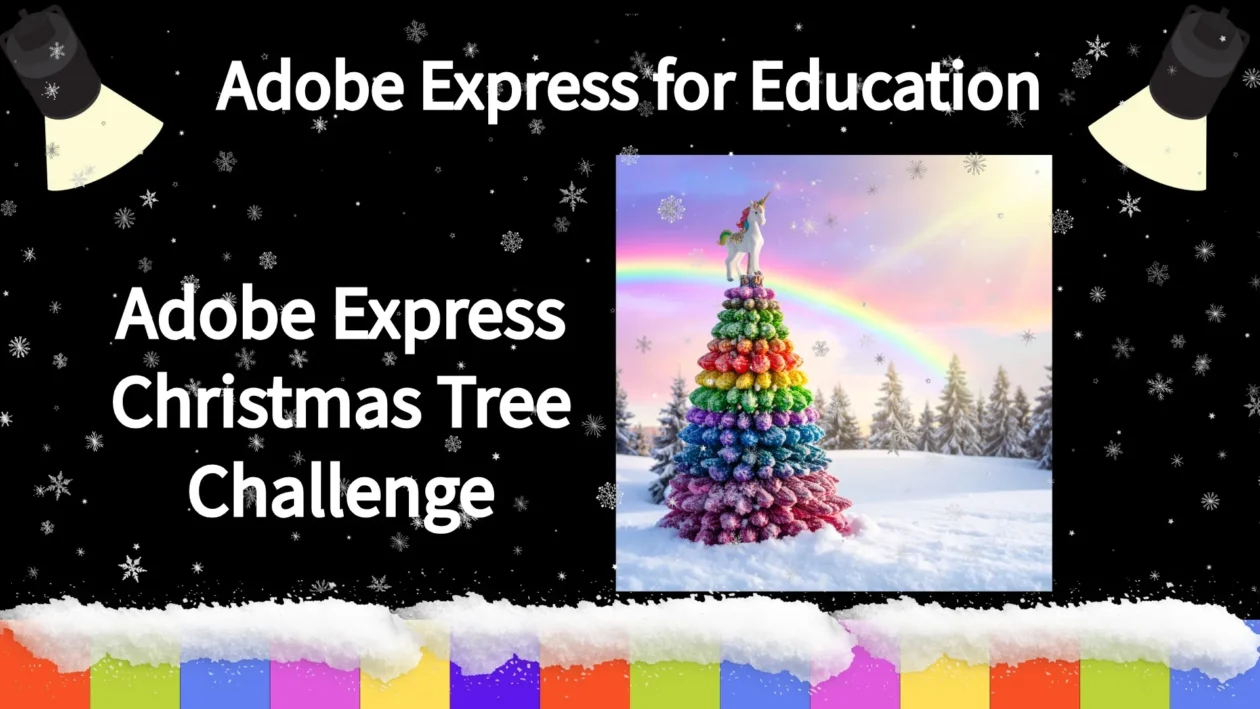
Glow Adobe Express Christmas Tree Challenge

Glow are running an Adobe Express Christmas Tree Challenge! The challenge is to use the powerful tools in Adobe Express for Education to design and create a unique Christmas tree. Find out more here. 

Session Resources: AI in Education – Assessment and Feedback

This page is for session resources from our AI in Education: Engagement and Interaction session. This session explored AI tools aimed at assisting with evaluating learner understanding and providing feedback.

Session Slides

You can view a PDF copy of the slides below. If you’d prefer the Keynote version please contact Kerry Abercrombie.

Additional Content

Our sessions tend to have a lot of live demonstrations within them. The remainder of the page outlines some of the digital tools covered in the session or signposting to some of the resources shown or mentioned in a format which can be easily revisited or passed along to colleagues who were unable to attend the session.

AI in Education: Guiding Principles and Support

All Falkirk Council education staff using or considering using AI in education should familiarise themselves with the AI in Education: Guiding Principles and Support information

AI Teacher Tools – Starter Suite

Navigating the rapidly evolving landscape of AI in education can be overwhelming for busy educators. Our starter suite offers a carefully curated collection of nine free AI-powered tools which have been assessed to ensure their educational value and ease of initial use. The hope is that this provides a practical entry point for teachers and establishments embarking on their AI journey. The document sorts the tools by educational function, gives an education focused use overview and provides quick guides for each tool.

Falkirk AI Teacher Network

Are you interested in exploring the potential of AI in education? Express your interest in joining our AI Teacher Network. By filling out this form, you’ll help us connect with like-minded educators and keep you updated on exciting opportunities, resources, and events. You will also have the opportunity to influence the use if AI in education within Falkirk. We’ll be in touch with details of how to join the Microsoft Teams space.

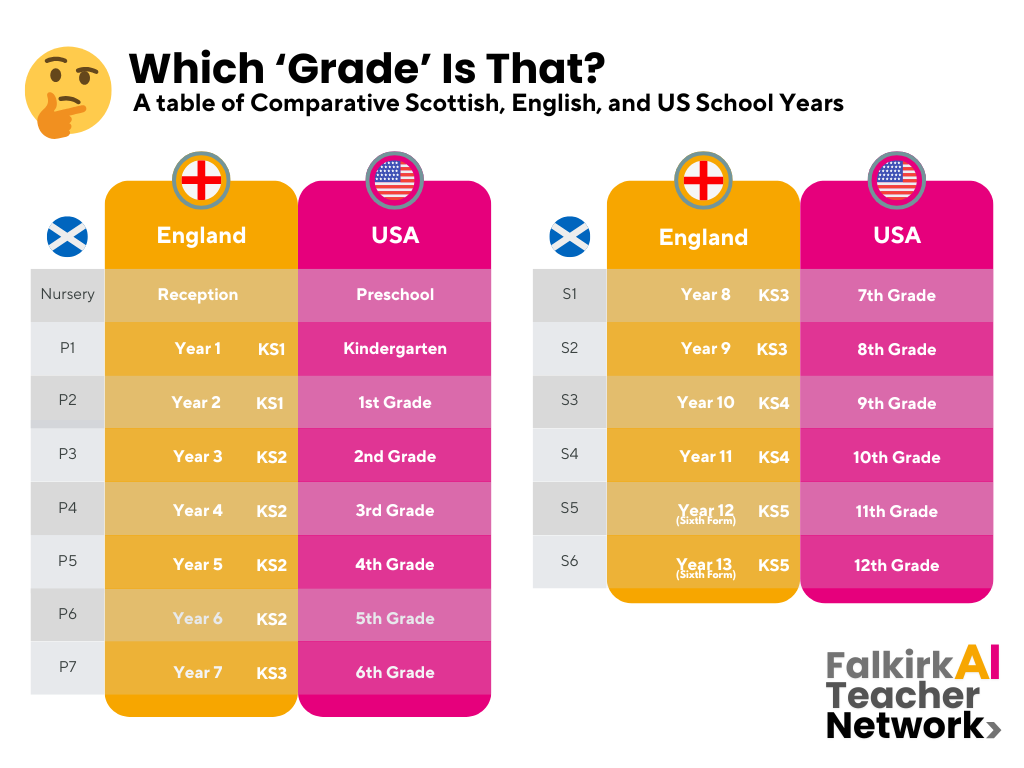
Which ‘Grade’ is That? Conversion Table

Here is that handy conversion table for use with AI tools which default to the US system.

Quick Guides

Below you can find the quick guides for the four tools featured in this session.

Curipod

Curipod Quick Start Guide by Miss Abercrombie

What does it do? Curipod is a platform designed to assist educators in creating engaging and interactive lessons. It combines elements like polls, word clouds, and drawing activities to make learning dynamic and participatory. Curipod’s built in AI features allow educators to generate interactive lessons quickly and easily. All AI output is customisable. Additionally, Curipod’s AI adapts content to suit different teaching styles and student needs, streamlining the lesson material creation process while making learning more interactive and engaging.

How do I get access? Teachers can access Curipod by signing up for a free basic account on the Curipod website.

Pupils do not need accounts to participate in Curipod lessons.

Wayground (Quizizz)

Wayground Quick Start Guide by Miss Abercrombie

What does it do? Wayground (formerly Quizizz) is an online learning platform that enables teachers to create and share interactive quizzes, polls, and lessons. Wayground has integrated AI features that allow teachers to automatically generate quizzes, worksheets, and questions based on specific topics or curriculum needs. By using AI, Wayground can suggest questions tailored to different skill levels, provide instant feedback to students, and offer personalised learning paths. This streamlines lesson planning and helps teachers quickly assess student understanding, making the platform more efficient for educational purposes.

How do I get access? Teachers can sign up for a free account at wayground.com

Pupils do not need accounts to participate in Quizizz activities.

Magic School – Quick Start Guide

Magic School Quick Start Guide by Miss Abercrombie

What does it do? Magic School is a collection of 70+ AI tools (Magic Tools) to help teachers with a variety of tasks including lesson planning, differentiation, planning group work, generating vocabulary lists, and so much more. It also has 40+ responsible AI tools that can be launched to students to allow them to explore generative AI while the teacher can monitor their interactions with and the outputs from the AI model. Tools for students include study habits, debate partner, multiple explanations and more.

How do I get access? Teachers can sign up for a free account on the Magic School website.

Pupils do not need accounts to participate in Magic School activities.

School AI – Quick Start Guide

SchoolAI Quick Start Guide by Miss Abercrombie

What does it do? School AI allows learners to explore a Large Language Model in a safe environment through ChatGPT powered experiences called Spaces. Teachers can choose from a library spaces, or create their own with custom instructions tailored to learners’ needs. Teachers can manage, moderate and steer as students interact with the machine and receive real time ‘insights’ as well as being able to access live conversations from the teacher moderation screen.

How do I get access? Teachers can access School AI by signing up for a free basic account on the School AI website.

Pupils do not need accounts to participate in School AI spaces.

Session Recording

Here is a recording of the session for those who wish to watch it again or who missed it. Please be aware that the session recording is edited to remove all discussion and task sections. This is to protect the privacy of our participants and ensure everyone feels comfortable speaking freely on mic and in the chat without worry that their comments will be made publicly available.

Session Resources: AI in Education – Engagement and Interaction

This page is for session resources from our AI in Education: Engagement and Interaction session. This session explored AI tools aimed at making learning more interactive and captivating for students.

Session Slides

You can view a PDF copy of the slides below. If you’d prefer the Keynote version please contact Kerry Abercrombie.

Additional Content

Our sessions tend to have a lot of live demonstrations within them. The remainder of the page outlines some of the digital tools covered in the session or signposting to some of the resources shown or mentioned in a format which can be easily revisited or passed along to colleagues who were unable to attend the session.

AI in Education: Guiding Principles and Support

All Falkirk Council education staff using or considering using AI in education should familiarise themselves with the AI in Education: Guiding Principles and Support information

AI Teacher Tools – Starter Suite

Navigating the rapidly evolving landscape of AI in education can be overwhelming for busy educators. Our starter suite offers a carefully curated collection of nine free AI-powered tools which have been assessed to ensure their educational value and ease of initial use. The hope is that this provides a practical entry point for teachers and establishments embarking on their AI journey. The document sorts the tools by educational function, gives an education focused use overview and provides quick guides for each tool.

Falkirk AI Teacher Network

Are you interested in exploring the potential of AI in education? Express your interest in joining our AI Teacher Network. By filling out this form, you’ll help us connect with like-minded educators and keep you updated on exciting opportunities, resources, and events. You will also have the opportunity to influence the use if AI in education within Falkirk. We’ll be in touch with details of how to join the Microsoft Teams space.

Which ‘Grade’ is That? Conversion Table

Here is that handy conversion table for use with AI tools which default to the US system.

Quick Guides

Below you can find the quick guides for the four tools featured in this session.

Curipod

Curipod Quick Start Guide by Miss Abercrombie

What does it do? Curipod is a platform designed to assist educators in creating engaging and interactive lessons. It combines elements like polls, word clouds, and drawing activities to make learning dynamic and participatory. Curipod’s built in AI features allow educators to generate interactive lessons quickly and easily. All AI output is customisable. Additionally, Curipod’s AI adapts content to suit different teaching styles and student needs, streamlining the lesson material creation process while making learning more interactive and engaging.

How do I get access? Teachers can access Curipod by signing up for a free basic account on the Curipod website.

Pupils do not need accounts to participate in Curipod lessons.


Wayground (Quizizz)

Wayground Quick Start Guide by Miss Abercrombie

What does it do? Wayground (formerly Quizizz) is an online learning platform that enables teachers to create and share interactive quizzes, polls, and lessons. Wayground has integrated AI features that allow teachers to automatically generate quizzes, worksheets, and questions based on specific topics or curriculum needs. By using AI, Wayground can suggest questions tailored to different skill levels, provide instant feedback to students, and offer personalised learning paths. This streamlines lesson planning and helps teachers quickly assess student understanding, making the platform more efficient for educational purposes.

How do I get access? Teachers can sign up for a free account at wayground.com

Pupils do not need accounts to participate in Quizizz activities.

Padlet ‘AI Image’ 

Padlet AI Image Quick Start Guide by Miss Abercrombie

What does it do? Padlet’s “AI Image” feature uses a text-to-image AI model to transform users’ written descriptions into images.

How do I get access? Teacher sets up a Padlet and learners access via link or QR code. Pupils do not need to log in.

Adobe Express

Adobe Express Quick Start Guide by Miss Abercrombie

 What does it do? Adobe Firefly in Adobe Express is an AI-powered tool that allows users to generate and edit images using text prompts. It enabling users to quickly create designs, add effects, and make creative adjustments to photos, illustrations, and graphics.

How do I get access? Learners have access to Adobe Express via Glow.


Session Recording

Here is a recording of the session for those who wish to watch it again or who missed it. Please be aware that the session recording is edited to remove all discussion and task sections. This is to protect the privacy of our participants and ensure everyone feels comfortable speaking freely on mic and in the chat without worry that their comments will be made publicly available.

Session Resources: Planning for Effective Digital Experiences

This page is for session resources from our Planning for Effective Digital Experiences session. This session explored planning for digital learning from both a documentation and a practical application point of view. 

Session Slides

You can view a PDF copy of the slides below. If you’d prefer the Keynote version please contact Kerry Abercrombie.

Additional Content

Our sessions tend to have a lot of live demonstrations within them. The remainder of the page outlines some of the digital tools covered in the session or signposting to some of the resources shown or mentioned in a format which can be easily revisited or passed along to colleagues who were unable to attend the session.


Planning for Digital Learning Document

Below we have embedded the new Planning for Digital Learning document. You can also access this in full screen here. As we mentioned in the session, this is only part one – part two which focuses on practical application is currently being created. 


Session Recording

Here is a recording of the session for those who wish to watch it again or who missed it. Please be aware that the session recording is edited to remove all discussion and task sections. This is to protect the privacy of our participants and ensure everyone feels comfortable speaking freely on mic and in the chat without worry that their comments will be made publicly available.

Session Resources: AI in Education – Differentiation and Accessibility

This page is for session resources from our AI in Education: Differentiation and Accessibility session. This session explored AI tools designed to help cater to diverse learner needs.

Session Slides

You can view a PDF copy of the slides below. If you’d prefer the Keynote version please contact Kerry Abercrombie.

Additional Content

Our sessions tend to have a lot of live demonstrations within them. The remainder of the page outlines some of the digital tools covered in the session or signposting to some of the resources shown or mentioned in a format which can be easily revisited or passed along to colleagues who were unable to attend the session.

.

AI in Education: Guiding Principles and Support

All Falkirk Council education staff using or considering using AI in education should familiarise themselves with the AI in Education: Guiding Principles and Support information

Education Prompt Library

The education prompt library is a collection of pre-prepared, high-quality prompts covering a wide range of planning and preparation tasks and pedagogical approaches. Educators can browse the prompts, copy and paste their selected prompt directly into Google Gemini, then customise it to suit their specific context and needs. The education prompt library is an ongoing piece of work and will continue to grow over time. Prompts 4, 5, 7, 10, 11 are specifically related to differentiation or accessibility.

AI Teacher Tools – Starter Suite

Navigating the rapidly evolving landscape of AI in education can be overwhelming for busy educators. Our starter suite offers a carefully curated collection of nine free AI-powered tools which have been assessed to ensure their educational value and ease of initial use. The hope is that this provides a practical entry point for teachers and establishments embarking on their AI journey. The document sorts the tools by educational function, gives an education focused use overview and provides quick guides for each tool.

Falkirk AI Teacher Network

Are you interested in exploring the potential of AI in education? Express your interest in joining our AI Teacher Network. By filling out this form, you’ll help us connect with like-minded educators and keep you updated on exciting opportunities, resources, and events. You will also have the opportunity to influence the use if AI in education within Falkirk. We’ll be in touch with details of how to join the Microsoft Teams space.

Which ‘Grade’ is That? Conversion Table

Here is that handy conversion table for use with AI tools which default to the US system.

Quick Guides

Below you can find the quick guides for the four tools featured in this session.

Google Gemini – Quick Start Guide

Gemini Quick Guide by Miss Abercrombie

What does it do?

Google Gemini chatbot is a large language model (LLM) developed by Google. While Google Gemini describes a family of LLM tools integrated throughout Google Workspace, the Google Gemini standalone chatbot is available to all staff via Glow login to the Google Workspace tenancy operated by Glow/Education Scotland. Its ability to process and generate diverse information aims to create more natural and helpful AI interactions. Google Gemini is an 18+ product and is only available to staff users within Glow. It is designed to be multimodal, meaning it can understand and operate across text, code, images, and more.   

How do I get access? Staff can log into Google Gemini for free via their Glow account. Learners do not have access to Google Gemini via Glow as it is an 18+ product.

Diffit

Diffit Quick Start Guide by Miss Abercrombie

What does it do? Diffit is an AI-powered tool designed to help educators create differentiated learning materials quickly. It allows teachers to generate customised content at various reading levels based on a given text or topic. By adjusting the complexity of language, Diffit ensures that students with different abilities can engage with the same subject matter, supporting personalised learning and making lesson planning more efficient for teachers. 

How do I get access? Teachers can sign up for a free account on the Diffit website.

Pupils do not need to access Diffit.

Magic School – Quick Start Guide

Magic School Quick Start Guide by Miss Abercrombie

What does it do? Magic School is a collection of 70+ AI tools (Magic Tools) to help teachers with a variety of tasks including lesson planning, differentiation, planning group work, generating vocabulary lists, and so much more. It also has 40+ responsible AI tools that can be launched to students to allow them to explore generative AI while the teacher can monitor their interactions with and the outputs from the AI model. Tools for students include study habits, debate partner, multiple explanations and more.

How do I get access? Teachers can sign up for a free account on the Magic School website.

Pupils do not need accounts to participate in Magic School activities.

School AI – Quick Start Guide

SchoolAI Quick Start Guide by Miss Abercrombie

What does it do? School AI allows learners to explore a Large Language Model in a safe environment through ChatGPT powered experiences called Spaces. Teachers can choose from a library spaces, or create their own with custom instructions tailored to learners’ needs. Teachers can manage, moderate and steer as students interact with the machine and receive real time ‘insights’ as well as being able to access live conversations from the teacher moderation screen.

How do I get access? Teachers can access School AI by signing up for a free basic account on the School AI website.

Pupils do not need accounts to participate in School AI spaces.

Session Recording

Here is a recording of the session for those who wish to watch it again or who missed it. Please be aware that the session recording is edited to remove all discussion and task sections. This is to protect the privacy of our participants and ensure everyone feels comfortable speaking freely on mic and in the chat without worry that their comments will be made publicly available.

Session Resources: Accessibility – Reaching All Learners

This page is for session resources from our Accessibility Reaching All Learners session. This session explored accessibility tools built into iPad as standard which are available to all learners on Connected Falkirk devices. 

Session Slides

You can view a PDF copy of the slides below or download the PDF by clicking on the three dots and selecting ‘Download PDF File’. If you’d prefer the Keynote version please contact Mari-Jane Wilcox.


Additional Content

Our sessions tend to have a lot of live demonstrations within them. The remainder of the page outlines some of the digital tools covered in the session or signposting to some of the resources shown or mentioned in a format which can be easily revisited or passed along to colleagues who were unable to attend the session.

The images and videos below are from a Connected Falkirk iPad – if you don’t have some of these features it may be because you are running a different version of iOS please update your iPad software by going to General > Software Update.

Apple categorise their accessibility features through for main categories of need: visual, motor, hearing and cognitive. We have organised this guide by elements which may help specifically in learning contexts: reading, writing, focus and physical.


Reading

Writing

Focus

Physical

Reading

There are many features on the iPad that can make reading easier. From display settings to read aloud functions there are lots of ways to customise your device.

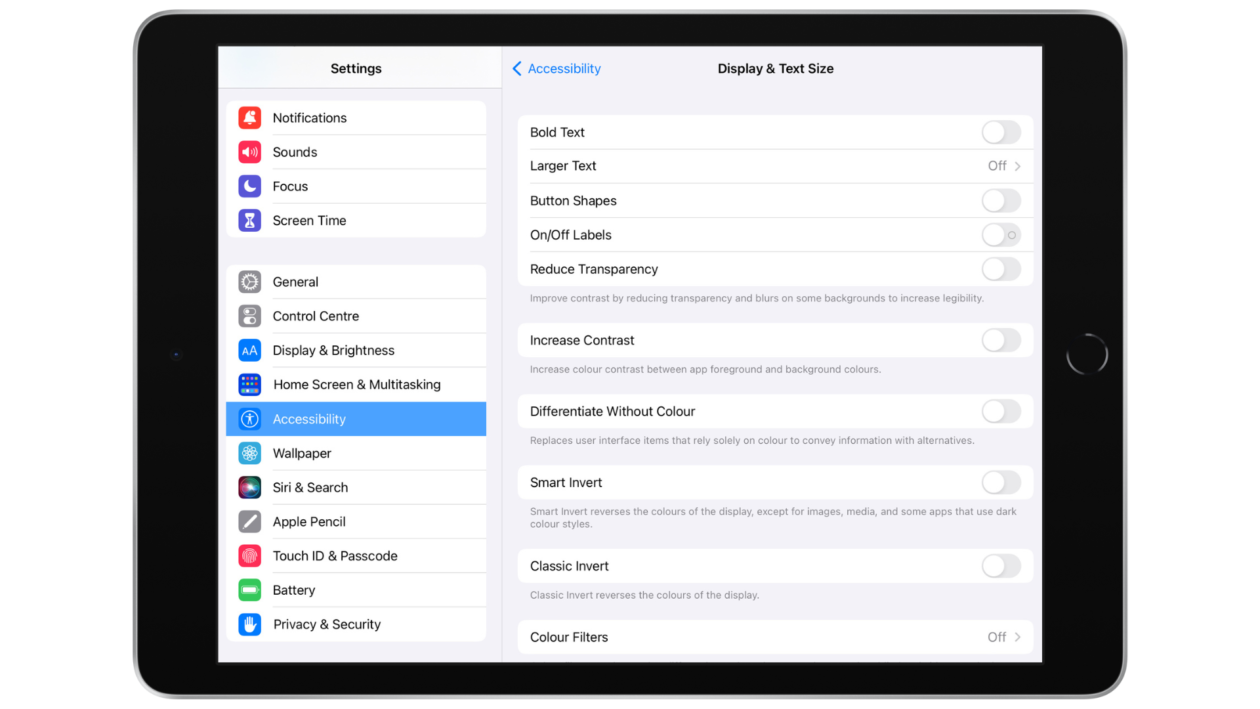
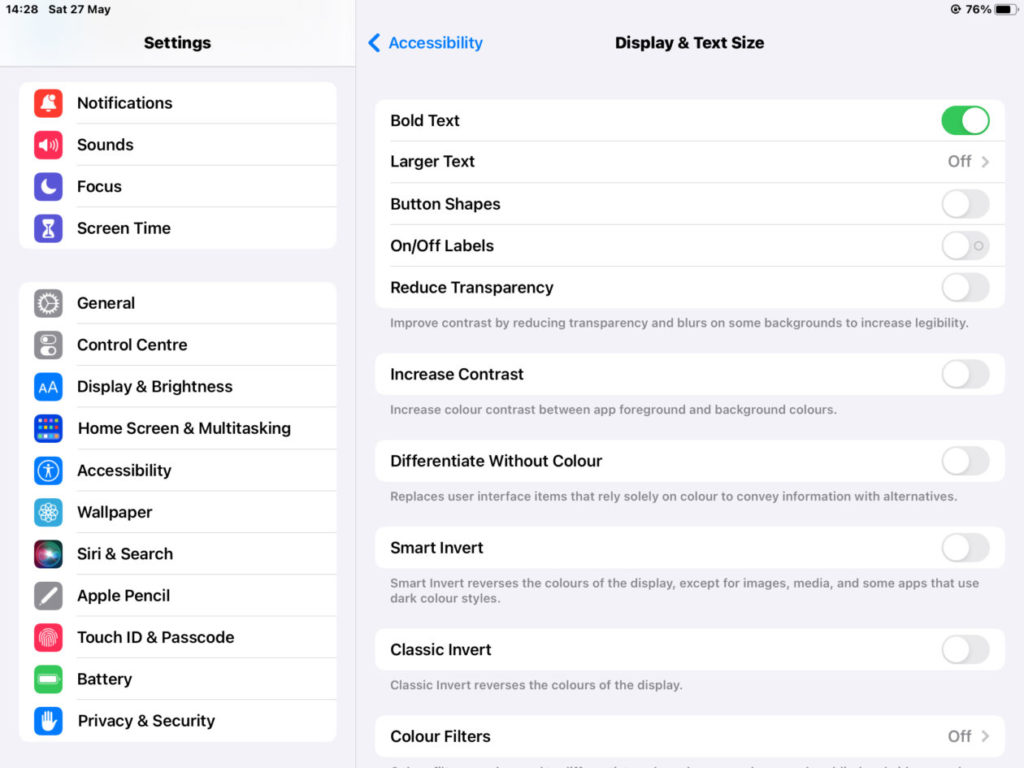
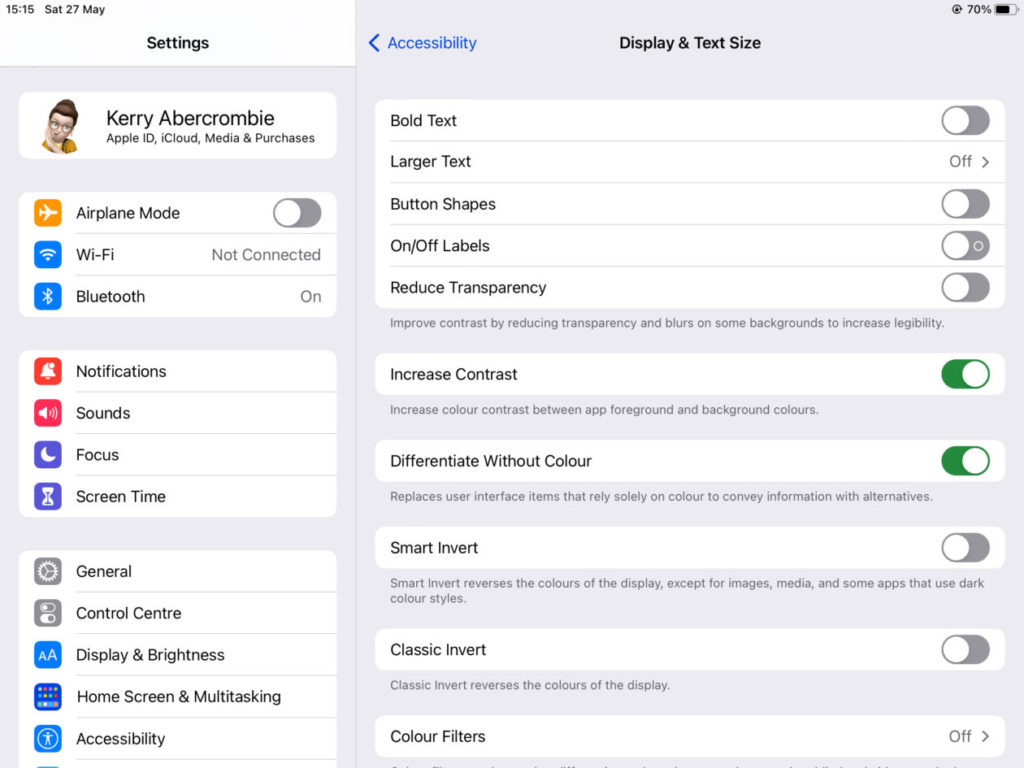
Settings > Accessibility > Display & Text Size

Display & Text size options allow you to change the display settings on your device, these settings are applied to objects like buttons, menus, colours, dynamic text and other elements of the core display. Please note they do not apply to third party app contents and interfaces.

The clickable graphic below gives more information on what some of the most useful options within Display & Text Size do. 

Display & Text Size
Bold Text Larger Text On/Off Labels Increase Contrast Colour Filters

Bold Text

Bold text makes the text always bold throughout the system (app tile names, menu items, etc).

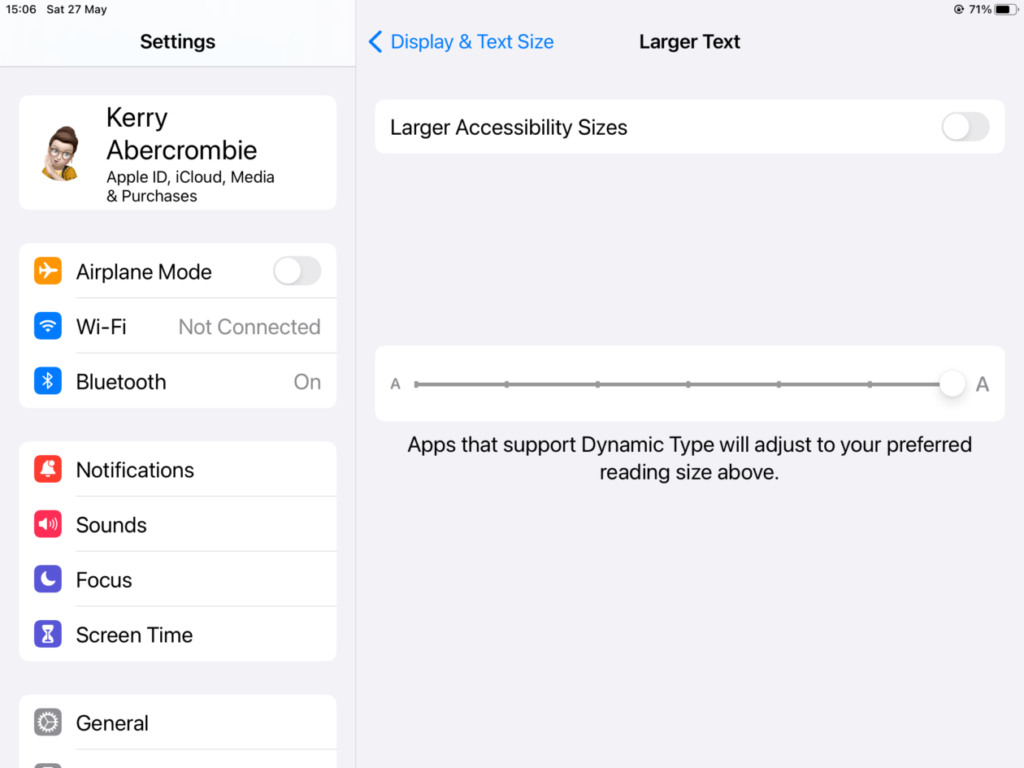
Larger Text

Larger text allows you to use the slider to increase or decrease the text size of your iPad display. If the largest size is not big enough you can toggle on Larger Accessibility Sizes which will enable a further slider.

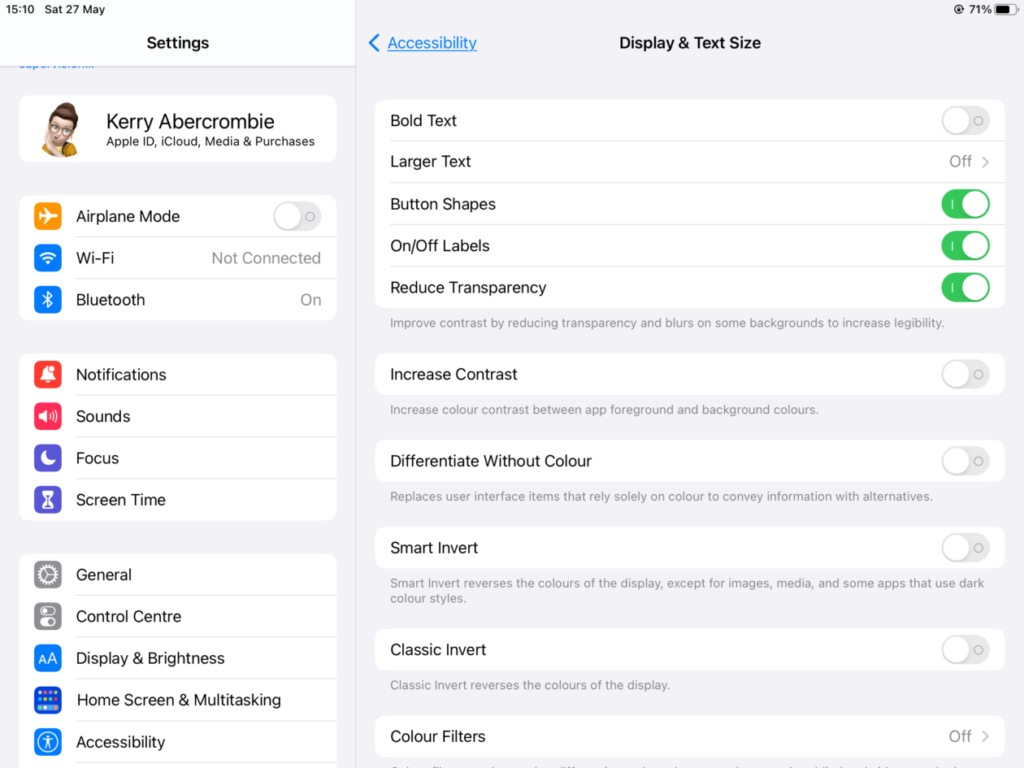
On/Off Labels

On/Off Labels are handy for seeing when toggles are on or off by adding an additional visual mark that doesn't rely solely on colour.

Increase Contrast

Increase contrast increases the colour contract between app foreground and background colours - the contrast makes text appear darker which some people find easier to read.

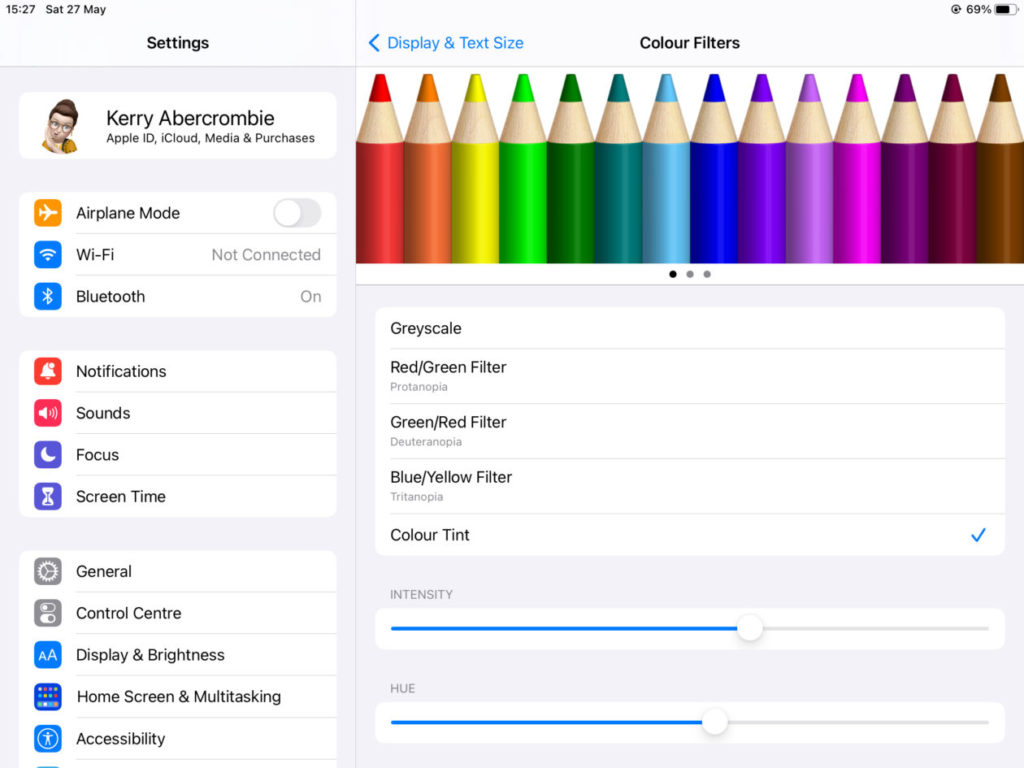
Colour Filters

Colour filters allow you to apply a colour filter to your screen. Once toggled on you can choose from different filters or you can select your own colour tint and adjust the intensity and hue. This is very useful for people who benefit from a coloured overlay in class. The setting is only applied to your own device so does not appear on screenshots or screen mirroring keeping the support discreet for the user.

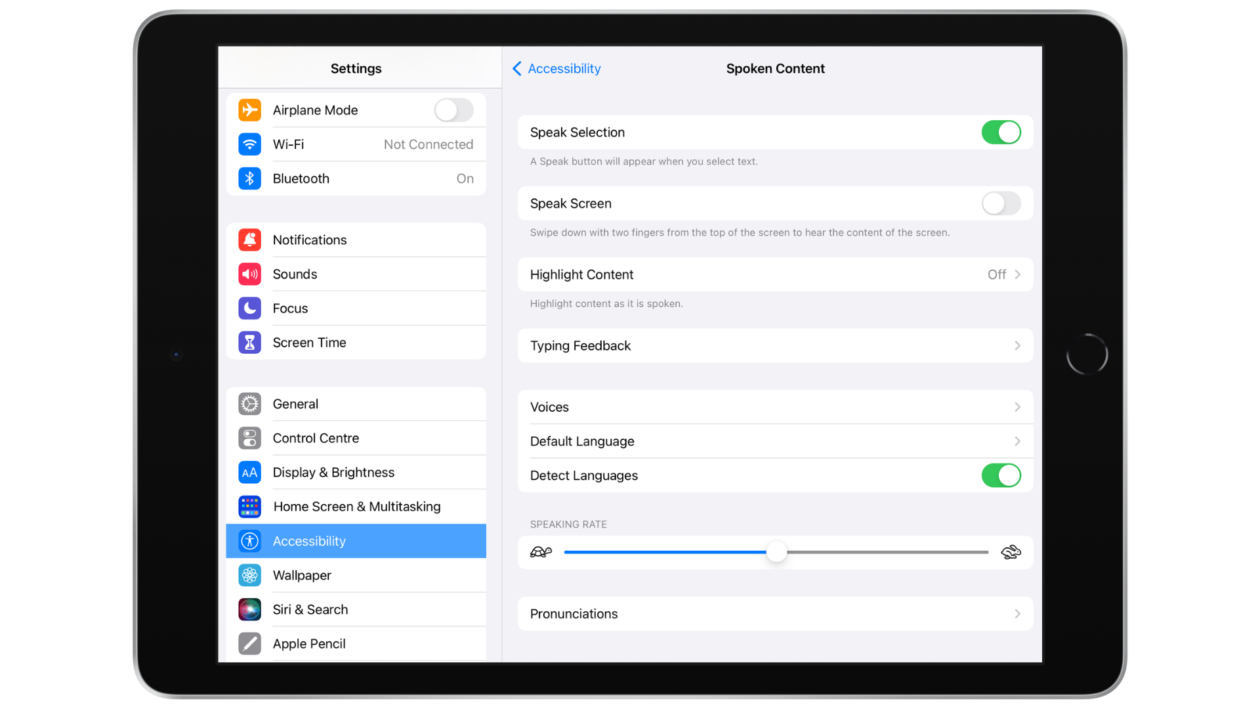
Settings > Accessibility > Spoken Content 

Spoken Content features give lots of options for users who benefit from hearing words and sentences spoken aloud. Please note that these features are designed to work with core apps, some third party apps may not allow these system features to be used.

Spoken Content
Speak Selection Speak Screen Highlight content Typing Feedback Voices Pronunciations

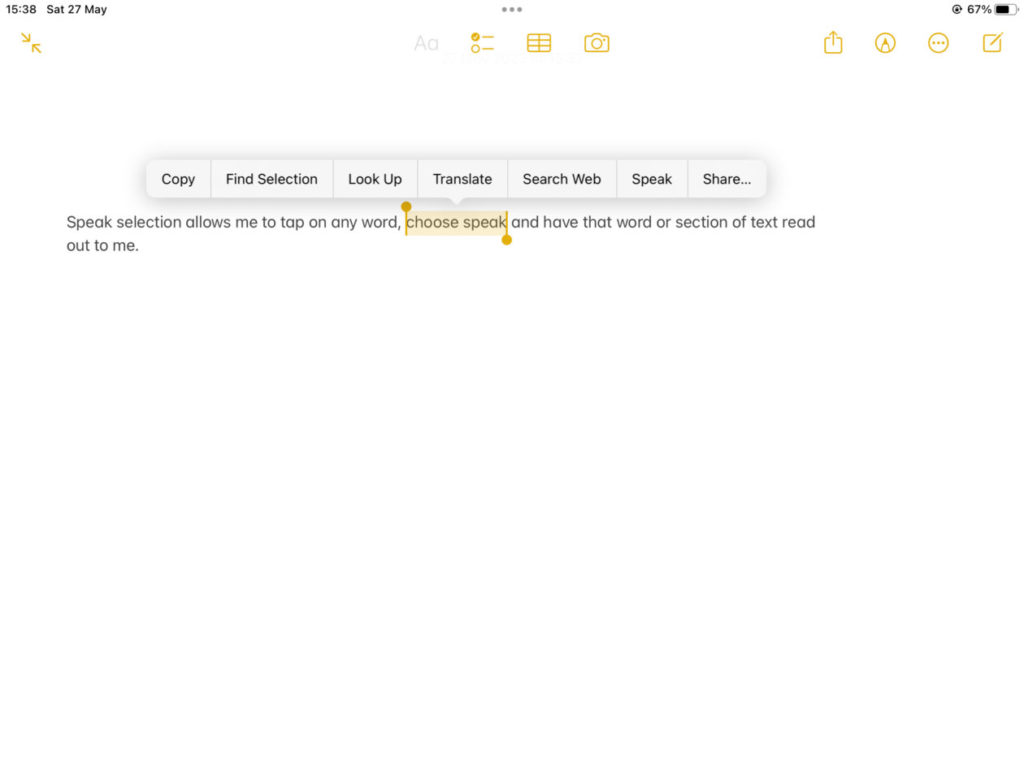
Speak Selection

This is one we think everyone should have switched on. When you select text on an iPad (by double tapping) a number of options appear above the text. Speak selection adds

Speak Screen

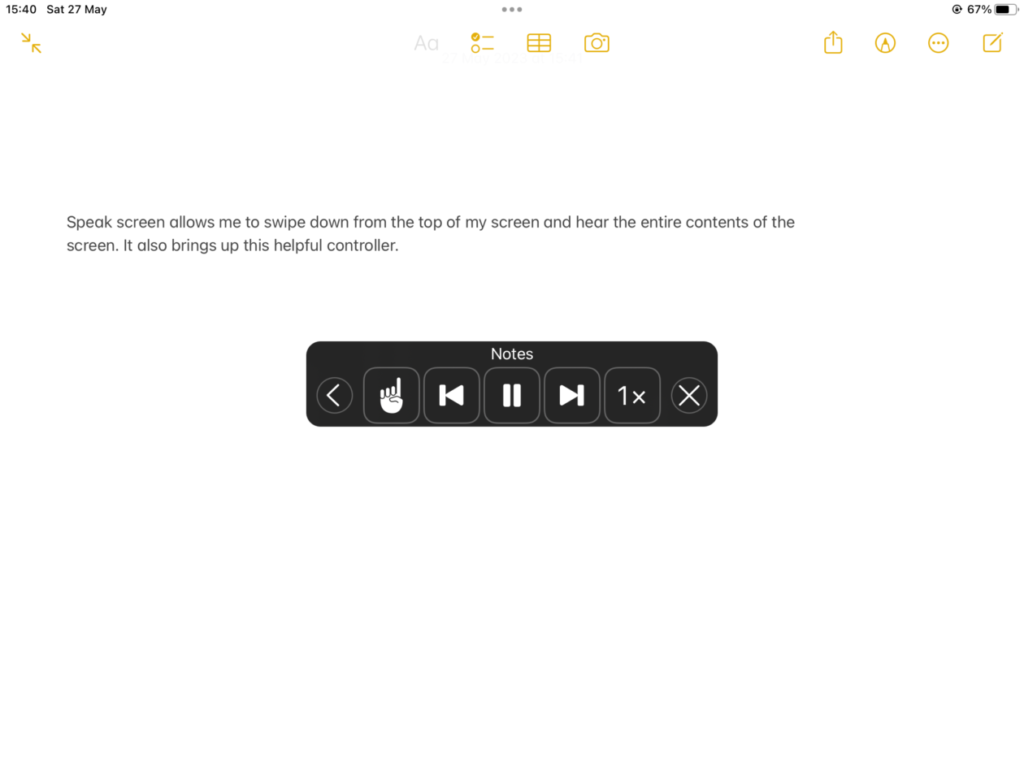
When speak screen is turned on users can swipe downwards from the top of the screen with two fingers to have the entire screen read to them. It also brings up a controller which allows for moving backwards and forward through the reading as well as speeding up or slowing down the pace.

Highlight content

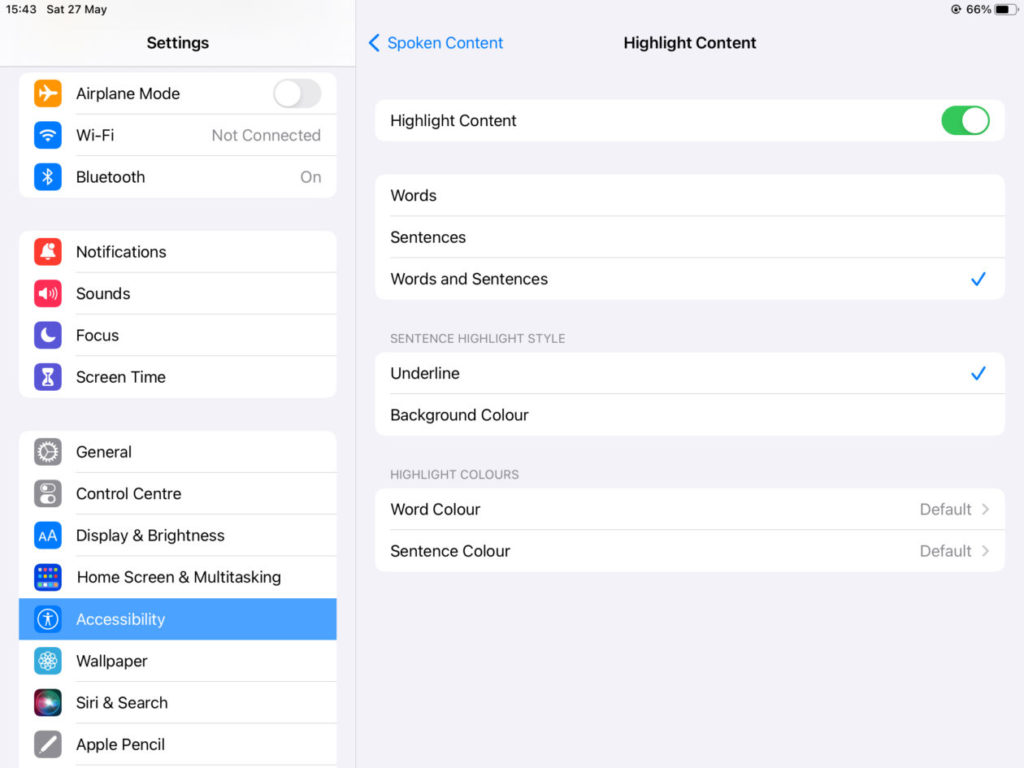
Highlight context gives users several options for having spoken content highlighted as it is read aloud. You can choose from words, sentences or words and sentences as well as being able to customise highlight styles and colours. This can be really useful for people who like to follow along with a visual cue.

Typing Feedback

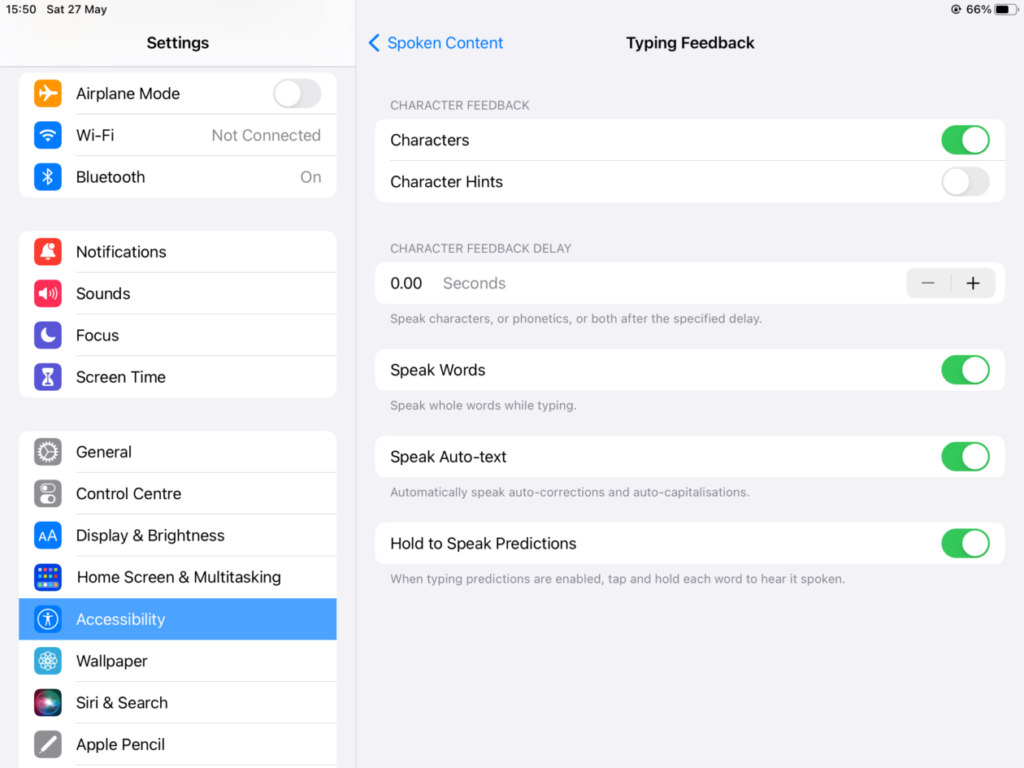
Possibly more useful for writing than reading. Typing feedback allows users to have what they are typing read back to them automatically, there are many options for the level of support the device can give.

Character Feedback reads each individual letter out as it is typed, with character hints toggled on it will also gives the phonetic alphabet version of the letter (i.e. "H - Hotel").

Speak Words will read the whole word back to the user either when they have pressed space at the end of typing the word or added a full stop to indicate the end of a sentence.

Hold to Speak Predictions allows users to tap and hold on predicted words to have them read out before they select them.

Voices

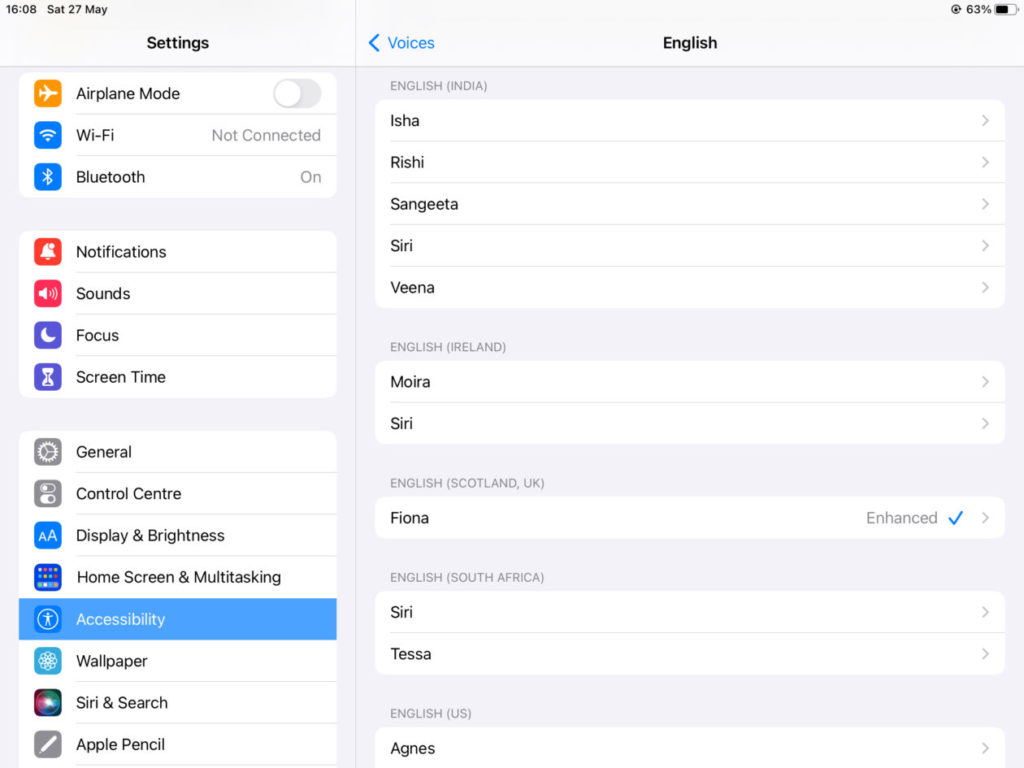
Voices allows you to chose which voice reads the spoken content. With iOS 16 there is now (for the first time) a Scottish accent - Fiona - on your iPad. This can be useful both for native English speakers who are used to Scottish accents and for EAL learners who are in the process of learning/acquiring English through Scottish friends and teachers.

Detect languages being toggle on is helpful this setting automatically detects text that is typed in a different language and will read it aloud in that language when Speak is tapped.

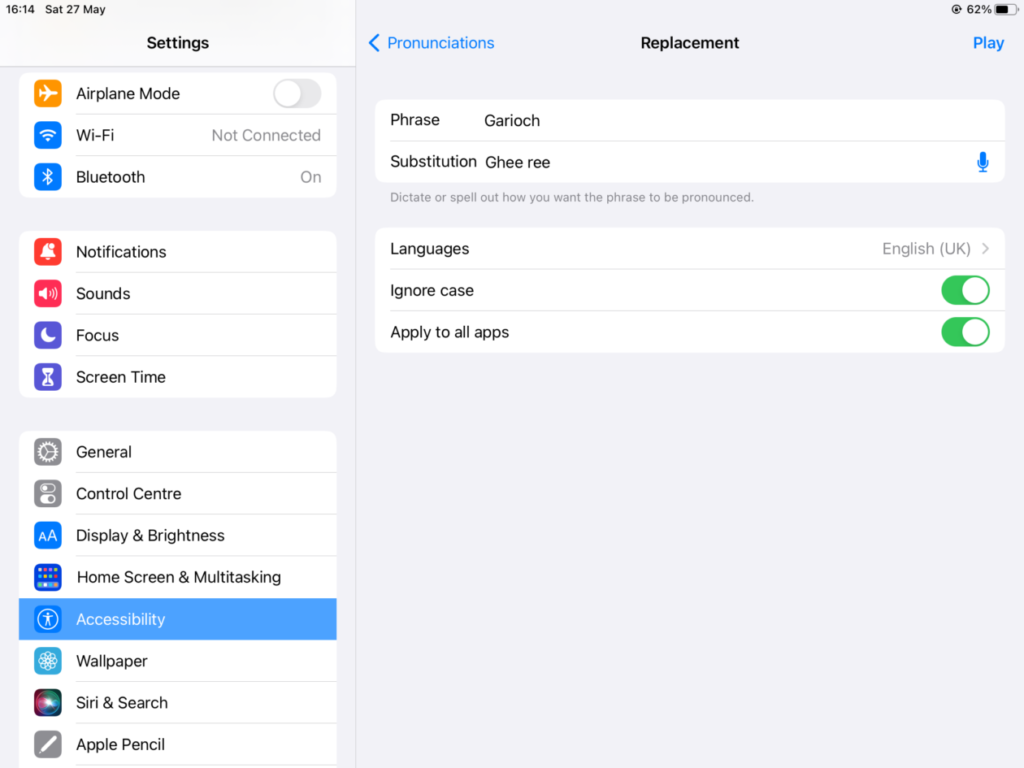
Pronunciations

Every now and again the pronunciation of a word isn't quite right. Users can adjust these by adding custom pronunciations for their iPad. Simply type the word that is being mispronounced and then type the phonetic way it should/could be said.

Writing

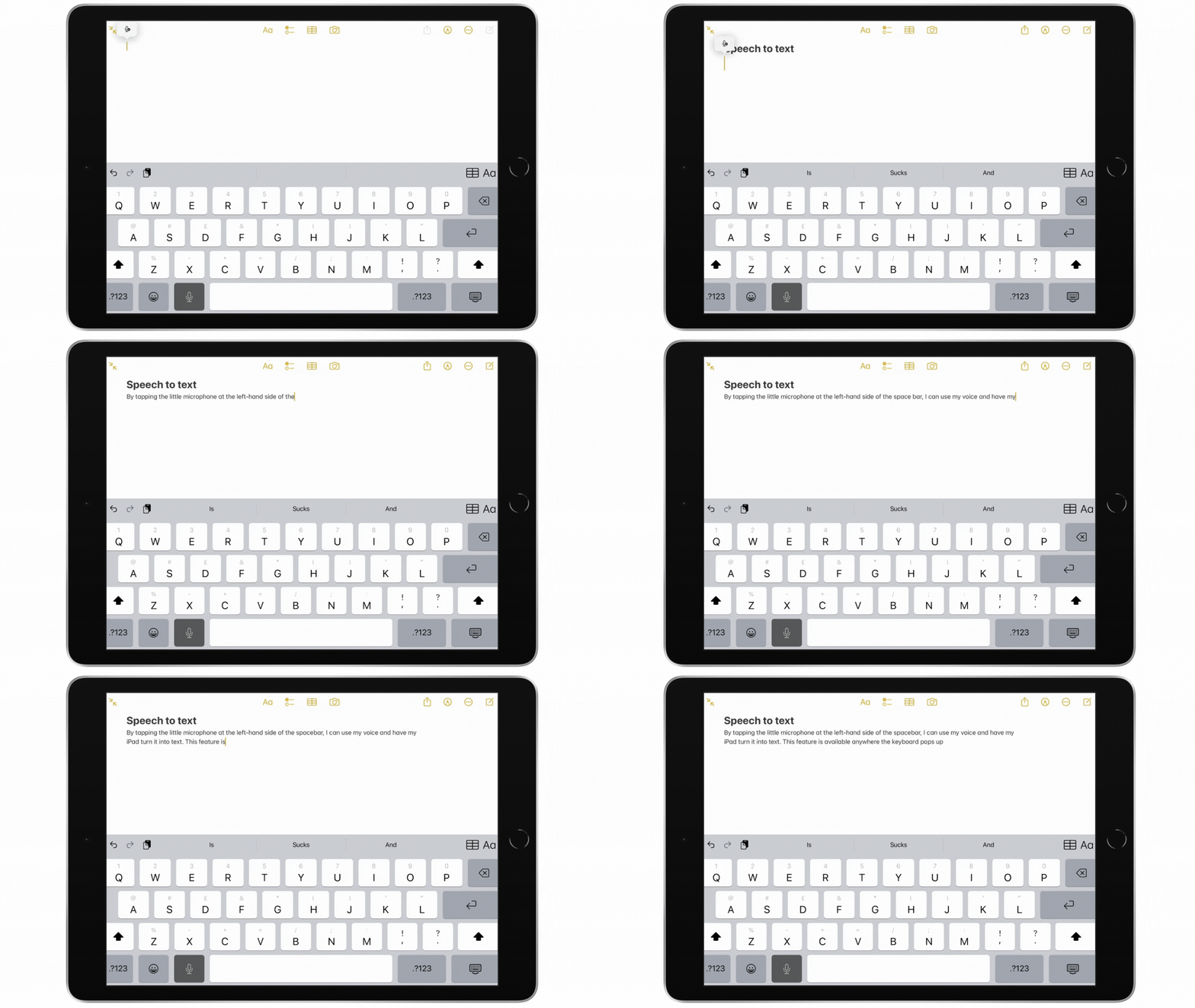
Dictation

One of the most useful features to help with writing is the in built dictation or speech to text tool which appears as standard on the keyboard every time it pops up. Users can simply tap the little microphone icon to the left of the space bar and speak what they want to be typed on the screen. This can be a big time saver when searching for information, making notes, writing reminders, etc. It is also useful for those who find spelling challenging. In using this tool, learners also get to practice diction, enunciation and clarity in their speaking.

.

Accessibility > Spoken Content > Typing Feedback

The typing feedback tools in Spoken Content may also be useful in supporting writing. See the Spoken Content section above for more information. 

Focus

While not necessarily found in the accessibility menu, there are a number of tools available on iPad which can help with focus by making the screen easier to read or stripping away some of the on screen distractions. 

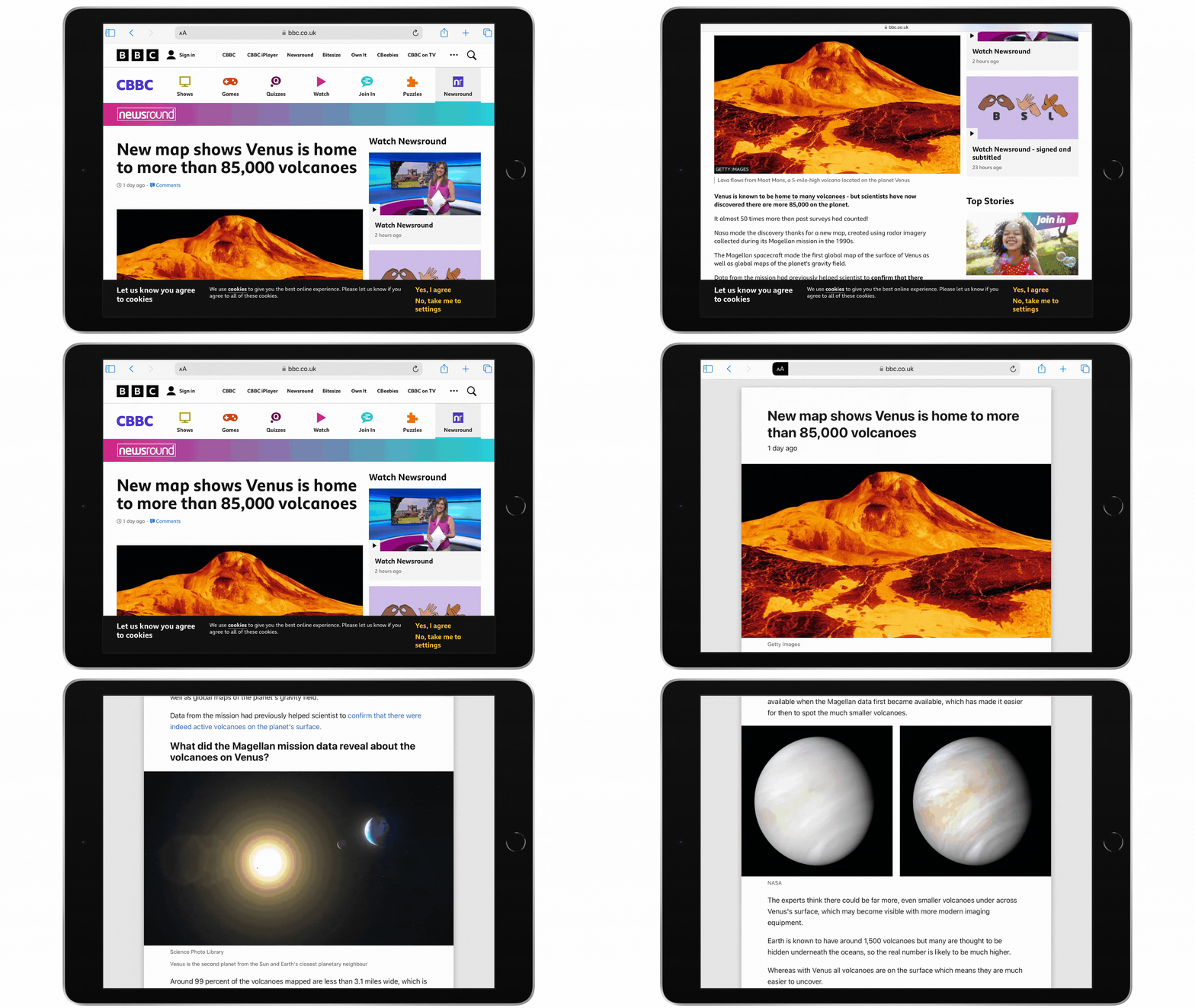
Reader in Safari

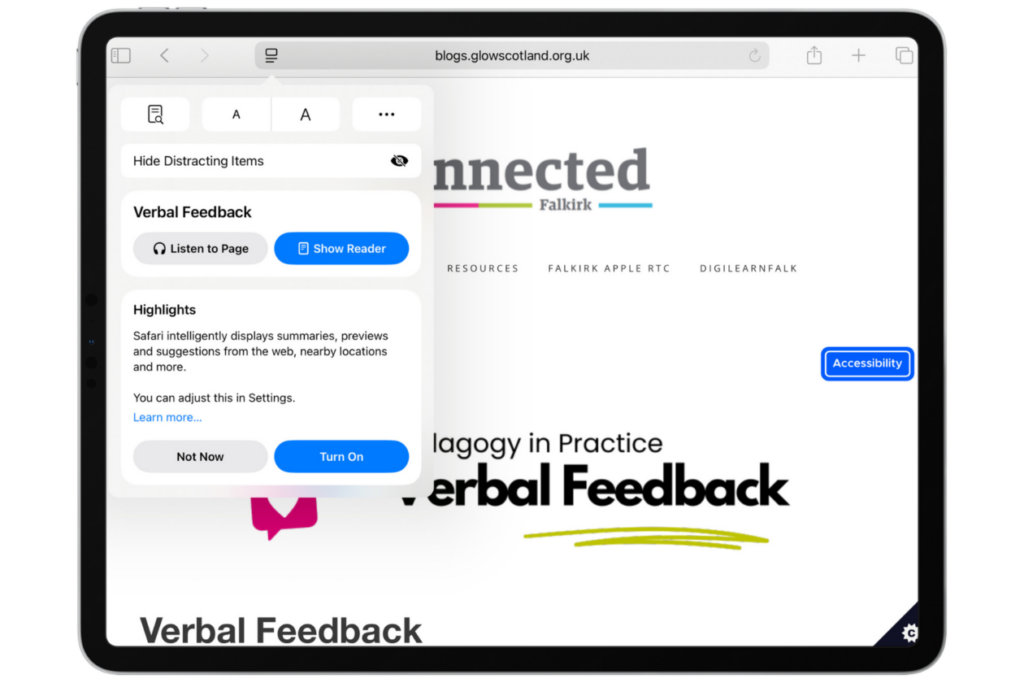
Safari is the default web browser on iPad and it comes with a built in tool called Reader which allows users to view a web page article in one page, formatted for easy reading and presented without ads, navigation or other distracting items. You can adjust font, font size and background colour for Reader.

To enable it look to the left of the web address bar at the top of the screen. Depending on which iOS you are using you will either see an AA button or a small rectangle with two lines underneath, tap on this button to Show Reader. If you don’t see any of the Reader options, tap the button again. To come out of Reader tap the Reader button and select Hide Reader.

This is what the older version of Reader looks like in iOS 17 or below:
.

This is what the new version of Reader looks like on iOS 18:
 

Focus

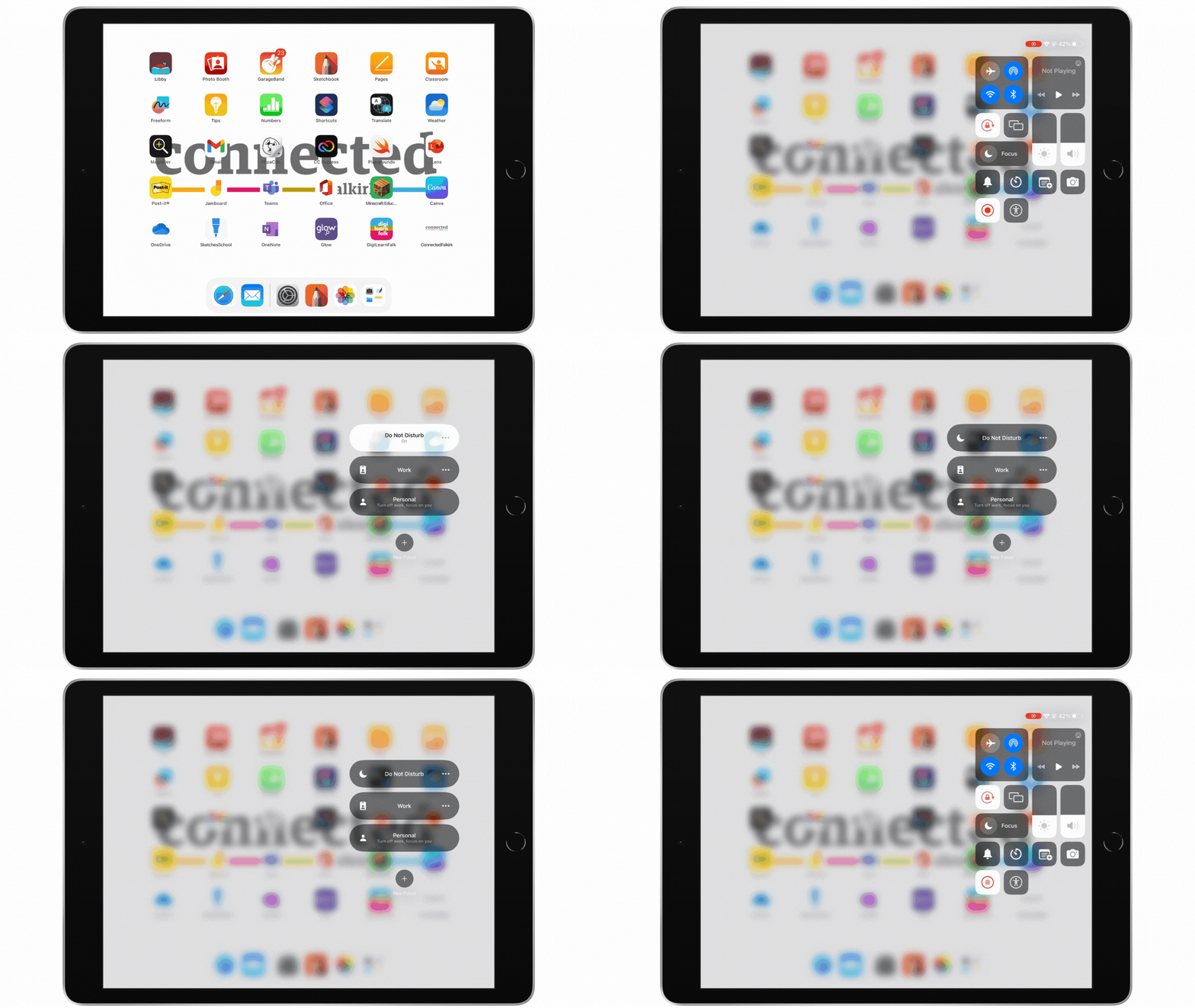
Focus is a helpful feature on iPad (and iPhone) which allows users to put their device into a temporary mode which automatically filters notifications and apps on their device. There are three pre-set modes: do not disturb; work; and personal. Users can customise these pre-set Focus modes or create their own. Find out more about Focus features here.

The easiest and quickest way to enable Focus is to swipe down from the battery indicator in the top right hand corner to open your Control Centre. Focus appears as an option in one of the panels indicated by the word Focus, this panel will also tell you when a particular mode is switched on. Two switch focus on or off simply tap Focus and then tap the mode you want to activate/deactivate.
.

Light Mode/Dark Mode

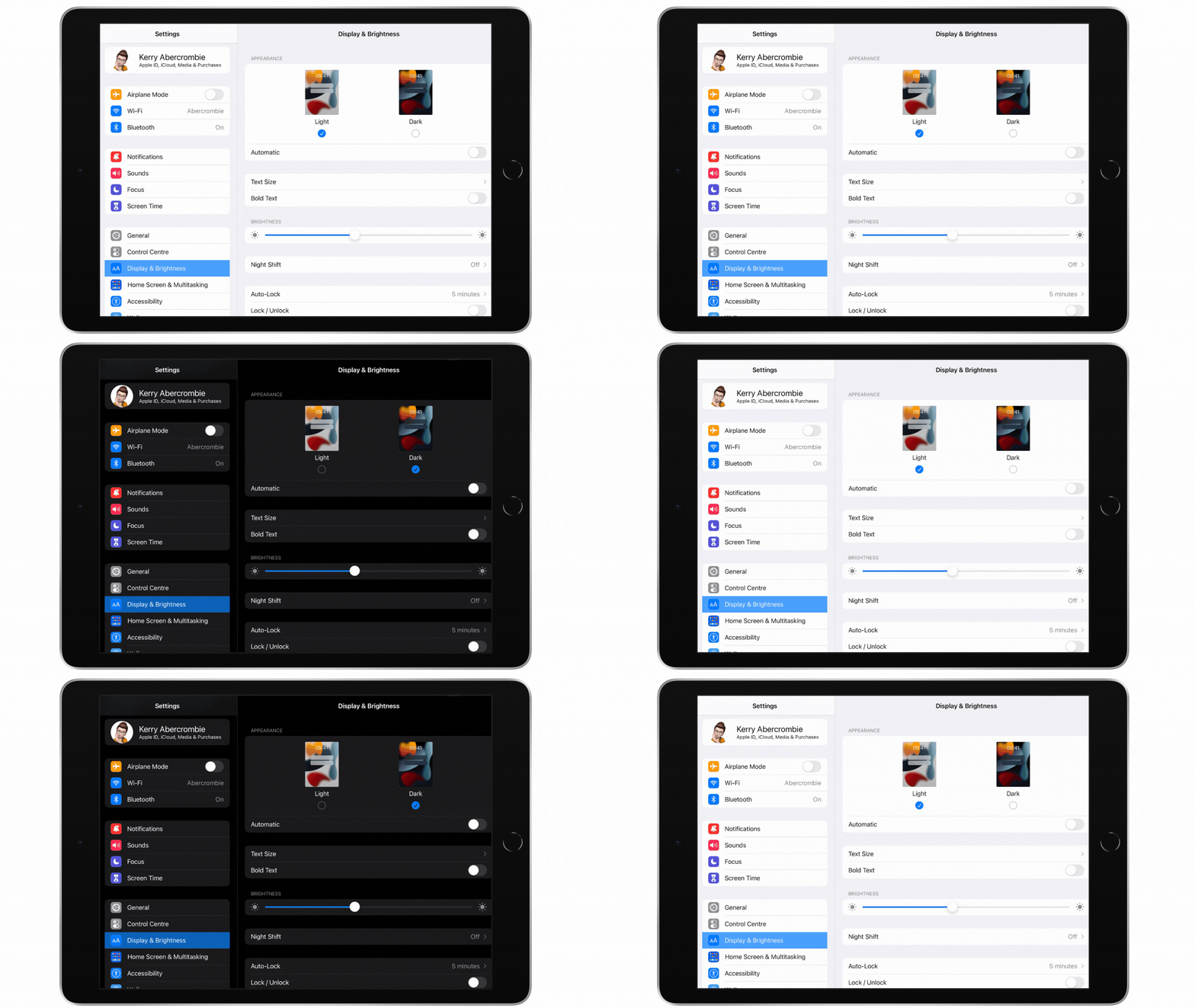
Often seen as an aesthetic choice, the option of light or dark mode can also help with reading by increasing clarity and reducing strain on the eyes. This option changes the screen display between Light mode which uses a light background with dark text (positive contrast polarity) and Dark mode which uses a dark background with lighter text (negative contrast polarity).

The ability to change between modes is found in Settings > Display & Brightness, where you can toggle between the two or set a schedule for when you want your device to move between the two options
.

Night Shift

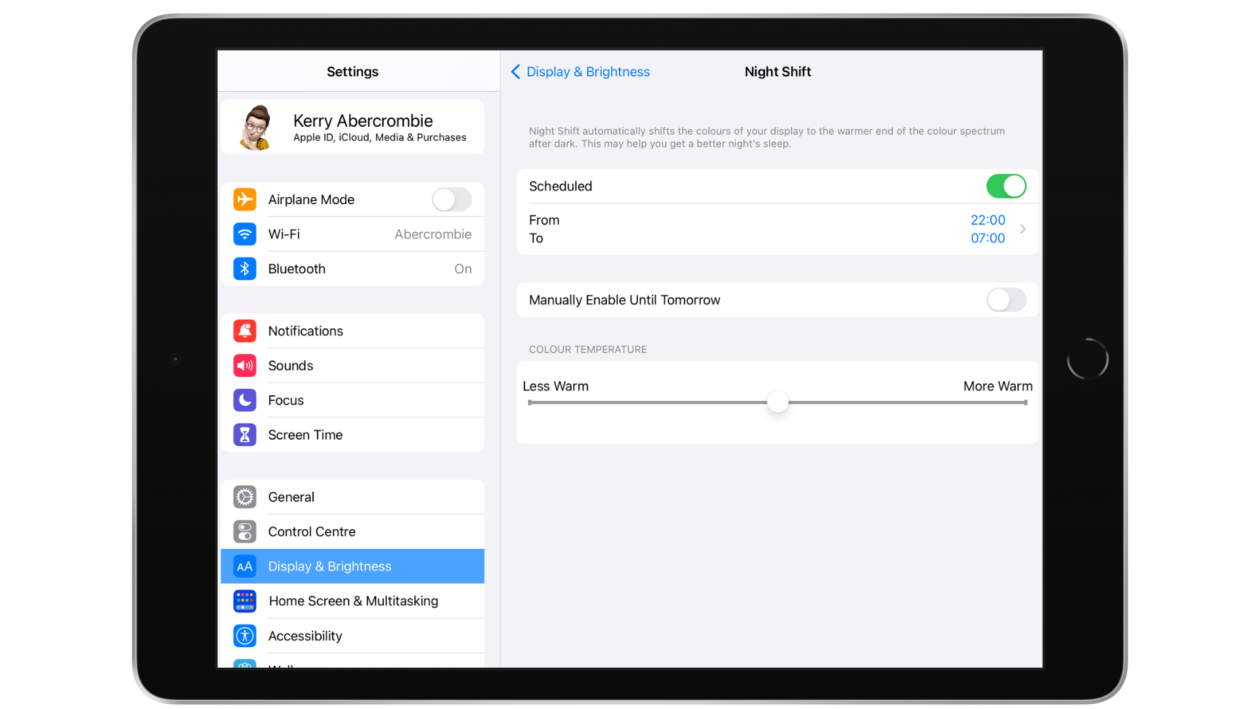
Another feature which can make the screen easier on the eyes is Night Shift. Night Shift automatically adjusts the colours of the iPad display to the warmer end of the spectrum. It can be set to come on at a specific time of day through the schedule toggle.

Find Night Shift in Settings > Display & Brightness > Night Shift
Physical

There are several features on the iPad which make it easier for people with physical or motor challenges. While some of these make use of external equipment such as switches, keyboards, trackpad and mouse, there are a few handy ones that make things easier for everyone.

Corner Gestures

A gesture refers to how you control the iPad and its apps this includes things like — tap, touch and hold, swipe, scroll, and zoom. Each of these gestures do different things and can do different things in different areas of the screen. For more information on gestures see here.

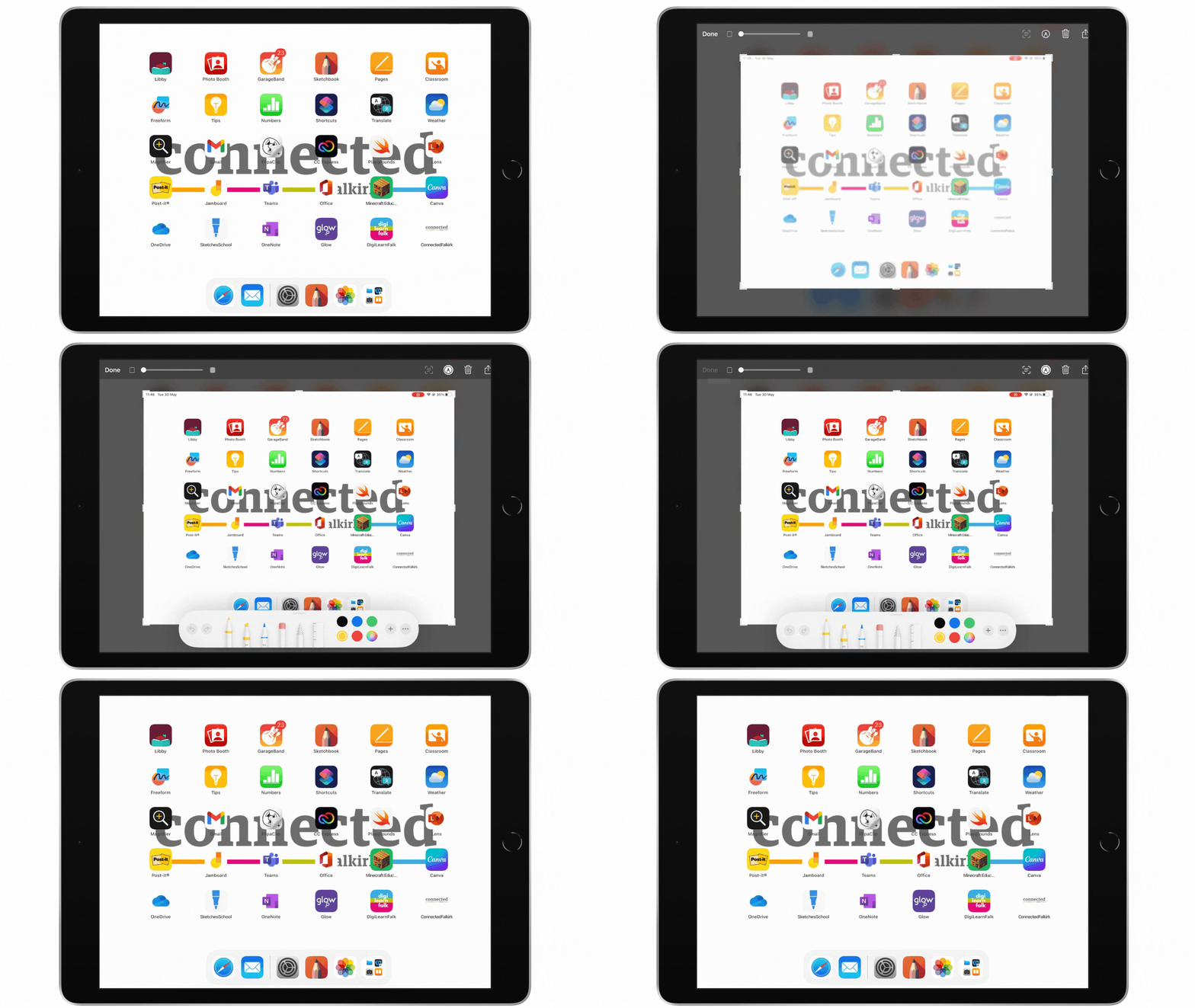
iOS 16 and above includes two corner gestures which can be very handy. Corner gestures are when you swipe from the corner of the screen towards the middle.

Swiping from the bottom left corner to the centre of the screen is a quick and easy way to take a screen shot for those who find it tricky to hold the home and power buttons at the same time.

.

Swiping from the bottom right corner to the centre of the screen opens quick notes which allows users to make notes in a pane that appears over the top of their current view. This can be helpful for people who find moving between apps tricky or who find split screen makes things too small.

.

Voice Control

You can turn on Voice Control via Settings > Accessibility > Voice Control if you wish to be able to control your iPad with your voice. This can be helpful for people who need or want to use their device hands free. When voice control is activated your iPad listens for commands and allows users to navigate and interact with their device using voice to tap, swipe, type, and more.

To turn voice control off you can go into Settings > Accessibility > Voice Control and toggle it off or you can simply speak the command ‘Turn off voice control’. You can find out more about Voice Control here.

Accessibility Assistant Shortcut

Looking for personalised accessibility suggestions? The iPhone & iPad Accessibility Assistant shortcut can give users personalised suggestions for accessibility tools.

Open the Shortcuts app, tap on Shortcuts for Accessibility in the Gallery, choose iPhone & iPad accessibility Assistant and tap Add Shortcut. This Shortcut will now appear in My Shortcuts. When you open it you will be asked to choose a category and then a specific condition, you can add as many as you like, once you’re done tap on Finished and the assistant will automatically generate and open a note with all of the accessibility features available to meet your needs.

Session Recording

Here is a recording of the session for those who wish to watch it again or who missed it. Please be aware that the session recording is edited to remove all discussion and task sections. This is to protect the privacy of our participants and ensure everyone feels comfortable speaking freely on mic and in the chat without worry that their comments will be made publicly available.

Session Resources: AI in Education – Exploring Planning and Preparation

This page is for session resources from our AI in Education: Exploring Planning and Preparation session. This session explored AI tools specifically focused on helping teachers create and organise learning materials.

Session Slides

You can view a PDF copy of the slides below or download the PDF by clicking on the three dots and selecting ‘Download PDF File’. If you’d prefer the Keynote version please contact Kerry Abercrombie.

Additional Content

Our sessions tend to have a lot of live demonstrations within them. The remainder of the page outlines some of the digital tools covered in the session or signposting to some of the resources shown or mentioned in a format which can be easily revisited or passed along to colleagues who were unable to attend the session.

.

AI in Education: Guiding Principles and Support

All Falkirk Council education staff using or considering using AI in education should familiarise themselves with the AI in Education: Guiding Principles and Support information

Education Prompt Library

The education prompt library is a collection of pre-prepared, high-quality prompts covering a wide range of planning and preparation tasks and pedagogical approaches. Educators can browse the prompts, copy and paste their selected prompt directly into Google Gemini, then customise it to suit their specific context and needs. The education prompt library is an ongoing piece of work and will continue to grow over time.

AI Teacher Tools – Starter Suite

Navigating the rapidly evolving landscape of AI in education can be overwhelming for busy educators. Our starter suite offers a carefully curated collection of nine free AI-powered tools which have been assessed to ensure their educational value and ease of initial use. The hope is that this provides a practical entry point for teachers and establishments embarking on their AI journey. The document sorts the tools by educational function, gives an education focused use overview and provides quick guides for each tool.

Falkirk AI Teacher Network

Are you interested in exploring the potential of AI in education? Express your interest in joining our AI Teacher Network. By filling out this form, you’ll help us connect with like-minded educators and keep you updated on exciting opportunities, resources, and events. You will also have the opportunity to influence the use if AI in education within Falkirk. We’ll be in touch with details of how to join the Microsoft Teams space.

Which ‘Grade’ is That? Conversion Table

Here is that handy conversion table for use with AI tools which default to the US system.

Quick Guides

Below you can find the quick guides for the four tools featured in this session.

Google Gemini – Quick Start Guide

Gemini Quick Guide by Miss Abercrombie

What does it do?

Google Gemini chatbot is a large language model (LLM) developed by Google. While Google Gemini describes a family of LLM tools integrated throughout Google Workspace, the Google Gemini standalone chatbot is available to all staff via Glow login to the Google Workspace tenancy operated by Glow/Education Scotland. Its ability to process and generate diverse information aims to create more natural and helpful AI interactions. Google Gemini is an 18+ product and is only available to staff users within Glow. It is designed to be multimodal, meaning it can understand and operate across text, code, images, and more.   

How do I get access? Staff can log into Google Gemini for free via their Glow account. Learners do not have access to Google Gemini via Glow as it is an 18+ product.

NotebookLM – Quick Start Guide

NotebookLM Quick Start Guide by Miss Abercrombie

What does it do?

NotebookLM is a specialised mini-LLM (Large Language Model) from Google. Unlike LLMs like Gemini, ChatGPT and Copilot, Gemini interacts only with the content you provide. You can upload up to 50 sources, including web links, YouTube videos, and various file types (PDF, .txt, Markdown, audio, images). You can use NotebookLM to question, summarise, and interact with your materials in the chat, or utilise the “studio” to create new assets, even generate downloadable AI podcasts. It’s like having a dedicated AI research assistant focused solely on your specific documents.

How do I get access? Staff can NotebookLM  via their Glow account. Learners do not have access to NotebookLM via Glow at the moment.

Magic School – Quick Start Guide

Magic School Quick Start Guide by Miss Abercrombie

What does it do? Magic School is a collection of 70+ AI tools (Magic Tools) to help teachers with a variety of tasks including lesson planning, differentiation, planning group work, generating vocabulary lists, and so much more. It also has 40+ responsible AI tools that can be launched to students to allow them to explore generative AI while the teacher can monitor their interactions with and the outputs from the AI model. Tools for students include study habits, debate partner, multiple explanations and more.

How do I get access? Teachers can sign up for a free account on the Magic School website.

Pupils do not need accounts to participate in Magic School activities.

School AI – Quick Start Guide

SchoolAI Quick Start Guide by Miss Abercrombie

What does it do? School AI allows learners to explore a Large Language Model in a safe environment through ChatGPT powered experiences called Spaces. Teachers can choose from a library spaces, or create their own with custom instructions tailored to learners’ needs. Teachers can manage, moderate and steer as students interact with the machine and receive real time ‘insights’ as well as being able to access live conversations from the teacher moderation screen.

How do I get access? Teachers can access School AI by signing up for a free basic account on the School AI website.

Pupils do not need accounts to participate in School AI spaces.

Session Recording

Here is a recording of the session for those who wish to watch it again or who missed it. Please be aware that the session recording is edited to remove all discussion and task sections. This is to protect the privacy of our participants and ensure everyone feels comfortable speaking freely on mic and in the chat without worry that their comments will be made publicly available.

AI in Education: Education Prompt Library

Looking for some help with AI prompting for education? Visit our new education prompt library. Designed to help you boost your prompting to get better outputs and save valuable time.

The education prompt library is a collection of pre-prepared, high-quality prompts covering a wide range of planning and preparation tasks and pedagogical approaches. Educators can browse the prompts, copy and paste their selected prompt directly into Google Gemini, then customise it to suit their specific context and needs. 

The education prompt library is an ongoing piece of work and will continue to grow over time.


Click the image below or use the link to visit the education prompt library: https://blogs.glowscotland.org.uk/fa/promptlibrary/ 

AI in Education: Guiding Principles and Support

As technology evolves, Artificial Intelligence (AI) offers powerful tools to enhance teaching and learning. This guide provides our position on AI use, links to guidance from other bodies and organisations and recommends tools that educators might consider exploring in their classroom. We emphasise the importance of AI literacy to prepare both educators and students for the future and offer a model for educators to work from. This is also where we will provide access to resources to help you navigate AI’s role in education confidently and responsibly.

As this is a rapidly evolving field we will review and update this page when necessary. The last time this page was updated is: 26 November 2025

Our Position in Education Services

As a digital learning team, we have developed this stance in co-ordination with Falkirk Council’s Data Protection Officer and the Information Management Working Group.

It is important that staff familiarise themselves with and consider the risks involved in using AI before they begin making use it. These risks include:

      • AI lacks human empathy and insights. It cannot judge if something is ethically correct.
      • It can inadvertently replicate bias that is present in the web pages, documents, books, articles etc it is trained on.
      • It can provide answers that are inaccurate and can be inconsistent.
      • Responses can be out of date.
      • Any input can become part of the ‘learning’ of AI, so you cannot guarantee any information you input will be dealt with in confidence. You should not input any confidential Council information, including personal information we hold (for example, about our employees and citizens).
      • It is susceptible to copyright infringement.
      • It has limited creativity as it can only generate responses based on existing data.
      • It can be used to generate fake news and misinformation.

The Learning about AI section of this page provides signposting to materials staff can access to learn more about AI, machine learning and the ethics of AI.

Our position emphasises that AI should enhance, not replace, human teaching. We are committed to ethical and responsible AI use, ensuring compliance with data protection principles. Teachers are empowered to use AI tools thoughtfully, with a focus on professionalism and informed decision-making, while safeguarding sensitive information and conducting proper risk assessments.

All education staff making use of AI in schools must comply with the following advice:

Staff Use

Teachers are permitted to use generative AI tools for a variety of educational activities, provided they adhere to established professionalism and data protection legislation.

Tool Approval and Risk Assessment

Currently, no generative AI software requiring pupil login credentials is approved for pupil use. As with any digital tool, teachers must conduct an appropriate risk assessment before implementation as outlined in Falkirk Council’s Service Circular 50, available on the Intranet.

Professionalism

Teachers using generative AI to create content are reminded of their professional responsibility to thoroughly review any AI-generated material before sharing it with pupils or the wider school community. Just as with any other resource, teachers must ensure content accuracy and appropriateness.

Data Protection

Under no circumstances should sensitive or personal information about pupils, staff, or other stakeholders, including the school itself, be submitted to AI tools or software. This is a critical GDPR compliance issue. Only data already in the public domain may be used, and no personally identifiable information should be shared with AI models.

Additional Documentation

Links to further guidance and support documentation from public bodies and organisations.

Digital Scotland

SCOTLAND’S ARTIFICIAL INTELLIGENCE STRATEGY

 Scotland’s AI Strategy focuses on building a trustworthy, ethical, and inclusive AI ecosystem. While the strategy isn’t exclusively education focused, for educators it highlights the importance of AI literacy and education to equip both students and teachers with essential AI skills. The strategy encourages integrating AI into education to enhance learning while preparing students for an AI-driven future. It also discusses the importance of teaching ethical AI use, ensuring technology benefits society fairly and inclusively.

You can access the full document here.

UK Government Department for Education

GENERATIVE ARTIFICAL INTELLIGENCE (AI) IN EDUCATION

The UK government’s document on generative AI in education provides guidance on using AI tools responsibly in educational settings. It mentions the potential benefits of AI for personalised learning and administrative efficiency while highlighting the importance of ethical considerations, data privacy, and avoiding reliance on AI-generated content for assessments. The document encourages educators to develop AI literacy among students and to integrate AI in ways that support, rather than replace, traditional human led teaching methods.

For more details, visit here.

Llywodraeth Cymru (Welsh Government)

GENERATIVE ARTIFICIAL INTELLIGENCE IN EDUCATION

Hwb’s* guidance on generative AI in education focuses on fostering AI literacy, critical thinking, and creativity within Wales’ Curriculum. It emphasises safeguarding against online risks, equitable access, and supporting educators with resources. Estyn (education and training inspectorate for Wales) is reviewing AI use in schools to explore its benefits and challenges, with findings due this summer.

*(Hwb is a digital learning platform provided by the Welsh Government to support education across Wales)

Access the full guidance here.

Education Scotland

MACHINE LEARNING AND AI WITHIN GLOW

The “Machine Learning and AI within Glow” guide outlines the use of AI and machine learning tools within Scotland’s Glow platform. It explains how educators can leverage these technologies to enhance teaching and learning, while also touching on ethical considerations and data privacy. The resource highlights the importance of AI literacy for both students and teachers, providing guidance on responsible AI use in educational settings.

For more details, you can visit the full document here.

WEST Partnership

AI IN EDUCATION SCOPING REVIEW 

The AI in Education Scoping Review explores the potential of AI in educational settings, examining its benefits, challenges, and ethical considerations. It emphasises the importance of teacher training, data privacy, and the need for careful implementation to enhance learning outcomes. The review calls for ongoing research and collaboration to effectively integrate AI into education.

You can access the full document here.

Goodison Group

21ST CENTURY SKILLS: AI AND EDUCATION REPORT

The report from Scotland’s Future Forum explores the impact of AI on education, discussing its potential to transform teaching and learning. It highlights the need for ethical considerations, teacher training, and equitable access to AI tools. The report emphasizes collaboration between educators, policymakers, and technologists to harness AI’s benefits while addressing challenges.

For more details, you can access the full report here.

OECD (Organisation for Economic Co-operation and Development)

GENERATIVE AI IN THE CLASSROOM: FROM HYPE TO REALITY?

The OECD document discusses the role of artificial intelligence (AI) in education, focusing on its potential to enhance learning outcomes, address educational challenges, and support personalized learning. It also emphasizes the need for ethical guidelines, data privacy, and teacher training to ensure responsible AI integration. The report provides recommendations for policymakers and educators on effectively using AI in education systems.

For more details, you can access the full document here.

Daydream Believers and Education Scotland

GenAI IN EDUCATION EXPLORATION HUB

The GenAI in Education Exploration Hub is a website in joint partnership between Daydream Believers and Education Scotland to help make sense of the Generative AI advancements and how best to utilise them in learning environments to be helpful tools for educators and students.

You can access the website here.

DigiLearnScot (Education Scotland)

ARTIFICIAL INTELLIGENCE IN SCOTTISH EDUCATION

This blog post explores the burgeoning presence of artificial intelligence (AI) within the Scottish education landscape, outlining key considerations for educators and stakeholders. It highlights the potential of AI to transform teaching and learning practices, including personalized learning experiences and streamlined administrative tasks. However, it also underscores the critical importance of addressing ethical implications, data security, and the necessity for professional development to equip teachers with the skills required to navigate and leverage AI tools effectively. The article serves as an informative resource for understanding the current and future impact of AI on Scottish education, promoting informed discussions and strategic planning.

Read the full post here.

Children’s Parliament

EXPLORING CHILDREN’S RIGHTS AND AI

This webpage details the Children’s Parliament’s project “Exploring Children’s Rights and A.I.” conducted in partnership with the Scottish A.I. Alliance and The Alan Turing Institute. This programme investigates how children in Scotland interact with Artificial Intelligence, focusing on their views concerning the potential opportunities and risks of A.I. use, while also exploring ways to involve them meaningfully in policy development. A key outcome of this work is the children’s development of twelve powerful ‘Calls to Action’. The project has produced educational resources to help bridge the knowledge gap highlighted by national surveys of both pupils and school staff on this important technological and ethical landscape.

For more details, you can access the full page here.

SQA Guidance

It is imperative that secondary teachers are aware of the clear SQA clear stance around pupil use of generative AI for assessments associated with national qualifications including assessed coursework and exams. Below you can find the guidance published around this.

SQA – Generative Artificial Intelligence (AI) in Assessments UPDATED 12 JULY 2025

The SQA have produced a new position statement for academic session 2025-26 on the use of Generative AI in assessment. Broadly speaking, it is permissible to use GenAI if it doesn’t undermine assessment integrity or a learner’s ability to show their skills, or if the course explicitly allows it. However, AI-generated content cannot be used as an independent source or submitted as a learner’s own work, as this constitutes malpractice. They stress the importance of following assessment conditions.

For full details on the official SQA stance, visit this page.

You can also view the SQA’s Generative AI Consultation Results on this page.

SQA – Authenticating Learner’s Work Good Practice Advice for Centre Staff

The SQA’s document on authenticating learners’ work provides guidance to ensure the integrity of assessments. The advice includes strategies such as supervising assessments, using plagiarism detection tools, and encouraging learners to maintain a reflective log. It also highlights the need for clear communication between educators and students regarding expectations and the consequences of academic misconduct.

For more details, you can access the full document here.

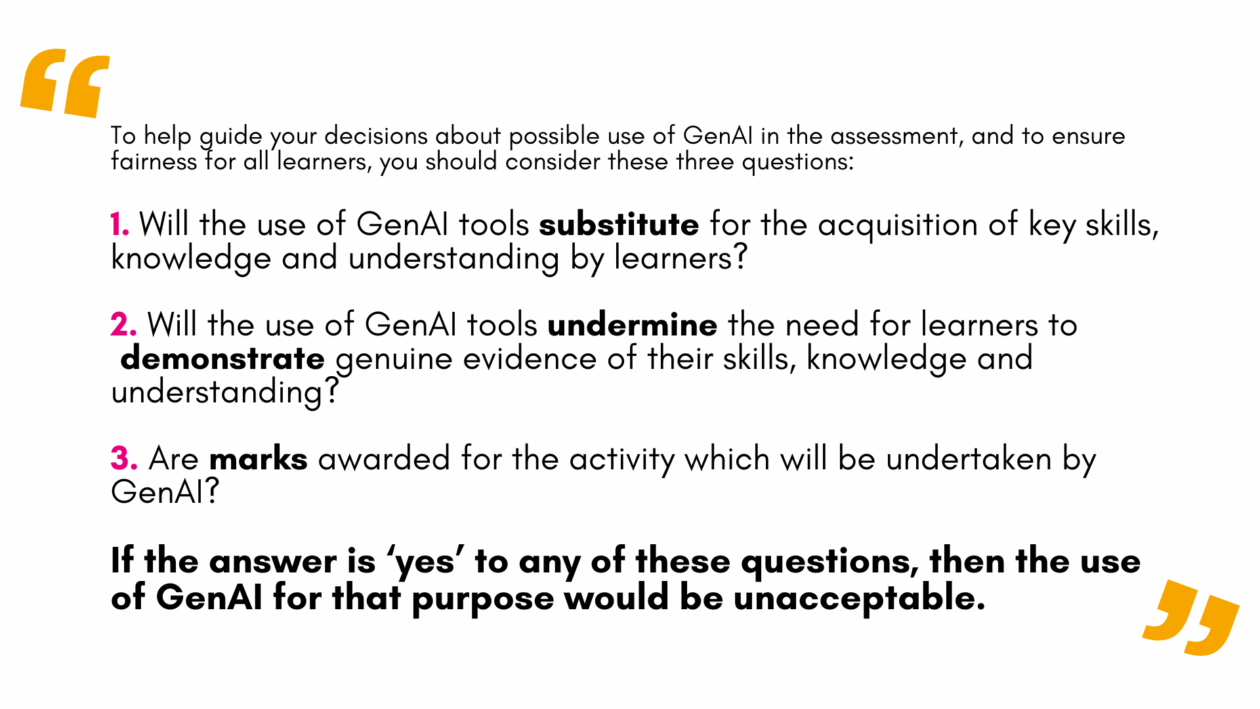
Within their AI Exemplification document the SQA outline three critical questions that are useful for all teachers when considering learner use of AI:

Learning About AI: Courses for Educators

Links to free online courses where teachers who are keen to learn more about AI generally (how it works and the wider societal and ethical implications of AI) can learn at their own pace. These courses are not specific to an education context. All of these courses are free, self paced and completed online.

Forth Valley College – Introduction to Artificial Intelligence (AI) – Online

Artificial Intelligence (AI) is revolutionising the world, and this free short course provides you with an exciting opportunity to learn the fundamentals of AI. Whether you’re a beginner or seeking to expand your skills, the Introduction to AI course offers a flexible and accessible pathway to learn more about this transformative field.  Applicants for this course must reside in Scotland. The course is online and self paced.

For more details and how to apply, see the FVC website.

Google Cloud Skills Boost – Introduction to Generative AI Learning Path

 This Google Cloud Skills Boost pathway offers a series of courses designed to help learners develop an understanding of artificial intelligence. We recommend the first three short courses in this pathway to professionals looking to deepen their knowledge of Generative AI, Large Language Models and principles of responsible AI. Courses are free and award badges at the end upon successful completion of a quiz.

For more information, visit Google Cloud Skills Boost

University of Helsinki – Elements of AI

 Elements of AI is an online course designed to make AI accessible to everyone, regardless of their background. Part one of the course, ‘Introduction to AI’ covers what AI is, what is possible (and not possible) with AI, and how it affects our lives – with no complicated math or programming required. The course is free, self-paced, and suitable for learners of all levels, helping them understand and engage with AI technology responsibly.

For more information, visit Elements of AI.

University of Helsinki – Ethics of AI

The Ethics of AI is a free online course created by the University of Helsinki. The course is for anyone who is interested in the ethical aspects of AI – we want to encourage people to learn what AI ethics means, what can and can’t be done to develop AI in an ethically sustainable way, and how to start thinking about AI from an ethical point of view.

For more details, you can access the course here.

Google – Making Friends With Machine Learning

Making Friends With Machine Learning was a 6 hour internal-only Google course specially created to inspire beginners and amuse experts. It has now been made available to everyone and this article by presenter Cassie Kozyrkov gives the links to watch the videos. Part one of the course, Introduction to ML and AI simplifies AI concepts and gives real-world examples, it is ideal for those looking to better understand how AI works without diving into too much technical detail.

For more details, you can read the full article here.

Children’s Parliament – Why Children’s Rights Matter in AI: A Resource for Professionals

A series of five free eLearning modules aimed at giving adults who work in the AI, digital, and data space an introduction to children’s human rights and how to best ensure that their work in developing, deploying or making decisions around AI technologies can respect and protect children’s rights.

For more details and to access the course visit this page.

Tools for Educators

Discover some AI tools, or services which use AI models, handpicked for their ability to either assist teachers in planning and delivery of learning or to allow learners to explore and work with AI in a controlled manner.

.

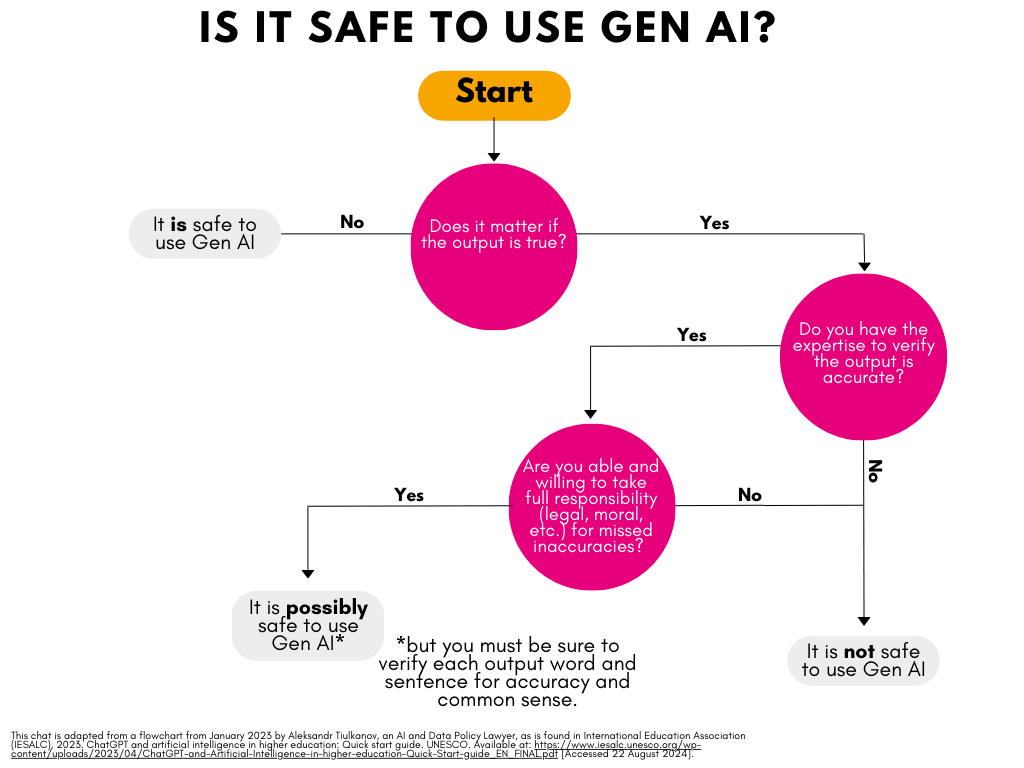
Before you take a look at the tools please remember that there are many tasks that Generative AI can be used for, educators and learners should use the chart below to assess whether it is safe to use Generative AI for a task.

In addition, anyone using Generative AI should remember:

  • Check for Bias and Accuracy: AI may produce biased or incorrect content. Always double-check your output thoroughly before sharing.
  • Human Judgment Matters: See AI-generated content as a starting point, not a final product. AI outputs can be helpful, but they should not be used to replace human/professional judgements.
  • Protect Privacy: Do not give any personal or sensitive information about people or organisations to the AI model.

.

Education Prompt Library

Looking for some help with AI prompting for education? Visit our new education prompt library. Designed to help educators boost their prompting to get better outputs and save valuable time.

The education prompt library is a collection of pre-prepared, high-quality prompts covering a wide range of planning and preparation tasks and pedagogical approaches for use with Large Language Models. Educators can browse the prompts, copy and paste their selected prompt directly into Google Gemini, then customise it to suit their specific context and needs. 

The education prompt library is an ongoing piece of work and will continue to grow over time.

AI Teacher Tools: Starter Suite

Our Starter Suite offers a carefully curated collection of free AI-powered tools to provide a practical entry point for teachers and establishments embarking on their AI journey. Covering a range of essential functionalities, from lesson planning to differentiation, this suite provides accessible and valuable tools to explore and integrate AI into teaching practices.

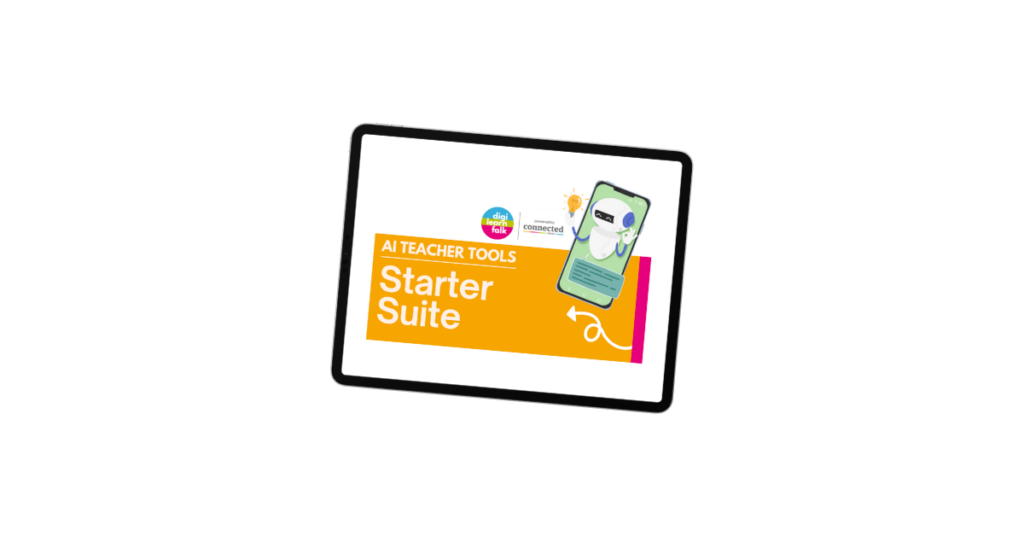
Each tool has been assessed to ensure its educational value and ease of initial use, allowing you to confidently begin harnessing the power of AI to enhance learning outcomes. View the Starter Suite embedded below or use and share the short link: https://bit.ly/aistartersuite


AI Starter Suite by Miss Abercrombie

Google Gemini

Gemini Quick Guide by Miss Abercrombie

What does it do?

Google Gemini chatbot is a large language model (LLM) developed by Google. While Google Gemini describes a family of LLM tools integrated throughout Google Workspace, the Google Gemini standalone chatbot is available to all staff via Glow login to the Google Workspace tenancy operated by Glow/Education Scotland. Its ability to process and generate diverse information aims to create more natural and helpful AI interactions. Google Gemini is an 18+ product and is only available to staff users within Glow. It is designed to be multimodal, meaning it can understand and operate across text, code, images, and more.   

How do I get access? Staff can log into Google Gemini for free via their Glow account. Learners do not have access to Google Gemini via Glow as it is an 18+ product.

NotebookLM

NotebookLM Quick Start Guide by Miss Abercrombie

What does it do?

NotebookLM is a specialised mini-LLM (Large Language Model) from Google. Unlike LLMs like Gemini, ChatGPT and Copilot, Gemini interacts only with the content you provide. You can upload up to 50 sources, including web links, YouTube videos, and various file types (PDF, .txt, Markdown, audio, images). You can use NotebookLM to question, summarise, and interact with your materials in the chat, or utilise the “studio” to create new assets, even generate downloadable AI podcasts. It’s like having a dedicated AI research assistant focused solely on your specific documents.

How do I get access? Staff can NotebookLM  via their Glow account. Learners do not have access to NotebookLM via Glow at the moment.

Wayground (Quizizz)

Wayground Quick Start Guide by Miss Abercrombie

What does it do? Wayground (formerly Quizizz) is an online learning platform that enables teachers to create and share interactive quizzes, polls, and lessons. Wayground has integrated AI features that allow teachers to automatically generate quizzes, worksheets, and questions based on specific topics or curriculum needs. By using AI, Wayground can suggest questions tailored to different skill levels, provide instant feedback to students, and offer personalised learning paths. This streamlines lesson planning and helps teachers quickly assess student understanding, making the platform more efficient for educational purposes.

How do I get access? Teachers can sign up for a free account at wayground.com

Pupils do not need accounts to participate in Quizizz activities.


Curipod


Curipod Quick Start Guide by Miss Abercrombie

What does it do? Curipod is a platform designed to assist educators in creating engaging and interactive lessons. It combines elements like polls, word clouds, and drawing activities to make learning dynamic and participatory. Curipod’s built in AI features allow educators to generate interactive lessons quickly and easily. All AI output is customisable. Additionally, Curipod’s AI adapts content to suit different teaching styles and student needs, streamlining the lesson material creation process while making learning more interactive and engaging.

How do I get access? Teachers can access Curipod by signing up for a free basic account on the Curipod website.

Pupils do not need accounts to participate in Curipod lessons.


Diffit


Diffit Quick Start Guide by Miss Abercrombie

What does it do? Diffit is an AI-powered tool designed to help educators create differentiated learning materials quickly. It allows teachers to generate customised content at various reading levels based on a given text or topic. By adjusting the complexity of language, Diffit ensures that students with different abilities can engage with the same subject matter, supporting personalised learning and making lesson planning more efficient for teachers. 

How do I get access? Teachers can sign up for a free account on the Diffit website.

Pupils do not need to access Diffit.


Magic School


Magic School Quick Start Guide by Miss Abercrombie

What does it do? Magic School is a collection of 70+ AI tools (Magic Tools) to help teachers with a variety of tasks including lesson planning, differentiation, planning group work, generating vocabulary lists, and so much more. It also has 40+ responsible AI tools that can be launched to students to allow them to explore generative AI while the teacher can monitor their interactions with and the outputs from the AI model. Tools for students include study habits, debate partner, multiple explanations and more.

How do I get access? Teachers can sign up for a free account on the Magic School website.

Pupils do not need accounts to participate in Magic School activities.


School AI

SchoolAI Quick Start Guide by Miss Abercrombie

What does it do? School AI allows learners to explore a Large Language Model in a safe environment through ChatGPT powered experiences called Spaces. Teachers can choose from a library spaces, or create their own with custom instructions tailored to learners’ needs. Teachers can manage, moderate and steer as students interact with the machine and receive real time ‘insights’ as well as being able to access live conversations from the teacher moderation screen.

How do I get access? Teachers can access School AI by signing up for a free basic account on the School AI website.

Pupils do not need accounts to participate in School AI spaces.

Padlet ‘AI Image’ 

Padlet AI Image Quick Start Guide by Miss Abercrombie

What does it do? Padlet’s “AI Image” feature uses a text-to-image AI model to transform users’ written descriptions into images.

How do I get access? Teacher sets up a Padlet and learners access via link or QR code. Pupils do not need to log in.


Adobe Express

Adobe Express Quick Start Guide by Miss Abercrombie

 What does it do? Adobe Firefly in Adobe Express is an AI-powered tool that allows users to generate and edit images using text prompts. It enabling users to quickly create designs, add effects, and make creative adjustments to photos, illustrations, and graphics.

How do I get access? Learners have access to Adobe Express via Glow.


Importance of AI Literacy

Learn why developing AI literacy is crucial for both teachers and students, preparing them for a tech-driven future.

.

Developing AI literacy is crucial for both teachers and students as it equips them with essential skills to thrive in a tech-driven future. It enhances critical thinking, problem-solving, and ethical awareness, enabling students to navigate AI technologies responsibly. For teachers, AI literacy allows them to guide students effectively, integrating AI into learning while fostering digital citizenship. This knowledge ensures both educators and students are prepared for the evolving job market and societal shifts driven by AI advancements.

AI literacy as a concept is still evolving because AI technology itself is rapidly advancing and becoming more integrated into everyday life. As generative AI and automation, continue to shift the landscape, requiring ongoing adaptation in educational frameworks and public understanding to keep pace with innovation.

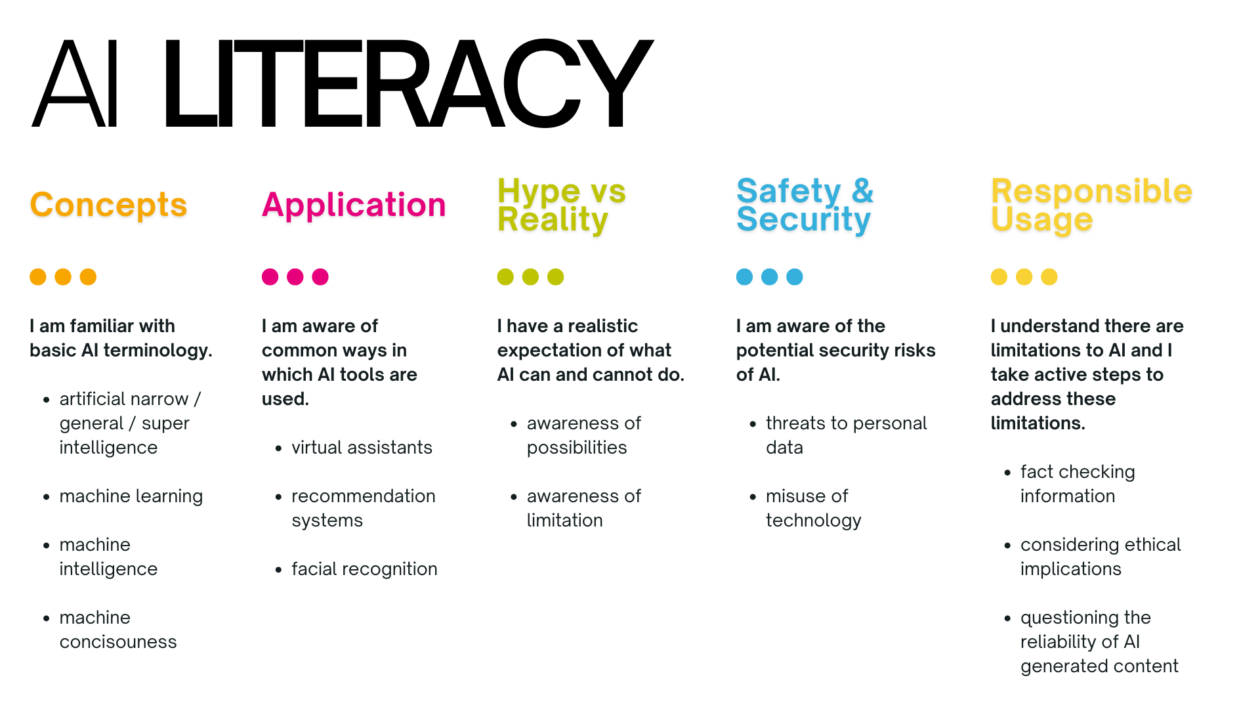
The AI literacy model we will work with in Falkirk Council education establishments is shown below. This is adapted from a model from the University of Hong Kong and includes principles and conceptualisations from across AI4K12 Initiative, ISTE’s AI Education Framework and the OECD’s AI Literacy Principles. It has been adapted to be simple, clear and suitable for children, young people and adults alike.