What impact has this had on my own professional identity?

As a teacher I think I am more conscious of my advocacy for my learners and I am requesting change and highlighting areas of inequality in a more strategic and logical manner.

My understanding of the term ‘teacher leadership’ changed through your participation in this programme because previously I believed leadership was mostly an exercise in power, delegating to subordinates and often keeping to the council ‘company’ line.
Now I understand leadership as a driving force, someone working collaboratively using the experience  and expertise of others.

I have achieved a deeper understanding of leadership roles and class teachers’ ability to be a driving force for change in education starting in their school and through supporting their learners.

In the future I hope to continue to engage with practitioner enquiry and research particularly around areas of inequality in education.Teacher Leadership Poster TLP Snapshot

What are the implications and next steps?

I have learned that even within the category of EAL learners there are still so many varied additional barriers that impact equality and attainment. There are many factors such as length of time in the country, previous school experience, literacy levels in the first language and so on that generate further barriers to learning.

I was surprised by the amount of Data and information that is missing within EAL statistical breakdowns which make it particularly challenging to make data informed targeted changes to practice.

I believe my enquiry and the passion I bring to my role means that I have tried to spotlight the importance of meeting the needs of EAL learners and highlight areas of good practice within mainstream classes. The wider school community is more engaged with EAL matters and I am collaborating more with other colleagues.

There is definitely more work to be done in ensuring consistent support for EAL learners, within the school community EAL learners without refugee status only receive minimal support 0.05 if any and these learners are often off track for writing and likely still developing academic fluency in English.

I am particularly passionate about supporting the integration of English as an Additional Language learners into the school community. Going forward I would be interested in reviewing the New Scots Integration strategy and what this looks like in practice in primary schools in Scotland.

What has happened in my enquiry?

My area of enquiry is ongoing, meeting the needs of learners who speak English as an Additional Language will need more input at initial teacher education and accountability for EAL learners in the GTCS standards for provisional and full registration.

The positive aspects of my enquiry were how much more research I was able to engage with, how I could see my classroom and school story replicated in lack of support and funding for EAL learners across other schools and other local authorities. After engaging in TLP I am a more confident advocate for my learners and I have become more solution focused.

The difficulties throughout this enquiry were time management, online logistics and the challenges of focusing on a narrow area of enquiry when there are so many inequalities to challenge.

What did you plan to do and why?

I planned to highlight the needs of learners who have Refugee status and speak English as an Additional Language (EAL). I sought to exemplify what good practice for EAL learners looks like, I hope this with benefit both practitioners and pupils in mainstream primary classrooms. The issue of supporting refugees access Scottish education is pertinent now with the intake of Afghani and Ukrainian pupils across local authorities in Scotland.

Through reading, reflection, discussion and my daily practice I feel like we often highlight equality in education on paper but implementing policies and ensuring the diverse pupil demographic of the school has their needs met in the reality of a large school setting is particularly challenging. I knew focusing on EAL refugee pupils was an important focus of my enquiry firstly because it is directly relevant to my current remit as an EAL teacher funded for refugees and secondly because I face so many challenges in my role advocating for these pupils with bureaucratic red tape, a lack of specific funding for refugee pupils and a misunderstanding that these pupils are the “same as everyone else”.

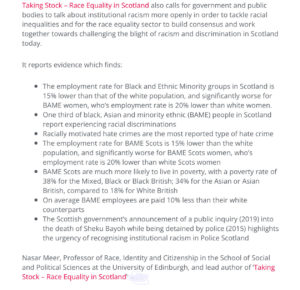
The report Taking Stock: Race Equality in Scotland detailed significant existing inequalities in Scotland and argues that despite the race equality agendas of the last few decades, the is still a lot more work to be done. This connection between my classroom perspective and national statistics conveyed a picture of inequality for Black Minority Ethnic pupils, Second Language Learners and Refugees that spans beyond education, into later life experiences.