What impact has this had on my own professional identity?

As a teacher I think I am more conscious of my advocacy for my learners and I am requesting change and highlighting areas of inequality in a more strategic and logical manner.

My understanding of the term ‘teacher leadership’ changed through your participation in this programme because previously I believed leadership was mostly an exercise in power, delegating to subordinates and often keeping to the council ‘company’ line.
Now I understand leadership as a driving force, someone working collaboratively using the experience  and expertise of others.

I have achieved a deeper understanding of leadership roles and class teachers’ ability to be a driving force for change in education starting in their school and through supporting their learners.

In the future I hope to continue to engage with practitioner enquiry and research particularly around areas of inequality in education.Teacher Leadership Poster TLP Snapshot

What are the implications and next steps?

I have learned that even within the category of EAL learners there are still so many varied additional barriers that impact equality and attainment. There are many factors such as length of time in the country, previous school experience, literacy levels in the first language and so on that generate further barriers to learning.

I was surprised by the amount of Data and information that is missing within EAL statistical breakdowns which make it particularly challenging to make data informed targeted changes to practice.

I believe my enquiry and the passion I bring to my role means that I have tried to spotlight the importance of meeting the needs of EAL learners and highlight areas of good practice within mainstream classes. The wider school community is more engaged with EAL matters and I am collaborating more with other colleagues.

There is definitely more work to be done in ensuring consistent support for EAL learners, within the school community EAL learners without refugee status only receive minimal support 0.05 if any and these learners are often off track for writing and likely still developing academic fluency in English.

I am particularly passionate about supporting the integration of English as an Additional Language learners into the school community. Going forward I would be interested in reviewing the New Scots Integration strategy and what this looks like in practice in primary schools in Scotland.

What has happened in my enquiry?

My area of enquiry is ongoing, meeting the needs of learners who speak English as an Additional Language will need more input at initial teacher education and accountability for EAL learners in the GTCS standards for provisional and full registration.

The positive aspects of my enquiry were how much more research I was able to engage with, how I could see my classroom and school story replicated in lack of support and funding for EAL learners across other schools and other local authorities. After engaging in TLP I am a more confident advocate for my learners and I have become more solution focused.

The difficulties throughout this enquiry were time management, online logistics and the challenges of focusing on a narrow area of enquiry when there are so many inequalities to challenge.

What did you plan to do and why?

I planned to highlight the needs of learners who have Refugee status and speak English as an Additional Language (EAL). I sought to exemplify what good practice for EAL learners looks like, I hope this with benefit both practitioners and pupils in mainstream primary classrooms. The issue of supporting refugees access Scottish education is pertinent now with the intake of Afghani and Ukrainian pupils across local authorities in Scotland.

Through reading, reflection, discussion and my daily practice I feel like we often highlight equality in education on paper but implementing policies and ensuring the diverse pupil demographic of the school has their needs met in the reality of a large school setting is particularly challenging. I knew focusing on EAL refugee pupils was an important focus of my enquiry firstly because it is directly relevant to my current remit as an EAL teacher funded for refugees and secondly because I face so many challenges in my role advocating for these pupils with bureaucratic red tape, a lack of specific funding for refugee pupils and a misunderstanding that these pupils are the “same as everyone else”.

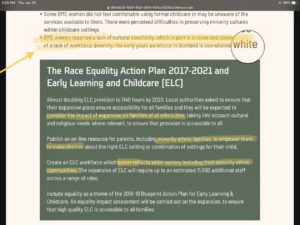
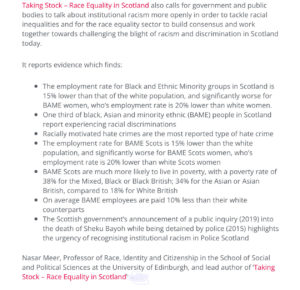
The report Taking Stock: Race Equality in Scotland detailed significant existing inequalities in Scotland and argues that despite the race equality agendas of the last few decades, the is still a lot more work to be done. This connection between my classroom perspective and national statistics conveyed a picture of inequality for Black Minority Ethnic pupils, Second Language Learners and Refugees that spans beyond education, into later life experiences.


February Update

After watching the recall session recording I feel clearer about how to be successful in TLP. Enquiry sounds scary, overwhelming and unmanageable under current unpredictable and tiring school circumstances. Participating in these modules, creating a poster and selecting a pre, during, post TLP picture is something I can do.

I feel clearer that my area of enquiry, although definitely pushing me outside my comfort zone in terms of leadership, is something both relevant to the needs of the school, wider Scottish education system and something I feel personally passionate about. Supporting pupils with EAL and refugee families is both a difficult and rewarding job. I can’t solve all the issues they face but if I can support by making differentiation in mainstream classes easier, increase awareness and understanding about second language learners and have a positive impact on the educational experience of pupils who speak EAL – I will feel that I have contributed by moving the needle in the right direction!


January Update

My reading, classroom experiences and professional conversations have made me more confident and deliberate in my professional practice to openly raise issues of EAL equality, cultural inclusion and try to increase awareness of meeting the needs of Muslim pupils.

In my enquiry, as recommended by someone kind enough to comment,  I am going to add a digital element through an online questionnaire gathering information about what the teacher would like help with and provide an opportunity for those who don’t have a lot of experience in EAL early acquisition to ask any questions.

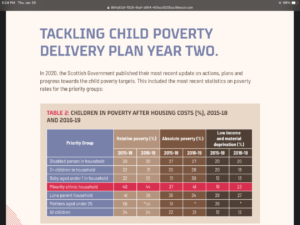
What’s working best so far is my engagement in reading, thanks to a TLP lead who suggested some powerful reading with current data about ethnicity, racism and poverty in Scotland (see attached). What potentially needs a rethink for my enquiry is a way to capture and record pupil voice, to get feedback from EAL learners themselves and record their experience of teaching and learning with targeted differentiated strategies in place and whether it helps them learn.

I am not sure about what happens next, I was sorry to have missed out on the recall day as it would have been helpful for me to hear how other people are getting on. I think I am keeping up but as teachers know it’s comforting to have a comparison. I am looking forward to reading more of other people’s  blogs. There are a lot of interesting and detailed areas of enquiry happening across topics.

My Process for Enquiry

At the planning stage I knew I would focus on equality and English as an Additional Language, I continue to reflect on how meeting the needs of learners with EAL particularly Syrian refugees that I support will improve how we get it right for these learners in our school.

After reading the other areas on enquiry as well as the recommended reading about practitioner enquiry I will continue to review my first draft question to insure it is doable, measurable and specific.

I continued my process of reflection and as I considered the other areas of enquiry I remind myself that the goal is not to meet the needs of EAL learners across education as a whole but to have a purposeful impact on improving our practitioner skills, knowledge and understanding of teachers in our school to support their Syrian EAL learners in class through approaches of differentiation and inclusive practice.

What I am finding most challenging is narrowing this focus into a a manageable project of practitioner enquiry that will improve classroom practice and empower educators to meet the needs of second language learners. Any suggestions would be appreciated.


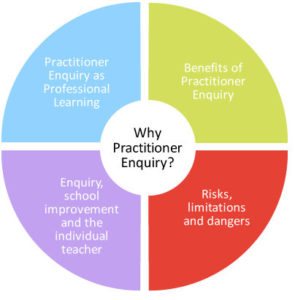
image source: https://www.gtcs.org.uk/professional-update/research-and-practitioner-enquiry/practitioner-enquiry/why-practitioner-enquiry.aspx

My enquiry question (first draft)

After a powerful professional discussion at my last staff meeting I am interested in: how mainstream primary teachers are equipped and supported to meet the needs of second language learners?

My role as full time English as an Additional Language teacher is unique, and specifically funded for Syrian Refugee Resettlement, across the service other EAL teachers are peripatetic equivalent to 0.05 or a half day in each school. In my school 25% of our school demographic speak English as an Additional Language and speak a range of thirty different languages at home. Arriving at all stages, throughout the year, with varying levels of English acquisition, cultural understanding and school experience. I’d like to focus on meeting the needs of pupils who speak English as an additional language in the mainstream primary classroom by providing training and support to practioners to develop professional confidence, knowledge and understanding of how to support second language learners in an inclusive and differentiated classroom.

Why Practitioner Enquiry is Worth Doing

The purpose of practitioner enquiry is to ask questions that will provide useful information about learners to inform our classroom practice and the support strategies implemented.

As a teacher it’s important to use professional reflection to ask questions about what is working and why. Teachers are on a journey of career long professional learning and it is part of our practice to reflect on the effectiveness of our teaching opportunities and learning environments, to consider what is working that we can replicate and what isn’t working well and could be improved.

Professional enquiry bridges research and pedagogy for teachers, by enabling them to improve their teaching practice and the outcomes for learners by embedding critical reflection and questioning into our professional dialogue and investigation by building on a process of plan, do, review, continue. With an emphasis on sharing the findings of an enquiry with pupils, teachers, the school community and beyond.


‘What’s already known?’

Literature & Policy

Diversity and equality policies have been embedded throughout the Curriculum for Excellence, policies such as Getting it Right for Every Child and the Scottish Attainment Challenge highlight educational aims of equity and opportunities for success and achievement. The 2017 National Improvement Framework network stated its aims to ensure consistent high quality education and effective teaching practice by providing learners opportunities to develop a broad spectrum of transferable skills, capacities, knowledge and understanding. Closing the poverty related attainment gap between those in the most and least deprived areas in Scotland is a priority because every child in Scotland deserves equal opportunities in their education and also because poverty, social circumstances and additional support needs such as not speaking English do create challenging barriers to learning in school and accessing the curriculum without appropriate support, resources and funding.

https://www.scottishrefugeecouncil.org.uk/wp-content/uploads/2019/10/New_Scots_2018_-_2022.pdf

By reviewing literature on progressive changes to EAL educational terminology in Northern Ireland, it is suggested that to meet the needs of the holistic pupil in school and promote active integration – we must go beyond the needs of acquiring English, focusing on social development, cultural awareness, language for communicating with peers and supporting recovery from trauma. This has shifted how pupils with English as an Additional Languages needs are identified and met in N.I. , pupils who do not speak English, who have limited schooling experience and who have refugee status as referred to as “Newcomers”. Although this terminology change may seem insignificant, behind this literature is a push to change how we ensure our EAL pupils are integrating in their class and school community. To ensure that their social, cultural and emotional needs are being met within their education as a hierarchy of needs that must be met prior to language acquisition and development of competency during the pupils silent period.

https://core.ac.uk/reader/4150687


Report a Glow concern
Cookie policy  Privacy policy