
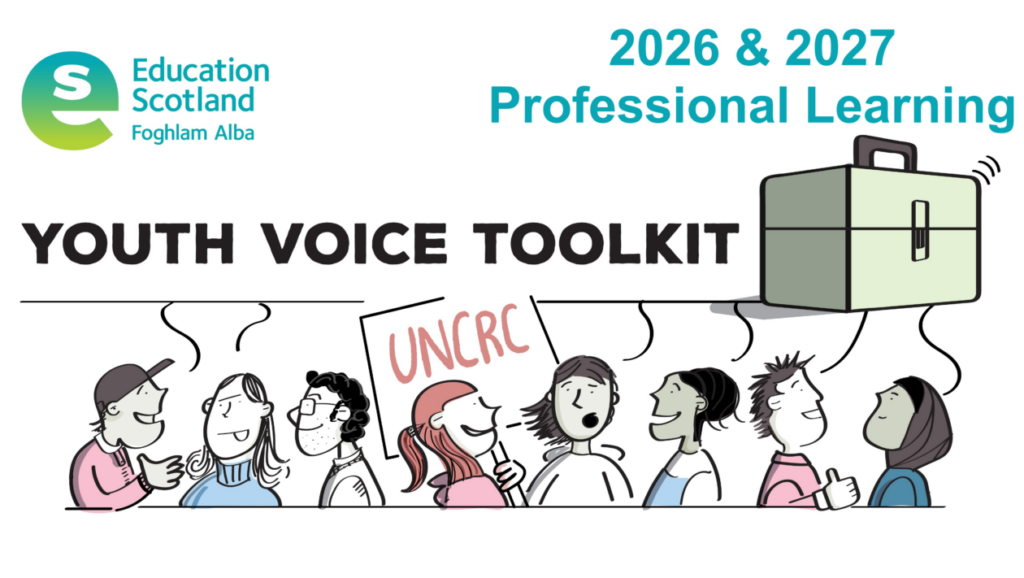
Due to popular demand, Education Scotland are providing a range of future dates for professional learning on the Youth Voice Toolkit. The toolkit allows practitioners to support non-tokenistic and representative consultations of children and young people in schools, communities, organisations and local authorities, around any theme or topic. A complete list of these dates can be found below alongside a synopsis of the toolkit and why it’s important for all pracitioners and settings:
Dates
Youth Voice Toolkit: Professional Learning Tickets, Thursday, October 8 • 4 PM – 5 PM
Youth Voice Toolkit: Professional Learning Tickets, Wednesday, November 4 • 4 PM – 5 PM
Youth Voice Toolkit: Professional Learning Tickets, Wednesday, December 9 • 4 PM – 5 PM
Youth Voice Toolkit: Professional Learning Tickets, Thursday, January 14, 2027 • 4 PM – 5 PM
Youth Voice Toolkit: Professional Learning Tickets, Wednesday, February 17, 2027 • 3 PM – 4 PM
Youth Voice Toolkit: Professional Learning Tickets, Thursday, March 25, 2027 • 4 PM – 5 PM
What is the Youth Voice Toolkit?
The toolkit is a national package of guidance and resources designed to help educational, community, and place-based settings effectively consult with children and young people. It provides a clear, step-by-step approach, alongside practical tools and resources, to support meaningful and inclusive participation.
Why is this important?
Youth voice, whenever children and young people are asked for their views on a theme, issue, or decision, can often be rushed, unrepresentative, tokenistic or poorly planned. This can leave young people feeling frustrated, disengaged and as though their opinions do not matter. The toolkit addresses these challenges by guiding practitioners through a proven approach that gives clear and concise instructions with easy to use resources.
What difference can it make?
The toolkit equips settings with the tools and confidence to work with children and young people to agree how they want to be consulted on issues that matter to them. It also empowers young people to gather and represent the views of their peers. As a result, feedback is more accurate, inclusive of seldom-heard voices and more likely to lead to meaningful action and positive change.
What does the toolkit involve?
It requires a practitioner to lead on its adoption, following these key steps:
- Creating a youth voice charter which details how children/young people wish adults to work with them when it comes to consultation
- Deliver part 1 of the Empowering Youth Voices resource pack to a youth voice structure (e.g. pupil council, youth forum, class etc) to upskill them on how to work as a team to represent their peers
- Deliver part 2 of the resource pack to the same youth voice structure to guide them through the process of planning and carrying out peer research on a chosen theme or issue within their setting.
- Support the youth voice structure to analyse findings, share results and create an action plan based on what their peers have said.
- Repeat part 2 of the resource pack when examining a new theme or topic
If you have any questions or thoughts please contact youthvoice@educationscotland.gov.scot