NCNN Resource for developing moderation in school – NCNN Evaluation Guide Moderation.pptx
Expectations & Standards for Learning and Teaching
Rationale
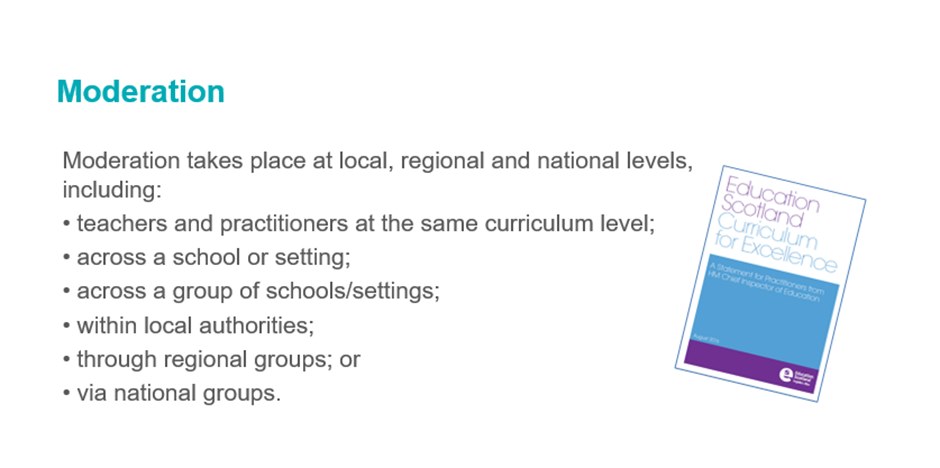
- Understand fully the process of moderation in Rosslyn School considering National, Regional and Local guidance.
- Understand the expectations and standards within Rosslyn school at each stage of the Learning and Teaching Cycle.
- Confidently make high quality assessments supported by PSA staff, families and partners.
- Network and work collaboratively to support moderation processes.
- Take an active part in moderation practice across school.
- Support wider moderation processes leading to greater consistency across the school, local authority and beyond.
The aim is to support teacher judgement and confidence in planning, assessing and tracking learners with complex needs in Rosslyn School. This in turn will impact learner engagement, timely progress, and achievement.
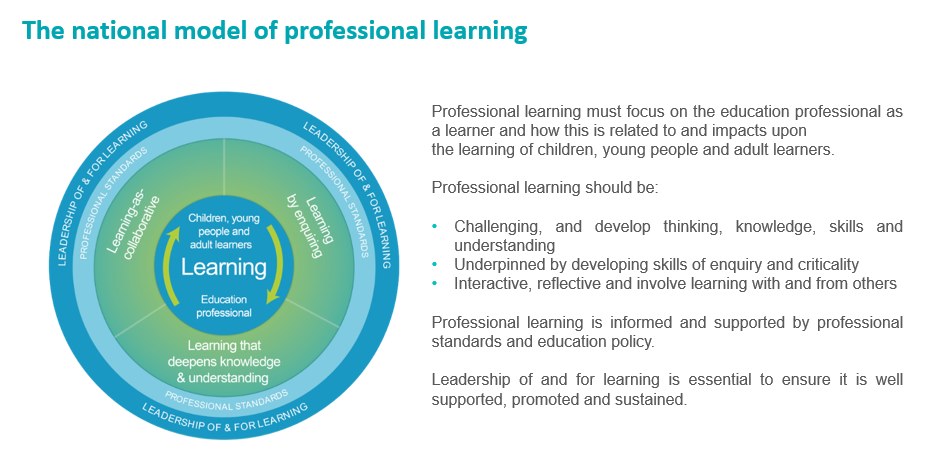
- At each stage of the process there is information for staff to understand the National guidance. This has been developed by members of the National Complex Needs Network (NCNN).
- Some sections will have Fife Authority guidance, (for example the use of PLPs in special schools in Fife).
- At the end of each step of the cycle there is then clarity on Rosslyn school expectations and standards agreed in consultation with class teachers.
National Guidance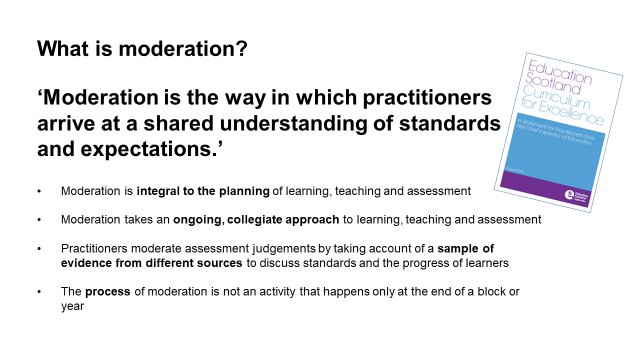
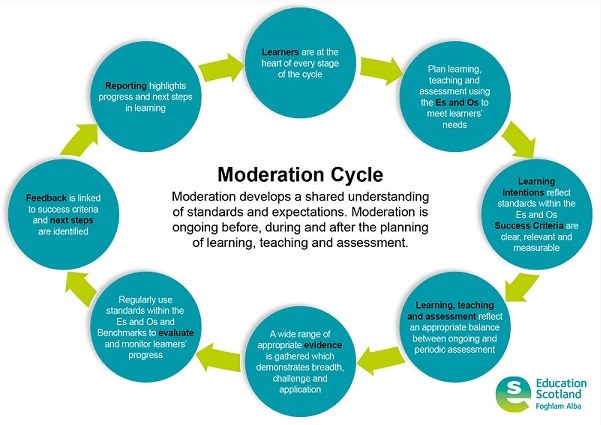
Moderation using the Learning and Teaching Cycle
From National, to local, to school guidance
At Rosslyn we use a variety of profiles to ensure that our planning keeps the learner at the centre. We work closely with our families and partners to ensure our profiles and plans are up to date and fit for purpose.
These documents may include:
- UNCRC – Self-esteem guidelines (whole school approach)
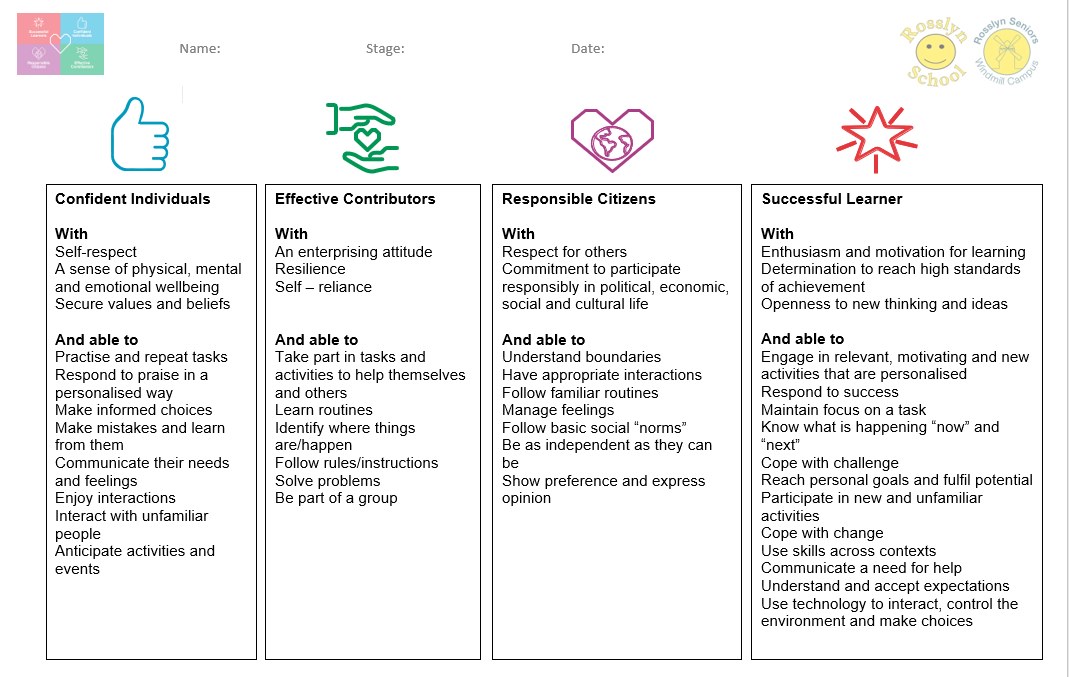
- 4 capacities profile (whole school approach)
- Pupil Passport N3, P7, or transition times
- Child’s Plan (Needs led)
- Learner Mat (whole school approach) that may include signposting to:
- Sensory profile
- Play skills profile
- Proactive management profile
- Risk assessment
- Person Centred Profile
- Communication profile
- Eating and drinking profile
- Moving and Handling profile
- RSHP profile/plan
- EHCP
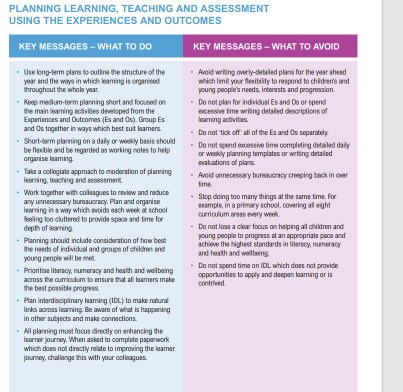
At Rosslyn we use a variety of learning and teaching approaches personalised for our learners. When planning using the Es and Os we give consideration to the needs of the individuals, how they learn, and the activities they enjoy learning through.
The PLP has a focus on literacy, numeracy and health and wellbeing.
BGE is then offered through a personalised IDL project. This has become part of the PLP document.
Similar to ELC, our IDL approach is about exposure to other areas of the curriculum. A learner may only require tracking through the benchmarks where they have demonstrated a particular gift and interest and are making progress within that curriculum area.
When planning for IDL the team decide on a ‘need’ that is personalised either to individuals, partners, or small groups within the class. This is based on school observations, seasons/festivals, tracking information, feedback from families, upcoming appointments, family events etc.
Social groupings for projects would be created in consideration of the stages of play for each learner. Where a learner is at a solitary stage of play, they would not necessarily be grouped on need alone, but also their ability to learn from/with peers.
Teachers are encouraged to plan collaboratively as this strengthens our approaches and moderation of the standards within Rosslyn.
As the PLP moves through the school with the learner, new staff are able to see what has been covered in previous years and consider areas of the curriculum when planning new projects.
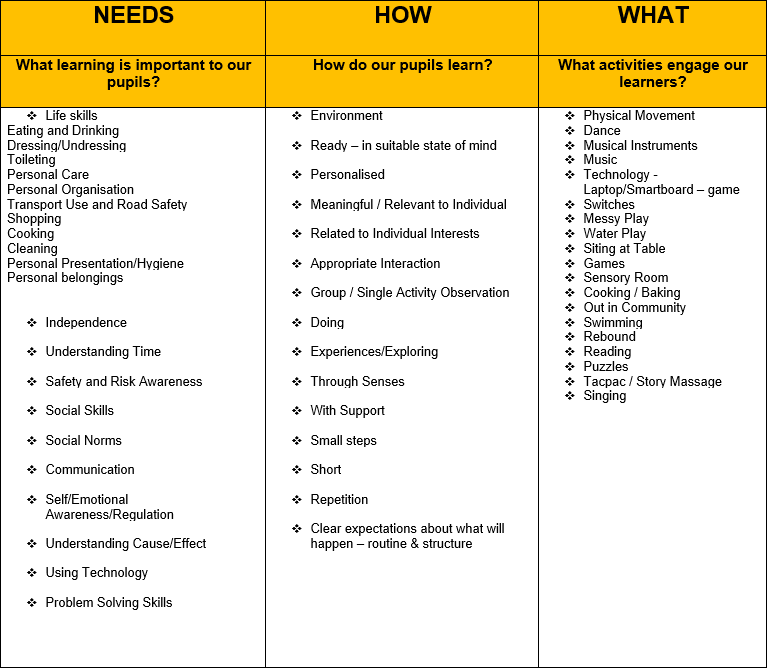
Each learner has this page within the PLP. This may identify their needs, how they learn, and the activities they enjoy.
Principles of IDL at Rosslyn:
- The IDL project is based on the need of the individual
- Activities are motivating to individuals
- Opportunities are offered across the week for learners to take part in their IDL project, with an expectation that this is at least 3 times a week, but may be more
- Success criteria is created over a period of weeks. Base line information is gathered to evidence what the learner already knows, and what they need to learn
- As learners acquire the skills required for their project, they are encouraged to generalise this knowledge to new and unfamiliar settings
- All learners will be exposed to the curriculum areas (Es and Os) within their project – They may not achieve the outcomes, this is okay
- Teachers should look across levels as it may be a first or second level experience that is age/stage appropriate
- Where a learner does show understanding within another curriculum area, this would become part of the PLP and tracked – but this is not mandatory
- The IDL project can be delivered till the LI and SC is met. This may be 4, 8 or 12 weeks
- Staff are responsive to adapting the learning experiences across the week to ensure there is pace, challenge and engagement
- Certain areas of the curriculum will be covered more than others based on learner preference and choices of activities
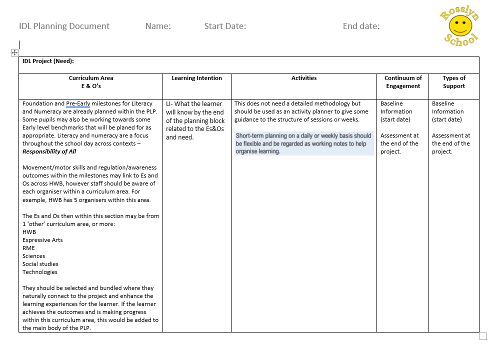
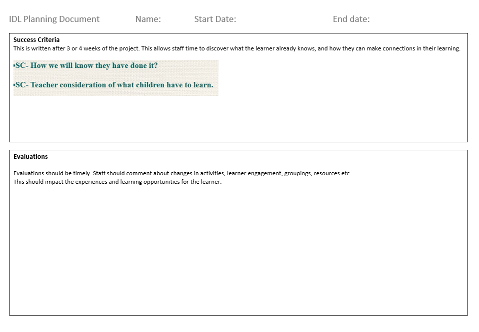
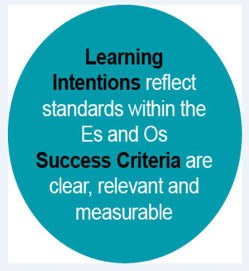
•LI- What children will know by the end of the planning block related to the Es & Os?
•SC- How we will know they have done it?
•SC- Teacher consideration of what children have to learn.
•SC- Evidence of co-construction agreed with children.
Fife Special School Collaborative – PLP Guidance
Across our special schools in Fife, we recognise the importance of valuing the unique learning needs, strengths, and preferences of individual learners. Personal Learning Plans (PLPs) must capture comprehensive information which includes all areas detailed below. Personal Learning Plans are individual and should be considered in collaboration with staff, families and partners, with the learner at the centre.
The Personal Learning Plan should take into consideration individual targets to meet pupil needs, but should be flexible and adaptable to reflect the changing nature and progress of our young people. Within the Personal Learning Plan, diversity and inclusivity should be celebrated and decision making should be firmly based on strong assessment information captured over time.
Schools should be empowered to develop their Personal Learning Plan to meet the specific and changing needs of their communities. Ongoing professional learning for staff should encourage opportunities for staff to further develop their understanding of the curriculum and the changing demands of their communities. Within this planning tool, there has been an agreement that at the core of the PLP, there should be a unity of purpose through a diversity of means. This allows autonomy and individuality to be captured.
Targets must include:
Literacy/Communication
Numeracy & Maths/Making Connections
Health and Wellbeing/Self and Emotions and Functional Movement
Targets should have an overall desired outcome
These targets must be SMART and agreed with families.
Targets should identify appropriate success criteria
Targets should be reviewed and tracked in a responsive manner with a minimum cycle of termly (based on x3 terms per year).
Targets should be agreed using national curriculum standards and guidance. Schools may also take into cognisance other tools such as SCERTS Framework, Circle Framework, Planning and Progression toolkit and other relevant Fife documentation.
All targets should reference appropriate CfE Experiences and Outcomes.
In Rosslyn school our PLP is a responsive planner in line with our tracking information and triangulation of assessment evidence.
- The focus is on Literacy, Numeracy and HWB. Where a learner has achieved progress within another area of the curriculum this is added to the PLP. For example, a learner might have Literacy, Numeracy, HWB and Music targets.
- Staff bundle the milestones that have been highlighted in the tracker and bring across a group of milestones identified either green (acquiring) or yellow (fluency) applying teacher judgement. Purple highlights are generalised and achieved.
- They then set a target that may be IDL in nature from the identified bundles. For example learning to match symbols is within the Literacy and Numeracy Pre-Early Milestones.
- They may also bring across the next milestone or two, (not highlighted yet), so that they can see what the learner is working towards. Within our setting learners may not follow the milestones progressively one by one. They may skip a milestone, or a bundle, and present with a higher skill level. Identifying these heightens staff awareness of this and ensures progress is timely.
- All staff are aware of the Next Steps and record significant observations within the planner. There should be a triangulation of evidence including staff dialogue and
- comments, observations and data. This should be done holistically including partners and families as appropriate.
- When the teacher has ‘enough’ evidence they will review the target in response to this. They may change the support level, continuum of engagement, context etc.
- Teachers will review the tracker, updating it as required in response to the evidence. This may be 4 weeks, 8 weeks etc. As a minimum the tracker is updated 3 times a year.
- They will then update or set a new target.
- The levels are coded as FM (Foundation Milestones), PE (Pre-Early) and EL (Early Level). This allows staff to see learning across levels at a glance within the PLP.
- All learners will have targets within Literacy, Numeracy and HWB. These will vary in number. There is no ‘set’ number of targets. This allows learners to have the optimum amount of targets set in the areas of strength. We refer to these as ‘gifts and gaps’. It may not be appropriate to continue to set targets in areas where there is no progress. Teachers use their professional judgement to make this manageable for the learners in their class.
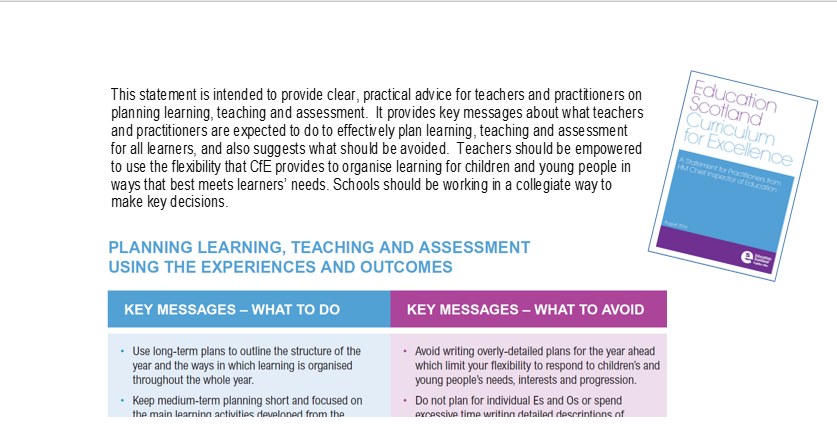
- Use the Es & Os when planning learning, teaching and assessment.
- Plan the assessment when selecting the Es & Os
- Assess using bundles of Es & Os.
- Avoid teach-test-teach-test.
- Planning should suit local contexts.
- High quality assessments that provide the learner with the opportunity to demonstrate; breadth, challenge and APPLICATION in new and unfamiliar situations.
- Four contexts for learning.
- Opportunity to apply knowledge from one organiser to another.
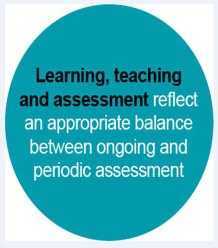
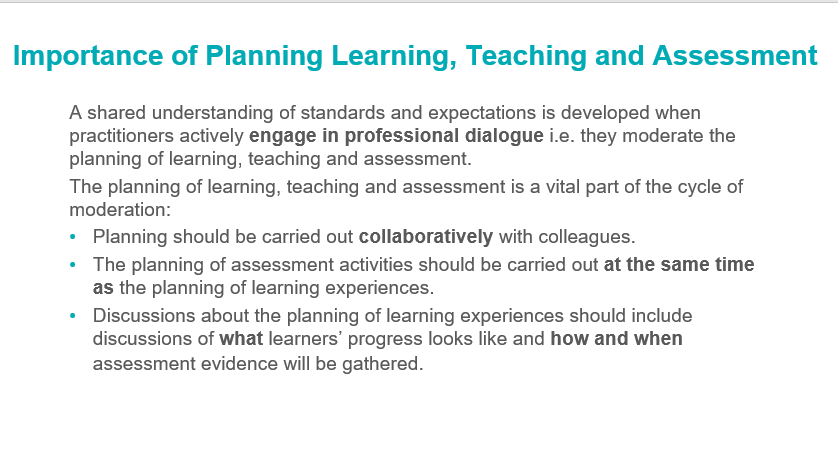
Importance of Planning Learning, Teaching and Assessment
A shared understanding of standards and expectations is developed when practitioners actively engage in professional dialogue i.e. they moderate the planning of learning, teaching and assessment.
The planning of learning, teaching and assessment is a vital part of the cycle of moderation:
- Planning should be carried out collaboratively with colleagues.
- The planning of assessment activities should be carried out at the same time as the planning of learning experiences.
- Discussions about the planning of learning experiences should include discussions of what learners’ progress looks like and how and when assessment evidence will be gathered.
What are High Quality Assessments and what are they not?
High quality assessments ARE:
- Individualised and learner needs led
- Shaped by the planning, informing the selection of Es and Os/ASN Milestones context to assess
- Engagement
- Breath
- Challenge
- Application
- Collective professional judgement based on evidence gathered over a period of time
- Continuation of engagement within progression towards
High quality assessments ARE NOT:
- Checklists
- Constraints to progression
- An end of unit assessment
- The only assessment evidence to be considered as part of achievement of, and progress through, CfE levels
What are key features of High Quality Assessments?
High quality assessments can be taken from one of the four contexts of learning:
- Ethos and life of school as a community
- Curriculum areas and subjects
- Interdisciplinary learning (IDL)
- Opportunities for personal achievement
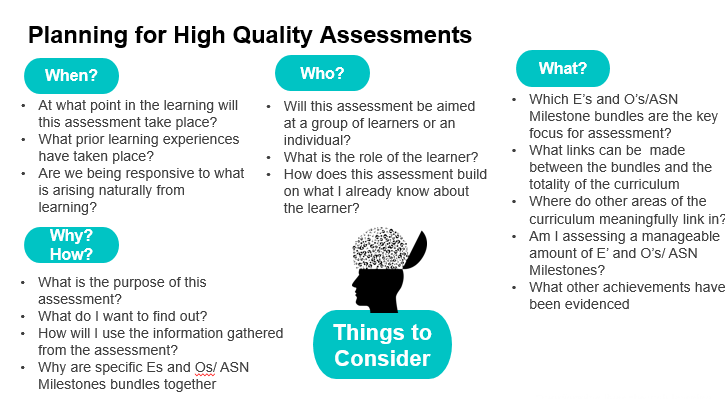
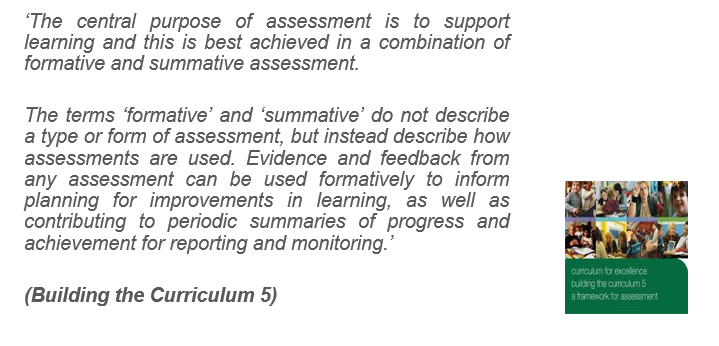
What is the purpose of Assessment?
- Assessment supports learning by focusing on the process of children and young people moving from where they are in their learning towards outcomes
- Promoting learner engagement
- Meet learner needs
- Ensuring appropriate pace, support and challenge
When do we use assessment ? (Ongoing and periodically)
Ongoing assessment opportunities might include:
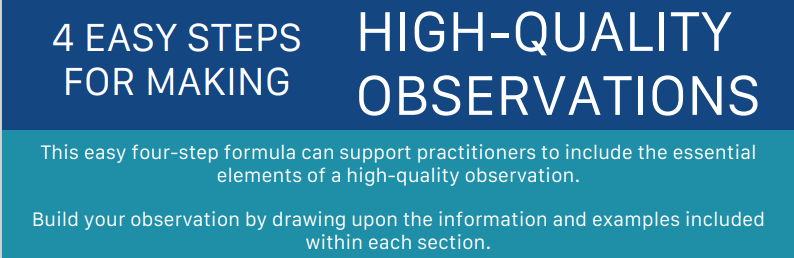
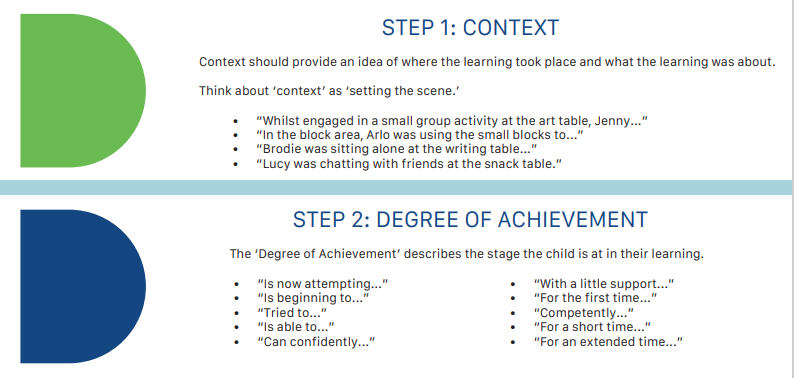
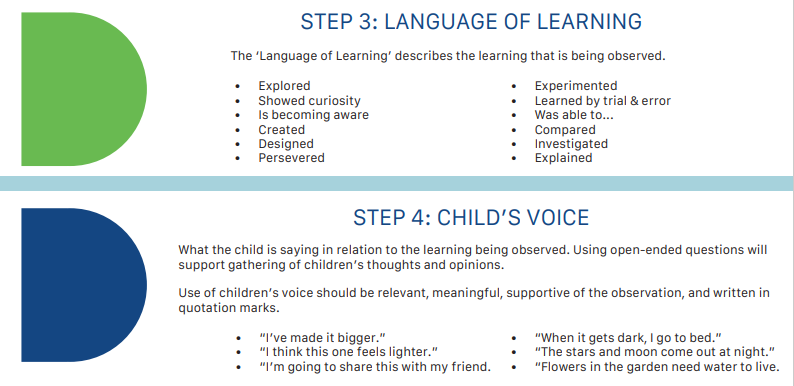
- Observations
- Appropriate Questioning
- Collaborative
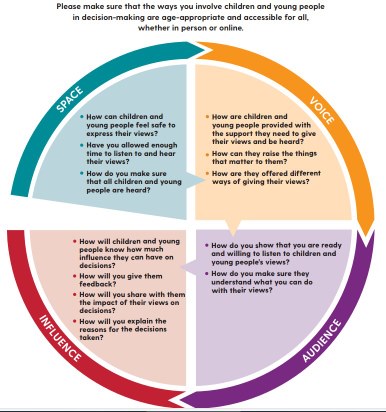
- Pupil Voice
Periodic assessment includes:
- Outcome evaluations
- Progress / summary report
Fife Collaborative –
Assessment will be timely and responsive based on individual pupil progress and as part of holistic discussions with the team around the child. This will be used to inform next steps.
Assessment comment should include:
- Overview of progress
- Stages of Development (fluency codes)
- Types of Support
- Support Codes
- Continuum of engagement
- Suggested Next Steps
Staff in Rosslyn record significant observations daily or in response to achievement.
PSA staff use a learner progress diary to record their observations.
Teachers then summarise these, recording them in to the learners Responsive PLP.
Evidence should be in the form of;
- Observations
- Dialogue
- Data
This ensures triangulation of evidence and robust assessment.
Next Steps are then set. These targets are a ‘summary’ of need across the bundle, as opposed to identifying a single milestone/step within this.
Teachers code the target with the continuum of engagement code that the learner on.
Experience (E) Actively Engaging (AE) and Applying and Extending (ApEx)
This allows the learner to move through the 3 stages of engagement within these forms of engagement before a new code need be applied.
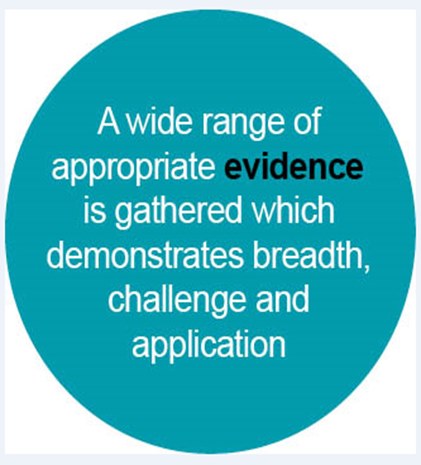
- Different types of evidence.
- Planned periodic, high quality assessments.
- Demonstrate application of knowledge from one organiser to another.
- Clear evidence of breadth, challenge and application.
Evidence Should…
- Be planned for in a personal way.
- Demonstrate breadth, challenge and application.
- Evidence the targeted LEARNING – not the activity.
- Relate to the success criteria that has been set.
- Be varied and gathered over time.
- Be proportionate and manageable.
- Be captured in an accessible format.
Evidence – Valid and Reliable?
•To ensure that evidence is valid and reliable, at the planning stage the assessment should be discussed with, reviewed by or created in collaboration with colleagues so that there is agreement that it provides opportunities for the learner to successfully demonstrate their learning.
•Evidence should be moderated with colleagues against shared, agreed standards, for example levels of engagement. This will increase its validity and reliability as the professional judgement reached in terms of progress is more objective; not only dependent on the opinion of an individual.
•This can be done in a planned, proportionate way and subject to the normal quality assurance and self-evaluation processes of the establishment.
Evidence of Progress and Achievement
- Is there enough evidence to confidently say – ‘that’s enough to show…..’
- Questions you need to ask yourself/team?
- Team work/high quality observations/collective assessment and evidence
- Building on where the learners is…
- We use a range of evidence in Rosslyn school.
- Significant Observations – Recorded in learner progress dairies.
- Photos and videos
- Charts and recording formats personalised to the learner.
- Weekly team meetings where staff discuss progress and review targets.
- Feedback from parents – often written via SeeSaw
- Regular reviews with families
- Questionnaires – FORMS
Feedback from partners
Meets the success criteria
- Appropriate level of challenge
- Has the learner responded consistently well to challenge and moved on to some aspects of the next level.
- Knowledge applied from one organiser to another.
- Demonstrates breadth of learning.
- Demonstrates application in the new and unfamiliar situations.
- Standards within and achievement of a level.
Evaluating the process of learning:
- Meets the individualised success criteria.
- Demonstrates meaningful and purposeful learning.
- Appear to demonstrate building on prior learning.
- Appropriate level of challenge and support.
- Has the learner responded consistently well to challenge and moved on to some aspects of the next step/level.
- Demonstrates application in the new and unfamiliar situations.
- Standards within and achievement of a level.
Evaluating the process of learning:
- Meets the individualised success criteria.
- Demonstrates meaningful and purposeful learning.
- Appear to demonstrate building on prior learning.
- Appropriate level of challenge and support.
- Has the learner responded consistently well to challenge and moved on to some aspects of the next step/level.
- Demonstrates application in the new and unfamiliar situations.
- Standards within and achievement of a level.
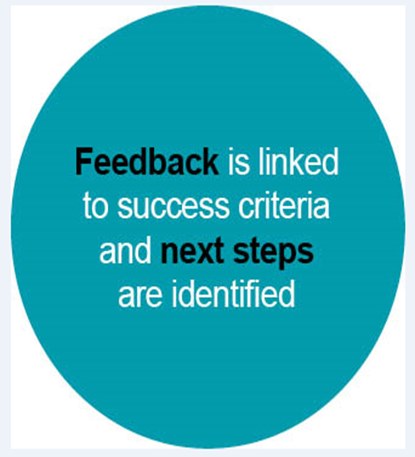
Feedback is linked to success criteria.
- Learners are clear about what they have done well and what they need to do next to improve.
- Quality dialogue and/or written comments.
- Age and stage appropriate.
- Peer and self feedback.
Feedback in Rosslyn school must be personalised, timely and understood by the learner.
This is often more about a response to staffs tone, facial expression, body language and interactions.
Class staff may choose to share feedback with other staff or peers, depending on the group.
Feedback MUST be in the moment.
Rosslyn do not use Circle Time or other formats of group feedback.
While some learners may like a sticker or a ‘high 5’, other learners do not like the emotions and noise that can come with praise. They may prefer a thumbs up, symbol, or object to quietly show them that they have done well.
Feedback will always be in relation to the target. “Good matching”, “Good choosing” etc.
In the senior school staff interactions are still the key to understanding praise. Staff are mindful that the tone is age appropriate and may offer a ‘fist pump’ or a more age appropriate reward/signifier.
The responsive PLP gathers evidence and feedback and informs next steps in a timely way.
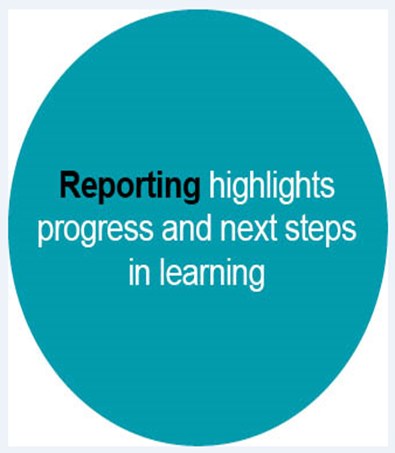
An ongoing process.
•Provides a clear account of progress against which to base further discussion about learning with the learner, parents and carers, and partners.
•Clearly stated progress and next steps.
Reporting to families happens daily via SeeSaw and termly either through family meetings and reviews, Child’s Plans or calls home.
At Rosslyn school we currently provide a full annual report using SWAY.
For our new learners this is in the format of: Interactions, Experiences and Spaces. Example below.
BGE we use the 4 contexts for learning. Example below.
Next steps are suggested within the report, and agreed with families during the meeting.
4 capacities are also shared and families agree what is important to them within wider achievement.
Moderation Reflective Questions and Self Evaluation
•Do you plan for assessment when planning learning and teaching?
•Do you discuss and moderate at the planning stages?
•Does the assessment and evidence allow learners to demonstrate the application of their knowledge, understanding and skills?
•What information / evidence of learning do you hope to get from this assessment evidence?
•What does this evidence tell you (and what are the next steps)?
•Does it reflect breadth, challenge and application?
•Does it demonstrate application in new and unfamiliar contexts?
•Does it reflect one of the four contexts of learning?
•Do you have a range of evidence to support your professional judgements?
HGIOASL