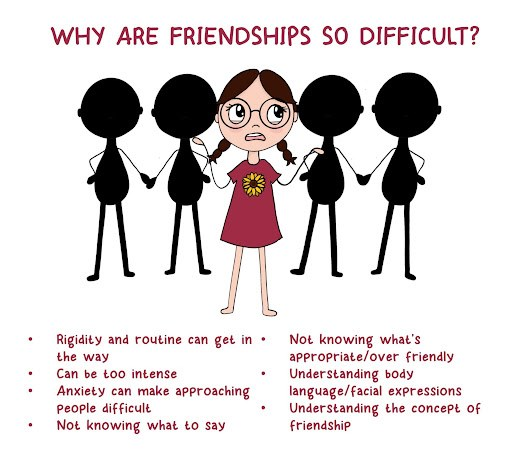
Friendships can be challenging for autistic people due to their differences in social communication and thinking style. These challenges may be more subtle in females, as evidence suggests that they are more socially oriented and more likely to attempt to mask their autistic traits compared to their male counterparts. Unstructured times can be particularly challenging as autistic people need a high level of structure and routine to help them to cope, and autistic girls .
Autistic girls
Some of the following points relate to differences in communication as this can also influence their ability to form friendships and social relationships.
- May try hard to fit in and be accepted by mimicking the behaviours, interests and even speech patterns of people they are friends with.
- May be on the edge of friendship groups or have intense friendships vulnerable to falling out.
- May use echolalia (repeated, scripted speech) likely to be from TV shows etc.
- May have a tendency to people please and give the answers they think you want to hear.
- May have difficulties with appropriate facial expressions and responses (eg. laughing inappropriately or infrequent use of gesture).
- May not use social “chit chat” .
- May find recognising and managing conflict much more difficult than non-autistic girls, impacting on their ability to repair and maintain friendships.
- May have interests in topics that are common to peers (eg. animals, fiction, celebrities), however these will be of a greater intensity.
- May have difficulty identifying inappropriate friendship behaviours and are at risk of being victims of bullying.
- May report feeling like an “outsider” or suffering from intense feelings of loneliness.
- May be less conforming to gender stereotypes
- May struggle to recognise social status/authority (eg. getting into trouble for correcting teachers).
- Often, girls are able to socialise more successfully with people in other age groups. Differences are normal for people of different ages so she will probably may feel less different. Older girls may offer protection and can be more understanding. Or with younger friendships she may feel more confident may try to control the friendship.
Supporting autistic girls to experience successful social experiences
- Provide structured lunchtime clubs, focusing on shared interests.
- Consider providing learning activities to help increase understanding of social situations, interpret non-verbal signals and practice skills such as turn-taking, listening and negotiating.
- Use social stories or comic strip conversations if a pupil is concerned about a particular situation, or to support consideration of another’s point of view.
- Teach neurodiversity to celebrate differences and uniqueness.
- Discuss positive friendship qualities and support the pupil to identify “true” friends.
- Have a zero tolerance anti-bullying policy.
- Use a buddy system or have a buddy bench in the playground.
- Some autistic pupils may find social interaction too demanding. If you have tried to help them form friendships, but the pupil would rather be alone, then try to accommodate them having this time in a quiet and safe area.
Resources
- Fife Council Educational Psychology Service Resilience Toolkit Primary School
- Fife Council Educational Psychology Service Resilience Toolkit Secondary School
- Social stories and comic strip conversations (autism.org.uk)
- NHS resilience-toolkit
- Resilience Parent Booklet under 12