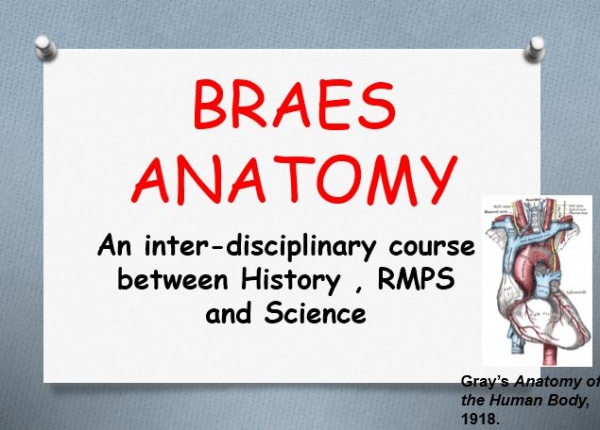
 Fiona Malcolm, Faculty Head of Social Subjects and RMPS at Braes HS worked with a range of colleagues to create an interdisciplinary unit of work entitled Braes Anatomy. Over the course of last session, all S2 pupils experienced connected learning across science, history and religious, moral and philosophical education. The theme which connected this learning was vaccination and its impact on society past and present. In science, pupils discovered how vaccination works with the body’s immune system, and in RMPS they explored the ethics of the ways in which vaccines are produced and used. During history lessons, pupils explored the pioneering role of Edward Jenner and his discovery of the first “vaccinations” as the cure for smallpox.
The overarching learning intentions for this connected learning were:
By the end of these courses, I will:
Be able to develop an understanding of medical knowledge and innovation in the past and present
Be able to develop an understanding of social, moral and ethical views on medical discoveries, past and present.
The project was launched during a history lesson, then each teacher taught their subject content discretely. Click here to see the introductory teaching presentation and here to see the final one for pupils. Pupils then used the 2 weeks leading up to their Easter holiday in their RMPS lessons to begin the task below – they completed this as a homework task. Click here to see the overall IDL homework task.
You are part of the original scientific team that discovered HPV. This is the most important scientific discovery on cancer research in the past 5 years. As such, your evidence is in demand. To keep your funding, you have to produce an article for Medical News Today sharing your findings on HPV.
You must consider the social, moral and ethical implications of your research, including the historical background.
One challenging element of the collaboration for staff was their shared responsibility for marking the pupils’ work. To help with this, each department prepared assessment guidance on their subject content – click here for science, here for history, and here for RMPS key learning points. Fiona and colleagues are still working on how best to manage the joint assessment and maintain their focus on teaching for deep understanding and higher order thinking in line with Curriculum for Excellence ideals.
Staff involved in the project are keen to develop it further this session because it obviously engaged pupils’ interest in all 3 subjects. By making the overlap between subjects evident to the pupils, staff increased the coherence and relevance of learning. Pupils have responded positively and enthusiastically, and can better appreciate how curricular learning in school is actually used and applied in an interconnected way in the workplace and by society. Despite the challenges of finding time to communicate and co-ordinate their work, Fiona and her colleagues have designed connected learning which uses an interesting theme to integrate effective assessment, and develop a shared set of skills, knowledge and understanding for their pupils.