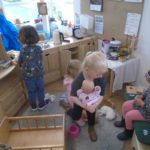
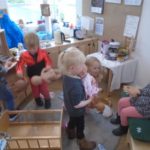
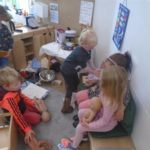
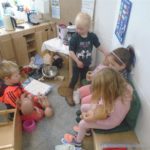
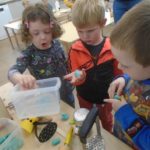
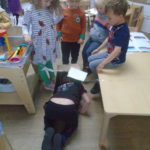
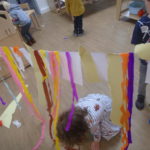
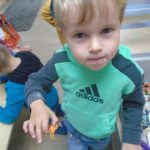
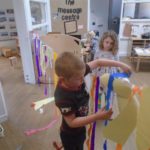
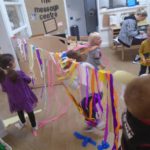
This week we’d like to share some of the ways we’ve been developing our literacy skills and knowledge this week. At this age our engagement with talking, listening, reading and writing is called “emergent literacy”. We need to acquire emergent literacy before we can learn formal literacy and the best way we can do this is through play.
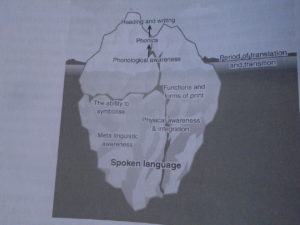
As this iceberg shows there is A LOT for us to learn before we are ready to formally read and write. One of the first, and most important things, that we need to develop is our spoken language. This includes being able to listen carefully and respond to what we hear as well as having opportunities to hear words, use these and practise talking in a range of situations.
Neaum,S. (2017).
As we play we learn to listen. It is important for us to be given time and space to listen to our friends, and to the adults around us, as this helps us to absorb language and respond to what we hear. As we play we learn to talk. Role play is a great way for us to talk together as we take on different characters and require each other’s attention in order for a game to proceed.
Listening and talking through our play in these ways develops our cognitive flexibility which we need for learning and for life. Having cognitive flexibility means we can switch between changing priorities and demands and can keep up with games as rules and scenarios change.
Here are some of the ways we have been developing these skills this week.
“I’ll drive wis to the shop, doo sit yunder.” “ok, I sit. Let’s go.”
“Dis is wir x-box game. Hold it dis way so we use the controls.””
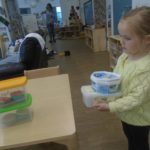
“Whit wid you lik to eat?” Staff – “Could I have pasta with cheese please.” “Ok, let me get some pasta. Wid doo lik white cheese or orange cheese?”
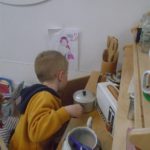
Baby dolls, different characters and cooking food.
Baby dolls and taking on character roles.
Baby dolls and taking on character roles.
Baby dolls and taking on character roles.
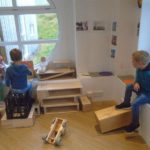
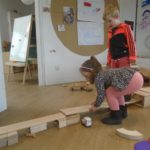
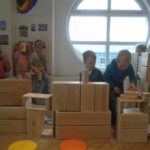
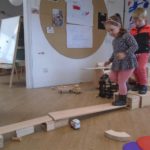
Building block balance. Waiting, watching, listening and sharing ideas.
Shop/House build by listening and talking together.
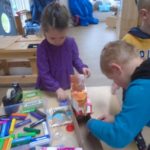
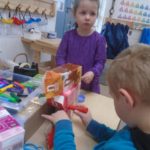
Shared model making. “You do the back. I do the front.” “I can put the buttons on the back.” yeah”
Discussion on where to putt the “meatballs”
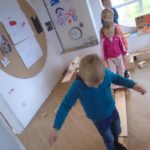
Under? Over? Through? Group discussion and exploration
“put dee head doon a bit more so dee hair dusnoo stick.” Giving and following instructions.
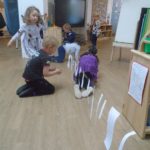
“Your turn S, you come through it now.” Waiting turns, following and giving instructions.
Learning to read happens alongside listening and talking development. We must be able to hear differences in sounds before we can read. We must be able to understand and to use words verbally. In order to read we must develop good working memory which means we can hold information in our minds and use it. We learn this through play. All of the photos shared above show us developing reading readiness through play but here are some extras!
“Dis is how you hold a crab see so he canoo nip” Retaining and recalling information.
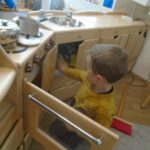
“I’ll fix this cupboard. It needs a hammer.” Understanding and using appropriate language for context.
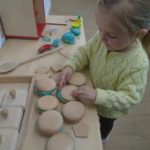
M-“Is it cakes?” “Yes I’ll flatten it dan doo cut.” N- “you can pit dem in dis tub.” Using books as inspiration, creating story.
“I need to carry all the burgers to my hamster car for the hall.” Creating stories and using real life contexts in play.life contexts
Role play.
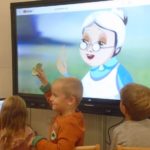
Listening to The Gingerbread man
Creating familiar characters from familiar stories.
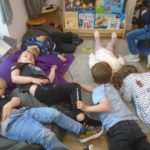
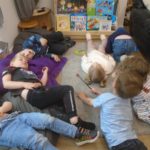
Sleeping bunnies action songs
Sleeping bunnies action songs.
There is a link between physical movement and becoming literate. We learn and develop through being active in the world around us. We explore, investigate, observe, and experience our world through all of our senses. To become physical writers we need good sensory awareness and fine/gross motor control so we can control a pencil and know how much pressure to exert. We learn this through messy play and play that requires us to cross our midlines and use our fingers, thumbs, hands, arms and shoulders. In order to write formally we need good balance and proprioception. We learn this by moving and by getting a sense of our bodies in space, gaining control over them. If we do not have good balance it makes it very hard for us to concentrate and focus. We learn balance through physical play.
Here are some of the ways this week that we have been using our bodies in ways that will help us become writers of the future.
Balancing
Balancing and giving personal spaceBal
Balancing, waiting, giving personal space.
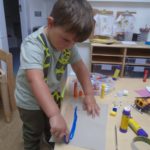
Horizonal lines on horizontal surface.
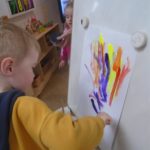
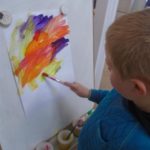
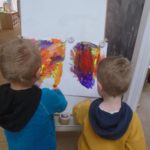
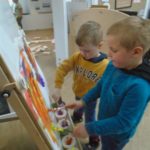
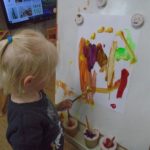
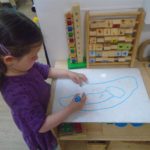
Vertical surface painting for shoulder stability. Horizontal and vertical lines.
Vertical surface for shoulder stability, arm control
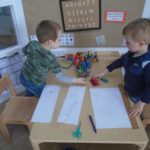
Sharing space, developing awareness of paper boundaries.s.
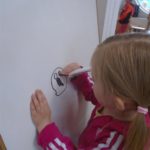
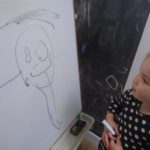
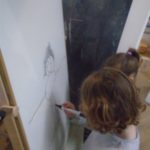
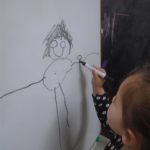
Pen on vertical surface. A great way to naturally develop good pencil grip.
Pen on vertical surface. A great way to naturally develop good pencil grip.
“This is mummy, she’s got lots of frooshy hair.” Creating characters with a story linked to real life.
Pen on vertical surface. A great way to naturally develop good pencil grip.
Pen on vertical surface. A great way to naturally develop good pencil grip.
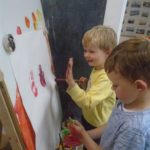
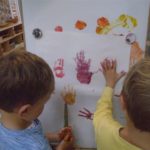
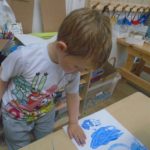
Painting our hands makes us more aware of them, their features and how they move. Hand printing.
Painting our hands makes us more aware of them, their features and how they move. Hand printing.
Painting our hands makes us more aware of them, their features and how they move. Hand printing.
Painting our hands makes us more aware of them, their features and how they move. Hand printing.
Whiteboard and pen means changes can be made quickly as we practice pencil control
Painting our hands makes us more aware of them, their features and how they move. Hand printing.
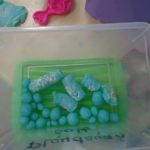
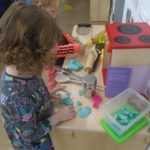
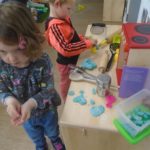
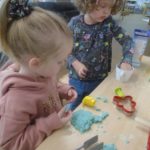
Rolling playdough into balls is a great way to developing sensory awareness and motor control.
Rolling playdough into balls is a great way to developing sensory awareness and motor control.
Rolling playdough into balls is a great way to developing sensory awareness and motor control.
Presssing, pushing, squeezing dough makes fingers, hands and wrists strong and ready for writing.
Presssing, pushing, squeezing dough makes fingers, hands and wrists strong and ready for writing.
Presssing, pushing, squeezing dough makes fingers, hands and wrists strong and ready for writing.
Pinching paper onto lines develops pincer grip and delicate movements of fingers.
Pinching paper onto lines develops pincer grip and delicate movements of fingers.
Pinching paper onto lines develops pincer grip and delicate movements of fingers.
Pinching paper onto lines develops pincer grip and delicate movements of fingers.
Pinching paper onto lines develops pincer grip and delicate movements of fingers.
Pinching paper onto lines develops pincer grip and delicate movements of fingers.
Thanks for taking the time to see how we have been developing our love for literacy this week. We look forward to sharing more of our learning with you next week.