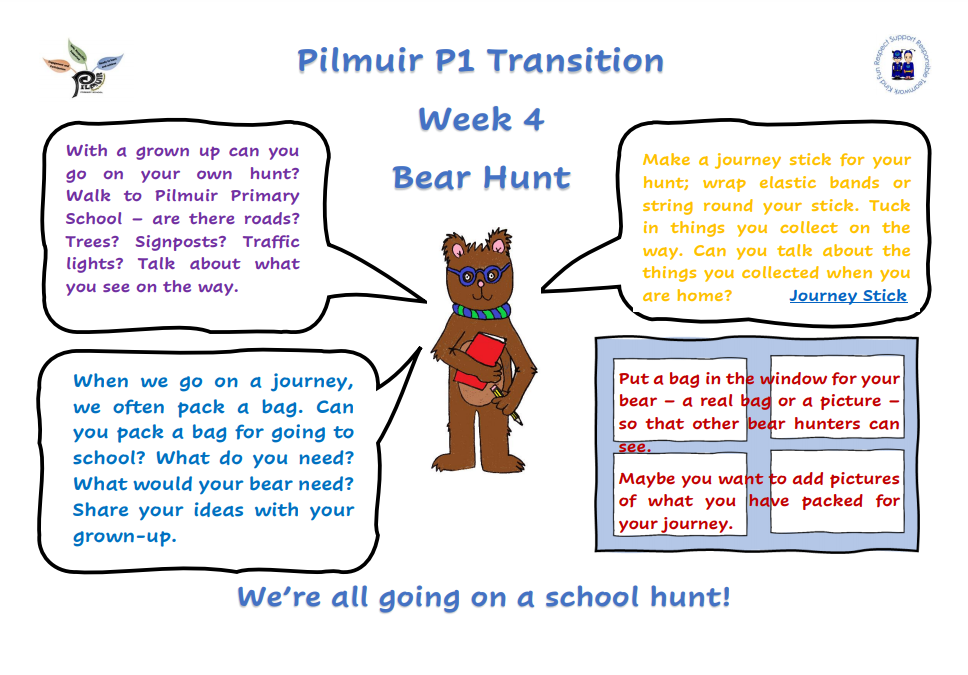
We would love to see any photographs of you on a walk to Pilmuir Primary, tag us on Twitter @PilmuirPrimary #P1Pilmuir
or email admin.pilmuirp@moray-edunet.gov.uk

We would love to see any photographs of you on a walk to Pilmuir Primary, tag us on Twitter @PilmuirPrimary #P1Pilmuir
or email admin.pilmuirp@moray-edunet.gov.uk
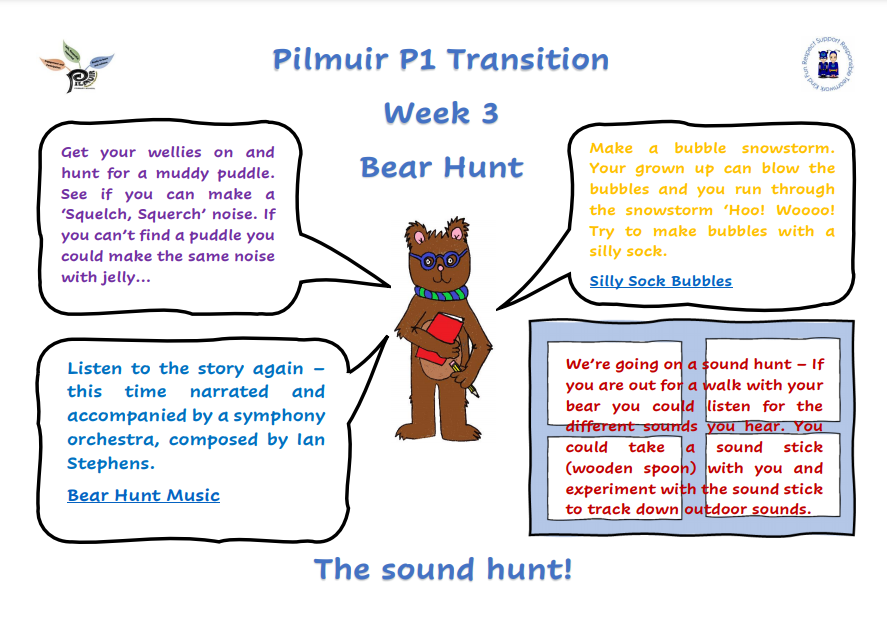
This week we are thinking about sounds on our bear hunt.
We would love to see your photographs on Twitter, tag us @PilmuirPrimary #P1Pilmuir
or email admin.pilmuirp@moray-edunet.gov.uk
In Scotland we benefit from a curriculum model that spans Early Learning Centres (ELC) and the early years of Primary School. The Early Level of CfE supports the use of a responsive, continuous and play based curriculum for children aged between 3 and 6. This involves learning in ways which include a more active, play-based approach to learning and teaching in early Primary School and also supports the transition for ELC to Primary School.
Play is an essential part of human nature and development, through play a child develops their cognitive, social, emotional and physical capacities. Play can be thought of as children’s work (Isaacs, 1930) and is anything but simple!
Play allows children to make connections in their learning and to be actively involved with their learning. A play-based curriculum offers rich opportunities to equip our young learners with the skills, attributes and dispositions necessary for them to thrive in an ever-changing world.
Teachers and other adults in the class take the lead from the children, to identify what needs to be reinforced and how to extend children’s learning and development. It involves supporting, enriching and giving children space to build their own ideas.
At Pilmuir, we take a developmental approach to Emerging Literacy in Primary 1, which involves interactions between adults and children which support children’s language development in literacy and across the curriculum.
The four areas of literacy which skills are developed are phonological awareness, oral language, pre-handwriting and concepts of print. A screening tool is used to identify and plan for children’s strengths and gaps in phonological awareness and pre-handwriting skills. Active learning approaches are used as teachers plan to meet the developmental needs of children. To develop oral language, children’s strengths and gaps are identified and adults make use of play situations to model and support the development of language. Play also provides opportunities for children to access texts and make marks. Sharing books and texts leads to many opportunities for children to retall stories as a foundation for creating their own texts.
We also use synthetic phonics to introduce reading and writing to children in direct teaching lessons. This involves learning the 42 phonic sounds which have fun actions, stories and songs to help the children learn. We use the Jolly Phonics programme to learn the letter sounds, learn letter formation, how to blend phonics, how to identify sounds in words and about tricky words that can’t be sounded out. The videos below show how this may happen in your child’s class.

TO SIGN UP
Follow the link
http://sportinmoray.co.uk/mcsh/active-schools/active-schools-moray/forres-asg/
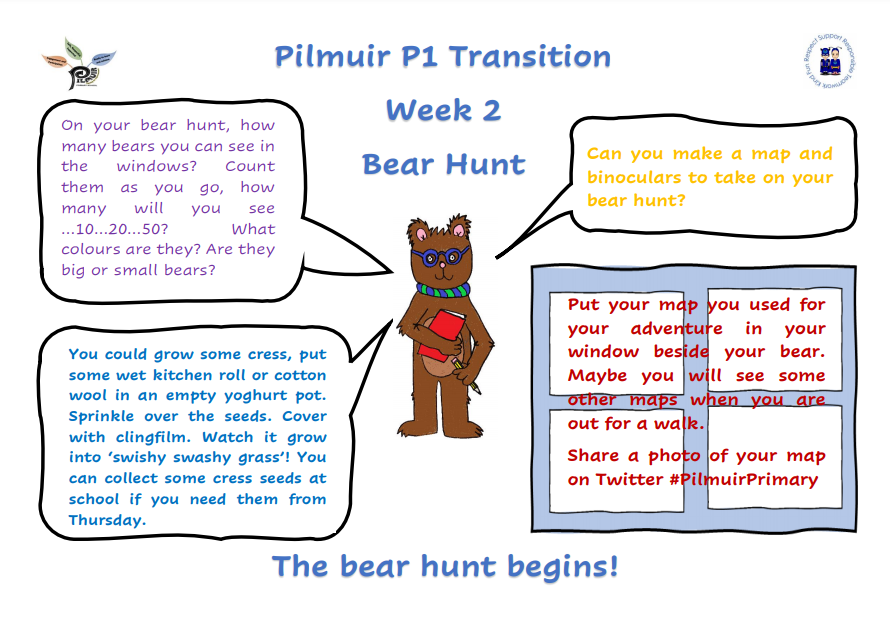
We hope you have managed to put a bear in your window and are ready to continue on your bear hunt this week. There are some new activities for you to join in with if you would like. We would love to see any photos – you can post on Twitter and tag the school @PilmuirPrimary #P1Pilmuir . You can also email the school admin.pilmuirp@moray-edunet.gov.uk
Last year we were sent a great outdoor activity hunt for Forres that is all about following directions – going up, down, across, towards, over and under. It is a circular route and should take about half an hour. Have fun!
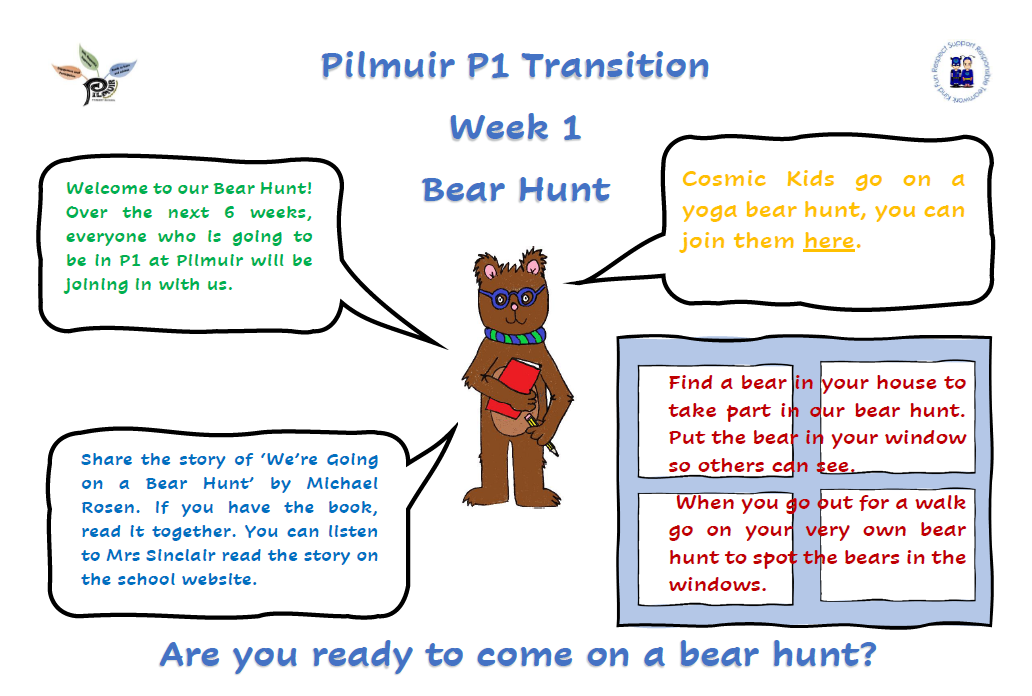
Look out for bears in windows, you might even see a warning sign!

If you are happy to share pictures from your Bear Hunt you can post them on Twitter @Pilmuir Primary with the tag #P1Pilmuir
Or you can email the school – admin.pilmuirp@moray-edunet.gov.uk
The link below will take you to the Forres Academy transition website where you will find information about the school, the transition process and key people involved in the transition process. You can return as many times as you like to explore the website and information will be uploaded regularly.