Number Talks: Developing Mathematical Fluency through Discussion
What is a Number Talk?
A Number Talk is a short, daily routine (typically 5 to 15 minutes) where learners engage in mental math problems and discuss their strategies. Based on the work of Sherry Parrish and Barbara Blanke, it is a powerful tool for shifting the focus from “getting the right answer” to understanding the “how and why” behind the numbers.
In a Number Talk, the teacher presents a problem—usually horizontally to discourage standard column algorithms—and learners solve it mentally, using “silent signals” to show they are ready.
The approach is built on three foundational pillars:
-
Mental Strategy over Algorithms: Learners are encouraged to decompose and manipulate numbers in ways that make sense to them, rather than relying on memorised procedures or “borrowing and carrying” on paper.
-
The Teacher as Facilitator: The teacher’s role is to record (scribe) learner thinking exactly as it is described, using visual representations like number lines or bar models to make the abstract thinking visible.
-
A Safe Learning Environment: The classroom becomes a “discourse community” where mistakes are viewed as opportunities to explore misconceptions and where every learner’s strategy has value.
Why Are Teachers Making the Switch?
The Number Talk approach addresses the lack of confidence and “maths anxiety” often found in traditional settings. Here is how it redefines the mathematical experience:
-
Conceptual Fluency over Rote Memorisation: Instead of focusing on speed, Number Talks value efficiency, accuracy, and flexibility. Learners begin to see numbers as flexible units that can be broken apart and put back together.
-
Visible Thinking through Representation: By using open number lines or area models to record learner strategies, teachers help the whole class “see” the math. This bridges the gap between concrete materials and abstract symbols. Teachers may also use concrete manipulatives to represent learner’s thinking and model computation strategies.
-
Empowering Learner Agency: When a student sees their specific strategy written on the board and named after them (e.g., “Sarah’s Strategy”), it builds an identity as a capable mathematician.
-
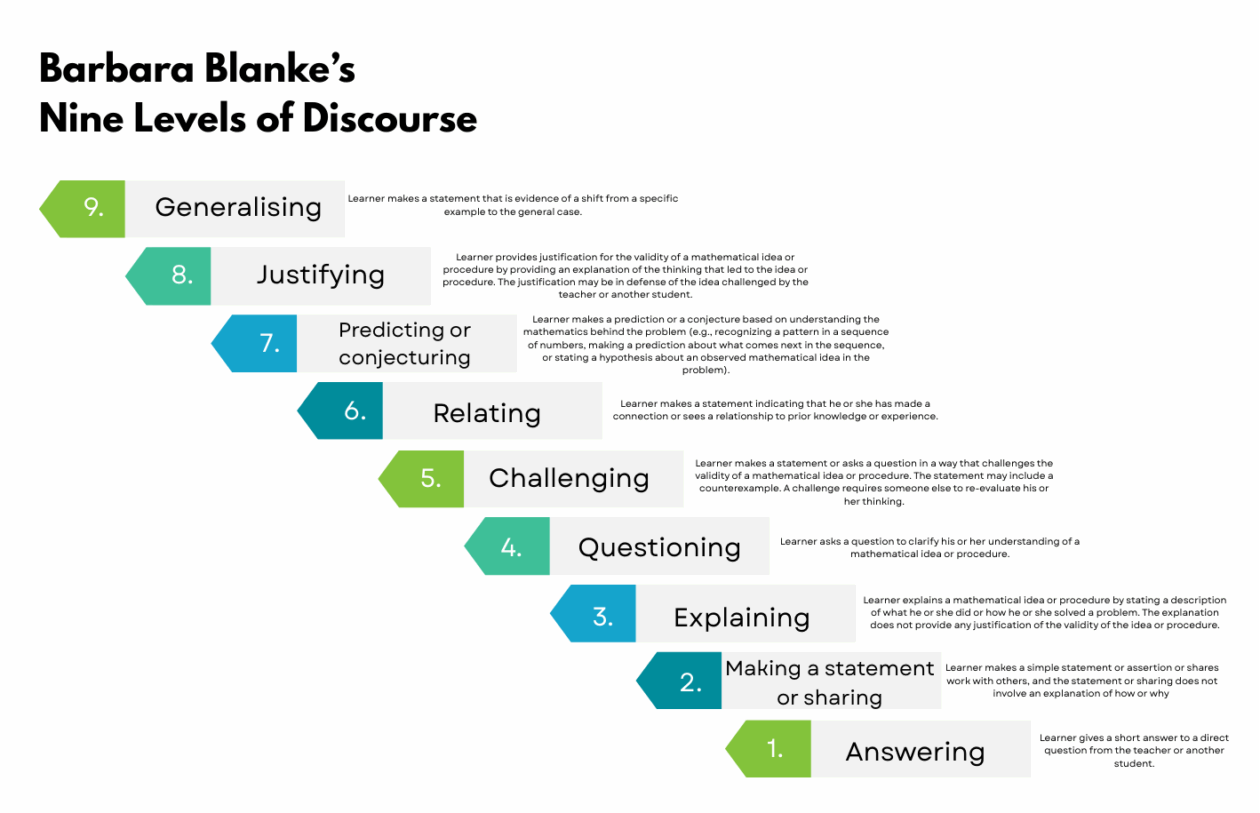
Developing Mathematical Language: As Barbara Blanke emphasises, “letting the kids talk” is vital. Learners practice using mathematical vocabulary (e.g., partitioning, compensation, landmark numbers) in a meaningful context. Teacher’s should also use purposeful questioning to facilitate opportunities for learners to increase the sophistication of their mathematical discussion, moving through Barbara Blanke’s 9 Level’s of Mathematical Discourse;
Who benefits from the approach and why?
While Number Talks benefit all learners, they provide specific advantages for different groups within the Scottish classroom:
-
Reluctant or Lower-Confidence Learners: The use of “silent hand signals” (like a thumb against the chest) removes the pressure of being the first to raise a hand. These learners benefit from hearing their peers explain multiple ways to solve the same problem.
-
High-Achieving Learners: These learners are pushed beyond the “correct answer.” They are challenged to find the most efficient strategy or to justify why a certain property of operations works, deepening their algebraic thinking.
-
Teachers: Number Talks provide an immediate, daily formative assessment. Teachers can quickly identify common misconceptions (such as place value errors) and adjust their core numeracy lessons accordingly.
-
The Learning Community: It fosters a culture of respect. Learners learn to listen to one another, agree or disagree politely, and value different perspectives—essential skills for Life, Learning, and Work.
Common Issues Number Talks Help Address
This approach was designed to solve several persistent hurdles in primary mathematics:
-
The “Column Method” Dependency: Many learners can perform a column sum without understanding place value. Number Talks force learners to think about the value of the digits (e.g., 40 + 30 rather than 4 + 3), strengthening their “Number Sense.”
-
Maths Anxiety: By removing the timer and the pencil-and-paper pressure, Number Talks create a low-stakes environment. The focus is on the process, which reduces the fear of being “wrong.”
-
Passive Listening: In a traditional “teacher-led” lesson, learners often tune out. In a Number Talk, the discourse is driven by the learners. They are expected to defend their logic and critique the reasoning of others.
-
Lack of Flexibility: Many learners get “stuck” if they forget a specific rule. Number Talks equip them with a “toolkit” of strategies (like Doubling and Halving or Compensation), so they always have a way into a problem.