Review by Elaine Swan, Langlees Primary School, Falkirk
Suitable for: older 1st level and/or 2nd level
Themes – identity, racism, bullying, mixed-race families, 1950s, fostering of ‘brown babies’, post-war life and dealing with the loss of family members, rural life, mining and the use of animals in the pits
The many themes in the book ‘Birdie’ makes it a book that can be read in conjunction with learning about the themes listed above or just as a beautifully written story that made me think of ‘The Secret Garden’, ‘Black Beauty’ and ‘Anne of Green Gables’ as I read.
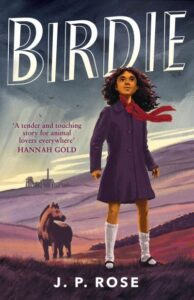
Set in the 1950s, BIRDIE follows the story of a ten-year-old Birdie Bagshaw (great name) living in a ‘brown babies’ children’s home in Leeds – until her great-aunt and uncle invite her to come and live with them in their little village in Yorkshire. When Birdie gets to Barrington Dale she is treated badly by almost everyone she encounters and as Birdie navigates the racist treatment of those around her, she comes across an old pit pony she names Mr Duke, and the pair find a connection, love, and companionship which at that point they both desperately need.
I loved the character of Birdie, a driven little chatterbox, strong but not unemotional, full of opinions, and a love of animals – from the pigeons at the children’s home and her ladybirds kept in numerous matchboxes, to the pony Mr Duke, the last pit pony in residence in the now-nationalised coal mine who Biridie tries to save from the grinding existence of the mine – and from the knackers.
This story will tug on your heart in many ways, and I loved how the author handled difficult aspects of Birdie’s life compassionately and in a way that is perfect for young readers to read and understand.
The reason I gave the book 4 out of 5 and not 5 out of 5 stars (I did love reading it) was because I couldn’t really believe that Birdie would not have, by the time she had gotten to Yorkshire, encountered racism of some sort.
Really liked – Yorkshire dialect, a story about horses without being about privilege, variety of characters (The Reverend, Mr Walter, Julie) and the historical note at the end of the book.