PHONICS
In Primary 1, Phonics is taught with two main focussed lessons in the week, followed by short daily activities to reinforce the learning. Initially, two sounds are taught per week.
In Primary 2 and Primary 3, phonics is taught with one main focussed lesson in the week, followed by short daily activities to reinforce the learning. In Primary 2 and Primary 3 there is generally one taught phoneme sound per week.
A phoneme is the smallest unit of sound that can alter the meaning of a word. This can be in the form of a single letter or a joined phoneme e.g. p/b pin/bin ch / sh chop/shop etc.
The teacher introduces each sound in a context i.e. a story/song and then demonstrates the letter formation and word building through the use of a magnetic board and letters. The children are provided with a magnetic board to allow them to mirror
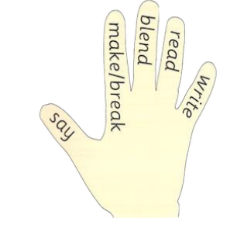
the taught lesson and work independently / with a partner throughout the week. Children are taught with a partner to consolidate the taught lesson. This is called reciprocal teaching. They take turns to guide each other through the word building reading and writing process. The child encourages their partner to say, make/break, blend, read and write each word. The activity alternates between partners and they then check their partner’s work for correct formation and accurate spelling.
READING
Children are taught to read using the guided reading approach. The teacher provides an overview of the text. This is known as a ‘walk through’. At the start of the lesson, the teacher is the only person with a copy of the book. The teacher has read the book prior to teaching and has identified any tricky vocabulary and any common words the children have already learned in class.
Word Attack Strategies
- Look at the first letter
- Sound out the first few letters
- Break the words into syllables
- Look at the last letters
- Read the sentence again
- Look at the picture
- Look at the shape of the word
|
|
The teacher helps the children to read the words in the book by drawing the their attention to the pictures clues. Time is taken to teach the children various comprehension strategies to help them gain a better understanding of the text.
As their phonics knowledge increases, children will also learn Word attack strategies to enable them to decode words that they find difficult.After the initial ‘walkthrough’, the children have opportunities to read aloud. This happens in a group setting /with a partner. The teacher circulates to listen and provide feedback.
Children are taught to read using a structured reading scheme. In the Early Stages, Oxford Reading Tree is used and in the Middle and Upper stages Rapid Readers and class novels. Children are provided with a variety of texts in which to develop their reading and writing skills. The support of parents at home is vital in helping children to read. ICT websites and resources are used to support and enhance the learning and teaching process.
We teach the children to make use of the school library and visit our local library fortnightly. Children have to learn to use a variety of skills in reading different types of text, but they also have to derive enjoyment from books. We value the help from parents in encouraging children to read regularly.

WRITING
Our establishment uses the ‘Big Writing’ approach to develop Writing skills. Big Writing focuses on the four key aspects of quality writing:
- Vocabulary—every child is encouraged to widen their use of language, in order to make their writing richer e.g. ‘The sirens filled the sky.’ – not that interesting! However, by developing vocabulary: ‘The screaming sirens were suffocating the quiet night.’ is a far more interesting sentence to read!
- Connectives—or joining words, are really important for ensuring writing is cohesive and interesting. Good examples are: although, however, besides, even though, never the less, in addition to, contrary to, despite, etc.
- Openers—by varying the way you open sentences, writing becomes more engaging to read. Many Connectives also make good openers, other good examples are: Before very long, An important thing, Having decided to, etc. Meanwhile. Using adjectives at the start of sentences is also powerful e. g, ’The golden sun’ or ’The grumpy old man’. Varying the sentence length and word order can also help, as well as using complex sentences structures.
- Punctuation —Children are encouraged to use appropriate punctuation to lift their writing off the page e.g. ‘We were sailing hard at 23 knots (very fast!) through perilous and ice cold waters.’ By Primary 7 pupils should be using a range of punctuation, for example, “ ”:; , … ( ) ? ! .-’Contexts for teaching the skills of writing are provided. This gives relevance to the tasks and the children are motivated because they are interested. Children require to express themselves in different written formats and for different reasons. They are given the opportunity to express their own ideas and opinions or for a more practical purpose, to learn skills for letter writing, completing forms, etc. We use a variety of resources to teach writing including Literacy World and other areas of the curriculum.SPELLINGChildren have opportunities throughout the week to work with a partner. This is called reciprocal teaching. They take turns to dictate words and sentences. The activity alternates between partners and they then check their partner’s work for correct formation and accurate spelling.The strategies the children are taught are:
- Children are taught strategy spelling. Strategy Spelling teaches children to problem solve and enables them to spell tricky words. Tricky words are words which don’t always follow patterns or rules.
- Spelling and phonics are taught separately at this stage. Spelling is taught with one main focussed lesson in the week, followed by short daily activities to reinforce the learning. The words from the taught lesson are known as the common words. These are the words that the children are most likely to come across when reading simple texts. They will also use these words in their writing.
- Assessment is for learning strategies will be used to help pupils develop their skills. For example, self and peer assessment using the VCOP grids. Children are encouraged to develop and consolidate their writing skills across the curriculum.
- Children take part in a range of VCOP activities to develop their skills in the following areas: Vocabulary, Connectives, Openers and Punctuation. Rapid Writing is used to support some children with their writing skills.
- Using phoneme knowledge (sounding out)
- Syllabification – breaking words down into syllables. The children clap out words to identify syllables e.g. go-ing / An-drew
- Word Shape – look at letter shape, size, ascending and descending letters
- Tricky letters – looking at the position of tricky letters as an aid to spelling
- Compound Words – breaking the compound word into simple words e.g. into = in + to
- Mnemonic – using an aide memoir e.g. because – Big Elephants Can Add Up Sums Easily
- Using Analogy – if you know how to spell one word you can spell similar words e.g. if you can spell hill, you can spell mill, will, fill etc.
Spelling games are also used to consolidate pupil learning. Homework Spelling activities are related to Big Writing activities and other curricular areas.

HANDWRITING
Handwriting skills are developed throughout the school. Skills are developed using Nelson Handwriting. Children are encouraged to take care with their handwriting and presentation of work at all stages.
LISTENING & TALKING
In the classroom, children are taught to be active listeners. A variety of activities are used such as tapes, games, stories and specially devised materials. Listening skills are developed through many aspects of the curriculum.
It is through discussion and talking together that children make sense of their learning. Opportunities are planned across the curriculum for children to talk in pairs, groups or individually with their peers, the teachers or other adults.

LITERACY ACROSS THE CURRICULUM
Literacy is the passport to essential learning across the wider curriculum and lifelong learning. It is important to make and highlight connections between the different curricular areas and promote the development of literacies across the different curriculum areas: expressive arts, health and wellbeing, languages, mathematics, religious and moral education, science, social subjects and technologies. It is important that pupils recognise that skills are transferable across all subject areas.
MODERN LANGUAGES
French is taught across all stages.