“The defining feature of being a young active learner is the need to widen
experiences and learning in all areas of development. The important role
for the practitioner is to determine what the young child could learn through
their own interests, balanced with learning across the areas of the curriculum.
Supporting this in a quality learning environment with high quality interactions
will enable the young child to support and extend their learning, deepen
thinking and make progress.” Realising the Ambition (2020:21)
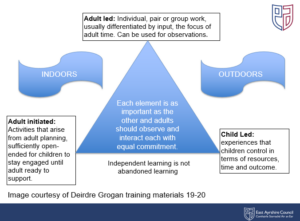
Types of Experiences: There are 3 levels of experiences that you may plan for in the Early Years.
Child Led: These can be experienced by children through a well planned Continuous Provision and will be completely led by them in terms of time, space and resources.
Adult Initiated: During adult-initiated learning, practitioners will draw from a combination of responsive planning and intentional promotional planning to present open-ended provocations to facilitate children’s exploration and comprehension of a subject. Adult initiated learning can follow on from previous adult-led experiences. Practitioner’s fathom/ignite children’s thinking – the adult sets up a starting point, invitation, provocation or stimulus with planned intentions and then stands back to wait, watch and wonder. Children engage independently until the adult joins to observe, interact or enhance learning
Adult Led: During adult-led learning, the adult is teaching specific skills and concepts. This might be for example, a baking or sewing experience, or a focused phonics session in a P1 classroom.
Practitioners can also set up invitations and provocations in response to observations of children’s interests to elicit further learning.
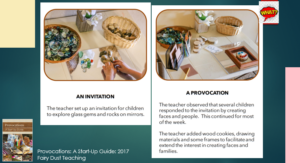
Developing the right balance between child-initiated, adult initiated and adult directed experiences, will depend on the uniqueness of the needs of each setting’s children and wider context; including the cultural environment in which children learn and play.’ Realising the Ambition (2020:49)
All of these types of experiences can be documented within the Proforma and you should ensure an appropriate balance.
In order to support you further, we have developed a number of provocation cards that can give you ideas for initial invitations and/or provocations that are linked to children’s initial sparks of interest and questions. Further provocations and learning experiences can then be designed in response to practitioner observations to children’s engagement with these experiences. These were discussed at our recent “Zones” training – which can be facilitated or followed up on request.
We also have a number of books in our TAP catalogue that we can loan to help you explore this area further.