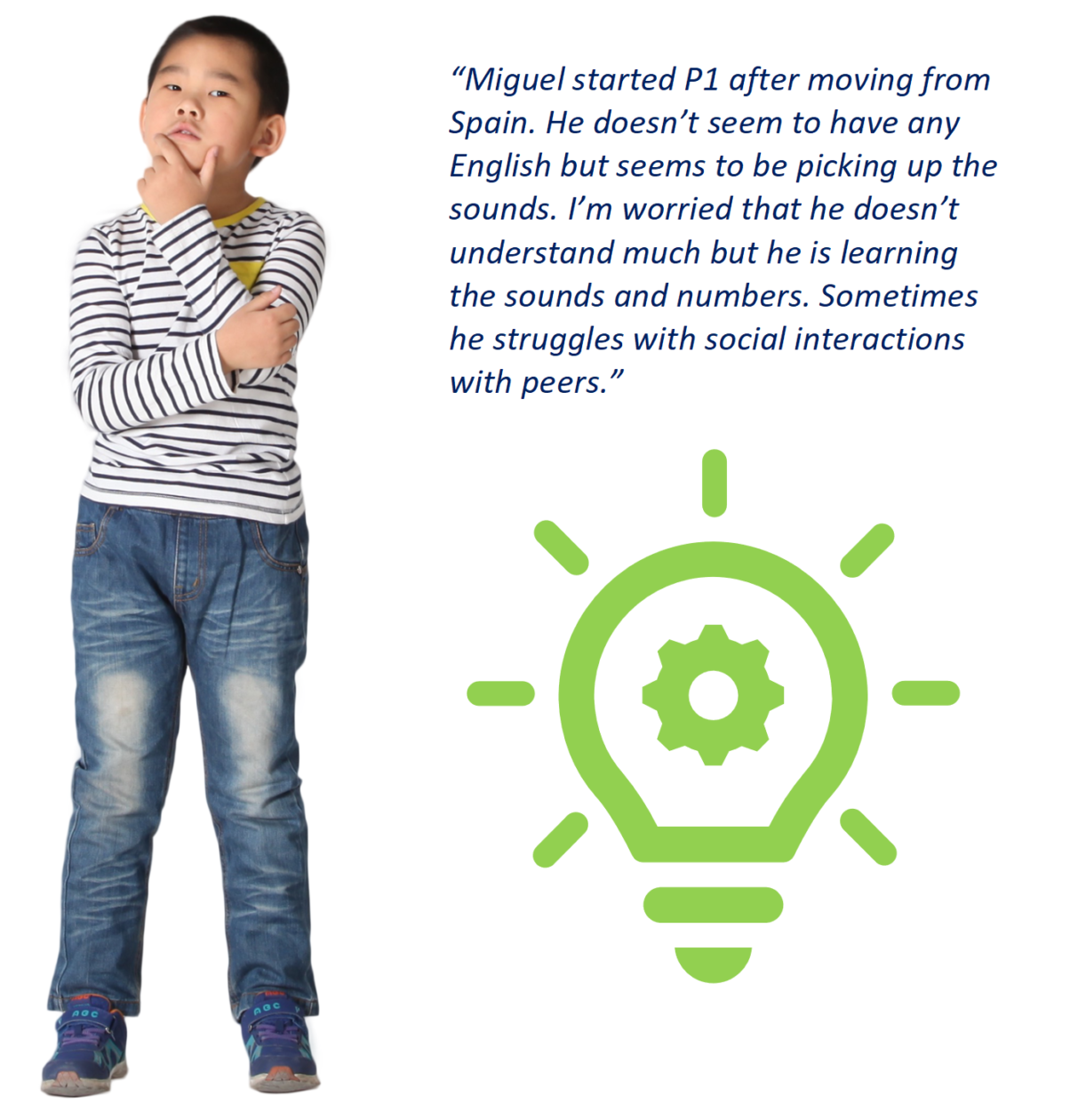
Ideas for the Classroom - Primary - Case Study 1 - Advice

Find out:
· When did he arrive in the UK?
· What language is spoken at home?
· Does Miguel have any siblings or extended family?
· Do the family have friends with the same home language?
· Does Miguel have any friends who share the same first language to support his Spanish social language?
· Has Miguel been in contact with any English language before joining primary one?
· Has he been to an early years setting?
· Is he happy at home and in class?
· Are there concerns about Miguel’s development at home?
Advice:
· Children can go through a ‘silent period’ in the initial stages of new language acquisition. This is okay and may last a short time or a long time as they continue to process the new language.
· It can be really tiring for children who are learning in English while also learning English. Miguel may need a lot of breaks.
· Miguel may feel frustrated if he doesn’t understand or feels lost or confused. Clear repeated instructions will help if his frustration manifests as poor behaviour.
· It can help for the class teacher to role play social situations with the class if Miguel is finding it hard to interact with peers.
· Continue to follow the P1 curriculum with visuals to increase his vocabulary
· Use a visual timetable
· Play lots of vocabulary building games including teddy talk, barrier games (any game where children cannot see something and have to communicate to find things out – Guess who, Headbands).
· Give a lot of praise (Stickers!) – You can get some translated stickers too!
· Plan quality time (daily) for the pupil to spend with either the teacher or PSA
· Invite parents or older pupils who are literate in first language to read a dual language story (could be on video)
· Encourage opportunities to ‘have a go’
· Further strategies can be found here
Further advice:
Learning in 2+ Languages Section 4 (Advice for classroom)
Bilingual Family p22 (silent period), p38 (Communication with parents)
Primary Teachers’ ALDO Course (EAL Training)
HGIOS Inclusion and Equality Series Part 4: EEPBL p12,13 (Examples of good practice)
See also:
· 2.4 – Personalised Support
· 2.7 – Partnerships
· 3.1 – Ensuring Wellbeing, Equality and Inclusion
· 3.2 – Raising Attainment and Achievement
· Article 12, 30