School Ethos
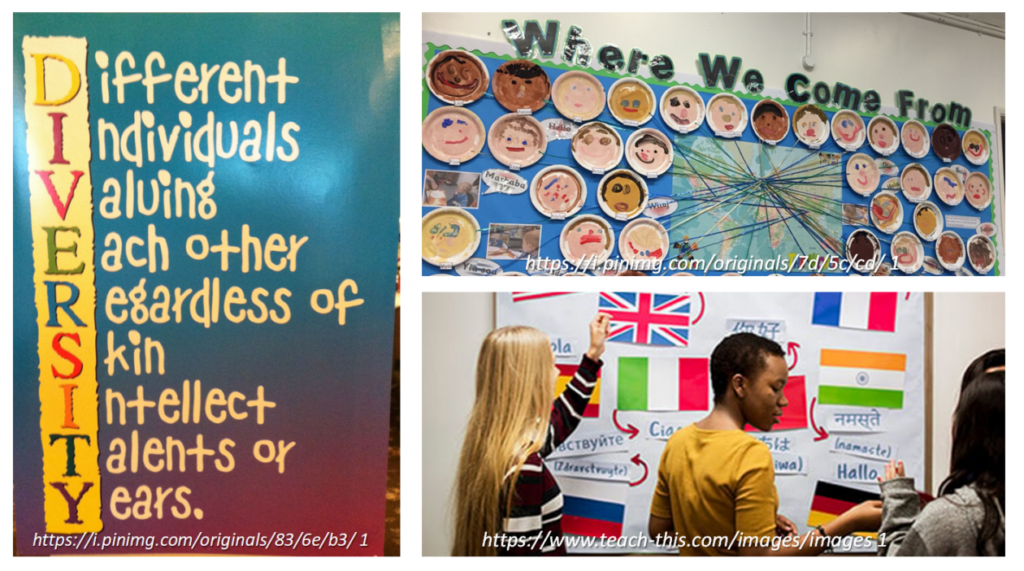
A starting point for schools in becoming culturally responsive is building a whole school ethos where culturally responsive practice is embedded and celebrated. A culturally responsive ethos will mean that the school recognises that every child brings unique experiences and strengths to the classroom and will celebrate and nurture those strengths, encouraging all children and staff to celebrate differences and to learn from each other.
Some key actions that can support your school in becoming more culturally responsive:
· Make use of clear visual signage and widgit symbols to support navigation of the school, classrooms and to support communication.
· Encourage all staff to speak clearly, use gestures, and make use of visual signage and widgit symbols.
· Involve pupils and their families in creating displays to show the linguistic and cultural diversity represented in the school. This can link with work on L1+2 and language of the month, explained in later sections.
· Identify a member of staff who can be the lead practitioner for culturally responsive practice in school.
· Encourage the pupil council and parent council to work with pupils and families on some of the suggestions in later sections.
· Reflect the school ethos in the school newsletter/news.
· Become a rights respecting school: Articles 28, 29 and 30 of UNCRC will underpin a culturally responsive ethos.
See:
· Culturally Responsive Teaching: Strategies and Tips | American University
· Scottish Government guidance on developing a positive whole school ethos and culture.
EAL policy

Develop an EAL policy in partnership with pupils (UNCRC article 12), parents, as well as school staff and EAL staff. Schools that have EAL policies value diversity of language and culture. It is important to set out how the school will become culturally responsive by bringing the diverse range or languages and culture into the curriculum.
Policy should be part of the school approach to inclusion, equality and diversity and should set out how the school will value the linguistic and cultural diversity of pupils, their families and staff. The advice and information in this toolkit give lots of suggestions about how a school might do that.
School improvement
Ethos, policy and improvement planning should work together in meeting the needs of all learners. Involve pupils and their parents/carers actively in ongoing improvement (HGIOS 4, Partnerships). The parental engagement section of this toolkit provides support to tackle some of the barriers that discourage parents/carers of bilingual learners from being involved in school life.
Some key documents to refer to are:
· SEALCC evidence of good practice
· HGIOS Part 4 EEPBL evaluating educational provision for bilingual learners
Working with parents & carers

Encouraging all parents/carers to be actively engaged and involved in school and their child’s education is recognised good practice and that is no different for multilingual pupils.
Language is the obvious barrier when working with parents/carers of bilingual pupils. Schools should ensure that interpreters are offered to parents/carers for any meetings or for emergency calls. Translated communication can be used as well. See EAL guidance on accessing interpreting and translation services. A range of translated resources for parents/carers is available, with key ones highlighted in the ‘Inside the classroom’ resources section.
Beyond language, there can be other barriers. Parents/carers may have a different experience and understanding of what their role in their child’s education should be. They may be used to a different power/status relationship between school and parent. They may not have knowledge of important areas of school life including absence procedures, applying for a school place, homework, the guidance system etc. They may also be underrepresented in parent councils etc.
See the parental engagement section for more information.
Achievement

Schools recognise wider pupil achievement as part of good practice. Bilingual pupils may also have achievements in L1 from a first language school or key events or celebrations in their faith or cultural tradition. Encourage pupils to share their achievements and bring in photographs and other things to celebrate. Create a display area where achievement can be celebrated.
Transition

Transition can be a challenging time for multilingual pupils and their families. They may not be aware of the school system and what happens at transition moments, and what to expect at the new school. Working with parents/carers is key, with some strategies including opportunities to:
· have a tour of the school.
· ask questions through an interpreter if required.
· meet other families who speak the same language, perhaps at a transition coffee morning supported by an interpreter.
As mentioned under ‘New Arrivals’, buddies are also helpful at these key transition moments.
The Bell Foundation offer some useful information on School Transition for EAL Learners.
Inclusive Practice

All multilingual learners should be supported to access the mainstream curriculum in class. Do not withdraw pupils from classes unless specific targeted support is needed, for example if pupils have not encountered the Latin script before and need to learn how to write English letters.
It’s important that pupils are in class with their peers so they can hear and see language modelled in context. See ‘Inside the classroom’ for more information on advice and strategies for supporting multilingual pupils in class.
Teaching staff and support staff should all be aware of the key strategies including: good models of language, clear visuals and using pupils’ first language.
Resources

There are a huge range of resources that schools can access. Some online highlights:
· The Digital Library - Live, Life Aberdeenshire (livelifeaberdeenshire.org.uk) (Translated eBooks)
· Twinkl great general resources and visual ones. This includes some translated resources in a range of languages
· Mantra Lingua eBooks available in a range of languages
· World book online (translated information on many topics)
· Home | LearnEnglish Kids (britishcouncil.org)
· British Council LearnEnglish Teens | Free resources for teens to help improve your English
Some physical resources:
· Dual language books, posters and talking pen from Mantra Lingua including My Bilingual talking dictionary, available in a range of languages.
· DK Visual dictionary A huge range of vocabulary on a wide variety of themes with clear visuals. Available in some languages, but the visuals alone are useful alongside English words.
· 1000 first words (Usborne) Available in a range of languages.
· Translation apps and tools including Google Lens, Microsoft Lens etc (See EAL guidance on accessing interpreting and translation services.).
· Talking buttons/tins/display.
· Visual signage (You can use Widgit)
· Ask your EAL teacher for more suggestions!
ASN

· Identifying Additional Support Needs (ASN) in bilingual pupils can be difficult. Sometimes we may put down any difficulty the pupil is having to EAL, but it may be something else. The opposite can also be true. We may assume there is an additional need but perhaps the difficulty is a common challenge related to speaking EAL.
· Early intervention and accessing specialist support and advice are key.
· The school approach to ASN should include working in partnership with the EAL service and other services to ensure good practice in identifying and supporting bilingual learners who have ASN.
· See more in the ASN section.
Sharples, R 2021, p174. Teaching EAL: Evidence-based strategies for the classroom and school. Multilingual Matters, Bristol.
Staff development

· Encourage staff to access EAL online training and access regular in person CPD from the EAL Service.
· Ensure staff have access to the EAL Resources for school Team on Microsoft teams and guidance on Viva Arcadia.
· The EAL Service can offer bespoke training on a particular issue.
· The EAL Service have courses available on ALDO:
§ Primary Teachers ALDO Course
§ Secondary Teachers ALDO Course
· Education Scotland online training module
Education Scotland has developed an online training module in partnership with Scotland’s National Centre for Languages and Glasgow City Council to support the New Scots Refugee Integration Strategy.
· The Bell Foundation offer webinars on a range of topics.
· The IOM have offered training in Aberdeenshire and more opportunities are likely to come up, with sessions focusing on information about specific countries.
· Postgraduate level qualifications are an option for those interested in a higher level of knowledge and skills. Availability varies year to year but you can search online or contact the EAL Service for more information.
Further Reading