
Myth 1

· You don’t need to spend a long time adapting or creating resources.
· There are many resources available from the EAL Service, a range of Websites and Apps (Nursery, Primary, Secondary), physical resources etc available to support learners that take minimal time.
· Apps can be used to generate illustrated key words lists in seconds.
· Many EAL strategies will not take long to use and will benefit many children in the class, not only those who are multilingual.
· See the strategies sections (Nursery, Primary, Secondary) for more information.
Myth 2
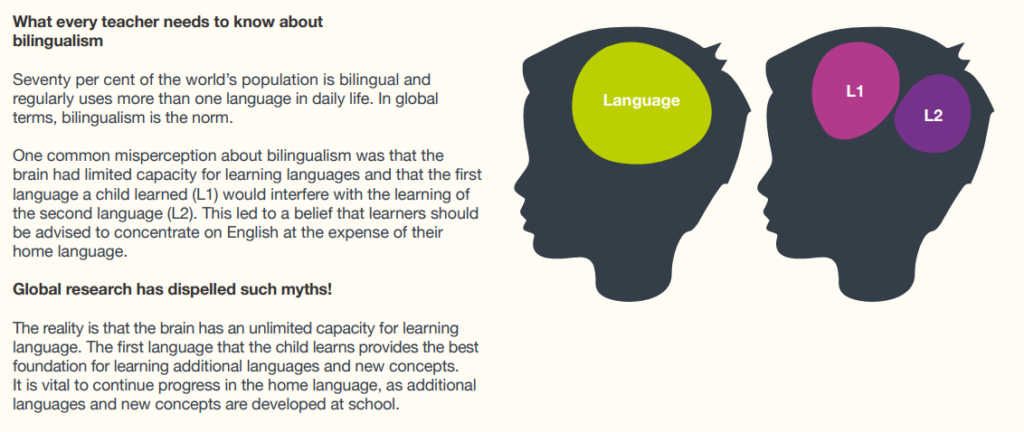
This is not the case, children’s acquisition of English will be best supported if they continue to develop their first language. See the theory section for more information.
Myth 3

There may be some occasions where withdrawal is appropriate to target particular skills that a multilingual pupil needs to support their learning in the mainstream classroom.
However, multilingual pupils will best learn English where there are good models of English and they also are entitled to learn a broad curriculum. Research shows that complete immersion supports language acquisition.
Any withdrawal should not be at the expense of an area of the curriculum e.g. Modern Languages etc. Robert Sharples (2021, p120) gives clear advice on withdrawal of pupils to support English language acquisition:
Effective withdrawal, in Ofsted’s terms, will:
· maximise opportunities for learning across the curriculum, including pupils in all subjects , including modern lanaguges, even at the earliest stages of the curriculum.
· have clear timings, targets and exit criteria, to minimise time away from their peers, the mainstream curriculum and the good models of language they will experience there.
· be planned in partnership with class/subject teachers to ensure joined up support.
See:
Sharples, R. (2021). Teaching EAL: Evidence-based strategies for the classroom and school. Multilingual Matters.
Myth 4

Many multilingual pupils will be able to access the curriculum through EAL strategies without any targeted support. Additional Support for Learning should only be put in place where the pupil has needs that would usually be met by ASL for example delayed progress in literacy or numeracy.
Pupils should not be deferred entry to their age-appropriate class based on their level of English, schools should follow the local authority’s usual processes for deferred entry. See the EAL strategies sections for advice on supporting pupils who are new to English and finding it difficult to access the learning because of language.
See also: A few more myths about speakers of multiple languages | British Council
Myth 5

This is not the case, children’s acquisition of English will be best supported if they continue to develop their first language. See the theory section for more information.