Whalsay Early Years Blog 2020\21

Just another blogs.glowscotland.org.uk – Shetland site

10/09/2021
by Miss Sandison
0 comments

Developing Curiosity

Curiosity is the desire to learn, to understand new things, and to know how they work.

Curious people ask questions, read and explore. They actively seek information and experiences, and are willing to meet challenges and to broaden their horizons which are important skills for life. Curiosity is important for learning at every age and something that is nurtured at nursery and in school.

Here are some ways in which we are developing and deepening our curiosity in the nursery setting.

As three and four year olds we have many interests. The nursery staff team understand the importance of observing our play and to “wait, watch us and wonder” as we play. This allows the adults around us to recognise our individual and shared interests and to encourage curiosity through these by selecting resources and activities that will connect us to our interests.

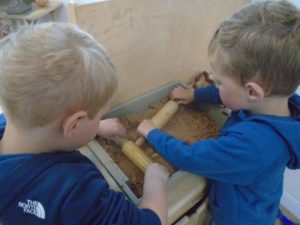
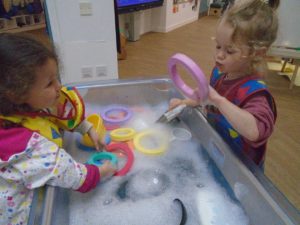
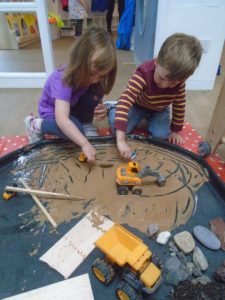
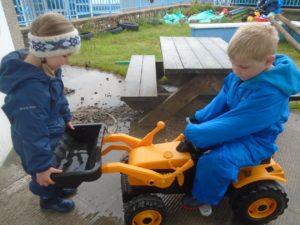
Harry loves diggers and trucks. He likes to spend time outdoors digging holes. He was excited to find an indoor quarry with different textures of “gutter”, differently sized stones to organise and count and other objects around to use for construction. Once the diggers had finished work Lucas and Jessie-Anne were on hand to clean them and make them ready for another day. Lucas and Jessie-Anne love to play in water and were very focussed on following the cleaning regime. Expanding upon our ideas and interests keeps us curious and deepens our play and learning.
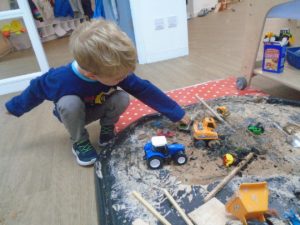
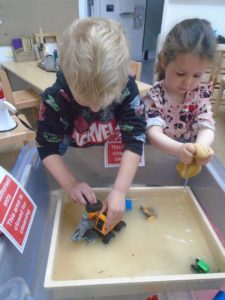
Our curiosity can take us down different avenues of learning. The adults around us in the nursery try hard to adapt to, and respond to, our play in the moment using our curiosity to explore and deepen our learning.

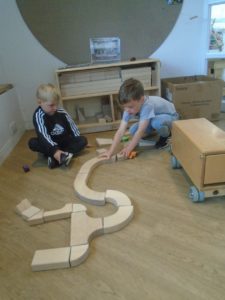
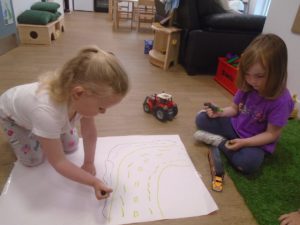
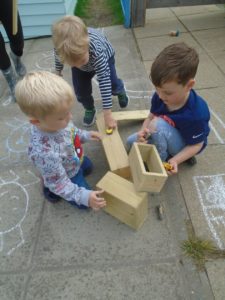
Harry, Tommy and Lewis spent part of an afternoon developing play with small cars. They discussed the need for ramps and garages after following chalk roads and creating their own roads. They noticed Lyn had some blocks and bits of wood nearby which they used. Adding these into the game extended their language and ideas as they used words such as “up, across, down”, “put it on top”, “this bit has a hole so the cars can go in”. 
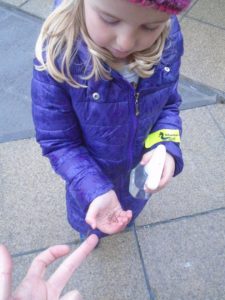
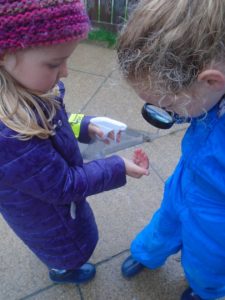
We continue to be fascinated by nature around us. This week there’s been a lot of Spinwullies outside. We’ve learned that they are also called Craneflies and Daddy Longlegs! It’s great when our curiosity leads to learning new words and teaches us that our island is unique. Thea, Ali, Elsie and Annie wanted to know what they felt like to touch. They learned how to gently handle the insects and spent time discussing their features. “Dis wan has lang leegs” (Annie) “My wan is sitting right still. I’m no going to spray him becis he’ll no lik dat on his wings” (Thea) “Can I tak my pet home? It’s a peerie Spinwullie so he could fit easy” (Ali). 
 

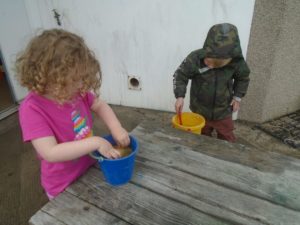
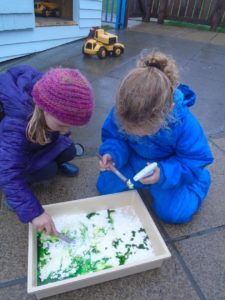
Annie and Thea were curious about colour mixing this week. They asked for green and red colours to paint the pavement. They were interested when a tray of powder (cornflour) with liquid colour (food colouring) appeared. They experimented with how to make the powder into paint, deciding on how much water to use. After some painting they decided to mix the colours which interested Ali and Annie. “Look” the green is going red and it’s turning broon! (Annie). The paint started running down the hill. Thea figured out a way to change the direction of the flow using her brush. Being curious about mixing colours and having adults around us to respond to our wonderings led to deep learning experiences linked to science, literacy and numeracy.
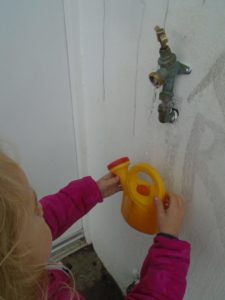
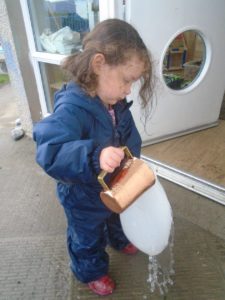
In order to develop our curiosity we are asked open ended questions as we play. This is to encourage discussion and conversation and helps us to become even more curious. We are asked questions like: “Why do you think the chalk disappears when you squirt water on it?”, “I wonder what is in the box?, “Who has some words to tell us what the jelly feels like?” and “Where do you think the box of treasure is buried?”. 
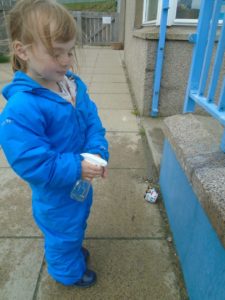
During our time at nursery we also ask many questions ourselves. This is an important literacy skill. It’s important for us that adults around us answer our questions thoughtfully and help us to seek out answers using the internet, real life contexts and books. Being listened to and being part of the process of finding answers develops excitement and enthusiasm for learning and keeps us curious. 

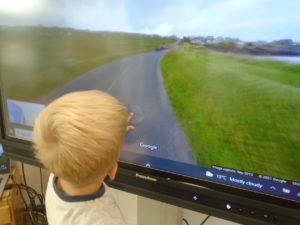
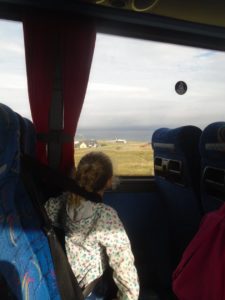
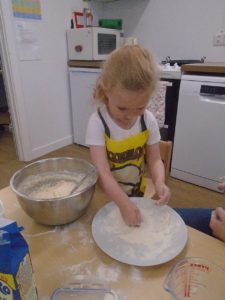
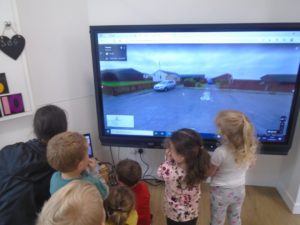
Over the past few weeks many of us have been asking questions such as “Where do you live?”, “Is doo near d beach?” We’ve been learning more about Whalsay to help answer our questions. We’ve used googlemaps to take virtual tours of the island and this week we even got to go on the big bus, stopping off outside our homes to take photos of where we live. We are also very interested in where our food comes from asking questions such as “What boat caught this fish?”, “Do bananas grow on trees?”, Does idder animals give wis milk?” “Can I bake bannocks at nursery?”. Last week Lottie baked bannocks with help from Mrs Williamson and we visited local pigs to discover what they provide for us and how to look after them. 
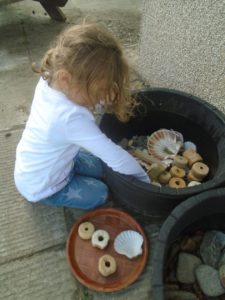
In the nursery we are provided with loose parts and open-ended resources to play with. This ensures that we are offered endless possibilities for curiosity and play. Loose parts encourages us to create our own toys to play with, using our imaginations to figure out what each item is for and how to use it. By engaging in loose parts and playing with natural open ended resources allows us to control and shape our play. We naturally collect items that intrigue and fascinate us such as seashells or smooth unusual pebbles or natural resources.  Encouraging these collections enables us to see how valuable our finds are and this in turn sparks curiosity and the desire to search further.
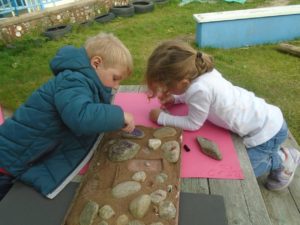
 

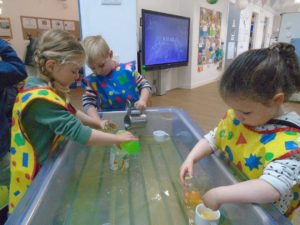
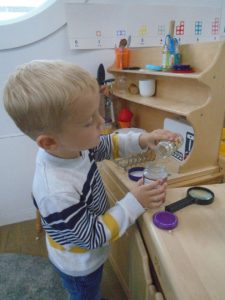
And lastly we are encouraged and supported to develop our curiosity by using tools for exploration, such as magnifying glasses, buckets, measuring tapes, sand, water and containers for our investigations. We are given time and space to explore and investigate our world using these resources, which nurtures a curious mind. 
 

We look forward to sharing more of our learning with you next week 🙂 If you are curious and want to learn more about any specific topic or subject that you would like to be a focus for the blog please get in touch with us.
03/09/2021
by Miss Sandison
0 comments

How we develop communication skills through our play at nursery.

Being able to communicate effectively with others is a very important life skill and is part of literacy learning at nursery. Through our play we organise and make sense of our social worlds as we engage actively with people, objects and representations.

Sometimes we choose to play alone. Solitary play encourages attention and listening skills which  helps us learn how to concentrate for periods of time and how to focus intently. We need to be able to do this in order to hold a conversation with others while listening to what is being said.

Sometimes we choose to play alongside a friend and to share moments of  play alongside them. Parallel play is important for building our communication skills as it helps us to interact with others without any pressure of playing directly together.

As we grow and develop we choose to play as part of larger groups and to play with others in more focused ways in order to work towards common goals. Being able to participate in cooperative play is important as it develops the skills we need later to collaborate and cooperate at school and in other social settings. Cooperative play allows us to learn from each other. It helps us to practice language skills and expand our vocabulary by learning and using new words. Interacting with our friends and staff helps us to refine our speech sounds through listening.

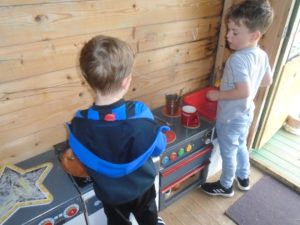
Ali and Lewis discussed recipes and ingredients during role play.

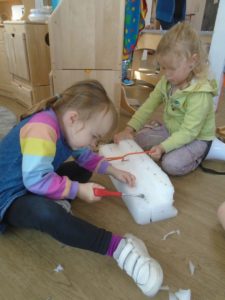
Annie and Lottie agreed on which areas needed sawing and worked together to make the shape they wanted.

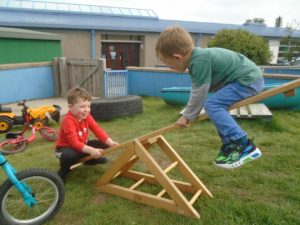
Jim and Alfie listened to how high each other wanted to go on the See-Saw.

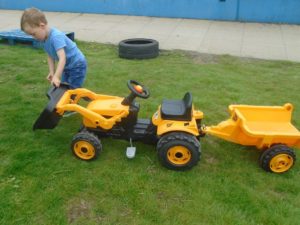
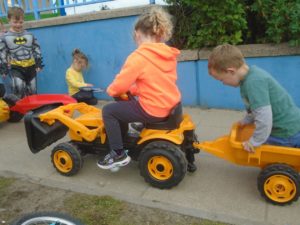
Elsie and Alfie agreed on who would drive and who would give directions when using the digger.

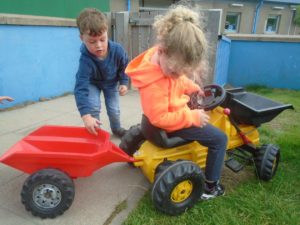
Lewis listened to what Elsie needed for her truck and they figured out how to connect the trailer together.

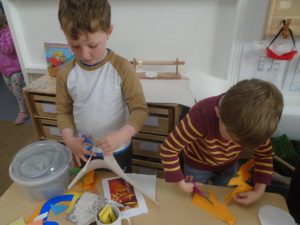
Jim and Alfie discussed what they had found at the creative table and what it might be used for. They worked together to try out their ideas and took turns using the spinner.

The “ferry” was very busy this week. Everyone had to work together to get on board, to negotiate with each other and to position the “cars” properly.

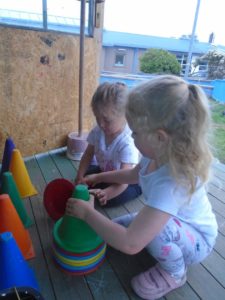
Lottie and Sophia discussed how to make barriers using cones. The cones were very sticky. They helped each other pull them apart and agreed on where each coloured cone should go.

Jessie-Anne and Millie made a puddle together, they took turns splashing and listening to the sound of the puddle. They then shared their ideas and cooperated to clean the trucks.

Imaginative play is a great way to support and enhance our speech development. Playing in this way gives us opportunities to recreate experiences and share our ideas. Taking on roles and pretending to be someone else increases our language and our confidence to use language that we have heard from adults around us.
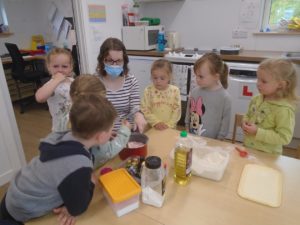
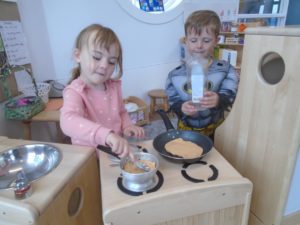
Annie and Alfie “baked and cooked soup and pancakes”. They spoke to each other about texture, amount, ingredients and took on different roles during the process.

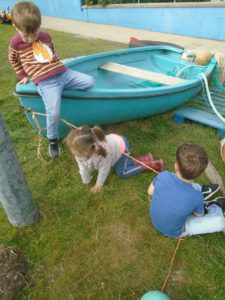
They also went fishing this week and worked together to row the boat far out to sea to find a big catch.

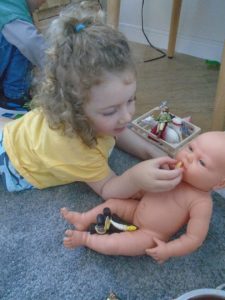
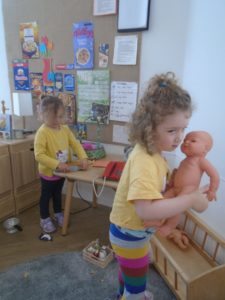
Sophia and Sophie played together in the house. Sophia made some delicious food for the baby and Sophie took on the role of feeding the baby.

Ali, Sophia and Lewis created an imaginary game where they turned into mermaids on leaving the boat. Exploring symbolism and taking on board other people’s ideas to enhance your play is part of communication development.

And finally we welcomed Millie to nursery this week. We look forward to learning through play with you!

27/08/2021
by Miss Sandison
0 comments

Some snippets from our first full week back at nursery

It’s been great to have a full week back at nursery to get into some deep play and learning. This week we have been developing our numeracy , literacy skills and knowledge through baking cakes and making playdough as well as much more!

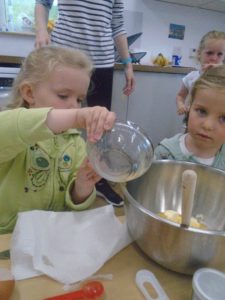
On Monday Alfie and Sophie wanted to bake a cake so Mrs Williamson took in some ingredients on Tuesday and lots of us joined in the baking session. Measuring out the ingredients helps us to recognise numbers, realise that they are meaningful and develops our sense of quantity.

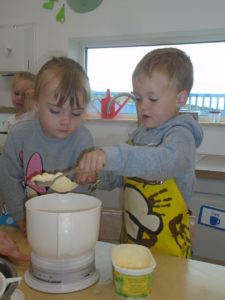
Alfie and Annie worked together to scoop butter into the bowl while watching for the scales to get to number 6.

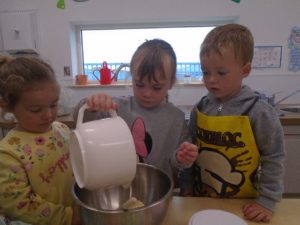
Sophia then helped to add flour and water. Pouring the water gently into the bowl needs strong arms and hands and helps develop our motor control and hand eye co-ordination. Sophia helped to steady the bowl. Taking turns and working together helps us to organise ourselves and be aware of others.

We learned how to crack eggs into small bowls and discussed where eggs come from. All of us knew that they come from hens. Lottie noticed that when we mixed the eggs “dey aa turn orange”. She carefully poured the orange eggs into the bowl.

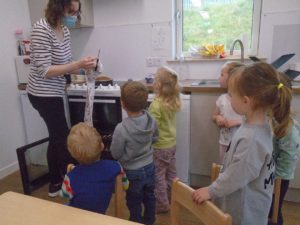
Once all the ingredients were in the bowl we took turns mixing. Mixing food in bowls helps develop our senses, such as smell, sight and touch. It increases strength in our shoulders, arms and hands needed for writing and drawing. Mixing ingredients develops our language skills as we learn new words and phrases such as “runny, thick, gloopy” and it develops our numeracy knowledge as we can mix fast or slow and right or left. After all the mixing it was time to put the cake in the oven and set the timer for 30 minutes. After 30 minutes we were excited to see if it was ready. Mrs Williamson taught us about being safe around the hot oven and how to check if the cake was ready.

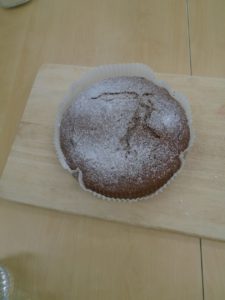
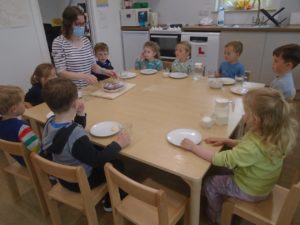
And it was! A lovely round chocolate cake! We counted how many people wanted a small slice and then cut it into pieces. We ate a small slice of cake with some healthy pear slices and discussed what other food is healthy and why fruit is good for us.
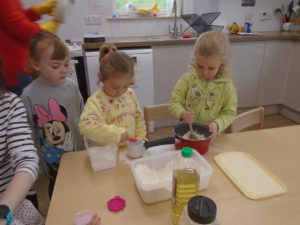
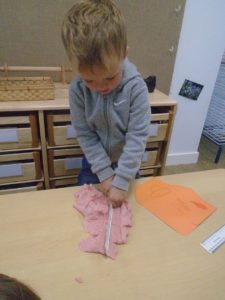
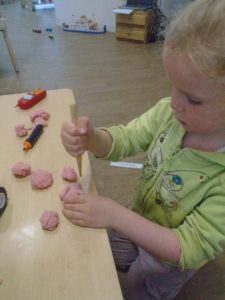
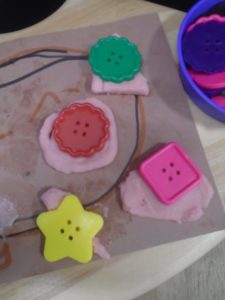
We have also been very interested in making playdough this week and choosing different smells and colours to include. We’ve had mint, orange, vanilla and strawberry playdough this week! Again, making playdough with friends allows us to learn how to follow instructions, measure, count, discuss our ideas, take turns and develop our senses.
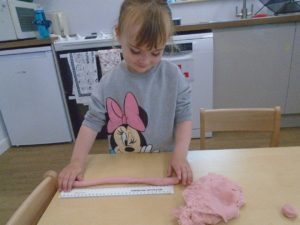
Once it’s ready our playdough has been used in many open ended ways.
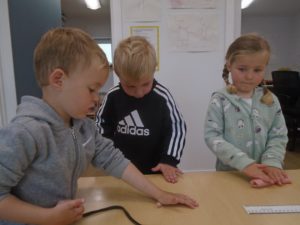
We’ve measured “worms” and “snakes” and compared who had the longest ones.

We’ve also rolled playdough into sausages which is one of the ways we develop hand eye co-ordination and gross and fine motor control. Discussing our sausages, and comparing them, develops our communication skills such as listening and talking and numeracy skills such as awareness of shape and length.

We’ve used tools to cut our playdough, to make marks in it and to create different flavoured pizzas. Cutting it into different sizes is part of early learning about fractions, making marks in playdough is part of early writing development and creating different flavoured pizzas was a great addition to deepen our role play.

The pizza flavours were apple (green), pepperoni (red), banana (yellow) and strawberry (pink). All very delicious!

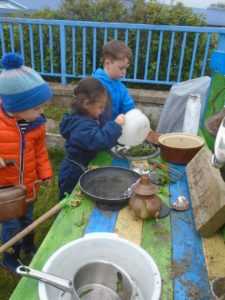
The mud kitchen has also been used for baking and making this week. Lottie and Jessie-Anne created some wonderful watery pies together.

Lewis, Stanley and Jessie-Anne created “soup” and “tea”. Using different shapes and sizes of containers develops our awareness of volume, shape and quantity.

The picnic bench cafe was very popular and a great place to learn literacy, numeracy and health and wellbeing skills. There was talking and listening, discussions, sharing and turn taking, mixing and pouring and lots of imaginary play.

We also developed our literacy, numeracy and health and wellbeing skills in other ways outdoors.

Thea and Lucas worked together to transport water. They agreed on the right amount of water and gave and followed each others instructions when moving it.

Cleaning bikes helped us to share space, take turns, discuss and decide on which parts of the bikes needed cleaned, which tools to use and which roles we played.

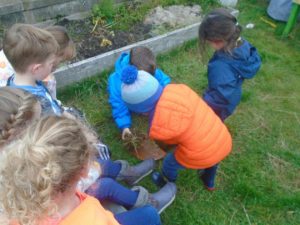
Some of us wanted to help Mrs Williamson to plant willows this week. We learned about the roots, the bark and the leaves of the tree and how special trees are to our planet. We helped to dig holes for the willows.

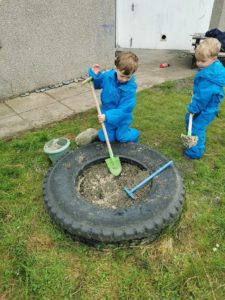
Digging holes with Mrs Williamson inspired some of us to continue this into our pretend play. Digging is an excellent way for us to develop shoulder and core stability and strength which we need for future writing and sitting. Ali and Harry used a rake and  big shovels to fill buckets with gravel for their “road”.

Sonny used the big shovel to dig for buried treasure.

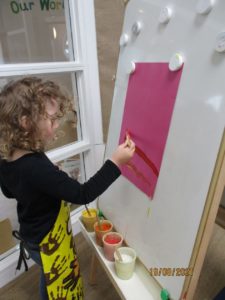
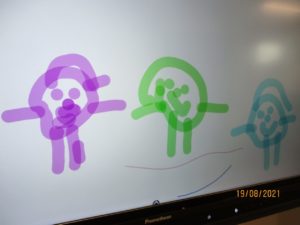
We’ve also been developing our gross motor skills such as shoulder, arm and hand strength and our fine motor skills such as more specific finger and movements indoors through painting and mark making.

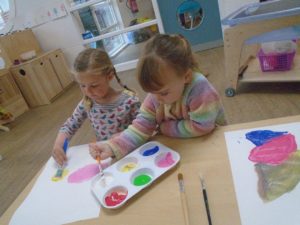
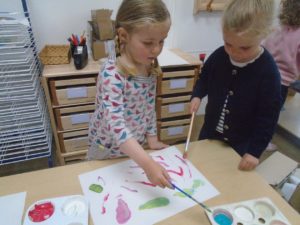
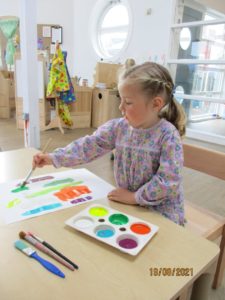
Not only does painting develop our motor skills, sharing paints together can be very relaxing and allows us to share creative ideas with each other. Painting and creating alone allows us to explore our ideas and tell stories in ways that are meaningful to us.

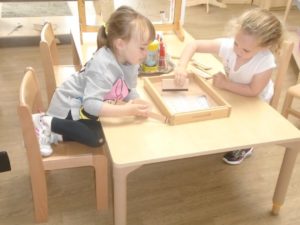
Making marks, lines and shapes in sand using different tools develops our early writing ability and engages us in fun ways to write and draw.

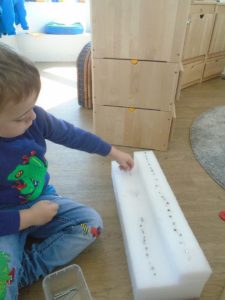
Pushing nails into foam to create “steps” encourages us to use a pincer grip which we need for writing as well as develops finger and hand strength.

Holding onto small containers and pouring ingredients between them develops fine muscle control and awareness of fingers and hands.

As you can see there has been a lot of learning through play during our first full week back!

We have also been excited to welcome three new pupils into nursery this week. A huge welcome to Tommy, Sonny and Jessie-Anne.

20/08/2021
by Miss Sandison
0 comments

Our first week back at nursery.

It’s great to be back at nursery after our summer holidays! We have all come back with big smiles on our faces and eager to learn through play.

This week we have focussed on re-connecting with the nursery environment, getting back into routines, sharing, turn taking and working together with our friends.

Over the summer our sandpit became a little overgrown. Miss Stewart found weeding it out was much easier with a group of helpers. Ali, Lucas, Thea, Alfie and Lewis volunteered and worked together to help Miss Stewart pull up the grass. Some of it was put into the dumper truck until it got really full! Alfie thought it was a lot of grass and his friends agreed. Working together in this way is great for helping us build healthy relationships.

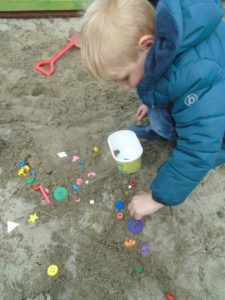
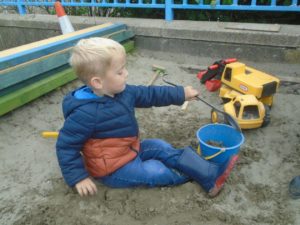
Once the sandpit was clear again a lot of us chose to play in it over the following days. We built sandcastles, dug holes and made tracks. Stanley and Ali took turns to shovel sand into the back of a truck. They shared their ideas and discussed what the sand was going to be used for, “It’s going to fill some holes” Stanley, “Yeah and dan the road will be fixed” Ali. Talking through our ideas with each other is important for developing our listening and talking skills. Problem solving how much sand is needed to fill the truck and exploring how that affects it’s weight is part of our numeracy learning.

Lottie and Thea also shared play in the indoor sand pit, exploring what was available to use as scoops.

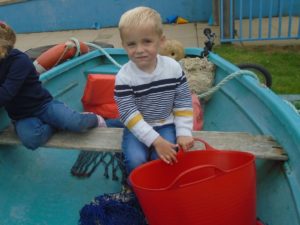
Playing together helps us develop leadership skills, communication skills, turn taking skills and teaches us how to work as part of a team. Ali, Lucas, Lewis and Alfie took on different roles during their play such as “steerer”, “fisher” and “walkie talkie man” when playing in the punt.

Jim, Lottie and Lewis played a numbers game with Miss Stewart. This game helps us to develop our turn taking skills as well as our ability to count and to recognise numbers.

Thea took on the role of “bike cleaner” and made sure everybody that wanted their bike cleaned got a turn. Waiting for turns is one of the ways that we learn how to regulate our emotions. Alfie was great at waiting for his turn and was delighted when his turn came.

Alfie, Harry and Lucas spent time at the woodwork station. They discussed what tools they needed and what they might build. They were great at sharing the space, being aware of each other and using the tools safely.

Jim used a selection of different sized boxes to build “Daddy’s boat”. Thea offered to help him with some of the detail. Jim was happy to share his ideas with Thea and add some paint himself.

Elsie and Annie used a big box as part of their shared play. They discussed which sections needed worked on and what tools they could use.

Sophia and Sophie spent time playing in the home corner. They shared the burden of dressing and then carrying all the babies to the window area before making and sharing “cups of tea” together. Being able to work together and share play in this way helps us become good decision makers and communicators.

We look forward to sharing more of our learning with you next week.

18/08/2021
by Miss Sandison
0 comments

We’re on Twitter!

We now have our own Twitter account where we will share little snippets of what we are up to with you. Any parents with a twitter account please follow us! Search Whalsay Early Years and you’ll find us there.

The blog will continue to be posted at the end of each week. If there’s anything you would like us to focus on in the blog at any point please just let us know.

Thanks 🙂

25/06/2021
by Miss Sandison
0 comments

The end of one road is the beginning of a new adventure.

So here we are. The final day of nursery for our Pre-School children. We are so proud of all of them. It has been a very challenging year, living through a pandemic, but the children have shown resilience and have not lost their love for learning and for life! For that we thank you – their families. We will miss them after the summer but look forward to seeing them out and about around the school and in the community.

So, for the final blog we hand it over to them…

This week we asked them three questions….

  1. What have you loved most about being at nursery?
  2. What are you most looking forward to about Primary 1?
  3. Can you smile for the camera?!

Freddie

What have you loved most about being at nursery? “Playing ootside.”

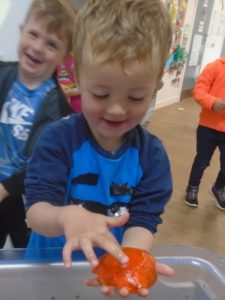
What are you most looking forward to about Primary 1? “Playing wi the orbies.” (water beads that grow in water and feel like jelly).

Ross

What have you loved most about being at nursery? “Playing wi my friends.”

What are you most looking forward to about Primary 1? “The big screen you can write on and colour on.”

Ertie

What have you loved most about being at nursery? “Makin’ bubbles and making folk food in d cafe” (home area)

What are you most looking forward to about Primary 1? “Playing”

Joanna

What have you loved most about being at nursery? “playing wi water and playing ootside.”

What are you most looking forward to about Primary 1? “Everything!”

Jordie

What have you loved most about being at nursery? “Biggin’ things wi blocks.”

What are you most looking forward to about Primary 1? “Playing wi the playstation.”

Jackson

What have you loved most about being at nursery? “Playing superpowers.”

What are you most looking forward to about Primary 1? “I will lik everything.”

William

What have you loved most about being at nursery? “Finding spiders”

What are you most looking forward to about Primary 1? “Playing with lots of toys.”

Max

What have you loved most about being at nursery? “Playing ootside being baddies and goodies and policemen.”

What are you most looking forward to about Primary 1? “Playing the game whar you pit things in d tap to stop the idder colour.” (Connect 4) and playing wi the rocket men (Astronaut small world play).

David

What have you loved most about being at nursery? “Trains, cars, garage.”

What are you most looking forward to about Primary 1? “Playing with my friends.”

Freya

What have you loved most about being at nursery? “Playing wi aa my friends.”

What are you most looking forward to about Primary 1? “Painting.”

Maggie

What have you loved most about being at nursery? “Painting and drawing wi my friends.”

What are you most looking forward to about Primary 1? “Playing”

James

What have you loved most about being at nursery? “Trains, train tracks and blocks.”

What are you most looking forward to about Primary 1? “I hoop there is a train track in Primary 1.”

Emmie

What have you loved most about being at nursery? “Being ootside and going on the SeeSaw.”

What are you most looking forward to about Primary 1? “Marble run.”


Henry

What have you loved most about being at nursery? “Playing wi trucks and diggers and pick ups.”

What are you most looking forward to about Primary 1? “Playing.”

Maisie

What have you loved most about being at nursery? “Painting and playdough.”

What are you most looking forward to about Primary 1? “The kitchen.”

Bobby

What have you loved most about being at nursery? “Dinosaurs and superpowers.”

What are you most looking forward to about Primary 1? “The space guys. They hae buggies and helmets.” (Small world play astronauts)

Micah

What have you loved most about being at nursery? “Playing ootside wi my friends.”

What are you most looking forward to about Primary 1? “Playing wi the tiny balls dat grow bigger and bigger in d water.” (Orbies)

It sounds like there is a lot to look forward to in Primary 1!

Have a lovely summer break everybody from all of us 🙂

18/06/2021
by Miss Sandison
0 comments

The great butterfly release and much more.

This has been a special week for our pre-school pupils who got to visit their P1 class on Tuesday afternoon. Everybody seemed to really enjoy their time there. In next week’s blog you will find out what they are most looking forward to in Primary one. So stay tuned!

This week was also special for our butterflies. They got released into the wild! Some of us chose to walk up to the poly tunnel with them. It was nice and warm in there for them. “They need to be warm to fly” (Freya).


On the way there we stopped a lot to look at all the flowers. The butterflies will like the flowers. We learned that butterflies stick their long tongues into flowers to drink the nectar which gives them energy to fly. We talked about the colours of the different flowers, the shapes of their petals and we did a lot of counting. Lottie told us “I saw a butterfly on flooers in wir garden.” Taking our time to notice nature on our walks continues our journey of becoming environmentally aware.

We also noticed other insects enjoying the flowers. Being able to notice things around us helps develop our questioning skills, curiousity and wonder. There was an insect on the pavement too! We had a look at it, counted how many legs, spoke about it’s size and remembered to be quiet and gentle around it. “Mind and be quiet so we dunno gluff him” (Alfie). Being able to think about how all creatures feel and learning to be kind towards living things helps us to develop our own understanding of feelings as well as a respect for living things.

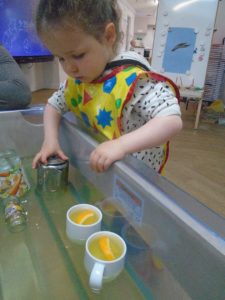
Once we got to the poly tunnel we released our beautiful butterflies and left them some segments of juicy orange to eat. “Pit dem oot in the wild!” (Jordie), “So they can fly away and find nectar!” (Freya), “so they can lay their eggs on leaves and make caterpillars!” (William) “The butterfly is stickin his lang tongue oot so she can get d nectar!” (Freya). Learning and remembering facts, and applying these to real life contexts is important for developing thinking and reasoning skills.

“The butterfly has orange bits the same colour as d orange.” (Maggie), “And white spots” (Joanna), “both wings ir d sam patterns” (Jordie). Finding and exploring patterns in the real world helps support the development of our mathematical thinking.

There was also lots of flowers at the old football pitch this week. A whole carpet of daisies! On Wednesday afternoon some of us requested to fly a kite so we took it to the pitch where the wind was blowing. Some of us wondered if the kite would fly. Some of us wondered how high it would fly. We found out that it flew so high that it became smaller and smaller as it went further away! We took turns flying it, running with it and steering it.

Having space and freedom to move our bodies in different ways and in different directions is fundamental for developing our spacial awareness and our gross motor control.

Exploring concepts such as forces, speed and direction through play is very important as it helps us to develop scientific and mathematical knowledge. Discussing and sharing our findings with each other develops our talking and listening skills and taking turns using the kite was great for developing our social and emotional skills.

Before we went back down the hill some of us chose to relax. Being outdoors amongst nature is a very natural way to relax our bodies and minds. Having time to relax throughout the day is important as it helps us to feel happy and more engaged with our world. Learning how to relax is a vital life skill.

Some of us also went to the Astro turf this week. We took lots of balls with us to practice our catching, throwing and kicking. We also used the whole space to run around and play. Finding enjoyment in movement at an early age is very important for future enjoyment in exercise as well as helping us develop core strength, large muscle strength and co-ordination.

We also found an interesting object at the Astro turf. We used our imaginations to interact with it. It became a balance beam and an aeroplane. The aeroplane took us to very interesting places such as “America” (Stanley), “Florida” (Maggie), “Dinosaur world” (Jackson) and “Lerwick” (Sophia) as well as many more places! Using objects to represent other things and sharing our imaginative ideas through play is how we develop important literacy skills, such as listening to others, taking turns talking, learning new words and phrases and asking questions.

We have also been developing our literacy, numeracy, social and scientific knowledge, skills and understanding around the setting this week. New squirty bottles arrived. They have been a fantastic tool to use for mark making and for developing hand and finger strength as well as a tool to teach us science and maths.

Many of us used chunky chalk to make marks and then used the water bottles to trace the lines or to clear away our marks.

Henry marked out the road and police station area using chalk.

Annie and Ertie found a lump of chalk. They squirted it with lots of water, taking turns to aim at the chunk. Annie thought the chalk was melting and Ertie thought it might wash away and disappear! Trying out hypothesis using practical materials is a great way to develop our understanding of the world and allows us to explore scientific concepts through play.

William and Ali used the bottles to draw pictures. William drew “a peerie man” who he noticed disappeared quickly in the sun. Ali made circles which dripped down the tyre to make “lines lik it’s raining.” Jackson and Ali drew zombies with chalk and then used their “water superpowers” to wash them away.


Jackson, William, Ali and Harry learned about evaporation. They made “puddles” together and watched as the sun dried the puddles away. They talked about what they thought would happen and guessed at how long it would take for the water to disappear and turn into vapour. Communicating with each other and taking part in sustained talking and thinking through play develops the skills we need to effectively contribute to group discussion in formal learning later on.

We’ve also built hand and fingers strength, fine motor control, literacy and numeracy skills by building with Duplo and playing with playdough during the past few weeks.

Following on from our outdoor adventures to America this week, Stanley persevered in building a really tall rocket which blasted off on adventures with the pilot on top. “He can see whar the rocket goes and he steers the rocket fae here. He is right high up so he can see everything. Dis rocket is big and lang and it goes up.” Using blocks in this way helps us develop our mathematical language.

Jim and David used the blocks to make rockets too. They compared lengths “Mine is still longer” (David) “I’ll get more” (Jim), counted the number of blocks they were using and tried to make their rockets equal lengths. They then shared ideas about where the rockets were going to land. They agreed it would be a good idea to go to the zoo!

Last week James and Ali spent time creating “pasta shapes” in their house. Ali flattened the pasta and James used his fingers to carefully curl the playdough into different shapes. Working together, taking turns, listening and sharing are important skills we learn through play.


Sophie also spent time rolling playdough into shapes. She carefully rolled it between her hands to make “peerie cakes” which she then arranged on the frying pan.


Emmie used a slicer in the playdough to cut her “pizza” in half. Freya and Ali used cutters to chop theirs into pieces and Annie used scissors to cut the playdough. Using different materials and tools in playdough develops our hand eye co-ordination as we are forced to manipulate materials to suit our ideas.

Squashing and squeezing, moulding and manipulating playdough is not only great for developing our fine motor control it is also an important way for us to develop symbolic thinking as we pretend and imagine it to be something else. Sophie and Maggie made lots of cakes to share out with their friends, Ertie and Elsie used patterned stones to make biscuits which they took to the home corner to “sell in d shop.” (Ertie)


Freya and Jim worked together, sharing playdough and sharing ideas, to make different patterns in their dough. Pressing materials into the dough changes it’s texture which helps develop our scientific understanding. “Use your fingers to push Jim.” (Freya) “Does doo want to push this on it?” (Jim). “Oh yes, oooh it feels bubbly noo” (Freya). Bobby and Elsie decorated their playdough together, sticking small decorative stones around the edges which made some parts feel hard and others soft.

Maggie, Jackson and Ali made a special cake for Miss Stewart this week. Maggie rolled the playdough flat and then Ali and Jackson helped decorate it and put the candles on top. Miss Stewart counted all the candles out loud and was very pleased to find out that she was 15 years old!


11/06/2021
by Miss Sandison
0 comments

Wonderful walks help us to learn.

This week we have continued with the momentum that we built up during the sponsored walks last week and have spent a lot of time learning and walking outdoors this week. A HUGE thank you to all donations from the walk. We raised a fantastic £541!! Some of this money has been spent on buying caterpillars already and the children would like to spend some on adopting a lion, getting more diggers and trucks for indoors and outdoors, small cars and vehicles with trailers. All of these are great ideas and things we need!

The caterpillars that we bought turned into butterflies this week which has been very exciting and interesting.

The beautiful butterflies stimulated a lot of discussion which is great for developing our talking and listening skills. Freya commented “they ir fluttering!” and Maggie said “We need to let dem oot so dey can fly awa”. Elsie asked “What happens if they land on your head?” and Lottie wondered “When can I touch dem?”

Miss Manson found the instructions and information booklet to help us find some answers. While we waited for our lunch we learned that butterflies like to eat fruit such as oranges and they like sugar water. We learned that they need time to flutter their wings to dry them  after coming out of the chrysalis before they can fly.

After lunch the butterflies got to have their lunch too. James, Maisie, Henry and David helped Miss Manson to follow the feeding instructions step by step. Using books and written materials in real life contexts is a great way for us to realise the importance and function of reading and writing. Caring for nature is important for our social development.

Showing interest in specific things and asking questions  helps staff to plan our learning experiences. After observing our interests in the butterflies and listening to our conversations in play we walked to the “Secret Garden” to see what creatures we could find. The mist meant we didn’t see any butterflies. James remembered “they don’t like getting weet.”

Back at nursery some of use chose to look at non-fiction books and the Smartboard to find out more about butterflies. William explained the steps that our butterflies had gone through from caterpillars. “They start in the egg on the leaf and then they are caterpillars that eat and get fatter and fatter then they go in the cacoon and now the butterflies are here and they are beautiful!”

Joanna watched a butterfly clip. She commented “yun butterfly has a pattern lik a zebra”. Ertie remembered what he learned earlier, “She is flapping her wings to dry dem and dan she can fly”. Being able to share knowledge, ideas and experiences are important literacy skills that we learn when we play and discuss our interests. 

Our beautiful butterflies have re-ignited our interest in other small creatures around us. Freddie found slaters and a spider while playing outside. He managed to carefully get them into the magnifier to show his friends. Appreciating all nature around us is an important part of our development as it helps us to develop our awareness of living things and to develop empathy, kindness and care.

William noticed that there were three slaters and just one fly. He wondered if the spider would eat the slaters? He thought the spider was “beautiful” and commented “she’s small, maybe she will grow bigger.”

Miss Stewart wondered what ate spiders. After some discussion it was agreed that birds eat spiders. Micah pointed out that spiders themselves eat flies. William didn’t want the birds to eat the spider so when we released the spider we hid it under some leaves near the nursery door.

After listening to the conversations around what spiders eat Henry wondered “do spiders bite?” He was reassured to hear that being gentle to the spider and keeping the box still would help the spider feel safe and so it shouldn’t bite. Recognising that all living things need to be treated with care and respect helps our emotional development as we become aware of feelings outside our own.

An animal that many of us did know bites is a lion. Last week when learning about predators through our dinosaur interest we learned that lions are endangered. Emmie pointed out that “Lions ir nearly extinct lik dinosaurs.” This made a lot of us feel sad and we wanted to find out more. We asked questions such as “Why ir dey nearly all extinct?” Ross, “Why does folk practice hunting dem?”Freya and “How can we help d lions?” Freya and Ertie. This week we found out more about lions by choosing to watch clips on the Smartboard. Some facts we found out were “dey hae sharp teeth” (William), “dey eat meat” (Jordie), “dey ir big and strong” (Joanna) and they “roooooaaaar” (Lucas). Learning to appreciate nature that lives in different environments helps us to develop more awareness of the wider world which is an important part of our social development.

Exploring and discovering the interesting features of our own local environment is also very important for us as it helps us to develop an awareness of the world around us. Miss Roberston explained that we have animals nearby that also need to be looked after. She wondered what animals we could think of. We came up with some great answers such as whales, birds, worms, sharks and seals. Miss Robertson found out that we could sign up for “The Big Beach Clean” to help our local environment which some of us thought was a very good plan.  “Yes then we can put rubbish away” (James), “We can clean up bruck” (Freya), “Pit it in the bin” (Elsie).

Being part of “The Big Beach Clean” has really helped us learn about why it’s important to care about our environment. All of us chose to watch short clips on the Smartboard to learn about the dangers of litter in the sea. Jordie noticed there was a hammerhead shark in the video, Emmie noticed that “litter is stuck to him” and James exclaimed that “His friends ir going to help him!” when the sea creatures helped a whale.


After watching the clips Joanna commented that “We want to save the animals, sharks and whales” and Alfie and Freya agreed “We need to stop the animals fae spewing” (Alfie), “They will get sore bellies if they eat the plastic” (Freya)

When asked if anyone would like to go to the nearby beaches and clean up some litter everyone said yes! Walking around our local environment helps us appreciate nature around us. Walking with a partner helps us to be aware of, and share, personal space and to work as a pair. Walking on the pavements and following road safety rules helps us develop important literacy skills such as listening to, processing and following instructions. Walking on quiet off road routes helps us become aware of plants, lichen and insects around us. Being able to compare these things and talk about their features is part of developing our numeracy skills and awareness of the world around us.


Our time at the beaches this week was spent finding litter, finding interesting things such as shells and sea-glass, sitting down to enjoy snack together and playing freely. The wonderful thing about learning through play is that it can happen anywhere and at any time!  Playing at the beach helped us to link our concerns and interests about animals and creatures to a real life contexts.


When we returned from our walks Miss Stewart laid out some of interesting finds such as shells, sea-glass, patterned pebbles and dry seaweed. Joanna and Sophie talked about the beach near their house which has sand and not stones. The items were left outdoors for everyone to play with and explore freely. It is important that we are given time to play with interesting objects throughout the day so that we can follow our own lines of enquiry and individual interests.

Indoors (once it had been cleaned) some of us chose to learn about the litter we had found on our walks. Exploring these items helps us find out about the past and develops our understanding of time. One item we found interesting was a crisp packet that was 10 years old! Freddie said “dat is really auld!”, David agreed that “It is a big number!”. We tried to understand what 10 years means, “I am five” said Maggie, a lot of us are five in nursery. It was surprising to think that the packet was double that age! “The packet is been in the water for a right lang time” agreed Emmie.

By listening to our questions and observing our ongoing interest in litter, the sea/beaches and animals/predators throughout the week some spaces in the nursery were set up with these in mind.

Old bottle tops, corks, plastic rolls and fruit netting were re-cycled and re-used as part of creative play and learning.

Freya and Maggie printed with the lids, creating shapes and mixing colours and shades. Lucas rolled the plastic to create wavy patterns and lines on paper.

Annie and Ertie pushed the corks down onto the paper. “Dey look lik bubbles” said Annie, “yeah dis is seaweed and bubbles” said Ertie. Creating pictures that are linked to our observations is a way that we record our personal experiences across the curriculum.

Picking up lids and “fiddly” objects helps develop pincer grip which we need for holding pens and pencils.

Annie and Elsie asked for paintbrushes as they had specific ideas that they wanted to put on paper. Painting is a great avenue through which we can express our ideas and feelings.

Painting and drawing on vertical surfaces develops our shoulder, arm and wrist strength ready for writing.

The Tuff tray became a sensory exploration area with the ocean in mind. Being able to identify our senses and use them to explore our world is important for our cognitive development.

“My hands ir blue lik the sea!” (Ertie), “It feels saft and foamy” (Jordie) “It’s lik the beach” (Alfie) “There’s a killer whale in the sea!” (Ross). Having time to play like this helps us to use our imaginations and to better understand our reality. It also gives us opportunities to explore our ideas and link what we have learned in real life situations.

“I’m pitten the bruck in the bin, it’s goin aa through the sea.” (Freya)

Squeezing out the foam was hard work on our hands too! Being able to use our hands to do two different movements is very important for being able to write later on. Holding bottles and twisting caps and holding foam while pushing down naturally helps develop this ability. Playing in this way helps us practise new skills in a natural way.

The foamy sea was also a great tool for mark making. Micah made lines to show that the sea was wavy.

Outdoors a variety of play equipment was used as part of a “cleaning up” game. Ross, Freya and Alfie organised themselves to be “brucky men” who collected rubbish and litter from around the area, filled the back of the truck and took it to be recycled. Trying to get it all to fit in the back required team work, problem solving and mathematical thought processes as well as good communication skills.

Lastly but by no means least we had a busy week of birthdays.

Firstly Freddie’s photos from last week.


And this week Sophia turned 4 and Micah turned 5. Happy birthday girls!


04/06/2021
by Miss Sandison
0 comments

Welcoming our special friends.

This week our pre-school children received some special friends to the nursery in the form of little knitted mice, kindly made and donated by Mrs Williamson’s mum! These little mice are all unique and stay in our dookits in nursery while we are not here. When we are at nursery they can join us on our many play adventures and can learn alongside us. Some of our mice have interesting names such as Rainbow, Miss Diamond, Sonic, Ironman, Fi Fi, Pinkie and Sparkle. They will join us into Primary 1 as part of our transition.

This week some mice enjoyed exploring and playing in a “Swiss cheese world” constructed from the big blocks.

Ross and Jackson listened to each other’s ideas and discussed different ways to create the world for their mice. Listening to other’s ideas and sharing your own ideas is part of literacy learning. Jackson explained to Ross that the cheese had to be “Swiss cheese becis the blocks hae holes in them.” Ross agreed this was a good idea and said “We can bigg it really strong with the cheese.”

Part of the discussion revolved around where to position each block. Jackson though it would be good to have “the sam number on each side”, Ross listened and constructed it in this way. Using the blocks in this way develops our numeracy skills in understanding counting, symmetry, shape and position. Carrying these heavy blocks helps our physical development and co-ordination.

They spent time deciding which direction each hole should face so that the mice could “go in different ways and directions and be able to hide in some bits” (Ross).

The big blocks were also used to build a motorhome/speedboat this week which led to a lot of interesting adventures such as trips to America and visits to volcanoes!

Constructing large builds like this helps to develop our awareness of how to work with each other when playing together. Discussing and debating together helps us to recognise each other’s emotions and to develop skills in how to resolve conflicts.

We organised ourselves onto the motorhome boat independently, figuring out where we could sit, giving each other space, discussing and debating who would be at the front, middle and back. These types of interactions are fundamental for our language learning and our social and emotional development.

After some time most of us had been on some kind of journey in the motorhome boat and there was only four of us left. The passengers could now stretch their legs out and each person could have their travel wish met by driver James. Elsie decided that she would try to balance a block on head while the boat went “really fast”. Ali was excited to see if it would stay on when they hit the waves. Having space and time like this to deepen our play and to explore it until it’s end point helps to develop our confidence and creativity.

Our mice were also part of small construction play this week. The large wedge of cheese that appeared in the nursery was very popular among our mice. They thought it was delicious! David’s mouse ate inside every hole. We counted how many holes there were – 14!

James and Jackson used the cheese to make a mousetrap. They found a crate and a wooden block. Once the trap was completed they tried it out and realised that it didn’t work without string being attached to the block. Experimenting through play develops our problem solving skills. Once string was attached the trap worked perfectly and mice were trapped! They shared what they had made with their friends. Freya and Ross asked a lot of questions about how they had made it and how the trap worked.

Building, problem solving and construction occurred outdoors this week too.

Ross, Lewis and James made a “mighty dam” by digging a hole with the digger and a spade and filling buckets full of sand. Being outdoors using tools to dig encourages us to move our bodies in different ways which helps develop our co-ordination, gross motor strength and balance.

When the started to flood they discussed how to stop the water. James thought “maybe adding more bricks will stop it”. After adding more bricks they tested their hypothesis by adding more water and checking the level it rose to. Understanding concepts such as more and less and exploring volume through play teaches us important numeracy skills.

Maisie, Micah, Henry and David used a variety of large hollow blocks, flat planks and differently coloured cones to make two different building sites. Being able to access resources like these encourage open- ended experimentation which in turn develops our scientific understanding of the world and our literacy and numeracy skills through play.


Harry and Jordie pretended they were digger and truck drivers in the sand pit where they made a lot of different noises to coincide with the play. They filled the trucks with sand to “big hooses wi”. Jordie took turns at filling both trucks while Harry steered them closer to the digger.

Ross, Henry and Lewis used the gravel area to fill trucks with stones to “lay doon a road”. The different sized trucks held different amounts of stones. With the help of an adult they moved large slate slabs to create ramps where they trucks could pick up and drop off their loads.

This week the children chose to listen to “The Gruffalo” as our group story. This story has a little mouse in it so our nursery mice were also interested in it! Through learning about dinosaurs we learned that the Gruffalo is a predator…but more on that next week. The story inspired paintings, re-telling of the story through play and drawings associated with the characters.

Some of us wanted to paint pictures for our mice after thinking about, and listening to, the story.


Emmie drew a Gruffalo. She copied the lines and shapes that she could see on the front cover of the book. Maisie used the colour purple, “Just lik the Gruffalo prickles” to create her picture.

Freya and Maggie shared pens and paper to draw a picture together. They discussed the features that they wanted in the picture and took turns to add these. Freya said “dis is a picture to hang up in nursery so wir mice can look at it.”

This week has also seen us do our sponsored walk. A HUGE thank you to everybody who has sponsored us. We’ve really enjoyed our walks this week! We will update you with a total soon. Walking around the loop gives us an understanding of where we stay in relation to other places on the island and develops our awareness of the world around us. It’s also been a great way to acknowledge and appreciate nature as we listened for bees and birds as we walked.

Finally we celebrated a big 5th birthday on Monday. Happy Birthday Freddie! Freddie’s fabulous photo is on the I-pad and we haven’t yet managed to download it so it will be posted next week instead.

31/05/2021
by Mrs Williamson
0 comments

Peerie Mice

Meet our Peerie mice that have been donated to our pre-schoolers as part of their transition to P1. The bairns will play with their Peerie mice and take part in activities at nursery. Their Peerie mice will then move to Primary 1 and be there waiting for them after the summer.


Report a Glow concern
Cookie policy  Privacy policy