
What is it?
Self-regulation is recognised in Realising The Ambition as one of the most important areas of child development. Self-regulation involves children’s developing ability to regulate their emotions, thoughts and behaviour to enable them to move forward in positive ways. Practitioners should develop a pedagogy, including the use of co-regulation strategies, which will help children develop their self-regulatory skills.
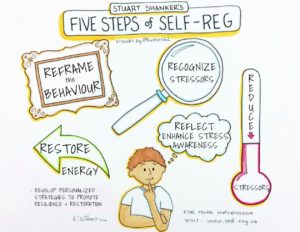 “As a starting point, research with young children supports the view that the following dimensions are among the most important aspects of child development, underpinning not just learning but also essential for survival and flourishing: executive function and self-regulation, communication and language, confidence, creativity and curiosity, movement and coordination, and self and social development.”
(Realising the Ambition, Scottish Government, 2020, p. 23)
Key messages:
Interactions
- The adult’s role as co-regulator is critical in a child’s development of self-regulation.
- As suggested in Realising the Ambition, young children often need to “borrow” our ability to manage stress. They need to be re-assured and learn from the adult’s understanding that all is well, they need help to manage strong feelings or work out what to do.
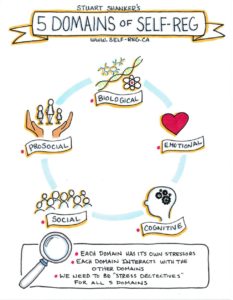
- Co-regulation requires self-awareness from adults. This requires us to understand our own triggers – whether this is a physiological trigger such as hunger or thirst, or an emotional trigger when we feel upset by comments or actions.
- Young children can be overwhelmed by what we perceive as quite small stressors. A child’s expression of their emotions is often an unconscious way in which they tell us that they have an unmet need, and that they can’t manage this for themselves.
Experiences
“The routines that we have in place help young children feel secure as they come to know what is happening, and what will happen next. They give children regularity, predictability, security and a sense of safety.”
(Realising the Ambition, Education Scotland, 2020, p27.)
- Children experience vertical and horizontal transitions Vertical transitions involve major changes for families. Horizontal transitions are smaller transitions that occur throughout the course of the day.
- Free play experiences also support children’s ability to Self-Regulate in later years “Results showed that the more time children spent in unstructured quiet play in the toddler and preschool years, the better their self-regulation abilities at ages 4–5 and 6–7 years.” (Early Childhood Research Quarterly, Free play predicts self-regulation years later, Collivera, Harrison, Brown and Humburg)
- It’s important to find a balance between familiar routines and opportunities for free flow and unstructured play
Spaces
- An uncluttered, quiet and calm environment is important for the development of self-regulation in children.
- Natural light has a more positive impact on wellbeing and learning. Bright lights can be overstimulating and dysregulating.
- Noise levels can be dysregulating for both children and adults in settings and children are less able to ‘tune out’ background noise.
- For some children, bright colours can be overstimulating. Spaces do not need to be fully neutral, but when colour is used more thoughtfully it can enhance mood and atmosphere and support children’s learning.
- “Settings need places that are quiet and places that can be noisier…places that are calmer and more tranquil. Conversations in quiet places are often more contemplative and can frequently be personal and revealing… Conversations in stimulating spaces are often energetic and quick-fire.” (Environments conducive to conversations, Open University Press, J. Fischer (p.60)
- A “feel better space” is an area of the learning environment where a child can go when they feel overwhelmed, distressed or need time and space to regulate their behaviour with a calm regulated adult.
Ways we can do this:
Interactions
Practitioners should:
Interact in warm, responsive ways.
Recognise and respond to children’s cues.
Provide physical and emotional comfort when a child is distressed.
Provide consistent routines and structure. (Implement a Care Plan+ to support this if necessary.)
Model self-calming strategies.
Identify and express emotion, calming , waiting, and solving problems together.
Consider using a self-regulation script to ensure consistent approach by a team.
Experiences
Be aware of changes and transitions in children’s lives and provide warm, safe and familiar experiences and routines to support their well-being.
Be as consistent as possible with familiar routines e.g. self registration, snack, gather times. Use these routines to signal change and prepare children for transitions, e.g. “We get ready to go home after brushing teeth.”
Using visuals – pictures and labels can help children to follow the flow of the day and know what is coming next.
Practitioners may also use signals to alert children that a change in routine is about to happen, e.g. music or sounds for ‘Stop and Sort’, snack and gather times.
Spaces
Use as much natural light as possible, keep windows clear of displays and use soft lighting where appropriate.
Reduce excessive noise by considering the layout of spaces, resources used and observing how children are interacting with spaces. Consider adding mats and soft surfaces in noisier spaces e.g. construction.
Provide some calm, tranquil, quiet places and some designated spaces for noisier, more energetic play. This could be achieved by design or through modelling the use of the space by practitioners.
Consider the impact of the use of that colour in the Learning Environment. Use colour to create different moods in different spaces.
Develop a “feel better space”, which can be used to support co-regulation and self-regulation. This should be an accessible space, designed to help children to feel calm and safe. It is not a time out space.