
Learning for Sustainability
Resources
What is it?
“Learning for Sustainability is learning to live within the environmental limits of our planet and to build a just, equitable and peaceful society. It is essential for the well-being of all and is an international priority.”
(UNESCO, 2013)
Learning for Sustainability (LfS) connects people and the planet. It encourages children, practitioners, and communities to explore local and global issues and take action for a fairer, more sustainable future.
In Scotland, LfS is an entitlement for all learners and a whole-setting approach which weaves together global citizenship, sustainable development education, and outdoor learning to create meaningful, coherent learning experiences.
“The term Learning for Sustainability, coined in Scotland, is now gaining traction internationally as a cross-curricular approach which enables learners, educators and their wider community to build a socially-just, sustainable and equitable society.”
(Target 2030 – Scotland’s Learning for Sustainability Action Plan 2023-2030)
LfS connects people and the planet. As you can see from the Sketchnote from Education Scotland, it provides a wide range of contexts and themes for learning for everyone and includes exploring what can be challenging and complicated issues, in relevant and inspiring contexts across the curriculum.
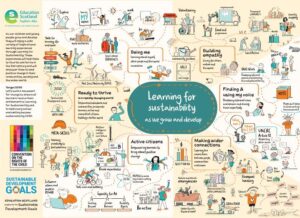
For more information follow the link below
Learning for Sustainability advice and guidance | Resources | Education Scotland
Key Messages:
- Learning for Sustainability is a core part of Curriculum for Excellence and central to children’s rights, wellbeing, and empowerment.
- Early level experiences nurture curiosity, care, and connection with the natural world.
- Practitioners model sustainable values through everyday choices, critical thinking discussions and relationships.
- LfS supports children’s voice, participation, and responsibility for themselves, others, and their environment.
- Embedding LfS is not an add-on — rather, much like embedding the UNCRC, it’s a mindset that runs through all areas of early learning.
“Through outdoor play, children are learning about sustainability, gaining a deeper understanding of how to care for and preserve their natural environment.”
The Quality improvement framework, Children experience high quality spaces. Children influence and affect change. p22
‘Creativity and learning for sustainability are embedded in our curriculum design’ P33 Curriculum, curriculum rationale and design
Ways we can do this:
- Provide daily opportunities for outdoor play and exploration, using local spaces to build connection with nature.
- Encourage reuse, reduce, recycle habits in playroom routines and resourcing.
- Support child-led inquiries into real-world issues (e.g. “Where does our food come from?” or “How can we help the birds in winter?”).
- Embed global citizenship and fairness through stories, songs, and discussions.
- Involve families and community partners in sustainable projects.
- Reflect together on how we care for people, places, and our planet.
- Growing and caring for plants in the nursery garden.
- Setting up a recycling or compost station.
- Planning a kindness or community action project.
- Exploring seasonal changes through outdoor learning.
- Using storybooks and play to explore fairness, friendship, and care for our world.