
Moderation
Moderation is when something is reviewed against agreed expectations to ensure consistency.
The Strategic Vision and Key Principles of the Curriculum for Excellence states that:
“Scottish Government, education authorities and other partners will work together to build on local and national practices for quality assurance and moderation of assessment. The aim will be to achieve consistency in standards and expectations and build trust and confidence in teachers’ judgements. Education authorities and national partners will work together to develop the most efficient and effective approaches possible for quality assurance and moderation.”
- Moderation is the term used to describe the process used to establish an understanding of standards and expectations for children’s learning.
- Moderation helps to ensure that there is an appropriate focus on outcomes for learners and that learning is at the appropriate level.
- Practitioners involved in developing their assessment approaches through participation in moderation activities is a highly effective form of professional development
- Moderation process must be robust and rigorous to ensure professional confidence in practitioner judgements.
- Moderation systems are open and respectful all of all skills and experience that practitioners contribute.
- Effective moderation ensures fairness and equality to all children and young people.
- Practices should be manageable and informative, using accessible methods.
- Effective moderation requires practitioners, teachers and leaders to work together, referring to guidance and exemplification to build on standards and expectations.
- Moderation activities will involve all professionals engaging regularly in ongoing professional dialogue and collegiate working and participating in local and national networking activities.
- It ensures that assessment tasks and activities provide learners with opportunities to meet the standards and expectations for their stage of learning.
- Moderation is reliant on sample evidence from learners’ work so that practitioners’ professional judgements can be reviewed.
- Moderation should provide feedback on professional judgements to inform improvements in practices.
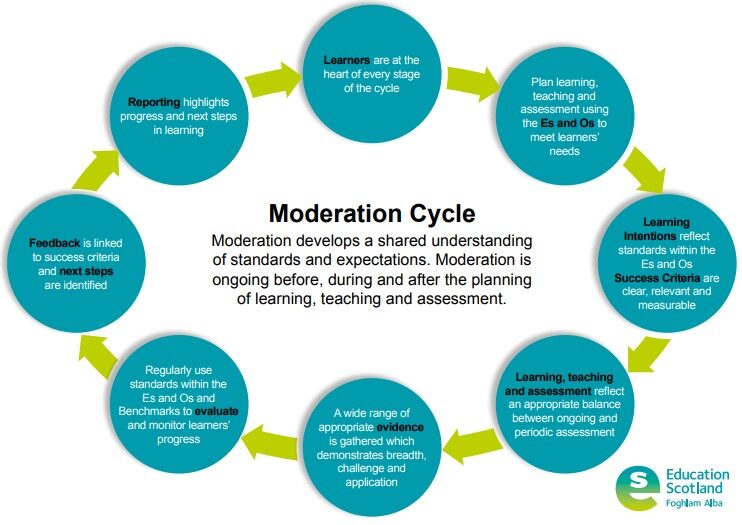
Moderation begins with knowledge of the child as an individual and as a learner.
Practitioners must plan learning, teaching and assessment that is appropriate for the individual, using the Curriculum for Excellence Early Level experiences and outcomes.
Practitioners record experiences and outcomes covered to ensure progression across the curriculum.
Planning for learning includes levelling of experiences and resources, to ensure appropriate differentiation is effective. Ensure all practitioners are aware of what the learning outcome all children expected to achieve and what practitioners expect most or a few to achieve.
Learning experiences that children engage with should clearly reflect the standards within the Es and Os, with success criteria that are clear, relevant and measurable.
Practitioners ensure an appropriate balance of ongoing observation assessment that will be evidenced in learning journals and periodic focused assessment, e.g. developmental overviews.
Standards and expectations are shared though documentation of learning in learning journals, floor books or learning walls demonstrating clear progression in skills.
Practitioners use age and stage appropriate discussions with children about their progress and target-setting as part of planning to meet their learning needs.
Practitioners agree strengths in learners’ attainment and set appropriate next steps for their learning, linked to appropriate forms of tracking which incorporate the Curriculum for Excellence benchmarks for Early Level.
Attainment meetings take place between key worker practitioners and senior leaders to ensure appropriate levels of support and challenge are in place. Where necessary, individual support plans are developed to ensure every child is progressing in their learning at an appropriate pace.
Parents receive information about their child’s learning at regular intervals and are involved in setting next steps and provided with information for how they can support their children’s learning at home.
Practitioner’s frequently discuss attainment and ensure a consistent approach is used to track progress across the setting, e.g. an ‘I can’ statement is observed at least three times before it is highlighted as secure.
Moderation of quality and frequency of children’s observations, next steps and tracking processes takes place consistently by the team and is planned for in the setting’s quality assurance calendar.