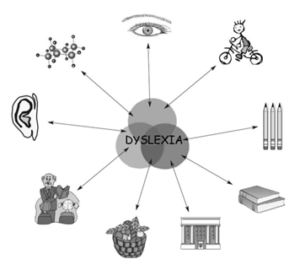
 The above diagram (Reid, 2012) refers to the different aspects that are influential in understanding of dyslexia. Whilst some are obvious there are some interesting elements to this which may help our understanding of dyslexia.
Hearing: The ear represents the auditory aspects. Phonological awareness (differentiating between sounds, remembering these sounds, and identifying them in words) is seen as a crucial factor in dyslexia. These aspects can present difficulties for dyslexic children especially with sounds which are similar.
Sight: The eye highlights dyslexic children may have some visual disturbance when reading which can cause blurring, words merging and omissions of words or lines when reading. Coloured overlays, coloured backgrounds for text and altering font characteristics and size have been successful.
Connections – The symbol in the diagram above between the eye and the ear represents the neurological basis for dyslexia and the importance of neurological connections. These connections help with the integration of different skills such as visual/motor integration, as in copying, and auditory/kinaesthetic integration, as in listening and carrying out instructions. There is considerable research evidence that highlights the neurological basis of dyslexia and in particular the connecting pathways of the left and right hemispheres as well as aspects relating to the cerebellum and the magnocellular visual system. These factors affect processing speed as well as visual accuracy and co-ordination.
Motor skills – The symbol of the child on the bicycle represents the motor aspects of dyslexia. The cerebellum has been implicated in this, and several dyslexic children will display fine motor and gross motor difficulties that can result in poor handwriting and/or clumsiness.
The core difficulties – The pencils and the book in the above diagram represent the core difficulties associated with dyslexia – reading, spelling and writing. These tasks are usually left hemisphere skills, apart from creative writing, which can be associated with the right hemisphere. The research indicates that dyslexic children have weaknesses in the left hemisphere so therefore tasks involving phonics, accuracy, sequencing and remembering will be more challenging and often more exhausting for the child with dyslexia.
Interaction – The last three symbols in the diagram above show a teacher with a student, the school building and a bowl of fruit. The teacher and the student highlight the importance of interaction. Quite often children with dyslexia need interaction with the teacher in order to provide the most appropriate cues,
The core difficulties: The pencils and book represent the core difficulties associated with dyslexia – reading, spelling, and writing. These tasks are usually left hemisphere skills therefore tasks involving phonics, accuracy, sequencing and remembering will be more challenging and often more exhausting for the child with dyslexia.
Interaction: The teacher and the student highlight the importance of interaction. Children with dyslexia need interaction with the teacher to provide the most appropriate cues, structure and to help develop connections with previous learning. This is essential for the young person because if interaction does not take place, for example through teacher/pupil question and answer, then the dyslexic person may fail to grasp the underlying concepts and the information will be less meaningful. This interaction can lead to what is sometimes referred toas metacognition which involves the student questioning themself as to why they think in a certain way.
School ethos: The school highlights the importance of the school ethos and learning environment. It is integral the child feels comfortable in the school particularly since for many dyslexic children school represents a place of failure. It is crucial that this view is reversed, and a welcoming and positive school environment can help greatly with this.
Reid, G. (2012). Dyslexia and inclusion: classroom approaches for assessment, teaching and learning. Routledge.