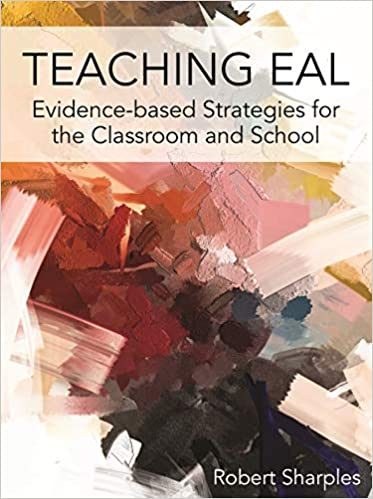
Having heard lots of good things about it – and having been kindly provided by the author with a chapter to view – I finally got hold of a copy of Teaching EAL: Evidence Based Strategies for the Classroom and School by Robert Sharples.
For those wondering about purchasing it, I simply say DO IT! The book is crammed full of insights and advice not only aimed at EAL Teachers, but thankfully all teachers and schools. This is no surprise given that Sharples is a strong advocate of every classroom being a place where learners’ full breadth of language skills should be utilised and where all young people’s cultural experiences should be both equally valued and seen as a resource for all to learn from. More to the point, he provides a wealth of evidence from a broad range of sources to support what he says and to stimulate further research and reflection by the reader – the pointers to additional reading on each topic at the end of chapters provide a road map for quality professional learning.
Along with current research, such as that on translanguaging, the work of Pauline Gibbons and Jim Cummings rightly take centre stage – particularly the focus on Gibbon’s instructions on scaffolding – but from a personal perspective, it was enlightening to see the practical application of Systemic Functional Linguistic theory introduced in a chapter that considers the importance of the concepts of context and register.
While the book is divided into three sections (How children acquire additional languages; How language works across the curriculum; How you can establish outstanding EAL practice in your school), each of which can be considered on its own or as part of the main body of the book, it is the clever use of short chapters which makes this book so accessible. Sharples confirmed that his intention was to create a book which practitioners could access in their working day – at lunchtime breaks, or between lessons – and it is clear that he shaped his work considering these timeframes. How he manages to pack so much into each chapter is testament to his skills as a writer: quantity and quality of information abound.
As someone new to the role, the testimonial on the back cover from Maria Walker, Head of English as an Additional Language Service at Glasgow City Council, which compares reading the book to “engaging in professional dialogue with a highly skilled EAL specialist” was particularly appealing, if seemingly a little starry-eyed, when I was considering buying it. Having now read it, I fully agree with Maria’s evaluation. Not only is the book well-informed, insightful and grounded in practical applications within learning and teaching settings of the research theory and evidence, it is written in a way that makes most accessible and a pleasure to read.
E-Portfolio tag: Language and Literacy