Who do house sparrows live with?
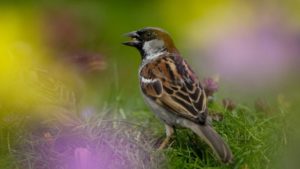
Sparrows are very social and friendly birds. They breed, feed, and flock with their own species as well as other similar-sized flocks of birds. They are found flocking around nest boxes and bird feeders.
How long does a house sparrow live?
The house sparrow lifespan ranges between three to four years in the wildlife.
What is a house sparrow’s habitat?
The house sparrow birds can live in habitats suited for humans. The only habitats that the house sparrow birds can’t live in are dense forests and tundra. They are mostly around humans and thus are frequently found indoors. They are also found in places such as warehouses, factories, and zoos. The ideal house sparrow habitat is building crevices and around human settlements. They can adapt to both urban and rural areas.
Smaller than blackbirds, with a short tail, pointed head, triangular wings, starlings look black at a distance but when seen closer they are very glossy with a sheen of purples and greens.
Their flight is fast and direct and they walk and run confidently on the ground. Noisy and gregarious, starlings spend a lot of the year in flocks.
Still one of the commonest of garden birds, its decline elsewhere makes it a Red List species.
The Blackbird
The breeding season lasts from early March to late July, and chicks are often found in a nest well into August.
Nesting habits
Blackbirds rear 2-3 broods. In a good year, fourth broods may be attempted. Weather determines the timing of the breeding season.
Warm or cold spells in spring can bring the breeding season forward or delay it by several days. Dry weather in June can shorten the season and even cause starvation of late broods. The nesting season starts up to two weeks earlier in gardens than in woodland.
The nest, built by the female, is low down in any suitable cover. Trees, shrubs and climbers are preferred, but nests can be found inside buildings, occasionally even on the ground.
The nest is a substantial cup of grass, straw, small twigs and other plant material. It is plastered inside with mud and lined with fine grass. It can take two weeks to complete, and sometimes the same nest is used for successive broods.
The Robin
The UK’s favourite bird – with its bright red breast it is familiar throughout the year and especially at Christmas!
Males and females look identical, and young birds have no red breast and are spotted with golden brown.
Robins sing nearly all year round and despite their cute appearance, they are aggressively territorial and are quick to drive away intruders.
They will sing at night next to street lights.
The Wood Pigeon
Key information
The UK’s largest and commonest pigeon, the woodpigeon is largely grey with a white neck patch and white wing patches, clearly visible in flight.
Although shy in the countryside it can be tame and approachable in towns and cities. Its cooing call is a familiar sound in woodlands as is the loud clatter of its wings when it flies away.
Hello everyone!
Welcome to Bishopton’s Big Bird Hunt activity. Designed by the Biodiversity division of our Eco-Committee, we took the most popular birds that we spotted during ‘Birdwatch’ and decided to find out a little more about them.
We’ve issued some quiz questions to pupils, and they should link to the correct QR codes to find the answers.
Let’s see who can learn the most about Bishopton’s most common birds!
Bishopton's Big Bird Hunt