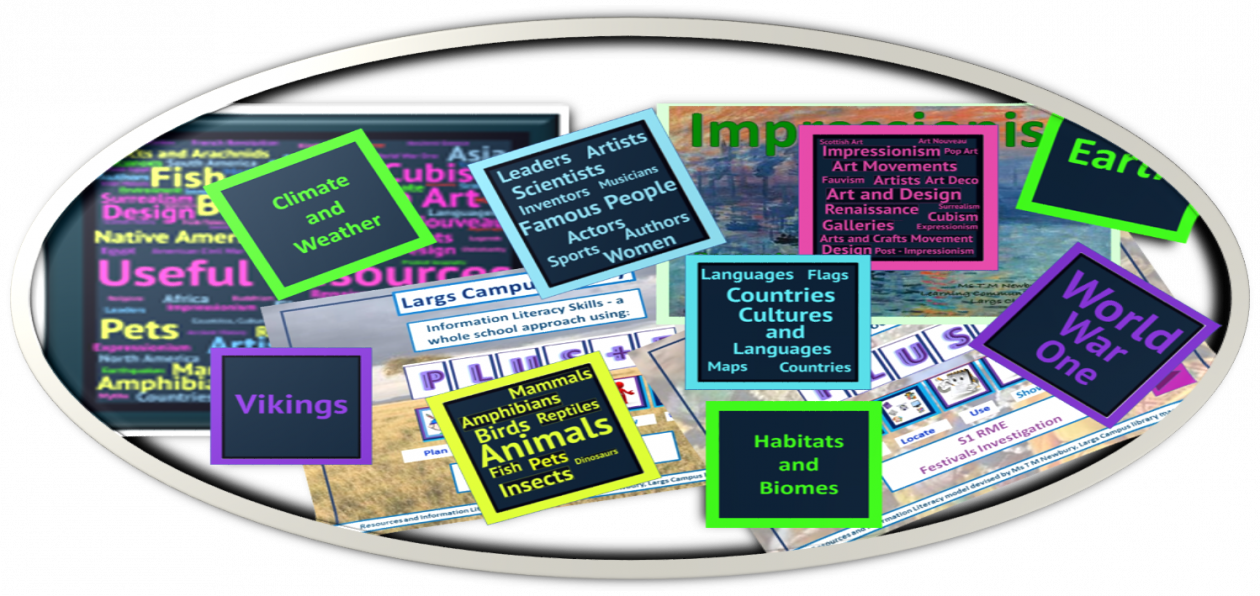

PLUS + E: help and support with every stage of your research!



This page is designed to help you to develop further the skills you need to evaluate sources of information, particularly when looking at topical information. These are topics which are frequently highlighted by the media – so there’s lots of information out there. They are topics which are frequently discussed by individuals, often because there are no easy solutions to the difficulties they can create.
People are often passionate in what they think about such topics, and may have very strong opinions. They may be prepared to look at only one side of an argument, and may have a biased viewpoint.
Since there is so much information available on these topics, much of it could be propaganda, misinformation, or fake news.
Telling the difference between these different types of information
 Why is this important?
Some of these topics will form part of your learning in a range of subjects including P S E, English, Modern Studies, R E, Geography, Science, Business Studies, P E and Home Economics ,and you may be asked to carry out your own research.
Since you will be expected to use only credible, high quality sources of information to increase your understanding of the topic you are researching, it is essential that you are aware of the different types of sources which exist, and that you know how to evaluate them by recognising bias, opinion, misinformation and disinformation, as well as being aware of reliable sources which give a well balanced, informative view.
Different types of content include:
Opinion
Opinion is someone’s own personal view on an issue which may. or may not be based on fact.
Avoid using this type of content by: looking at the kind of language used. Use of phrases such as ‘I think….’,’ it seems….’, ‘it’s obvious that…..’, or adjectives such as ‘good’, ‘better’ and ‘the best’ might indicate that this is someone’s opinion, or personal interpretation of the facts. Always double-check information from at least one other source
 More support for independent learners
 Online help – accuracy and impartiality
Videos on this BBC Bitesize page aimed at young reporters discuss why the best news stories have to be impartial, looking at both sides of an issue and citing the sources of the information used, as well as looking at the difference between fact and opinion
Propaganda and Bias
Bias means presenting information in a way that favours one argument or point of view over another; propaganda is designed to influence by promoting information which may be deliberately misleading or wrong. This may be set out in a way that encourages you to look at the issue only from the point of view of the author. There may be deliberate omission of information, even if it is important and central to the issue, if this does not fit in with the author’s view.
More support for independent learners
Online help – detecting bias in the news
This guide from the Library of the University of Washington looks at examples of bias in news stories
Avoid using this type of content by: finding out who is responsible for creating the article or site. Use Google to find out more about the person, group or organisation. Compare the layout of the information with other sources to look at the aspects covered and any that may have been omitted.
Misinformation
Misinformation is information that is misleading or wrong. The person who provided it may not have done this deliberately; a more likely reason is that they’ve got their facts wrong, or don’t know as much about the topic as they think they do.
Avoid using this type of content by: finding out what you can about the person responsible for the source – what is their level of expertise, and how qualified are they to write about the topic? Remember that there is no system for detecting mistakes or wrong information with online sources – you need to do this for yourself by checking the information from other sources to see how it compares.
Disinformation
Disinformation is information which is deliberately false . It could be supplied by individuals or groups who don’t want you to know the truth or real information because it could harm their purpose. Always be sceptical, until you can verify information from other sources.
Avoid using this type of content by: finding out about the aims of the creator of the source – what is their viewpoint likely to be? As always, compare this sources with as many others as you can to get a true overall view of the issue
Fake News
Fake news refers to news stories which have been completely made up to mislead the reader or viewer, or which have some elements of truth but others which are false or have not been verified.
Avoid using this type of content by: following the excellent advice on this resource from the the International Federation of Library Associations
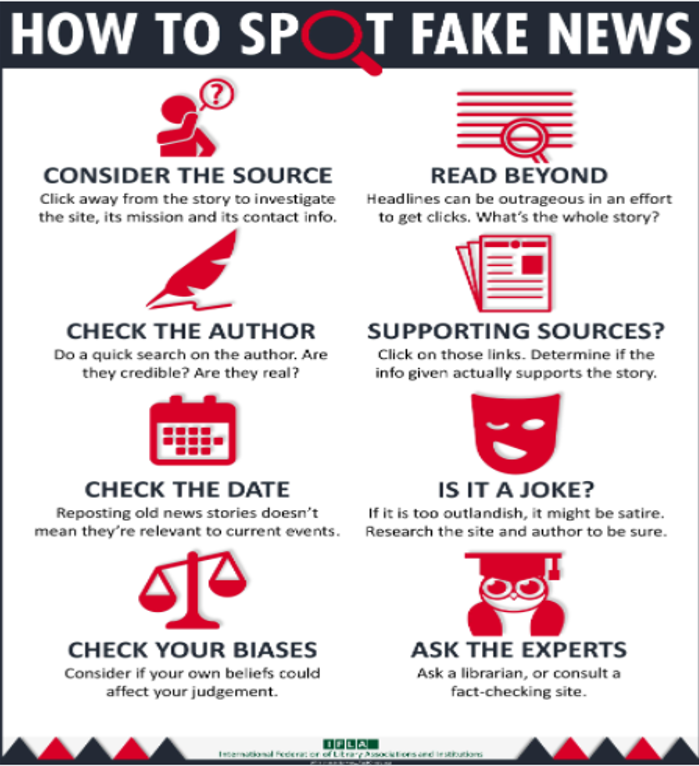
Click here to download this pdf on spotting fake news from the IFLA
More support for independent learners
Online help – fake news
Learn to spot Fake News with this fun quiz from the Guardian newspaper
A wide range of excellent articles on fake news from BBC Bitesize including this useful video which has tips for spotting fake news, and this one which looks at the seven types of people who start and spread fake news. Includes:
 Teaching Resources – fake news
A range of resources which teachers can use for lessons on fake news. From BBC Teach
Verifying information
With all online sources, it’s important to verify the information to see if other sources have used the same information, or agree with the information you’ve found. Always look at more than one source. As well as comparing the information with as many other sources as you can, you can also make use of some of these resources which aim to check the reliability of different sources of information, while identifying instances of bias, propaganda and disinformation
More support for independent learners
Online help -verifying information
Be Media Smart “a list of fact-checking sites that you can visit to get the most recently fact-checked stories. There is also a list of recently ‘de-bunked’ or stories proven to be false.”
Full Fact a registered charity and a non-profit company Read the ‘About Us’ pages for more information on the aims of the creators and how they go about checking information
BBC Reality Check is a BBC News service dedicated to clearing up fake news and false stories to find the truth
Channel 4 Fact Check “FactCheck seeks the truth behind claims made by those in public office. The blog has been commended for its statistical integrity and is frequently cited in the House of Commons”.
Fact Check an impartial organisation which monitors the factual accuracy of claims made by anyone involved in U S politics
Snopes verifies stories that have appeared in the media and declares them True or False
Verifying Images
Google explains how to check an image to see where it has come from to decide whether or not you can trust it
Largs Campus Library – verified information
In the section where we evaluated online information, we mentioned that a lot of that information is available free of charge. We talked about the importance of defining the purpose of this information and working out why it is available.
But not all online information is free – sometimes it is worth paying money to ensure that quality information is available without a long, time consuming search and the evaluation process we’ve already talked about.
Subscription-only online information
In a world where the information explosion means that there is a wealth of information to be found on any topic, a major strength of the support which school libraries and librarians can provide is access to high quality information resources with reliable information. The resources below are not free- they are paid for from the Library budget.
They provide excellent high quality information for research topics and your own personal development. They are of particular use in PSE, English, Modern Studies, R E and Geography, but may also be useful for Science, Business Studies and Home Economics
A browse through these resources is an excellent way to consider the range of possible topics if you’re not yet sure which topic you want to research
The collection includes print and electronic resources which you can use in the School Library, classroom or at home.
Click the links below for more information
Please note, we do not have subscriptions to these resources at the moment. If you would like to use them for research, please get in touch with Ms Newbury
- ISSUES, from Independence Publishers
- Independence publishers provide first class information for research on topical issues. The publishers produce 6 new volumes each quarter, which are available in both print and e-book format. You can search for topics under broad areas such as Crime and Justice, or use the search box to look for information on your specific topic.
- Search results will show resources in different formats including articles from quality journals, newspapers, government agencies and relevant organisations and charities. Statistical information, and sometimes multimedia are also included.
- The Key Facts link (scroll down the column on the left hand side) is a great way to get an overview of the topic and is useful for deciding on the keywords you will use to extend your research, and each topic also has links to other high quality online resources which you can use to do so
- Through you Library membership you have access to these resources. To access it, use the details below to log in from any computer in the campus network.
- available on request
- Printed versions are available in the Campus Library’s Social Issues section, located in the Reading Room.
- Carel Press produces an excellent range of printed resources including Essential Articles, Fact File and Key Organisations.
- As with Independence resources, the information comes from reliable sources.
- The School Library also has a subscription to the website. To access it, click the link above, and type in these login details:
- available on request