
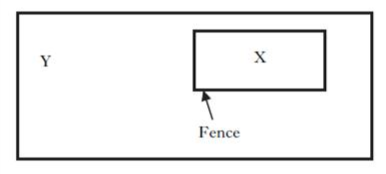
| 1. | The diagram below represents a field (Y) with an area (X) fenced off.
Sheep and rabbits provide very high intensity grazing in Area X, but cannot graze in the fenced off area, area Y. Which line in the table below describes the diversity of plant species in areas X and Y after one year? |
||
| Diversity of Plant Species | |||
| Area X | Area Y | ||
 |
A. | Higher | Lower |
| |
B. | Lower | Higher |
| |
C. | Higher | Higher |
| |
D. | Lower | Lower |
| 2. | Biodiversity can be defined as the | |
| |
A. | number of plants in a habitat |
| |
B. | number of animals in a habitat |
| |
C. | variety of species in an ecosystem |
| |
D. | plants and animal together with their habitat |
| 3. | The importance of biodiversity for ecosystems is that it | |
| |
A. | makes them unstable |
| |
B. | provides food |
| |
C. | helps ensure their survival |
| |
D. | keeps everything the same |
| 4. | Which of the following is not a resource for humans provided by biodiversity in ecosystems? | |
| |
A. | food |
| |
B. | medicines |
| |
C. | recreation |
| |
D. | minerals |
| 5. | Which of the following is a human activity which does not lead to habitat destruction? | |
| |
A. | conservation |
| |
B. | agriculture |
| |
C. | industry |
| |
D. | construction |
| 6. | An ecosystem which could be affected by deforestation is | |
| |
A. | moorland |
| |
B. | grassland |
| |
C. | woodland |
| |
D. | desert |
| 7. | What is causing the crisis in biodiversity in the world? | |
| |
A. | pollution of ecosystems |
| |
B. | conservation of species diversity |
| |
C. | loss of habitats |
| |
D. | deforestation |
| 8. | How is the low biodiversity of plants resulting from low levels of grazing best explained? | |
| |
A. | grazers only select the best plant species |
| |
B. | grazers damage all the plant species |
| |
C. | some plant species need to be grazed to survive |
| |
D. | a few plant species dominate the habitat |
| 9. | Which one of the following factors is not a major source of competition among animals? | |
| |
A. | available space |
|
B. | available shelter |
| |
C. | available soil nutrients |
| |
D. | availability of food |
| 10. | Plants compete mainly for | |
| |
A. | water, light and soil nutrients |
| |
B. | water, food and soil nutrients |
| |
C. | light, water and food |
| |
D. | light food and soil nutrients |
| 11. | The total variety of all living things on Earth is described as | |
| |
A. | an ecosystem |
| |
B. | biodiversity |
| |
C. | a community |
| |
D. | random assortment |
| 12. | In Scotland many forests are planted with a single species of tree, such as Douglas Fir. These forests have | |
| |
A. | a stable ecosystem |
| |
B. | complex food webs |
| |
C. | high intensity of grazing |
| |
D. | low insect species diversity |
| 13. | Natrual grasslands normally contain a rich biodiversity of plant species. Rabbits help to maintain this biodiversity because | |
| |
A. | their droppoings fertilise the soil |
| |
B. | they only eat the tall plants |
| |
C. | they keep the dominant species in check |
| |
D. | they can’t eat the woody plants |
| 14. | Which one of the following factors is not a major source of competition among animals? | |
| |
A. | available space |
| |
B. | available shelter |
| |
C. | available soil nutrients |
| |
D. | availability of food |
| 15. | As energy flows along a food chain it becomes | |
| |
A. | less because some is used for growth by the organisms |
| |
B. | less because some is lost by the organisms as movement and heat |
| |
C. | more because some is gained as movement and heat |
| |
D. | more because some is gained as organisms grow |
| 16. | The biomass at each stage in a food chain decreases because | |
| |
A. | there are fewer organisms |
| |
B. | the organisms are smaller |
| |
C. | biomass is converted to waste |
| |
D. | less energy is available for growth |
| 17. | Which of the following is not a description of a niche? | |
| |
A. | tiny decomposer in the soil |
| |
B. | small bird of prey |
| |
C. | microscopic floating producer |
| |
D. | large black beetle |
| 18. | An ecosystem is more stable when it has | |
| |
A. | only a few different members of each species |
| |
B. | many different species |
| |
C. | many members of each species |
| |
D. | few different species |
| 19. | A coal-burning facility is constructed in an area containing several pond ecosystems. How will this human activity most likely affect the pond ecosystems? | |
| |
A. | More nutrients will be available. |
| |
B. | Organism diversity will increase. |
|
C. | Disease will become less common. |
| |
D. | Water quality will be reduced. |
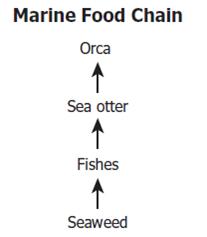
| 20. | What is the role of the Orca in this food chain?
|
||
| |
A. | Producer | |
| |
B. | Primary consumer | |
| |
C. | Secondary consumer | |
| |
D. | Tertiary consumer | |
| 21. | The quality of pond water can be determined by identifying the number and types of organisms found living in the water. Which piece of equipment will best help students identify some of these organisms? | |
| |
A. | Microscope |
| |
B. | pH paper |
| |
C. | Binoculars |
| |
D. | Pan balance |