
| 1. | What is biodiversity? | |
| A. | A high number of different species in an ecosystem | |
| B. | A low number of different species in an ecosystem | |
| C. | The number of different species in an ecosystem | |
| D. | The loss of species from an ecosystem | |
| 2. | What name is given to a region of the planet characterised by its climate and which contains distinctive communities of plants and animals? | |
| A. | Habitat | |
| B. | Biome | |
| C. | Ecosystem | |
| D. | Community | |
| 3. | What is an ecosystem? | |
| A. | All the non-living components of an area | |
| B. | All the organisms and non-living components of an area | |
| C. | All the organisms of an area | |
| D. | A population and its habitat in an area | |
| 4. | What are all organisms living in a particular area known as? | |
| A. | A community | |
| B. | An ecosystem | |
| C. | Biotic factors | |
| D. | A population | |
| 5. | Which of the following factors associated with an ecosystem are biotic? | |
| A. | Competition and parasitism | |
| B. | Parasitism and light availability | |
| C. | Light availability and temperature | |
| D. | Disease and pH | |
| 6. | Which of the following is a piece of equipment that can be used to sample the ground invertebrates in a habitat? | |
| A. | Light meter | |
| B. | Pitfall trap | |
| C. | Quadrat | |
| D. | Sweep net | |
| 7. | Which of the following reasons explains why grass grows abundantly in a field but not in a wood? | |
| A. | The woodland animals have eaten all the grass | |
| B. | The wood will be too sheltered from the wind | |
| C. | There is a higher light intensity in the field for photosynthesis | |
| D. | The trees’ leaves fall on the grass | |
| 8. | How can a representative sample of the plant species growing in a field be obtained? | |
| A. | Place a single quadrat in a specific area of a field | |
| B. | Place a number of quadrats in a variety of specific areas in the field | |
| C. | Place a single quadrat randomly once in the field | |
| D. | Place a number of quadrats in a variety of random areas in the field | |
| 9. | One biotic factor that affects consumers in an ocean ecosystem is | |
| A. | number of producers | |
| B. | temperature variation | |
| C. | salt content | |
| D. | pH of water | |
| 10. | Which is a biotic factor operating within an ecosystem? | |
| A. | the type of climate in a given region. | |
| B. | the carnivores that consume other animals | |
| C. | the amount of nitrogen gas in the air | |
| D. | the rate of flow of water in a river | |
| 11. | Which of the following factors, associated with an ecosystem, could be components of an organism’s niche? | |
| A. | Competition and food supply | |
| B. | Light availability and temperature | |
| C. | predation and soil moisture | |
| D. | all of the above | |
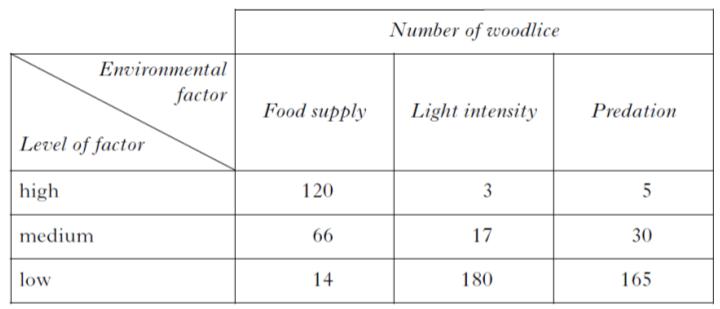
| 12. | An investigation was carried out into the effect of the levels of three environmental factors on the distribution of woodlice. Food availability, light intensity and predation were investigated. The results are shown in the table below.The biotic factor(s) investigated were?
|
||
| A. | Light intensity and predation | ||
| B. | Food supply and predation | ||
| C. | Light intensity and food supply | ||
| D. | all of the above | ||
| 13. | What technique could be used to sample woodlice in an ecosystem? | |
| A. | pitfall trap | |
| B. | tree beating | |
| C. | quadrats | |
| D. | sweep netting | |
| 14. | Beetles living in an ecosystem are in competition with woodlice. If the number of beetles increased, the number of woodlice would… | |
| A. | decrease because they would have less food | |
| B. | increase because they would be preyed upon less | |
| C. | decrease because they would be preyed upon more by the beetles | |
| D. | increase because they would have more food | |
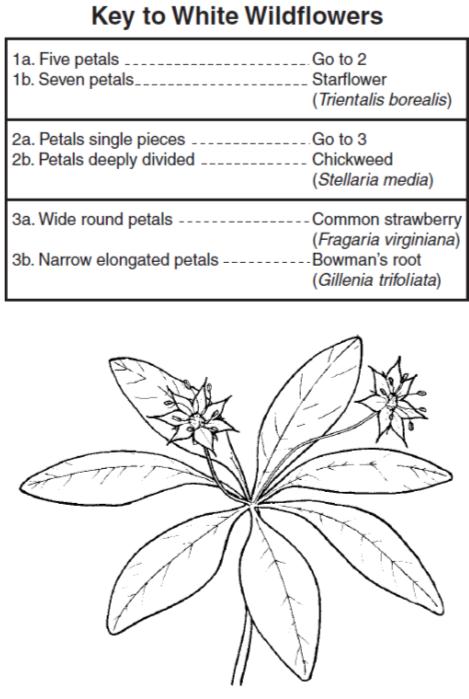
| 15. | This dichotomous key can be used to distinguish white wildflowers. According to this key, what type of flower is shown?
|
||
| A. | Trientalis borealis | ||
| B. | Stellaria media | ||
| C. | Fragaria virginiana | ||
| D. | Gillenia trifoliata | ||
| 16. | What technique could be used to sample white flowers? | |
| A. | pitfall trap | |
| B. | tree beating | |
| C. | quadrats | |
| D. | kick sampling | |
| 17. | A niche is: | |
| A. | The role of a species in a habitat | |
| B. | The variety of species in an ecosystem | |
| C. | The total population of one species | |
| D. | A feature of an organism that enables survival | |
| 18. | Which of the following is an example of a decomposer at work in the food web? | |
| A. | A tree growing in a field | |
| B. | A grasshopper eating leaves | |
| C. | A seagull catching a fish | |
| D. | A fungus growing on a log | |
| 19. | An ecosystem is more stable when it has | |
| A. | only a few different members of each species | |
| B. | many different species | |
| C. | many members of each species | |
| D. | few different species | |
| 20. | Which of these pieces of equipment can be used to measure an abiotic factor? | |
| A. | Light meter | |
| B. | Pitfall trap | |
| C. | Quadrat | |
| D. | Tullgren funnel | |