| 1. | A pyramid of energy shows | |
 |
A. | what happens to the solar energy entering a food chain |
|
B. | how the organisms in a food chain use energy |
|
C. | the quantity of energy at each stage in a food chain |
|
D. | how energy is passed from one food chain to another |
| 2. | As energy flows along a food chain the energy in the food chain | |
|
A. | decreases because some is used for growth by the organisms |
|
B. | decreases because some is lost by the organisms as movement and heat |
|
C. | increases because some is gained as movement and heat |
|
D. | increases because some is gained as organisms grow |
| 3. | A pyramid of numbers shows the | |
|
A. | number of organisms at each stage in food chain |
|
B. | number of organisms in different food chains |
|
C. | number of food chains in a food web |
|
D. | total number of organisms in a food web |
| 4. | Which of the following is a correct description of a decomposer? | |
|
A. | A micro-organism which lives inside animals and causes disease |
|
B. | An organism which releases chemicals from organic waste |
|
C. | A fungus which grows on living tissue |
|
D. | A green plant which roots in rotting vegetation |
| 5. | The biomass at each stage in a food chain decreases because | |
|
A. | there are fewer organisms |
|
B. | the organisms are smaller |
|
C. | biomass is converted to waste |
|
D. | less energy is available for growth |
| 6. | Why might a pyramid of biomass not have the same shape as a a pyramid of numbers for the same food chain? | |
|
A. | the biomass is not always related to the number |
|
B. | the biomass depends on the number |
|
C. | the number depends on the energy available |
|
D. | the number is always greater than the biomasss |
| 7. | Which food chain below would give a different pattern in a pyramid of biomass and a pyramid of numbers? | |
|
A. | rose bush → greenfly → ladybird |
|
B. | algae → waterflea → fish |
|
C. | grass → rabbit → fox |
|
D. | seed → vole → kestrel |
| 8. | The niche of an organism is | |
|
A. | where it lives |
|
B. | its role in the habitat |
|
C. | the type of habitat where it is found |
|
D. | the number of organisms present |
| 9. | Which of the following is not a description of a niche? | |
|
A. | tiny decomposer in the soil |
|
B. | small bird of prey |
|
C. | microscopic floating producer |
|
D. | large black beetle |
 |
||
| 10. | An ecosystem is more stable when it has | |
|
A. | only a few different members of each species |
|
B. | many different species |
|
C. | many members of each species |
|
D. | few different species |
| 11. | Plants convert 1% of the light energy they receive into new plant material. In the food chain below, primroses receive 100 000 units of light energy.Primrose → vole → weasel → owlHow much energy is available for the vole? |
|
|
A. | 10 000 units |
|
B. | 1000 units |
|
C. | 100 units |
|
D. | 10 units |
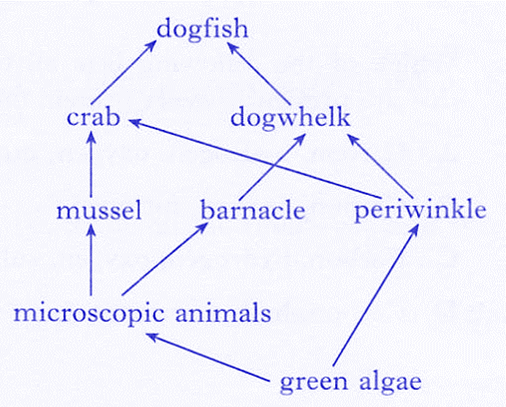
| 12. | The diagram below shows a food web from the seashore.
The microscopic animals could be described as the…… |
||
|
A. | producer | |
|
B. | primary consumer | |
|
C. | secondary consumer | |
|
D. | decomposer | |
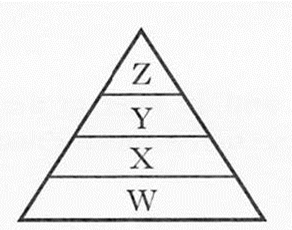
| 13. | The diagram below represents a pyramid of biomass.
W Reprersents the total mass of |
||
|
A. | producers | |
|
B. | prey | |
|
C. | predators | |
|
D. | herbivores | |
| 14. | Which term describes all the organisms living in the same area? | |
|
A. | food web |
|
B. | ecosystem |
|
C. | population |
|
D. | community |
| 15. | In a woodland ecosystem which of the following describes a population? | |
|
A. | all the oak trees |
|
B. | all the plants |
|
C. | all the plants and animals |
|
D. | all the oak trees and blackbirds |
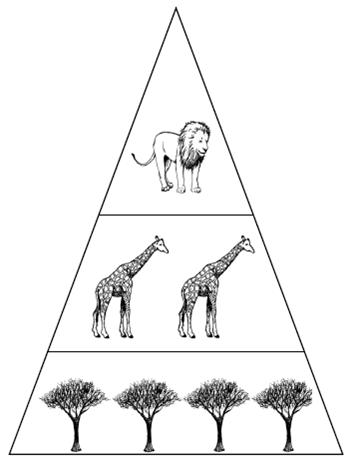
| 16. | Which of these best describes a relationship shown by this African energy pyramid?
|
||
|
A. | The lion is a predator of the giraffes | |
|
B. | The lion is the prey of the giraffes | |
|
C. | Giraffes are the prey of the trees | |
|
D. | Giraffes are predators of the lion | |
| 17. | The total variety of all living things on Earth is described as | |
|
A. | an ecosystem |
|
B. | biodiversity |
|
C. | a population |
|
D. | competition |
| 18. | Which of the following statements about a woodland describes a community? | |
|
A. | All the oak trees |
|
B. | All the plants |
|
C. | All the oak trees and blackbirds |
|
D. | All the plants and animals |