
| 1. | As energy flows along a food chain it becomes | |
 |
A. | less because some is used for growth by the organisms |
|
B. | less because some is lost by the organisms as movement and heat |
|
C. | more because some is gained as movement and heat |
|
D. | more because some is gained as organisms grow |
| 2. | Which of the following describes a community? | |
|
A. | the total number of one species present |
|
B. | all the living organisms and the non-living parts |
|
C. | all the living organisms |
|
D. | all the plants |
| 3. | The niche of an organism is | |
|
A. | where it lives |
|
B. | its role in the habitat |
|
C. | the type of habitat where it is found |
|
D. | the number of organisms present |
| 4. | Which of the following is not a description of a niche? | |
|
A. | tiny decomposer in the soil |
|
B. | small bird of prey |
|
C. | microscopic floating producer |
|
D. | large black beetle |
| 5. | An ecosystem is more stable when it has | |
|
A. | only a few different members of each species |
|
B. | many different species |
|
C. | many members of each species |
|
D. | few different species |
| 6. | Plants convert 5% of the light energy they receive into new plant material. In the food chain below, primroses receive 100 000 units of light energy.Primrose → vole → weasel → owlHow much energy is available for the vole? |
|
|
A. | 10 000 units |
|
B. | 1000 units |
|
C. | 100 units |
|
D. | 10 units |
| 7. | Animals that feed on both plants and animals are called … | |
|
A. | carnivores |
|
B. | herbivores |
|
C. | detritivores |
|
D. | omnivores |
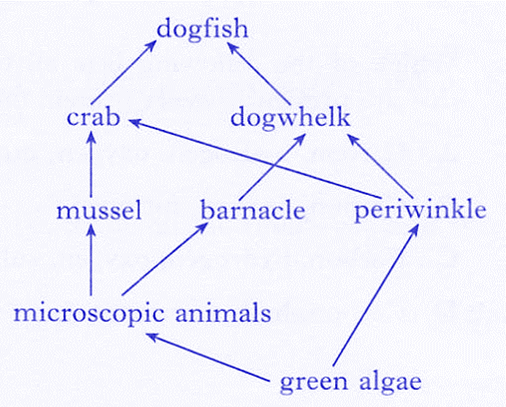
| 14. | The diagram below shows a food web from the seashore.
The periwinkle can be described as…… |
||||||
|
A. | producer | |
B. | primary consumer | ||
|
C. | secondary consumer | |
D. | decomposer | ||
| 9. | Which term describes all the organisms living in the same area? | |
|
A. | food web |
|
B. | ecosystem |
|
C. | population |
|
D. | community |
| 10. | Which term describes an animal that eats other animals in food web? | |
|
A. | prey |
|
B. | predator |
|
C. | producer |
|
D. | primary consumer |
| 11. | In a woodland ecosystem which of the following describes a community? | |
|
A. | all the oak trees |
|
B. | all the plants |
|
C. | all the plants and animals |
|
D. | all the oak trees and blackbirds |
Consider the food web below and use it to answer questions 12 and 13.

| 12. |
If the tadpole population decreases, the water boatman population is likely to
|
|||||
|
A. | decrease | |
B. | remain unchanged | |
|
C. | increases slowly | |
D. | increases rapidly | |
| 13. | If water beetles are removed, water boatmen have more food, but their number may not increase because
|
|||||
|
A. | water beetles also eat small herbivorous fish | |
B. | tadpoles may now be eaten by herbivorous fish | |
|
C. | tadpoles may run out of food | |
D. | carnivorous fish must now be eat more water boatmen | |
| 14. | In a Rain Forest Biome which of the following would be at the producer level? | |
|
A. | chimpanzees |
|
B. | monkeys |
|
C. | fruit bearing trees |
|
D. | pine trees |
| 15. | Biodiversity can be defined as the | |
|
A. | number of plants in a habitat |
|
B. | number of animals in a habitat |
|
C. | variety of species in an ecosystem |
|
D. | plants and animal together with their habitat |
| 16. | Which of the following is true about secondary consumers in an ecosystem? | |
|
A. | They eat only plants |
|
B. | They are omnivorous |
|
C. | They eat primary consumers |
|
D. | They are eaten by primary consumers |
| 17. | Which term describes an animal that eats other animals in a food web? | |
|
A. | prey |
|
B. | predator |
|
C. | producer |
|
D. | primary consumer |
| 18. | Animals that feed on both plants and animals are called … | |
|
A. | carnivores |
|
B. | herbivores |
|
C. | detritivores |
|
D. | omnivores |
| 19. | Arrows in a food chain indicate: | |
|
A. | the direction of energy flow |
|
B. | what organism will be eaten next |
|
C. | how much energy is being passed on |
|
D. | which organism eats which |
| 20. | If a kestrel eats a mouse that eats grass, the kestrel is a | |
|
A. | producer. |
|
B. | secondary consumer. |
|
C. | primary consumer. |
|
D. | decomposer. |