| 1. | Which of the following stages in respiration would result in the production of 38 molecules of ATP? | |
 |
A. | Glucose to pyruvic acid |
| |
B. | Pyruvic acid to lactic acid |
| |
C. | Pyruvic acid to carbon dioxide and water |
| |
D. | Glucose to carbon dioxide and water |
| 2. | Which of the following stages in respiration would result in the production of 36 molecules of ATP? | |
| |
A. | Glucose to pyruvic acid |
| |
B. | Pyruvic acid to lactic acid |
| |
C. | Pyruvic acid to carbon dioxide and water |
| |
D. | Glucose to carbon dioxide and water |
| 3. | The type of energy in food is | |
| |
A. | heat |
| |
B. | chemical |
| |
C. | movement |
| |
D. | kilojoules |
| 4. | The type of energy released when food burns is mainly | |
| |
A. | heat |
| |
B. | stored |
| |
C. | chemical |
| |
D. | movement |
| 5. | Which unit is used to express the energy content? | |
| |
A. | cm |
| |
B. | kJ |
| |
C. | g |
| |
D. | amps |
| 6. | By which process is energy released from food in the cells of living organisms? | |
| |
A. | combustion |
| |
B. | respiration |
| |
C. | osmosis |
| |
D. | photosynthesis |
| 7. | Which food molecule is the main source of energy in cells? | |
| |
A. | glucose |
| |
B. | protein |
| |
C. | fat |
| |
D. | starch |
| 8. | Respiration is controlled by | |
| |
A. | glucose molecules |
| |
B. | energy-releasing reactions |
| |
C. | chemical energy |
| |
D. | a series of enzymes |
| 9. | During respiration, some of the energy in food molecules is transferred to the chemical energy of other molecules. The rest of the energy is released as | |
| |
A. | movement energy |
| |
B. | sound energy |
| |
C. | light energy |
| |
D. | heat energy |
| 10. | Which best represents ATP? | |
| |
A. | adenosine – P – P – P |
| |
B. | adenosine – P – P |
| |
C. | adenosine – P |
| |
D. | adenosine – P – P – P – P |
| 11. | Which change represents the way in which ATP is formed in cells? | |
| |
A. | ADP + energy → ATP + Pi |
| |
B. | ADP + Pi + energy → ATP |
| |
C. | ADP + Pi → ATP |
| |
D. | ADP + Pi → ATP + energy |
| 12. | Which change represents the way in which ATP is broken down in cells? | |
| |
A. | ATP → ADP + Pi + energy |
| |
B. | ATP + energy → ADP + Pi |
| |
C. | ATP + Pi → ADP + energy |
| |
D. | ATP → ADP + Pi |
| 13. | The energy for the formation of ATP in cells comes from | |
| A. | ADP | |
| |
B. | glucose |
| |
C. | inroganic phosphate |
| |
D. | enzymes |
| 14. | The function of ATP in cells is to | |
| |
A. | make glucose |
| |
B. | act as an enzyme |
| |
C. | store food |
| |
D. | act as an energy source |
| 15. | A solution is added to muscle fibre. The fibre will contract if the solution is | |
| |
A. | glucose |
| |
B. | ADP |
| |
C. | ATP |
| |
D. | phosphate |
| 16. | A muscle fibre shrinks form 30mm down to 24mm. What is the percentage decrease in length? | |
| |
A. | 6% |
| |
B. | 20% |
| |
C. | 25% |
| |
D. | 80% |
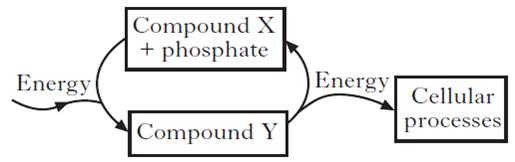
| 17. | The diagram below shows energy transfer within a cell. Compound X would be
|
||
| |
A. | ATP | |
| |
B. | Glucose | |
| |
C. | carbon dioxide | |
| |
D. | ADP | |
| 18. | The energy yield per glucose molecule during aerobic respiration is | |
| |
A. | 2 molecules of ATP |
| |
B. | 18 molecules of ATP |
| |
C. | 36 molecules of ATP |
| |
D. | 38 molecules of ATP |
| 19. | From what do animals obtain energy? | |
| |
A. | food |
| |
B. | the sun |
| |
C. | green plants |
| |
D. | photosynthesis |
| 20. | Which gas do animals need to carry out life processes? | |
| |
A. | Oxygen |
| |
B. | Carbon monoxide |
| |
C. | Helium |
| |
D. | Carbon dioxide |