
| 1. | The raw materials for photosynthesis are | |
 |
A. | carbon dioxide & oxygen |
|
B. | water & oxygen |
|
C. | carbon dioxide & glucose |
|
D. | carbon dioxide & water |
| 2. | What are the sources of the raw materials for photosynthesis | |
|
A. | air & soil |
|
B. | soil & clouds |
|
C. | sun & air |
|
D. | clouds and sun |
| 3. | What is the main product of photosynthesis? | |
|
A. | glucose |
|
B. | glycogen |
|
C. | starch |
|
D. | carbon dioxide |
| 4. | Which is the correct summary equation for photosynthesis? | |
|
A. | water + oxygen → glucose + carbon dioxide |
|
B. | water + carbon dioxide → glucose + oxygen + chlorophyll |
|
C. | water + carbon dioxide → glucose + oxygen |
|
D. | water + carbon dioxide + chlorophyll → glucose + oxygen |
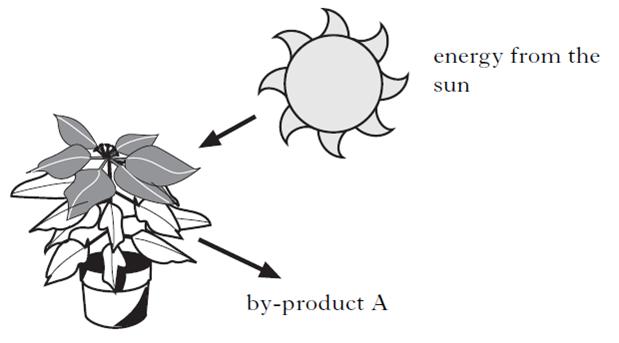
| 5. | Photosynthesis is the process by which green plants make glucose using energy from the sun.
|
||||||||||||
|
A. | oxygen | |
B. | carbon dioixde | |
C. | water | |
D. | starch | ||
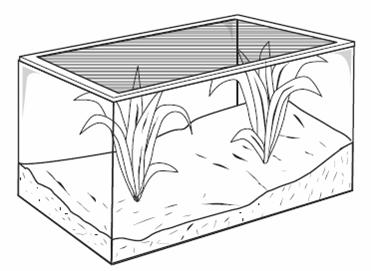
| 6. | A student constructs several terrariums, like the one shown, to investigate factors affecting the growth rate of plants. Each terrarium was exposed to a different amount of sunlight each day.
In order to determine the optimum level of sunlight required for plant growth, which of the following variables must be held constant?
|
||||||
|
A. | Age of scientist | |
B. | Growth rate of plants | ||
|
C. | Wavelengths of sunlight | |
D. | Amount of sunlight received | ||
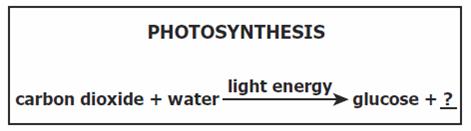
| 7. | The equation for photosynthesis is shown. Which of these is required to complete the equation for photosynthesis?
|
||||||||||||
|
A. | Carbon | |
B. | Oxygen | |
C. | Nitrogen | |
D. | Hydrogen | ||
| 8. | When plants undergo photosynthesis, they consume — | |
|
A. | carbon dioxide |
|
B. | oxygen |
|
C. | hydrogen |
|
D. | nitrogen |
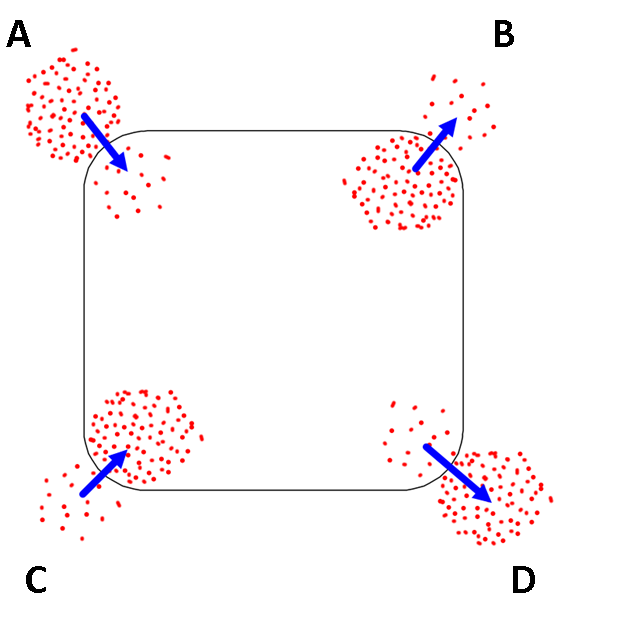
diagram below shows the ways in which molecules can move in to or out of a photosynthesising plant cell in the light.
Use the diagram to answer questions 9 & 10.
| 9. |
Which of the molecules could be oxygen? |
|||||||||||
|
A. | A | |
B. | B | |
C. | C | |
D. | D | |
| 10. | Which of the molecules could be carbon dioxide?
|
|||||||||||
|
A. | A | |
B. | B | |
C. | C | |
D. | D | |
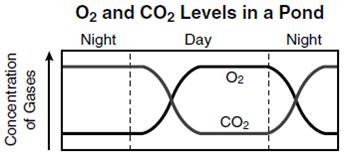
| 11. | Oxygen and Carbon dioixide levels changed in a pond over a 24-hour period.
What caused the decrease in oxygen concentration during the day? |
||||||
|
A. | Evaporation | |
B. | Photosynthesis | ||
|
C. | Respiration | |
D. | Decrease in temperature | ||
| 12. | A student performed an experiment to demonstrate that a plant needs chlorophyll for photosynthesis.He used plants that had green leaves with white areas. After exposing the plants to sunlight, he removed a leaf from each plant and processed the leaves to remove the chlorophyll. He then tested each leaf for the presence of starch. Starch was found in the area of the leaf that was green, and no starch was found in the area of the leaf that was white. He concluded that chlorophyll is necessary for photosynthesis.Which statement represents an assumption the student had to make in order to draw this conclusion? |
|
|
A. | Starch is synthesized from the glucose produced in the green areas of the leaf. |
|
B. | Starch is converted to chlorophyll in the green areas of the leaf. |
|
C. | The white areas of the leaf do not have cells. |
|
D. | The green areas of the leaf do not have cells. |
| 13. | In a typical plant, all of the following factors are necessary for photosynthesis except | |
|
A. | chlorophyll |
|
B. | light |
|
C. | oxygen |
|
D. | carbon dioxide |
|
E. | water |
| 14. | At night, plants | |
|
A. | don’t take in or give out any gases |
|
B. | take in carbon dioxide and oxygen |
|
C. | take in oxygen and give out carbon dioxide |
|
D. | give out carbon dioxide and don’t take in oxygen |
| 15. | We can test for glucose using | |
|
A. | benedicts solution |
|
B. | Hydrochloric acid |
|
C. | iodine |
|
D. | biuret solution |
 |
||
| 16. | During the course of a day when are the levels of oxygen likely to be at their highest? | |
|
A. | Midnight |
|
B. | Midday |
|
C. | They remain constant |
|
D. | It is not possible to tell |
| 17. | When a plant photosynthesises it produces | |
|
A. | water |
|
B. | carbon dioxide |
|
C. | oxygen |
|
D. | stripes |
| 18. | Plants are green because they contain | |
|
A. | photosynthesis |
|
B. | chlorophyll |
|
C. | green dye |
|
D. | starch |
| 19. | Leaves which have patches of white and green are called | |
|
A. | stripy leaves |
|
B. | diseased leaves |
|
C. | patterned leaves |
|
D. | variegated leaves |