
| 1. | The source of energy used by plants in photosynthesis is | |
 |
A. | Heat from the sun |
|
B. | Nutrients from the soil |
|
C. | Sunlight |
|
D. | Animal remains |
| 2. | Which of these statements best describes photosynthesis? | |
|
A. | Making food from simple raw materials |
|
B. | Breakdown of food into raw materials |
|
C. | Consumption of food and raw materials |
|
D. | Use of light to produce raw materials |
| 3. | The name for molecules which contain carbon hydrogen and oxygen which are made in photosynthesis is | |
|
A. | Proteins |
|
B. | Carbohydrates |
|
C. | Vitamins |
|
D. | Alcohols |
| 4. | What is the green substance in plant cells which is needed for photosynthesis? | |
|
A. | chloroplast |
|
B. | cytoplasm |
|
C. | chlorophyll |
|
D. | carbohydrate |
| 5. | A variegated leaf | |
|
A. | is green all over |
|
B. | is all white all over |
|
C. | is partly white and partly green |
|
D. | changes from white to green as it ages |
| 6. | Chlorophyll in plants cells is contained in the | |
|
A. | nucelus |
|
B. | cytoplasm |
|
C. | vacuole |
|
D. | chloroplasts |
| 7. | The role of chlorophyll in photosynthesis is to | |
|
A. | combine with carbon dioxide |
|
B. | capture light energy |
|
C. | absorb carbon dioxide |
|
D. | be converted into starch |
| 8. | What energy change takes place in photosynthesis? | |
|
A. | light energy → heat energy |
|
B. | heat energy → chemical energy |
|
C. | heat energy → light energy |
|
D. | light energy → chemical energy |
| 9. | The raw materials for photosynthesis are | |
|
A. | carbon dioxide & oxygen |
|
B. | water & oxygen |
|
C. | carbon dioxide & glucose |
|
D. | carbon dioxide & water |
| 10. | What are the sources of the raw materials for photosynthesis | |
|
A. | air & soil |
|
B. | soil & clouds |
|
C. | sun & air |
|
D. | clouds and sun |
| 11. | What is the main product of photosynthesis? | |
|
A. | glucose |
|
B. | glycogen |
|
C. | starch |
|
D. | carbon dioxide |
| 12. | In an experiment Leaf P was kept in the air with carbon dioxide added. Leaf Q was kept in air with no carbon dioxide. Both leaves were kept in a light, warm room. Which of the following results would be expected when the leaves were tested with iodine solution? | |
|
A. | both leaves turn black |
|
B. | only leaf P turns black |
|
C. | Leaf Q turns black |
|
D. | Neither leaf turns black |
| 13. | The overall effect of photosynthesis by a green plant on the gas composition in a closed jar would be to | |
|
A. | increase the concentration of carbon dioxide only |
|
B. | increase the concentration of oxygen only |
|
C. | decrease the concentration of carbon dioxide and increase the concentration of oxygen |
|
D. | keep the concentrations of carbon dioxide and oxygen relatively constant |
| 14. | Which is the correct summary equation for photosynthesis? | |
|
A. | water + oxygen → glucose + carbon dioxide |
|
B. | water + carbon dioxide → glucose + oxygen + chlorophyll |
|
C. | water + carbon dioxide → glucose + oxygen |
|
D. | water + carbon dioxide + chlorophyll → glucose + oxygen |
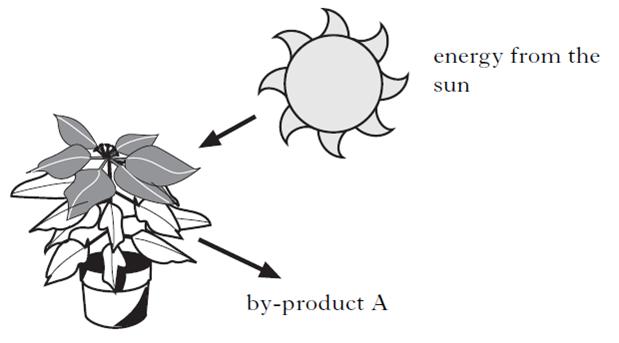
| 15. | Photosynthesis is the process by which green plants make glucose using energy from the sun.
What is byproduct A? |
||||||
|
A. | oxygen | |
B. | carbon dioixde | ||
|
C. | water | |
D. | starch | ||
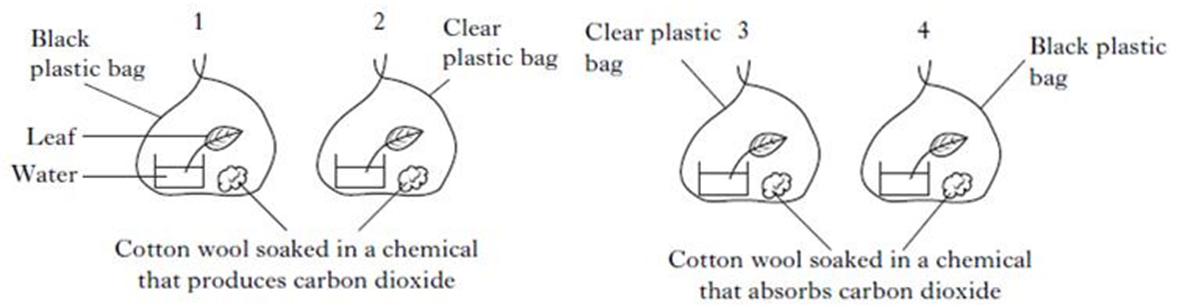
| 16. | The diagrams below show four experiments used to investigate the conditions needed for photosynthesis.
After two days, the four leaves were tested fo the presence of starch. The results from which two experiments should be compared to show that carbon dioxide is needed fro photosynthesis? |
||||||||||||
|
A. | 1 and 2 | |
B. | 2 and 4 | |
C. | 2 and 3 | |
D. | 3 and 4 | ||
| 17. | When plants undergo photosynthesis, they produce — | |
|
A. | carbon dioxide |
|
B. | oxygen |
|
C. | hydrogen |
|
D. | nitrogen |
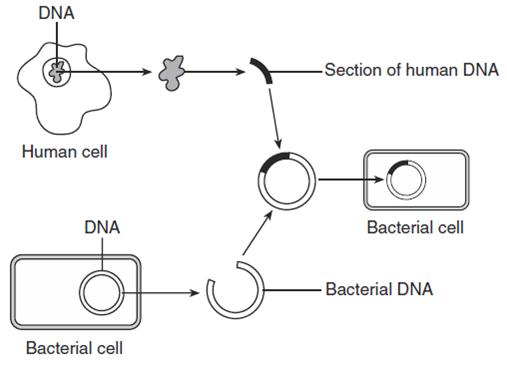
| 18. | The diagram below represents a technique currently used by scientists in the field of biotechnology. Which statement describes a possible outcome of this technique?
|
||||||
|
A. | The bacterium is able to produce a human hormone. | |
B. | It allows the bacterium to grow in humans, since it contains a human gene. | ||
|
C. | It allows humans to become immune to an infection from this type of bacteria. | |
D. | The bacterium can now produce human cells identical to cells of the DNA donor. | ||
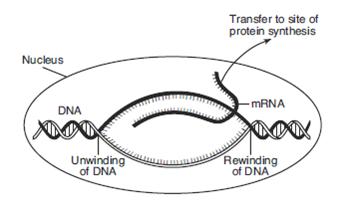
| 19. | The diagram below shows some of the steps in protein synthesis. The section of DNA being used to make the strand of mRNA is known as a
|
||||||||||||
|
A. | carbohydrate | |
B. | gene | |
C. | ribosome | |
D. | chromosome | ||
| 20. | The function of most proteins depends primarily on the | |
|
A. | type and order of amino acids |
|
B. | environment of the organism |
|
C. | availability of starch molecules |
|
D. | the diet of the organism |
| 21. |
The light energy for photosynthesis is captured by
|
|
|
A. |
water
|
|
B. |
hydrogen
|
|
C. |
chlorophyll
|
|
D. |
oxygen
|